
The cost to remove microblading in Austin depends on factors such as the pigment and the removal approach. Whether laser removal is suitable for your brows, including how the timing of the original tattoo may factor in, is something a professional can assess at a consultation.
It’s understandable to want clarity about the expense and healing process before deciding what to do. Removal is tailored to the brow, so the method and the amount of pigment being treated shape what to expect.
Here, you’ll learn what can affect removal costs, what healing after saline removal may involve, and how a professional can assess your brows and discuss an approach suited to your situation.
Key Takeaways
- Understand how pigment characteristics and the removal approach can influence the scope of treatment.
- Learn what healing after saline removal may involve, including why aftercare matters.
- Set realistic expectations: the number of sessions and results vary from person to person.
- See how pigment color, age, and depth can inform the removal plan.
- Explore how a consultation at Ogzy can help determine whether laser removal may suit your brows.
Healing timeline and expectations
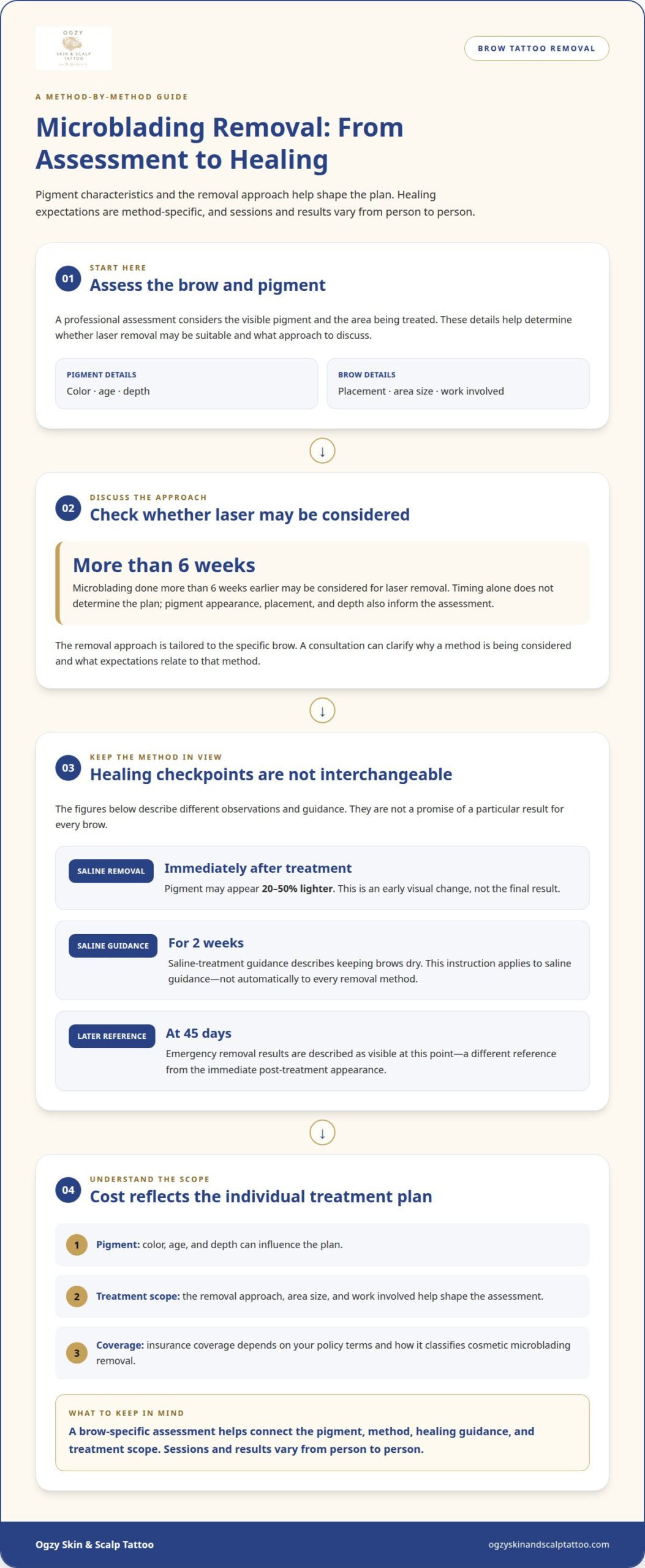
Healing after microblading removal depends partly on the method used. With saline removal, eyebrow pigment may look 20-50% lighter immediately after treatment. That early change offers a first impression, not the final result. Emergency removal results are described as visible 45 days after the appointment, so the immediate appearance and later result are different reference points.
Saline-treatment guidance describes keeping brows dry for 2 weeks. This is a method-specific aftercare detail, not an expectation that applies to every form of removal. The treating professional can explain the instructions for your procedure, including how everyday activities fit the guidance and what to expect during that period.
What risks and side effects can microblading removal cause? The National Library of Medicine notes that Q-switched Nd:YAG laser treatment can cause scarring and post-inflammatory pigment changes, including lighter or darker areas. These are possible risks, not a prediction of how your eyebrow will respond.
Saline and laser removal don’t have identical healing expectations. The 2-week dry-brow instruction applies to saline removal; it shouldn’t be assumed to apply to every method. Clarifying which approach is planned helps you understand which aftercare guidance relates to your treatment.
- Immediately after saline: pigment may appear 20-50% reduced, an early visual change.
- For 2 weeks: saline-treatment guidance describes keeping brows dry.
- At 45 days: emergency removal results are described as visible at this point.
The 45-day reference for emergency removal provides a later point of comparison than the immediate post-treatment appearance. A photograph taken just after treatment captures that early moment, while the later result is assessed at a different stage. Those observations describe separate points in the process, not a guaranteed degree of pigment reduction.
Before saline treatment, discuss the dry-brow guidance with the treating professional and ask how it applies to your routine. Questions about washing your face or other everyday activities can be answered in the context of the specific procedure. This keeps expectations tied to the method rather than assumptions drawn from another type of removal.
The most useful way to understand healing expectations is to separate the method, the immediate appearance, and the later reference point. For saline, the reported immediate change is 20-50%, while its aftercare guidance includes 2 weeks with dry brows. For emergency removal, results are described as visible at 45 days. These figures describe expectations, not an identical outcome for every brow.
brows. B. SWEET says microblading pigment usually fades by 40‐50% within 7 days. This describes fading of the pigment, while the immediate 20-50% change and the 45-day reference above concern different stated points in removal guidance. These figures should be read in their own context rather than treated as interchangeable measures or a promise of a particular outcome.
When comparing your brow’s appearance with an estimate, note when the observation was made and which removal approach it relates to. Your treating professional can help interpret the guidance for your procedure and explain whether the timeline being discussed applies to your treatment.
Laser removal for older microblading
Microblading done more than 6 weeks earlier may be considered for laser removal. The pigment’s appearance, placement, and depth help shape the assessment.
Older Pigment Considerations
Older eyebrow pigment can be assessed for laser treatment based on its visible color and location. Age alone doesn’t determine the approach; the pigment’s characteristics and the brow area also matter. Treatment is planned around the specific tattoo, rather than treating every faded brow identically. This distinction helps set realistic expectations before treatment begins.
Q-switch NdYag laser can lighten pigment using a 3-4 mm spot size, according to the National Library of Medicine. It requires expertise because it can cause scarring and post-inflammatory hypo- or hyperpigmentation, meaning lighter or darker areas. When choosing an Austin provider, look for relevant laser-removal experience, clear discussion of these risks, and an explanation of how the brow will be assessed.
Factors Affecting Removal Cost
Pigment color, age, and depth can influence the removal plan. For example, a visible pigment difference may affect the professional’s assessment, while deeper or more extensive pigment may call for a different approach. The area’s size and the work involved also inform the scope. A treatment plan should reflect these details, not just the fact that the tattoo is microblading.
The cost to remove microblading in Austin depends on the pigment’s characteristics and the treatment scope. Ogzy Skin & Scalp Tattoo provides personalized treatment plans based on your skin, pigment, and goals.
Insurance coverage for cosmetic microblading removal in Texas depends on the terms of your individual policy and how it classifies the procedure. Review your plan’s cosmetic-treatment wording to understand how your coverage applies.
During an assessment, the provider should examine the pigment’s color and placement, then explain why laser treatment is being considered. Ask how the spot size relates to the brow being treated and what risks apply to your situation. Clear answers help you understand the reasoning behind the approach before a session.
Laser removal is a considered option for older microblading, not a guarantee of a particular result. The 3-4 mm spot size and the pigment’s visible features are part of the technical picture, while the brow itself guides the assessment. Understanding those factors can help you weigh the plan, expected care, and case-specific quote with greater clarity.
If brows turn red after laser removal, they may require one or two additional sessions using a 532 hand-piece. This possibility is worth discussing during assessment, so the plan can account for the brow’s response rather than assuming the first session will be sufficient.
Laser removal may temporarily bleach eyebrow hair, which is different from hair loss. Ask the provider to explain what this possible color change could mean for your brows and how it fits into the planned treatment.
How many sessions are typically needed to remove microblading?
There isn’t one session count that fits every brow. A removal plan develops around the starting appearance, your goal, and what changes during treatment. One person may want the pigment softened, while another hopes for more substantial fading. Those different goals can shape how progress is assessed, but neither determines a guaranteed number of appointments.
Think of each session as one stage in a gradual process. At the beginning, the professional can document the eyebrow’s appearance and discuss what you’d like to change. Later, the brow’s visible condition helps determine whether another session makes sense. This step-by-step approach is more useful than treating an early estimate as a fixed commitment.
Your desired endpoint matters. If you’re seeking a softer appearance rather than complete pigment removal, the point at which you feel satisfied may differ from someone seeking a larger change. A professional can use your stated goal to guide the discussion and reassess whether the plan still reflects what you want.
Visible progress may not look uniform across the entire brow. For example, one section may appear lighter while another remains more noticeable. That difference can make a single overall impression misleading. Reviewing the brow by area keeps the conversation focused on what has changed and what remains important to you.
It can help to discuss these points before beginning:
- The change you hope to see in your eyebrow.
- How progress will be reviewed between appointments.
- What visible changes could inform the next treatment decision.
- How the plan may be adjusted if your preferences change.
These questions support a clearer conversation without requiring you to predict the final session count. Your goals may also become more specific as you see how the brow changes. Revisiting them during treatment helps keep decisions connected to your priorities, rather than continuing by habit or following a generic schedule.
Keep in mind that an appointment estimate is a planning tool, not a promise. The professional may discuss a possible course, then review the brow as treatment progresses. If your preference is to pause after a particular change, that can be part of the discussion. The plan should make room for informed decisions at each stage.
For microblading removal, the most helpful answer about sessions is individualized and reassessed over time. Your desired change, the appearance of the brow at each review, and your preferences all contribute to the discussion. Ask how progress will be evaluated and when the plan may be revisited. That gives you a practical framework without relying on a guaranteed count or timeline.
Does microblading removal cost vary by pigment color, age, or depth?
Those details can inform an assessment, but they don’t create a universal formula for the cost of microblading removal. To understand an estimate, look at how it describes the work being considered. A clear discussion should distinguish the planned treatment from assumptions about later appointments, so you can see what the estimate does and doesn’t represent.
Clarify whether an estimate applies to one appointment or outlines a broader treatment plan. These are different ways of describing the work. An estimate for an individual session doesn’t necessarily represent the overall course, while a plan should explain what it covers and how progress will be reviewed.
The proposed treatment area also deserves a clear description. For example, an estimate may refer to both brows, a section of one brow, or another specific boundary. Confirming that shared understanding helps prevent confusion about what the treatment includes. It also gives you a concrete basis for reviewing the plan later.
Use the consultation to understand how the estimate relates to your goal. A person seeking a subtle change may describe a different endpoint than someone hoping for more extensive fading. The discussion should connect the intended change with the proposed work, rather than leave you to infer what “removal” means for your particular brows.
Before deciding, clarify these points:
- Whether the estimate describes one appointment or a planned course.
- Which brow areas are included in the discussed treatment.
- What the stated treatment goal refers to.
- How changes to the plan would be discussed if your preferences shift.
These details make the estimate easier to interpret without relying on one factor as a shortcut. If your goal changes after seeing progress, the treatment discussion may need to be revisited. Understanding how that conversation would happen can help you plan thoughtfully, without assuming that the first estimate predicts every later decision.
Keep a note of the plan’s wording and the goal you discussed. For instance, if you’re considering fading only part of a brow, make sure that intention is reflected in the treatment conversation. Clear language can help you revisit the same priorities at later appointments and understand whether the proposed work still aligns with what you want.
Ultimately, color, age, and depth are elements of an individual assessment, not a standalone pricing calculator. The most useful estimate is one you can connect to a defined treatment area, a stated goal, and a clear explanation of what the plan covers. That context helps you understand the cost discussion without assuming that one feature alone determines the amount or outcome.
Ogzy Skin & Scalp Tattoo
Ogzy Skin & Scalp Tattoo offers laser tattoo removal for people considering a change to older microblading. If you’re weighing treatment options, the next step is an individualized assessment of your eyebrow pigment, its placement, and the approach that may suit your case. I’ll explain what I’m considering so you can make an informed decision without relying on a one-size-fits-all session estimate.
Laser removal uses targeted Nd:YAG laser energy to address tattoo pigment. For microblading, the brows deserve careful attention: their shape, pigment color, and the area involved help inform a personalized treatment plan. A consultation is a chance to discuss what you hope to change and understand what the process may involve. Results and the number of sessions vary, so no particular outcome or schedule is guaranteed.
It can also help to bring a clear account of your microblading history. If you know when the brows were tattooed or have noticed a color change, share those details during the consultation. The visible pigment and its location provide useful context. Together, these details help clarify the plan and the factors that may shape its scope.
During the assessment, I can talk through:
- The visible color and distribution of pigment across each eyebrow.
- The age and placement of the microblading, based on your history and its appearance.
- Why laser removal is being considered for your brows.
- What questions to revisit as you consider treatment and aftercare.
Clear communication matters. You should understand the reasoning behind a proposed approach and have room to discuss concerns, including possible pigment changes or scarring. Laser treatment requires expertise, and the brow area calls for a thoughtful, case-specific assessment. If the plan or its expected stages aren’t clear, ask for an explanation in plain language before deciding how to proceed.
Cost discussions should connect the estimate to your specific treatment scope, rather than assume every microblading removal case is alike. Pigment characteristics, the area involved, and the approach being considered are useful points to discuss. During a consultation, Ogzy Skin & Scalp Tattoo can explain how those factors relate to your case, without promising a fixed number of sessions or a particular result.
If you’re ready to discuss your brows, I invite you to book a consultation with Ogzy Skin & Scalp Tattoo. The studio is at 13130 Pond Springs Rd #1105, Austin, TX 78729.
Frequently Asked Questions
How much does microblading removal cost in Austin, TX?
The cost to remove microblading in Austin depends on the treatment plan for your brows. There isn’t a standard figure here to apply to every case. During an assessment, the scope can be discussed in relation to the specific pigment and area you want treated. Ask what the proposed plan includes, so you can understand what the estimate covers before deciding.
What is the average price per session for laser eyebrow tattoo removal in Austin?
An average per-session price isn’t provided here, and it would be misleading to suggest a figure that may not fit your case. Laser eyebrow tattoo removal is planned around the individual brow, so the number of sessions and total treatment scope can vary. For a useful comparison of estimates, make sure each one clearly describes the proposed treatment and what it covers.
Which Austin clinics offer microblading removal, and what are their prices?
Ogzy Skin & Scalp Tattoo offers laser tattoo removal in Austin, including treatment for permanent makeup. I can’t provide a comparative directory or prices for other clinics. If you’re considering Ogzy, the relevant details to discuss are your brow pigment, the treatment approach, and the scope of the proposed plan. That helps keep the conversation specific to your needs rather than relying on unrelated pricing.
How long should you wait between microblading removal sessions?
There isn’t one waiting period that fits every microblading removal plan. A consultation is the best place to discuss an individualized plan for your eyebrows, including session spacing. Ask how the proposed plan will be tailored to your brow pigment and treatment goals.

Article by
Opal Z
Opal is the owner and practitioner behind OGZY Skin & Scalp Tattoo in Austin, Texas. With more than three years in business and a longtime background in the aesthetics industry, she specializes in corrective and restorative treatments designed to address concerns that traditional aesthetics often overlook.
Her work focuses on scar and stretch mark revision, scar camouflage, scalp micropigmentation (SMP), hair regrowth treatments, and laser tattoo and permanent makeup removal. Opal works with a wide range of skin tones and takes an individualized approach to every client, considering skin color, texture, scar characteristics, treatment history, and realistic long-term outcomes.
Through OGZY Skin & Scalp Tattoo, her goal is to combine artistry, aesthetics, and technical treatment knowledge to help clients feel more comfortable and confident in their skin.
Love the skin you’re in.