
The most important SMP questions are about more than the look you want. The right questions to ask before getting SMP in Georgetown can help you explain your goals, raise personal concerns, and understand that scalp micropigmentation creates the appearance of hair density rather than growing hair.
It’s understandable to want clear, honest information before making a decision about your appearance. You deserve a conversation where your goals and concerns are heard, and the possibilities and limits are explained without pressure.
Use this guide to prepare for that conversation. Ask about your desired look, the practitioner’s approach, the process, and how SMP may fit your circumstances. Clear answers can help you decide whether to move forward with confidence.
Key Takeaways
- Understand what scalp micropigmentation can and can’t do, then consider how its appearance of density aligns with your goals.
- Ask about an artist’s training and experience to better understand their approach and suitability for your needs.
- Review healed results and discuss how the artist plans a natural-looking design for your scalp.
- Bring up pigment, equipment, and hygiene practices so you know what to expect during the procedure.
- Discuss session planning and healing with the practitioner, including the factors that can shape your individual process.
What is Scalp Micropigmentation (SMP) & Who is it for?
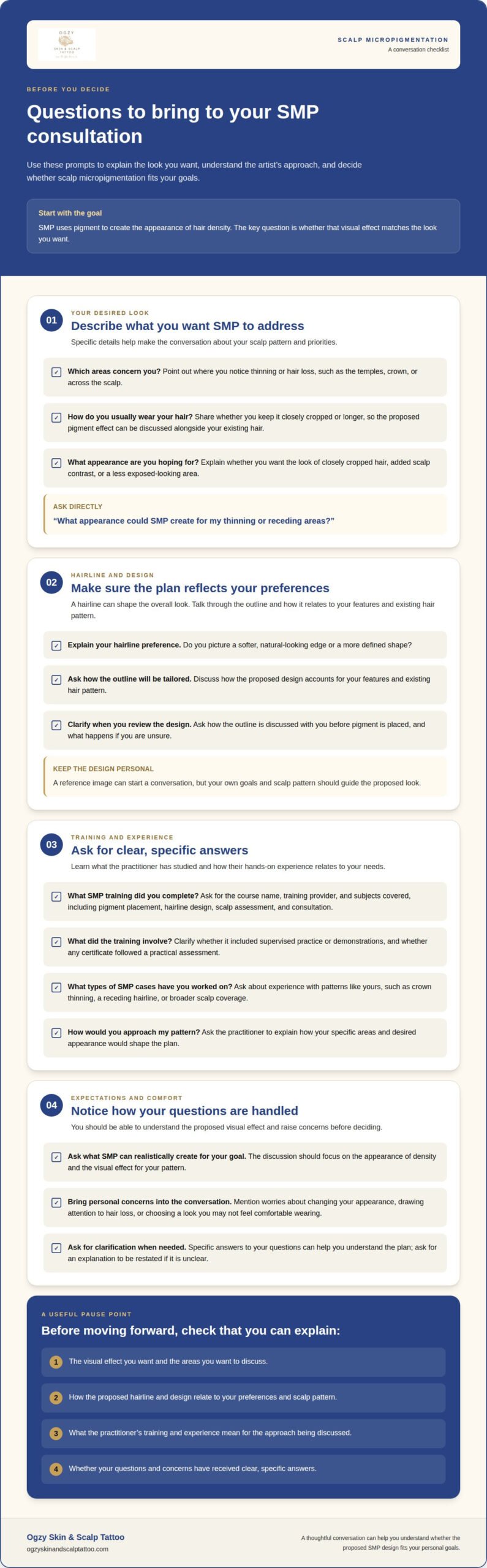
- Define the result you want. Scalp micropigmentation, or SMP, uses precision pigment deposits to replicate natural hair follicles. It creates the appearance of greater density; it doesn’t grow hair. Someone with visible thinning may want the scalp to look less exposed, while someone with a receding hairline may want a more defined outline. Ask how the proposed design would address your specific concern.
- Match your goal to SMP’s purpose. SMP may suit people seeking the look of closely cropped hair or added scalp contrast. It can be considered for thinning hair, baldness, or a receding hairline. The key question is whether a pigment-based, follicle-like effect matches the appearance you want. If your goal is new hair growth, SMP isn’t designed to provide it.
- Describe your current hair pattern. Explain where you notice thinning or hair loss, such as at the temples, crown, or across the scalp. Share whether you usually wear your hair closely cropped or longer. This gives context for discussing how visible pigment impressions may work alongside your existing hair. Ask how the proposed approach would address the areas you’ve identified.
- Discuss the hairline you have in mind. A hairline strongly influences the overall appearance, so describe whether you prefer a soft, natural-looking edge or a more defined shape. Ask how the practitioner would tailor the outline to your features and existing hair pattern. Focus on a design that feels believable for you, rather than copying a reference without considering your goals.
- Bring personal concerns into the conversation. You may feel uncertain about changing your appearance, drawing attention to hair loss, or choosing a look you’ll still feel comfortable wearing. Name your concern directly. For questions to ask before getting SMP in Georgetown, include: “What appearance can SMP create for my thinning or receding areas?” and “How will we discuss the design before beginning?” Clear answers help you judge whether the expected visual effect fits your priorities.
- Separate appearance goals from biological expectations. SMP is a cosmetic tattooing approach that simulates follicles; it doesn’t make existing hair grow or replace lost hair. If your priority is a denser-looking scalp, ask how the artist plans to create that visual effect for your pattern. If you expect SMP itself to change hair growth, clarify the difference before deciding.
What qualifications, training, and experience should an SMP practitioner have?
- Ask what SMP training the practitioner completed. Request the course name, training provider, and subjects covered. Useful topics include pigment placement, hairline design, scalp assessment, and client consultation. Ask whether the training included supervised practice or only demonstrations. A clear explanation helps you understand how the practitioner learned the technique, beyond a vague claim of being “trained.”
- Clarify what any certificate represents. Ask who issued it, what skills it recognizes, and whether it followed a practical assessment. A certificate can document course completion, but its name alone doesn’t explain the artist’s hands-on ability. Ask how the course assessed consistent follicle impressions and gradual design planning. The answer should distinguish classroom learning from observed practical work.
- Explore the practitioner’s direct SMP experience. Ask how long they’ve performed scalp micropigmentation and what kinds of cases they’ve worked on. Request examples, such as thinning at the crown, a receding hairline, or broader scalp coverage. Experience with one pattern doesn’t automatically demonstrate skill across every design. Ask how the practitioner would approach a case like yours.
- Ask how the artist plans a design before treatment. A thoughtful process includes discussing your preferred appearance, existing hair pattern, and hairline shape. Ask what happens if you’re unsure about the proposed outline. For example, clarify whether the design is reviewed with you before precision pigment deposits are made. The response can show how carefully your preferences guide the plan.
- Assess how clearly the practitioner explains limitations. Ask what SMP can realistically create for your specific goal. If you want the appearance of more density, the discussion should focus on visual simulation, not hair growth. Ask how the artist would explain differences between your reference image and your own scalp pattern. Direct, plain-language answers make expectations easier to understand.
- Notice whether your concerns receive specific answers. Bring two or three personal questions, such as how a receding hairline may affect the design or how your usual hairstyle relates to the planned look. The practitioner should address your concerns rather than rely on general assurances. If an explanation is unclear, ask for it to be restated before deciding. Feeling comfortable with the conversation is part of evaluating fit.
Keep any unrelated use of “SMP” distinct when weighing a practitioner’s qualifications. Georgetown SMP applicants are advised to have about 200 hours of clinical experience, and Georgetown SMP applicants are advised to have about 100 hours of community service focused on underserved persons. One Georgetown SMP applicant reported practice scores in approximately the 83% range. These figures describe applicant guidance and a reported practice score; they do not establish an individual scalp micropigmentation practitioner’s training, practical skill, or experience. For a treatment decision, return to evidence that relates directly to the artist’s work: ask about supervised practice, relevant cases, and how the practitioner assesses and plans your design. Consider whether the answers are specific to your situation, and whether you understand what the practitioner has personally done. Separate benchmarks from demonstrated technique so that a credential or score is not mistaken for proof of hands-on SMP ability.
What should I ask about an SMP artist’s portfolio and healed results?
- Ask to see healed work, not only fresh results. Fresh pigment can look different from healed SMP, so ask the artist to explain the difference. Request examples showing the same client at both stages, if available. Comparing them can help you see how the appearance changes after the initial appointment and assess the finished look more thoughtfully.
- Look for examples that resemble your goals. A portfolio showing a receding hairline may tell you more about your needs than one showing only crown coverage. Ask the artist to explain what each example demonstrates. If you’re concerned about diffuse thinning, look for work showing how pigment integrates with existing hair across a broader area.
- Review more than one angle. Ask to see front, side, and top views of a result. A single close-up may not show how a hairline connects with the temples or how coverage looks across the crown. Different views give you a clearer sense of the overall design and how it relates to the client’s existing hair pattern.
- Ask how the photos were taken. Lighting, camera distance, and styling can affect how pigment appears in a portfolio image. Ask whether comparison photos use similar angles and lighting. For example, bright overhead lighting in one image and softer indoor lighting in another can make scalp contrast look different, even when the work hasn’t changed.
- Discuss details that matter to your design. Point to a specific feature in an example, such as a soft hairline edge or subtle temple transition. Ask how the artist would adapt that element to your pattern rather than copy it exactly. The conversation should connect the reference image to your preferences and explain which details may suit the look you want.
- Ask what the portfolio can’t show. Images show appearance, but they can’t explain how the artist planned a design or considered a client’s preferences. Ask what decisions shaped a particular result, such as hairline placement or coverage distribution. This gives you context for the image instead of leaving you to judge it without explanation.
- Use the portfolio to guide a candid conversation. Choose one result you like and one detail you’re unsure about, then ask the artist to address both. For example, explain that you like a defined hairline but prefer a softer temple edge. Specific feedback clarifies your priorities and gives the practitioner a useful starting point for discussing your design.
Keep the discussion focused on portfolio evidence rather than unrelated application details. One Georgetown SMP applicant reported that their application file took about 4-5 days to be marked complete after the final recommendation was uploaded. The author describes Georgetown applicants as writing a page-long essay about why they want to attend the university. Those details concern applications, not healed pigment or portfolio quality, so they should not influence your assessment of an artist’s work. Return to examples closest to your goals and ask the artist to explain the choices visible in them, including how those choices relate to the appearance you want.
What SMP pigment, equipment, and hygiene practices should a provider use
- Ask which pigment is selected for SMP. Request the product name, its intended use, and an explanation of how its tone suits your scalp and design. Ask how the practitioner chooses pigment for a closely cropped look versus visible thinning. You can also ask how the selected shade will complement your existing hair, rather than matching a photograph without considering your features.
- Ask how pigment details are documented. Ask to see the product label and how the practitioner records the pigment used for your treatment. For example, ask whether the product name and shade are noted in your treatment records. Clear documentation helps you understand what was selected and gives you a specific reference if you have questions later.
- Discuss the equipment before treatment begins. Ask what device the practitioner uses for SMP and how it supports precise, consistent impressions. Ask how the equipment is prepared for your appointment and which parts contact your scalp. If the explanation includes a needle cartridge or another disposable component, ask how it’s handled before and after use.
- Ask about the hygiene routine from setup to cleanup. Request a plain-language walkthrough of how the work area is prepared, how surfaces are managed, and how used supplies are handled. Ask what you’ll see before the appointment begins and how clean items are kept separate from used items. Specific steps are more informative than a general statement about cleanliness.
- Clarify how hand protection and supplies are managed. Ask what the practitioner uses to protect their hands and when those items are changed during the appointment. If gloves, barriers, or disposable supplies are part of the process, ask when they’re replaced. A direct explanation helps you understand the sequence without assuming every studio follows identical procedures.
- Notice whether answers are specific and understandable. Ask the practitioner to explain unfamiliar equipment or product terms, such as a cartridge or pigment shade. You should understand what will touch your scalp, what is disposable, and how the workspace is prepared. If an answer is unclear, pause and ask for a simpler explanation before agreeing to proceed.
- Bring your questions into the consultation. Write down the pigment, device, and hygiene questions you want answered, then discuss them before treatment. For instance, ask, “What pigment will you use, and how do you prepare the work area?” The conversation can help you understand the planned process and decide whether you feel informed about the materials and setup.
How many SMP sessions are needed, how long does each take, and what is the healing timeline
- Ask for a session plan tailored to your coverage area. The practitioner should explain how your pattern, desired density effect, and design shape the plan. A small area near the temples differs from broader crown coverage. Ask how many appointments they anticipate, what each will address, and what might lead them to adjust the plan as treatment progresses.
- Clarify what happens at each appointment. Ask whether the first visit focuses on establishing the design and initial pigment impressions, and how later visits build on that work. A later appointment, for example, may refine coverage or balance the appearance across treated areas. Understanding each stage gives you a clearer picture than hearing only a session count.
- Ask how appointments are spaced. Have the practitioner explain how they decide when the next session should take place. The plan may account for how the scalp settles and how the pigment appears between visits. Ask what they assess before continuing, such as whether existing impressions provide the intended visual balance across the hairline or crown.
- Discuss the appointment length for your specific design. Ask how the size of the treated area and the amount of detail affect time in the studio. A focused hairline design and broader scalp coverage involve different areas of work. Ask whether planning, design review, and treatment are included in the appointment time to understand what the visit involves.
- Ask what changes to expect during healing. The practitioner should describe how the treated scalp may look as it settles and how that appearance can differ from immediately after pigment placement. Ask when they assess the result before planning additional work. This helps you avoid judging the final appearance solely by your first impression after an appointment.
- Get clear, written aftercare instructions. Ask what to do after each session, which activities or products to avoid, and how long the instructions apply. The guidance should be specific to your appointment, not a vague reminder to “be careful.” For instance, ask how to manage routine scalp care while the treated area settles.
- Ask how changes affect the next visit. If pigment appears uneven or your design preferences shift, ask how that will be discussed before further treatment. The practitioner can explain how healing, coverage, and your feedback inform the next step. A considered plan leaves room to review progress rather than treating every appointment as an identical repeat.
- Bring your schedule into the planning conversation. Tell the practitioner about work, travel, or events that could affect appointment planning or aftercare. Ask what time commitment the full process may involve, including visits and recovery considerations. For questions to ask before getting SMP in Georgetown, include: “What determines my session plan, and how will we review healing before continuing?”
Ogzy Skin & Scalp Tattoo
Ogzy Skin & Scalp Tattoo offers personalized, expert Scalp Micropigmentation (SMP) with a medical-grade approach and precision pigment deposits, with the goal of a natural-looking appearance. During a consultation, we can discuss how SMP creates the appearance of density and what approach may suit your goals. Bring reference images, describe the areas you’d like to address, and ask about design, sessions, and healing.
If you’re in Georgetown, Austin, or nearby, a consultation is a calm next step when you’re ready to explore SMP with clear expectations. I’ll listen to what matters to you and explain what may be realistic for your situation.
To discuss your questions, contact Ogzy Skin & Scalp Tattoo. The studio is at 13130 Pond Springs Rd #1105, Austin, TX 78729.
Choose Your Next Step With Clarity
Let the questions to ask before getting SMP in Georgetown keep you focused on what matters to you, not just what looks appealing in a photograph. Notice which answers leave you informed, which concerns still need discussion, and whether the design aligns with how you want to present yourself. Taking time to reflect is part of choosing with care.
If you’re ready to continue the conversation, contact Ogzy Skin & Scalp Tattoo to discuss your goals and questions. The studio is located at 13130 Pond Springs Rd #1105, Austin, TX 78729.
Whatever you decide, your preferences deserve to be heard. Move forward at a pace that feels right for you.

Article by
Opal Z
Opal is the owner and practitioner behind OGZY Skin & Scalp Tattoo in Austin, Texas. With more than three years in business and a longtime background in the aesthetics industry, she specializes in corrective and restorative treatments designed to address concerns that traditional aesthetics often overlook.
Her work focuses on scar and stretch mark revision, scar camouflage, scalp micropigmentation (SMP), hair regrowth treatments, and laser tattoo and permanent makeup removal. Opal works with a wide range of skin tones and takes an individualized approach to every client, considering skin color, texture, scar characteristics, treatment history, and realistic long-term outcomes.
Through OGZY Skin & Scalp Tattoo, her goal is to combine artistry, aesthetics, and technical treatment knowledge to help clients feel more comfortable and confident in their skin.
Love the skin you’re in.