
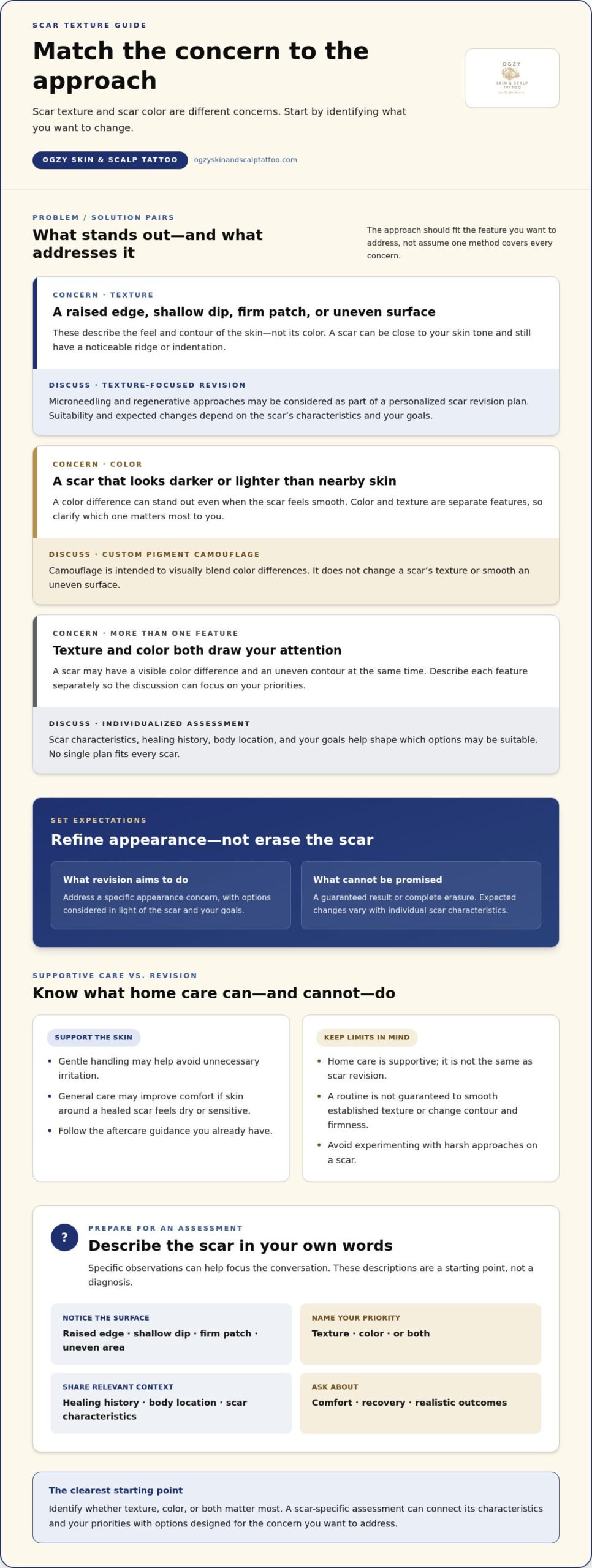
When a scar feels raised, indented, firm, or uneven, its texture may stand out more than its color. If you’re wondering how to improve skin texture on scars, the first step is to identify what you want to change. Texture and color are different concerns: an approach that visually softens a color difference won’t smooth an uneven surface.
Home care can support the skin, but it isn’t the same as scar revision. Professional options may include microneedling and regenerative approaches, while custom pigment camouflage is intended to blend color, not change texture. Knowing which concern matters most can help you compare these options and set realistic expectations.
No single plan suits every scar, and revision aims to refine its appearance rather than erase it. This guide explains how to describe your concern, prepare for an individualized assessment, and discuss comfort, recovery, and realistic outcomes. It also clarifies where pigment camouflage fits and what it can and cannot address.
Key Takeaways
- Describe what you notice, such as a raised edge, indentation, firm patch, or uneven surface, to clarify the texture concern you want addressed.
- Think of home care as supportive, not a guaranteed way to revise established scar texture.
- Compare approaches by your goal: microneedling and regenerative options are considered for texture-focused revision, while pigment camouflage targets visual color.
- Before an assessment, note whether texture, color, or both matter most, along with questions about comfort, recovery, and realistic outcomes.
- Ogzy offers personalized scar and stretch mark revision, with options considered in light of scar characteristics and your goals.
How to Improve Skin Texture on Scars: Start by Understanding the Scar
A scar may be a small detail to someone else and still catch your attention every day. Before exploring how to improve skin texture on scars, describe what you see or feel. Is the concern a raised edge, a shallow dip, a firm patch, a color difference, or a combination? Separating those features helps you focus on the result you want to explore.
Scar texture is the feel and contour of the skin over a healed injury, such as a raised, indented, firm, or uneven area. It describes the surface, not the scar’s color. A scar may look darker or lighter than nearby skin while feeling smooth; another may closely match your skin tone but have a noticeable ridge or dip. This distinction helps make conversations about your goals more focused.
What does uneven scar texture mean?
“Uneven” can describe several things: a raised line, a shallow depression, a firmer patch, or an irregular surface you notice when you run a finger over it. These descriptions don’t diagnose the scar. They give you a useful starting vocabulary. General background on how scars form and the ways they can differ is available in Understanding the Scar.
Consider two healed marks: one is flat but visibly darker, while another is close to the surrounding skin tone but feels slightly raised. A visual pigment approach may suit a color concern, while someone focused on a ridge may want to discuss texture-focused revision. The approach should match the feature you want to address, rather than assuming one method covers every concern.
Why scar type and healing stage matter
Scars can change in appearance as they heal. Their surface, firmness, and color may shift, so a single glance or an old photo may not tell the whole story. Healing history, body location, and the characteristics of the tissue all help shape how a scar looks and feels. There is no fixed timeline that applies to every person or scar.
Your goal matters, too. You may care most about a raised edge catching light, a dip changing the skin’s contour, a color difference, or several features together. Describe what bothers you in specific terms to help guide an individualized assessment and discussion of suitable options. Revision aims to refine a scar’s appearance, not erase its history, and results can’t be promised in advance.
What Can Support Smoother-Looking Scar Texture?
Once a scar has healed, everyday care may support the skin’s general condition, but it isn’t scar revision. Gentle handling and following the aftercare instructions you already have can help avoid unnecessary irritation. These steps don’t necessarily change established differences in contour or firmness. That distinction matters: general skin support and texture-focused revision address different concerns.
What at-home care can and cannot do
Keep expectations measured. If the skin around a healed scar feels dry or sensitive, general care may help it feel more comfortable. But a routine used for overall skin care isn’t guaranteed to smooth a raised edge or fill an indentation. Avoid experimenting with harsh approaches on a scar. If you’re unsure how to care for the area, follow your existing aftercare guidance or seek personalized advice.
Home care has limits when your main concern is the scar’s contour or feel. Products and routines aimed at surface appearance shouldn’t be assumed to revise established texture. The American Academy of Dermatology outlines a range of professional scar treatments, illustrating why options are selected according to the scar and the goal.
When professional scar revision may be considered
If an uneven surface remains your priority, professional scar revision is an option to discuss. Ogzy offers microneedling and regenerative approaches involving medical-grade stem cells or growth factors as part of personalized scar and stretch mark revision. Suitability and expected changes depend on the scar’s characteristics and your goals. No approach should be presented as a guaranteed way to erase a scar.
Color is a separate consideration. Custom pigment camouflage is a visual approach intended to address color differences, not change a scar’s texture. Naming your main concern clearly, whether it’s a ridge, a dip, firmness, or color, helps focus the discussion on what each approach is designed to address.
A scar-specific assessment can connect the scar’s characteristics and your priorities with options designed for the concern you want to address. That’s a practical starting point for anyone researching how to improve skin texture on scars, especially when general care hasn’t changed the feature that stands out.
Explore scar and stretch mark revision at Ogzy to discuss your goals, suitable options, and realistic expectations.
Microneedling or Pigment Camouflage: Which Addresses Your Scar Goal?
Start the comparison with your priority. If you want to address how a scar’s surface feels or catches the light, a texture-focused approach may be relevant. If the concern is a difference in color, pigment camouflage has a different purpose. These options aren’t interchangeable, and neither promises to erase a scar.
| Approach | Primary goal | What to keep in mind |
|---|---|---|
| Texture-focused revision, including microneedling | Address the appearance or feel of uneven scar texture | Suitability and expected changes depend on the scar and individual assessment. |
| Regenerative approaches, including medical-grade stem cells or growth factors | Consider as part of a personalized scar revision plan | They may be incorporated into an approach based on the person’s scar characteristics and goals; outcomes aren’t guaranteed. |
| Custom pigment camouflage | Visually blend a color difference with surrounding skin | It does not smooth, flatten, or otherwise change scar texture, and it isn’t appropriate for every scar or skin characteristic. |
How microneedling and regenerative approaches fit texture goals
Microneedling is a professional option to discuss when the concern is a scar’s texture. Ogzy also offers regenerative approaches using medical-grade stem cells or growth factors as part of personalized scar revision. The right plan depends on the scar’s features and what you hope to address. Discuss how the approach fits your goal, what changes may be possible, and relevant recovery considerations as part of an individualized assessment.
For more focused procedure education, read about microneedling for scars in Cedar Park. It can help you prepare questions about how a texture-focused option may fit your goals.
When pigment camouflage addresses a different concern
Custom pigment camouflage is designed to visually blend a scar’s color with the surrounding skin tone. It doesn’t change the physical surface: a raised area remains raised, and an indentation remains indented. If both color and texture concern you, name each separately during an assessment so the discussion can distinguish what each approach is intended to address.
In short, texture and color call for different considerations. A scar-specific assessment helps match the approach to your concern and set realistic expectations for possible refinement, rather than promising a particular result.
How to Prepare for a Scar Texture Improvement Plan
A clear description of what you’d like to change makes a scar revision discussion more useful. You don’t need to identify a scar type or arrive with a treatment in mind. Start with what you notice, what matters most, and any relevant history you can share. This helps connect your concern with options tailored to the scar rather than a one-size-fits-all plan.
What to note before discussing scar revision
- Describe the surface. Is the area raised, indented, firm, or uneven to the touch? Mention whether its appearance or feel draws your attention most.
- Identify the location. Note where the scar is and whether movement, clothing, or its position affects what you’d like to address.
- Clarify your priority. Decide whether your main goal is texture, color, or both. If the scar is uneven and has a color difference, list each concern separately so they can be considered on their own merits.
- Recall relevant history. Be ready to share how the scar developed, how it has changed as it healed, and any approaches you’ve already tried. You don’t need to diagnose it or change prescribed care in preparation.
How an individualized plan sets expectations
These details give an assessment a practical starting point. Scar characteristics, healing history, location, and your aesthetic priorities can inform a discussion of whether texture-focused revision or a visual pigment approach better matches your goal. If you’re concerned about both, the conversation can distinguish what each approach is intended to address. A personalized plan is shaped around those details, not a universal protocol.
Visible changes vary between individuals, so an assessment should set realistic expectations without promising a particular outcome. It’s reasonable to discuss what an approach involves, relevant considerations, and how progress may be evaluated before deciding what feels right for you.
If you’re in Austin and exploring a tailored approach, learn more about scar and stretch mark revision treatment in Austin. Bring your notes and questions to keep the discussion centered on your goals.
Ready to explore a personalized plan? Begin a scar revision discussion.
Explore Personalized Scar Revision with Ogzy in the Austin Area
Choosing an approach starts with understanding what you want to refine. A scar may catch your attention because of its texture, color, or both. Ogzy Skin & Scalp Tattoo offers personalized scar and stretch mark revision, with options considered in light of the scar’s characteristics and your goals. The aim is thoughtful refinement, not a promise to erase the scar or deliver a specific result.
A tailored approach to scar texture and appearance
For texture-focused concerns, Ogzy offers professional microneedling as part of its scar revision services. Revision options also include medical-grade stem cells or growth factors. These approaches can be discussed as part of a personalized plan, without assuming the same method suits every scar. An individualized assessment connects the features you want addressed with an option designed for that goal.
Custom pigment camouflage serves a different purpose. Pigment is matched to natural skin tone to visually blend a color difference. It does not smooth, flatten, or otherwise change the scar’s physical texture. If the surface feels raised or indented and the color also stands out, name both concerns so the discussion can distinguish the goals rather than treat them as interchangeable.
That distinction can bring clarity to the question of how to improve skin texture on scars. Texture-focused revision and pigment camouflage are separate considerations; a plan can be shaped around the scar and the outcome you hope to explore. Expected changes vary, and no particular result can be guaranteed.
Local next steps for Austin-area readers
Ogzy serves people in Austin, Cedar Park, Leander, Round Rock, and Georgetown. Before exploring options, note what you see or feel, where the scar is, and whether your priority is texture, color, or both. Sharing relevant healing history and any previous approaches can also help make an individualized discussion more focused. You don’t need to arrive with a diagnosis or a decision already made.
To learn more, explore scar and stretch mark revision treatment in Austin. It’s a practical next step for understanding which options may align with your concerns and what questions to bring to a personalized assessment.
Take a Thoughtful Next Step for Your Scar
Understanding how to improve skin texture on scars begins with naming the concern you want to address. Texture and color are different goals: personalized scar revision may include microneedling and regenerative approaches for texture-focused planning, while custom pigment camouflage matched to natural skin tone is a visual option for color blending. Camouflage doesn’t change a scar’s physical texture.
There’s no single approach for every scar. Its characteristics, healing history, and your priorities can shape an individualized discussion, with realistic expectations and no promise of complete removal. Ogzy offers personalized scar and stretch mark revision for people in Austin, Cedar Park, Leander, Round Rock, and Georgetown.
Ready to explore options? Explore personalized scar revision with Ogzy and take the first step toward a plan shaped around your goals.
Frequently Asked Questions
Can you improve the texture of an old scar?
An old scar’s appearance may be addressed through personalized revision, but the amount and type of change vary. Age alone doesn’t determine which approach may be suitable. A scar-specific assessment considers its texture, location, healing history, and your goals. If you’re exploring how to improve skin texture on scars, describe the feature you’d most like to refine, such as a firm area, raised edge, or indentation, rather than expecting complete erasure.
How can I make a raised scar feel smoother?
A raised scar may be considered for texture-focused revision, but no method can guarantee that it will feel smooth. Professional microneedling and regenerative approaches may be discussed based on the scar and your goals. Avoid trying to reshape the area with harsh or unverified home methods. Sharing when the scar developed, how it has changed, and what you notice by touch can help guide an individualized conversation about options and realistic expectations.
Does microneedling help improve scar texture?
Microneedling is a professional option that may be considered when scar texture is a concern. Whether it’s appropriate, and what changes may be possible, depends on the scar’s characteristics and an individualized assessment. It isn’t a guaranteed fix or a way to erase a scar. Ogzy Skin & Scalp Tattoo offers microneedling as part of personalized scar and stretch mark revision.
Can scar camouflage improve the texture of a scar?
No. Custom pigment camouflage is a visual approach intended to blend color differences with natural skin tone; it doesn’t smooth, flatten, or otherwise alter the scar’s physical texture. If a scar is uneven but its color is not your main concern, camouflage alone won’t address that texture goal. An assessment can help distinguish whether your priority is surface feel, color, or both, and discuss approaches according to those separate aims.
What happens during a scar revision assessment?
An assessment is a chance to describe what you notice and what you hope to change. Be ready to discuss the scar’s location, whether it feels raised, indented, firm, or uneven, how it developed, and any approaches you’ve tried. You can also clarify whether texture, color, or both matter most. These details help inform a tailored discussion of possible options, relevant considerations, and realistic expectations, without requiring you to diagnose the scar yourself.
How long does it take to see changes in scar texture?
There isn’t one reliable timeline for everyone. The type of scar, the approach considered, and individual healing and response can all affect how and when changes may be noticed. An assessment can help set expectations for the approach being discussed, but a specific result or timeframe shouldn’t be assumed. Discuss how progress may be evaluated and what factors could affect it for a clearer, individualized understanding before moving forward.
Is every scar suitable for microneedling or pigment camouflage?
No. Suitability depends on the scar’s characteristics, the person’s skin, and the goal being addressed. Microneedling may be considered for texture-focused revision, while pigment camouflage is intended to visually blend color and doesn’t change texture. Camouflage isn’t appropriate for every scar or skin characteristic. Ogzy’s personalized scar and stretch mark revision serves people in Austin, Cedar Park, Leander, Round Rock, and Georgetown, with options discussed in light of individual needs and goals.

Article by
Opal Z
Opal is the owner and practitioner behind OGZY Skin & Scalp Tattoo in Austin, Texas. With more than three years in business and a longtime background in the aesthetics industry, she specializes in corrective and restorative treatments designed to address concerns that traditional aesthetics often overlook.
Her work focuses on scar and stretch mark revision, scar camouflage, scalp micropigmentation (SMP), hair regrowth treatments, and laser tattoo and permanent makeup removal. Opal works with a wide range of skin tones and takes an individualized approach to every client, considering skin color, texture, scar characteristics, treatment history, and realistic long-term outcomes.
Through OGZY Skin & Scalp Tattoo, her goal is to combine artistry, aesthetics, and technical treatment knowledge to help clients feel more comfortable and confident in their skin.
Love the skin you’re in.