Imagine standing in front of your mirror on a bright Texas morning, reaching for a long-sleeved shirt despite the heat because you’re worried about the surgical mark on your arm. You’ve likely spent months applying topical creams that promised results but delivered none, leaving you frustrated and hesitant to believe anything can truly help. It’s exhausting to feel like your skin tells a story you’d rather keep private, and it’s completely normal to wonder if a paramedical tattoo for scars is the right path for you. You deserve to feel comfortable in a swimsuit or a sleeveless top without the constant anxiety of someone noticing a scar.
This guide reveals how this restorative technique combines clinical science with artistic precision to seamlessly diminish these marks and restore your confidence. You’ll discover the sophisticated difference between custom pigment camouflage and inkless revision, the restorative role of medical-grade growth factors, and how this specialized craft provides a natural-looking solution. We’ll walk through the entire process, from understanding Texas regulations to choosing the right revision method for your unique skin type, ensuring you have the professional guidance needed to reclaim your self-assurance.
Key Takeaways
- Understand the fundamental differences between traditional tattooing and restorative micropigmentation, prioritizing clinical depth and pigment precision over decorative art.
- Learn to distinguish between ink-based camouflage and inkless revision to determine the most effective approach for your paramedical tattoo for scars based on age and texture.
- Explore how specialized treatments utilize medical-grade stem cells and growth factors to refine the skin’s surface and encourage natural cellular renewal.
- Follow the collaborative journey from initial consultation to final restoration, emphasizing a supportive environment tailored to your personal aesthetic goals.
- Recognize the importance of partnering with a dedicated specialist in the Cedar Park and Austin area who understands the unique requirements of various skin types and scar locations.
What is a Paramedical Tattoo for Scars? Defining Restorative Art
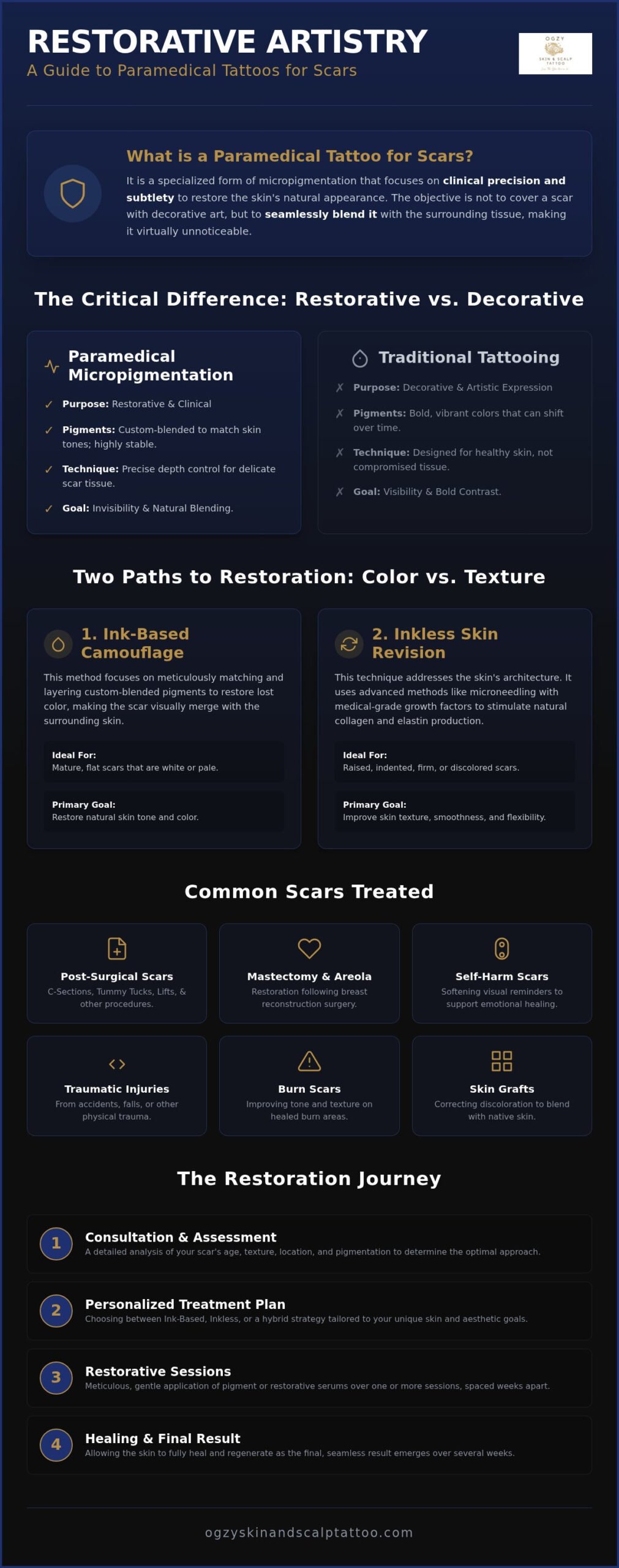
Many people mistake restorative work for standard body art, or they confuse it with general emergency medical services. In our studio, a paramedical tattoo for scars serves a fundamentally different purpose. While traditional tattooing focuses on bold contrast and artistic expression, this specialized field of Medical tattoo or micropigmentation focuses on subtlety and clinical precision. It’s an intricate process of skin revision that aims to restore what was lost to surgery or injury, helping the skin look and feel whole again. Skin revision is a holistic approach that considers the texture, tone, and emotional impact of the scar simultaneously. The objective isn’t to hide a scar under a layer of ink, but to blend it so seamlessly into the surrounding tissue that it becomes virtually invisible to the naked eye.
The Difference Between Camouflage and Traditional Ink
Standard tattoo inks aren’t designed for skin matching; they’re built for longevity and vibrant color, often containing pigments that can shift toward blue or green over time. In contrast, paramedical pigments are formulated to mimic the natural complexities of human skin tones. These specialized pigments remain stable, ensuring the camouflaged area doesn’t look like an obvious patch years later. The technique also requires specialized needles that can navigate the unique texture of compromised scar tissue. Traditional artists often don’t have the specific training needed to handle the varying density of a scar, which can lead to uneven results or further trauma to the skin. Choosing a specialist ensures that the depth and application are tailored to the specific needs of healed tissue rather than healthy, unscarred skin.
Who Can Benefit from Paramedical Tattooing?
This restorative art is a powerful tool for those who’ve undergone significant physical changes. Post-surgical patients, particularly those recovering from C-sections, tummy tucks, or mastectomies, often find that camouflaging their surgical marks provides the final step in their healing journey. For many in the Austin area, a paramedical tattoo for scars represents the final bridge between clinical recovery and emotional healing. It’s also highly effective for individuals with scars from traumatic injuries or self-harm, where the goal is to soften the visual reminder of a difficult time. Burn survivors and those with skin grafts also benefit from tone correction, as the procedure can re-pigment pale or discolored areas to match the rest of the body. Each treatment is customized to the individual, ensuring the result feels like a natural extension of themselves.
Ink Camouflage vs. Inkless Skin Revision: Choosing Your Path
At Ogzy Skin & Scalp Tattoo, we recognize that your skin is a living, breathing canvas with its own history. Because no two marks are identical, we offer two sophisticated paths for your paramedical tattoo for scars: pigment-based camouflage and inkless skin revision. The choice between these methods isn’t arbitrary. It’s a clinical decision based on the age of your scar, its current pigmentation, and its textural depth. Both techniques harness your body’s natural regenerative powers, but they serve different roles in the journey toward restoration.
Pigment-Based Camouflage: The Art of Color Matching
Pigment-based camouflage is a masterclass in subtlety. We blend custom pigments to mirror the melanin in your surrounding tissue, ensuring a seamless transition that looks natural under any lighting. We don’t just “paint” over the area. Instead, we use a meticulous layering technique that builds depth over time, creating a realistic, three-dimensional look. This method is the perfect solution for scars that have matured into a white or pale shade and are relatively flat. By restoring the lost color, we allow the scar to recede into the background of your natural beauty, giving you the freedom to stop hiding.
Inkless Revision: Healing with Stem Cells and Growth Factors
For scars that feel raised, firm, or indented, we often begin with inkless skin revision. This process focuses on the skin’s architecture rather than just its surface color. By utilizing microneedling with growth factors, we stimulate a profound healing response within the dermis. The addition of medical-grade stem cells encourages the production of fresh collagen and elastin, which helps to soften and flatten the tissue. This approach is widely respected by organizations like the Society of Permanent Cosmetic Professionals (SPCP) because it prioritizes the long-term health and flexibility of the skin before any pigment is introduced.
Every successful transformation starts with a professional assessment. We’ll look at how your tissue reacts to light and touch to find the most effective sequence of treatments for your specific needs. Sometimes, a combination of both methods yields the most breathtaking results. If you want to understand how these techniques can specifically help your skin, you can view our scar and stretch mark revision options to see the possibilities for your own restoration.
Common Scars Treated with Paramedical Micropigmentation
Scars carry memories, but they don’t have to define your appearance or dictate your wardrobe choices. A paramedical tattoo for scars is a versatile solution for various marks, provided the tissue has reached a stable state. We generally require scars to be at least 12 months old before treatment begins. This timeframe allows the internal healing process to conclude, ensuring that the texture and natural pigment have settled into their permanent form. Treating immature scars can lead to unpredictable results, so patience is a vital part of your restorative journey toward skin renewal. Before your first session, reviewing a scar revision Cedar Park preparation checklist can help you arrive fully informed and ready to begin your transformation.
Surgical and C-Section Scars
Surgical procedures often leave behind distinct linear marks that can feel like a permanent disruption to your skin’s natural flow. C-section scars, for example, can sometimes develop a “ropey” or uneven texture that feels prominent against the abdomen. Our goal is to soften this texture through precise needlework and blend the color to match your natural tone. For tummy tucks or breast augmentations, we often work within the natural creases of the body to camouflage incision lines. Additionally, we provide specialized areola restoration for those who have undergone mastectomy or top surgery, recreating a natural appearance with artistic precision and deep empathy.
Traumatic and Injury-Related Scars
Unlike surgical incisions, traumatic scars from accidents or injuries are often irregular in shape and vary significantly in depth. These marks can be hyperpigmented, appearing darker than the surrounding skin, or hypopigmented, appearing much lighter. We carefully match custom pigments to neutralize these discrepancies and create a seamless look. Beyond the physical change, there’s a profound emotional relief in softening the visual reminder of a past trauma. It’s about turning a mark of what happened into a surface of what is now, allowing you to move forward with a renewed sense of self-assurance.
While surgical scars are often the result of a single incision, stretch marks represent a different type of dermal change. Our stretch mark revision treatment differs from surgical scar work because it often covers larger, more diffuse areas. While surgical revision focuses on a specific line, stretch mark revision addresses the “striations” or texture changes caused by rapid skin expansion. We use specialized techniques to restore the skin’s elasticity and tone, making those silvery lines much less noticeable to the naked eye. Whether you’re in Austin or Cedar Park, this customized approach ensures every skin type receives the sophisticated craftsmanship it deserves.
The Procedure: What to Expect During Your Skin Restoration
Starting your journey with a paramedical tattoo for scars is a significant step toward self-reclamation. It’s not just a clinical procedure; it’s a collaborative path where your emotional comfort is prioritized as much as the artistic outcome. At Ogzy, we maintain a rigorous clinical standard while ensuring you feel heard and supported throughout every phase of your skin restoration. We view ourselves as your partners in this transformation, moving at a pace that respects both your skin’s biology and your personal comfort.
Step 1: The Personalized Consultation
Every transformation begins with a focused conversation. We examine the scar’s history, checking for that crucial 12-month maturity we discussed earlier, while also evaluating the health of the surrounding tissue to ensure a seamless integration. We take the time to explain the science behind the pigments and serums we use, setting realistic milestones for what your specific skin type can achieve. This consultation serves as a safe, judgment-free space where you can share your story and your goals with a specialist who truly understands the profound impact of skin revision.
Step 2: The Treatment Session
Once we move into the session, the focus shifts to meticulous craftsmanship. We operate in a sterile, medical-grade environment using specialized, single-use tools designed for delicate tissue. To ensure your comfort, we apply high-quality topical numbing agents; most clients describe the sensation as a light vibration or gentle scratch rather than intense pain. Whether we are using custom-blended pigments or restorative serums, we apply the treatment pixel by pixel. This slow, deliberate pace prevents trauma to the skin and ensures the most natural-looking, refined results possible.
Step 3: Aftercare and Long-Term Healing
The work of restoration continues long after you leave the studio. Your immediate aftercare involves keeping the area clean and dry to protect the newly stimulated collagen or pigment layers. You’ll likely see initial redness and minor shedding, which are normal signs of the skin’s renewal cycle. Achieving a virtually invisible blend typically requires two to four sessions spaced several weeks apart. This staged approach allows us to layer the restoration gradually, respecting the skin’s natural healing time and ensuring the final tone is a perfect, seamless match for your body.
If you’re ready to see how this process can work for you, you can schedule your restorative skin consultation to take the first step toward a more confident you.
Finding a Paramedical Tattoo Specialist in Cedar Park and Austin
Choosing where to receive your paramedical tattoo for scars is a decision that impacts your confidence for years to come. It requires finding a specialist who doesn’t just understand the mechanics of a tattoo machine, but one who possesses a deep knowledge of dermal biology and pigment chemistry. At Ogzy Skin & Scalp Tattoo, Opal leads our mission with a commitment to restorative excellence, ensuring every client from the greater Austin area receives a personalized plan tailored to their unique skin history. We’ve established ourselves as a premier hair loss confidence solution and skin revision center, bridging the gap between clinical safety and artistic refinement. Our approach is rooted in the belief that every scar tells a story, and our role is to help you turn the page toward a more confident chapter.
What to Look for in a Portfolio
When you’re researching specialists, prioritize viewing portfolios that showcase “healed” results rather than just “fresh” work. Fresh tattoos often appear darker or more vibrant than they’ll look after the skin fully settles, which can be misleading. A sophisticated portfolio should demonstrate a high level of technical skill through specific indicators. Look for these qualities in a specialist’s work:
- Consistency in color matching across a diverse range of skin tones, ensuring the pigment doesn’t shift toward unnatural hues.
- Smooth, seamless transitions where it’s nearly impossible to tell where the natural skin ends and the restoration begins.
- Documented evidence of improved skin texture in inkless revision cases, showing tissue that looks flatter and more supple.
Why Local Expertise Matters for Austin Residents
For those living in Cedar Park, Round Rock, or Georgetown, choosing a local expert offers more than just a shorter commute. Skin restoration is a methodical journey that often requires two to four sessions to achieve a perfect blend; having a studio nearby makes these essential follow-up appointments much easier to manage. Additionally, a local specialist understands how the intense Central Texas sun affects healing tissue and can provide specific guidance on protecting your results during the bright summer months. A face-to-face consultation with Opal allows for a tactile assessment of your scar, which is something a digital photo simply can’t replace. This personal connection ensures that the method chosen is perfectly suited to your skin’s unique needs, providing a level of care that feels like a true partnership in your transformation.
Reclaim Your Confidence and Restore Your Skin’s Natural Beauty
Restoring your skin is more than just a cosmetic change; it’s an emotional release that allows you to move past the physical reminders of surgery or injury. You’ve discovered how the synergy of clinical science and artistic precision can refine textures and blend tones until they’re virtually invisible. Whether your path involves custom pigment camouflage or inkless revision powered by medical-grade stem cells and growth factors, the focus remains on achieving a seamless result that honors your unique skin type. By understanding the sophisticated process of a paramedical tattoo for scars, you’re now equipped to take the final step in your healing journey.
We invite you to experience this transformation in a supportive, professional environment where your comfort and self-assurance are our highest priorities. Our studio is conveniently located for residents in Cedar Park, Austin, and Round Rock, offering specialized expertise in creating natural-looking outcomes that stand the test of time. You deserve to feel at ease in your own skin once again. Book Your Private Skin Revision Consultation at Ogzy Today and let’s begin the restorative work that brings your confidence back into focus.
Frequently Asked Questions
Is paramedical tattooing for scars painful?
Most clients experience very little discomfort during the procedure. We prioritize your comfort by applying high-quality topical numbing agents before and during the session to minimize any sensation. Many people describe the feeling as a light vibration or a gentle scratch. It’s much less intense than a traditional decorative tattoo because we work with a lighter touch and specialized needles designed for sensitive scar tissue.
How long does a paramedical scar tattoo last?
The longevity of your results depends on the specific method used during your treatment. Pigment-based camouflage typically stays vibrant for 3 to 5 years before a subtle touch-up is needed to maintain the color match. If you choose inkless revision, the textural improvements to the skin’s structure are considered permanent. We’ll provide you with a clear maintenance plan to ensure your restored skin remains seamless for years to come.
Can you tattoo over a raised (keloid) scar?
We generally don’t tattoo directly over active keloid scars because that tissue is unpredictable and can grow if it’s traumatized. However, we can often treat hypertrophic scars that are slightly raised but stable. If your scar is keloid-prone, we’ll carefully assess it during your consultation to determine if inkless revision might be a safer first step to soften the area. Our goal is always to improve the skin’s appearance without risking further irritation.
How much does paramedical scar camouflage cost in Austin?
The investment for your skin restoration depends on the size, location, and complexity of the area being treated. Every paramedical tattoo for scars is a highly customized procedure that requires a unique blend of pigments and techniques. Because of this, we provide a detailed quote only after a private consultation where we can assess your tissue in person. This ensures your pricing is fair and reflects the specific craftsmanship required for your personal transformation.
How many sessions will I need to hide my scar?
Most clients achieve their desired look within 2 to 4 sessions. We take a conservative, layered approach to ensure the pigment or texture revision blends perfectly with your surrounding skin. These sessions are typically spaced 6 to 8 weeks apart to give your body’s cells enough time to fully renew and settle. Patience is key to achieving a result that looks completely natural and virtually invisible to the naked eye.
What is the difference between scar camouflage and a regular tattoo?
The primary difference lies in the pigments, equipment, and the ultimate artistic goal. Regular tattoos use bold, long-lasting inks designed to stand out as art on the skin’s surface. In contrast, a paramedical tattoo for scars uses specialized, skin-toned pigments and a much more delicate application technique. We aim for subtlety and seamless integration, using our knowledge of dermal biology to make the scar disappear rather than drawing attention to it.
Can I get a paramedical tattoo if I have dark skin?
Yes, these restorative treatments are highly effective for all skin tones, including melanin-rich complexions. We specialize in custom pigment blending to ensure a perfect match that doesn’t look ashy or trigger hyperpigmentation. It’s vital to work with a specialist who understands the unique needs of darker skin types to avoid complications like keloiding. We’ll tailor every pixel of the treatment to respect and enhance your natural skin tone.
How long do I have to wait after surgery to get a paramedical tattoo?
You must wait at least 12 months after your surgery or injury before starting the tattooing process. The scar tissue needs to be fully matured, which is usually indicated by the mark turning white or pale. If we treat a scar that is still pink or red, the pigment may not hold correctly, or the procedure could interfere with the body’s natural healing. Waiting ensures that the skin is stable enough to achieve the most beautiful and lasting results.