
A realistic scalp micropigmentation result depends on more than pigment choice: careful technique and clean equipment matter, too. The risks of scalp micropigmentation include infection because the procedure breaks the skin barrier, as well as allergic reactions or a result that looks unnatural. Like tattooing, it requires pigment to be placed in the skin, so sterile technique is an important part of reducing avoidable risk.
If you’re considering SMP, it’s understandable to want clear answers first. Scalp micropigmentation creates the look of density by placing tiny pigment dots on the scalp; it doesn’t grow new hair. Understanding how it works can help you weigh the risks and decide whether its natural-looking effect fits your goals.
This article explains what happens during scalp micropigmentation, how its infection risk compares with tattooing, and what to consider about the technician, your scalp health, and your expectations. You’ll also learn which hygiene practices matter and why assessing your scalp and goals is essential to making an informed choice.
Key Takeaways
- Scalp micropigmentation creates the look of hair density with tiny pigment dots; it doesn’t grow hair.
- Infection is a possible risk because the procedure breaks the skin barrier, making sterile equipment and careful hygiene important.
- Pigment placed too deeply can heal as larger, blotchy marks, so technique and precise placement affect the appearance.
- Before choosing a technician, look for clear explanations of safety practices and examples of completed work.
- A thoughtful assessment of your scalp health, sensitivities, and expectations can help you decide whether the result you want is realistic.
What is scalp micropigmentation?
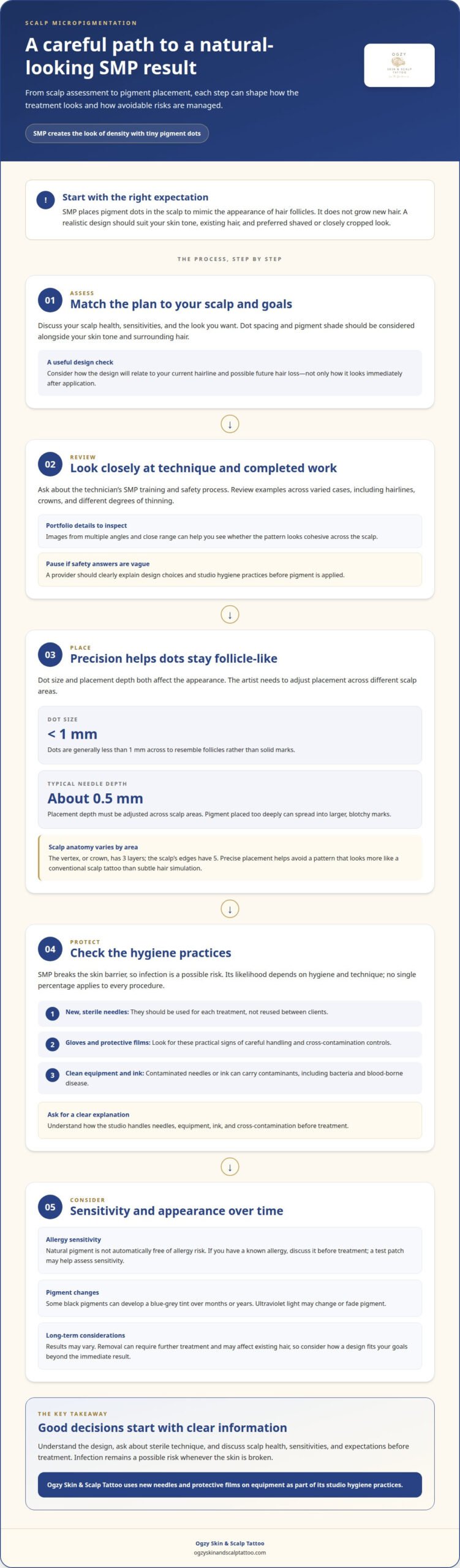
Scalp micropigmentation (SMP) places tiny pigment dots in the scalp to create the look of hair density. A machine with a fine needle deposits dots that mimic the appearance of natural hair follicles. The technique conceals visible effects of hair loss; it doesn’t stimulate new hair growth. Each dot should remain small, generally less than 1 mm across, to resemble a follicle rather than a solid mark.
Placement depth matters as much as dot size. Needles are usually inserted about 0.5 mm into the scalp, and the artist must adjust depth across different areas. The vertex, or crown, has three layers, while the scalp’s edges have five. If pigment enters too deeply, it can spread into larger, blotchy droplets instead of crisp follicle-like points. That uneven pattern may make the treatment look more like a conventional scalp tattoo than subtle hair simulation.
Pigment suitability also affects how the pattern looks over time. Some black pigments can develop a blue-grey tint after months or years, and ultraviolet light may change or fade pigment. “Natural” pigment isn’t automatically free of allergy risk. If you have a known allergy, discuss it before treatment; a test patch may help assess sensitivity. The final shade and dot spacing should suit your skin tone, existing hair, and preferred shaved or closely cropped look.
Hair-loss medicines don’t chemically interact with SMP pigment. However, changes in hair growth or density can alter how the dots relate to surrounding natural hair, which may mean the pattern needs adjustment. A hair transplant also changes the scalp’s appearance as transplanted hair grows, so timing matters. The transplant growth process takes 11-12 months; placing SMP before the resulting pattern is clear can leave uneven-looking density.
Long-term results may vary, and the appearance may not be what you want. Pigment may shift toward blue-grey or fade with ultraviolet exposure, while removal can require further treatment and may affect existing hair. These risks of scalp micropigmentation are reasons to consider how the design will look with your current hairline and possible future hair loss, not just immediately after application.
How likely is infection, and how does it compare with any tattoo?
Infection is a possible risk when the skin is broken. The likelihood depends on hygiene and technique, not the procedure’s name alone. The risks of scalp micropigmentation are therefore closely tied to how the treatment is performed.
Provider Experience and Infection Risk
An inexperienced provider may not follow safe handling and hygiene practices consistently during an SMP session. Each pigment dot involves repeated needle contact with the scalp, and mistakes can affect multiple treatment areas. Before treatment, ask for a clear explanation of the studio’s safety process and review examples of completed work. Vague answers about cleanliness are a reason to pause.
Unsterilized Needles and Blood-Borne Disease
An unsterilized or incorrectly used needle can transfer contaminants, including blood-borne disease. New, sterile needles should be used for each treatment, not reused between clients. Contaminated ink can also carry bacteria: the FDA announced a recall of six types of tattoo ink because of bacterial contamination. An infection may spread beyond the treated area and, in serious cases, require hospitalization or leave scars.
Broken Skin and Complication Frequency
SMP breaks the skin barrier as pigment is placed near the follicles, creating a potential entry point for infection. Complications are possible, but their frequency depends on sterile technique and individual healing; no single percentage applies to every procedure. Unlike a hair transplant, SMP doesn’t transplant follicles. The two procedures have distinct risks, so their complication rates shouldn’t be treated as interchangeable.
Risk Reduction and Treatment Comparisons
SMP is closer to hair tattooing than to a hair transplant because it deposits pigment rather than moving follicles. Like other tattoo procedures, it carries an infection risk if tools or ink are contaminated; there’s no sound basis here for ranking its likelihood against other procedures. Understanding the risks of scalp micropigmentation means looking for practical signs of careful technique, including new needles, gloves, protective films on equipment, and a clear explanation of cross-contamination controls.
At Ogzy, I follow studio hygiene practices designed to support a clean treatment environment, including using new needles and protective films on equipment. Infection remains a possible risk whenever the skin is broken.
Choosing a licensed, experienced technician
Choosing an SMP technician means assessing more than a polished final image. Notice how the provider understands your goals, plans the design, and explains decisions before applying pigment.
Technician Training and Experience
Training gives a technician a foundation, while practical experience helps them adapt that knowledge to different scalp patterns. Ask about their SMP training and review completed treatments across varied cases, not just one ideal result. Photographs can show whether the practitioner has worked with hairlines, crowns, and different degrees of thinning.
Look closely at how the portfolio is presented. Images from multiple angles and at close range can show whether the pattern looks cohesive across the scalp. A provider should be able to explain the design choices in each example, including how the hairline relates to the client’s features and surrounding hair.
Skill, Precision, and Poor Technique
Technical skill includes planning a design that suits your face, hairstyle, and existing hair pattern. Discuss the proposed hairline before treatment rather than accepting a standard template. For example, a design for a closely shaved look may not suit someone who keeps more length around the sides.
Use the consultation to see how your questions are handled. A thoughtful technician explains the intended look, the limits of pigment simulation, and how changing hair patterns could affect the design. Be cautious of promises of perfect density, permanent color, or a result that will never need reconsideration. Such claims leave little room for natural variation in hair and individual outcomes.
Consider whether the practitioner gives you time to reflect on the proposed appearance. A considered design should make sense from the front, sides, and crown, not just in one posed photograph. Reviewing these views together can help you understand how the pattern is meant to look in everyday settings.
Experience also shows in the quality of the conversation. You should leave understanding the intended design and its limitations, not feeling pressured to decide immediately. A transparent discussion helps you compare your expectations with the visual effect SMP can create before committing.
Sterile technique and infection prevention
Infection prevention depends on controlling contamination throughout the procedure, not on one isolated precaution. A clear explanation of the studio’s workflow helps you understand how that control is maintained.
Sterile Needles and Infection Prevention
Sterile technique means managing the treatment space and materials to reduce the chance of contaminants reaching the area being treated. Preparation, pigment handling, application, and cleanup are all part of the process. A careful provider should be able to explain how clean supplies are kept separate from used materials at each stage.
Pay attention to whether the explanation is specific and consistent. For example, the provider should describe how the treatment area is prepared and how items are handled after use. A clear process is more useful than a general assurance that everything is clean.
Studio Safety Practices
Before the procedure, ask the studio to explain its preparation process and how treatment details are recorded. Understanding the workflow can help you know what to expect during your session.
Ask how the studio shares its aftercare information and how you can refer to the instructions for your session. Clear written directions make it easier to follow the studio’s process for caring for the area afterward.
Questions About the Studio’s Process
If you have questions about the procedure, ask the tattoo artist to explain the steps involved and the studio’s safety practices. The treatment date and details about the pigment or procedure can help the studio refer to the correct information. This keeps the conversation focused on the treatment process.
A studio’s response should stay within its role: explain the procedure and its own safety practices without presenting a cosmetic artist as a medical professional. Clear, factual communication helps you understand what the studio does and what to expect from the process.
For scalp micropigmentation, make the studio’s use of gloves and protective films on equipment part of your pre-procedure questions. Ask when gloves are used and how protective films are applied to equipment. You should be able to see that these precautions are included in the workflow rather than relying on a broad statement about cleanliness. If the explanation is unclear, ask for clarification before proceeding.
You can also ask how the studio handles protective films and gloves during preparation, application, and cleanup. Look for an explanation that is direct and consistent with what you observe. These questions don’t replace the studio’s wider sterile technique, but they make visible safeguards easier to discuss. Consider whether staff explain the process clearly and address your questions. If you can’t establish what precautions are used, pause and request more information before deciding to continue.
Candidacy, scalp health, and realistic expectations
A careful candidacy assessment considers your scalp, health history, hair pattern, and desired appearance. These details help determine whether SMP suits your circumstances and what the procedure can realistically achieve.
Start with scalp health. Conditions involving inflammation, including psoriasis, scarring alopecia, or alopecia areata, need particular consideration. The available guidance recommends that these conditions be stable and disease-free for 2-3 years before SMP. If you have an active or changing scalp condition, discuss it during a consultation rather than treating pigment placement as a cosmetic-only decision.
A history of keloids or allergies also matters. Keloids are raised scars that can form in some people, and SMP may trigger them. Tell the technician about any keloid history before treatment. If you have allergies, discuss them in advance; a test patch may help assess sensitivity to pigment. “Natural” pigment does not automatically mean allergy-free.
Timing after hair transplant surgery can affect the pattern. SMP is generally avoided for at least a year after transplantation, allowing transplanted hair to grow. The growth process takes 11-12 months, and adding pigment before the outcome is clear may create uneven-looking density. Waiting allows the practitioner to plan around the hair that remains and the pattern that has developed.
Expectations matter as much as scalp condition. SMP creates the appearance of density with pigment; it doesn’t grow hair or change the underlying course of hair loss. A consultation should address your current hairline, the contrast between treated areas and natural hair, and how future thinning might affect the design. Be wary of claims promising perfect density, permanent color, no discomfort, or a risk-free procedure.
Your goals should also suit the visible hair around the treated area. For example, a closely shaved look may blend differently from a design next to longer hair. Before treatment, the practitioner should assess your scalp, health history, and expectations, then explain possible risks, maintenance, and how outcomes can vary. This conversation gives you a clearer basis for deciding without pressure to proceed.
SMP itself does not cause hair loss or damage existing hair follicles, but that reassurance doesn’t remove the need to screen for individual risks. People prone to keloids should not get scalp micropigmentation, because treatment can cause keloids to form in some people. If you have allergies, discuss them with your scalp micropigmentation technician before the procedure. Test patches are recommended to check for sensitivity before treatment.
SMP can work well for people whose scalp has hair everywhere at a density of over 20 grafts per square centimeter, but not as much density as they want. By contrast, SMP is not advised when a completely bald area is next to longer hair exceeding about 3 mm and density above 30 follicles per square centimeter. These distinctions can help frame whether pigment will blend with existing hair rather than create an isolated contrast. A practitioner should connect these patterns to the look you want and explain whether your surrounding hair is likely to support a balanced result. Suitability depends on the scalp and neighboring hair, not simply on a wish for more apparent fullness.
Ogzy Skin & Scalp Tattoo: Scalp Micropigmentation (SMP)
Ogzy Skin & Scalp Tattoo offers scalp micropigmentation to create the appearance of hair density with carefully placed pigment. It doesn’t grow hair or promise fuller hair. If you’re weighing SMP after learning about its risks, the next step is to consider whether its visual effect fits your goals and current hair pattern.
I approach SMP as a personalized cosmetic procedure, not a one-size-fits-all hairline design. Your existing hair, areas of thinning, scalp condition, and preferred look all shape what may be realistic. For example, a subtle shaved appearance calls for a different visual plan than blending pigment with surrounding natural hair.
A consultation gives us time to discuss the result you want and what the treatment can achieve. I consider the areas you want to address, your hair-loss pattern, and any relevant scalp or allergy history. You can also raise concerns about pigment, healing, or how the design may look as your hair changes.
Clear expectations matter. SMP uses pigment to imitate the appearance of follicles, creating an illusion of density rather than changing hair growth. I won’t promise that pigment will look permanent, that every area will match perfectly, or that hair loss will stop. The design should be considered alongside the look you want to maintain.
If you have a scalp condition, a history of allergies, or a previous hair transplant, bring that information into the conversation. These details can affect candidacy and timing. A thoughtful assessment helps identify questions to address before any procedure, rather than treating your concerns as an afterthought.
My role is to explain the approach, discuss realistic expectations, and help you make an informed decision without pressure. The goal is a considered plan for a natural-looking impression of density, with risks and limitations understood before moving forward.
If you’d like to discuss whether SMP suits your goals, book a consultation with Ogzy Skin & Scalp Tattoo. The studio is at 13130 Pond Springs Rd #1105, Austin, TX 78729.
Frequently Asked Questions
What can you expect with scalp micropigmentation?
Expect a planned series of treatments rather than assuming one visit will complete the design. Most people need three or more treatments, with appointments spaced several weeks apart. The number depends on the treatment area and how the pigment settles between visits. This staged approach lets the practitioner build the pattern gradually and assess its appearance as treatment progresses.
How long can an SMP appointment take?
A scalp micropigmentation appointment can take up to five hours, depending on the size of the treatment area. Treating a small area and covering a broader scalp involve different amounts of detailed pigment placement. Allowing for a longer appointment can help you plan your schedule and comfort without assuming every session will take the same amount of time.
Can scalp micropigmentation camouflage a scalp scar?
Scalp micropigmentation can create the appearance of follicle density over a scalp scar. The goal is visual camouflage, not changing the scar itself or growing new hair. The scar’s location and surrounding hair pattern help shape the design. A personalized assessment can clarify how the pigment pattern may blend with the area around it.

Article by
Opal Z
Opal is the owner and practitioner behind OGZY Skin & Scalp Tattoo in Austin, Texas. With more than three years in business and a longtime background in the aesthetics industry, she specializes in corrective and restorative treatments designed to address concerns that traditional aesthetics often overlook.
Her work focuses on scar and stretch mark revision, scar camouflage, scalp micropigmentation (SMP), hair regrowth treatments, and laser tattoo and permanent makeup removal. Opal works with a wide range of skin tones and takes an individualized approach to every client, considering skin color, texture, scar characteristics, treatment history, and realistic long-term outcomes.
Through OGZY Skin & Scalp Tattoo, her goal is to combine artistry, aesthetics, and technical treatment knowledge to help clients feel more comfortable and confident in their skin.
Love the skin you’re in.