
A polished portfolio can still leave important questions unanswered. Signs of a bad SMP job may include recurring concerns in reviews, pressure to book, or a consultation that leaves you uneasy.
Choosing scalp micropigmentation is personal. You deserve clear information and time to consider the design before deciding.
This article explains how to assess reviews, recognize pressure, and decide whether a proposed result feels right for you.
Key Takeaways
- Look for recurring themes in reviews rather than relying on one unusually positive or negative comment.
- Give yourself room to consider the plan; pressure to decide quickly can be a reason to pause.
- Pay attention to whether the consultation feels clear, respectful, and attentive to your goals.
- Learn how uneven pigment, unnatural-looking density, or a rigid hairline can affect the result’s appearance.
- Understand that SMP creates the look of density, not hair regrowth, and that a considered design matters.
1. Poor reputation and reviews
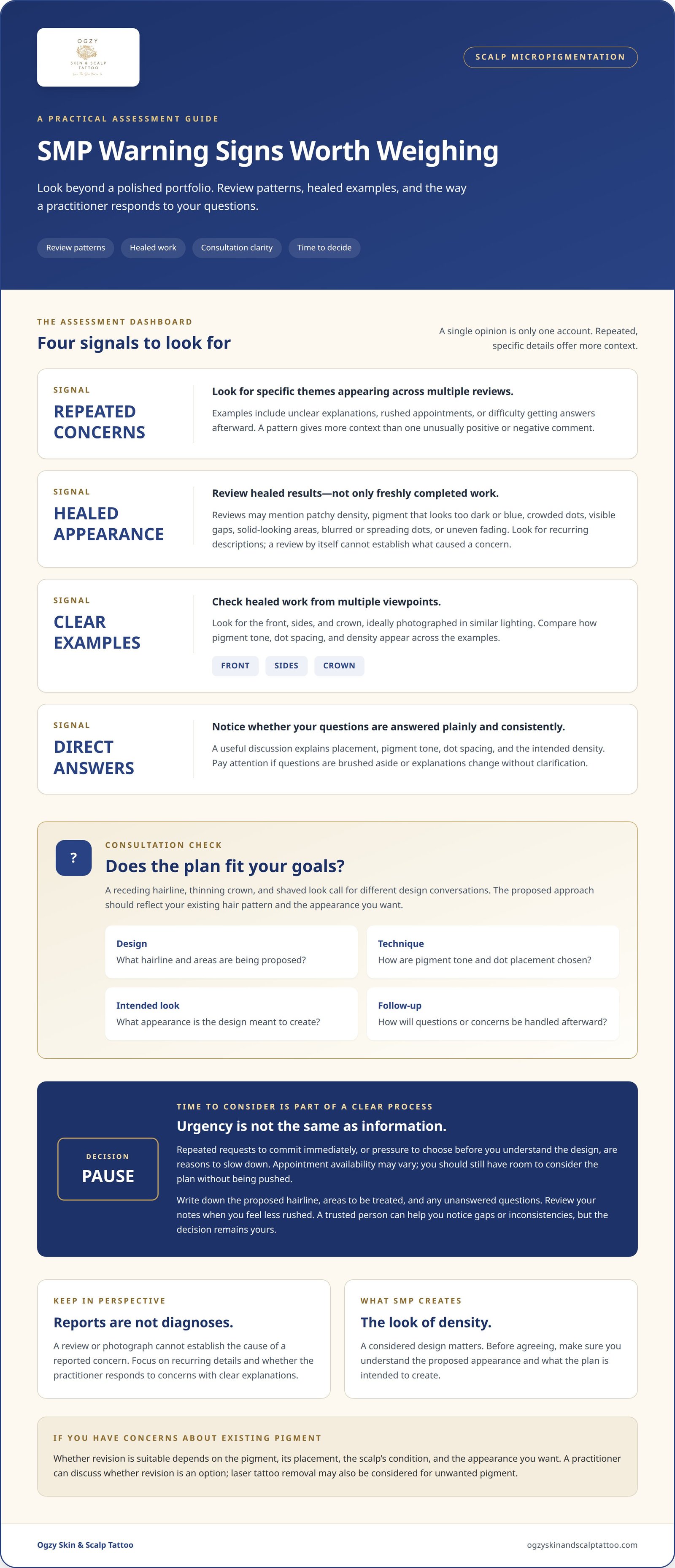
Look for recurring, specific concerns in reviews rather than relying on a single low rating or unhappy comment. If several people describe unclear explanations, rushed appointments, or difficulty getting answers afterward, the pattern may point to a repeated service issue. Specific experiences provide more context than general statements about satisfaction.
Look for comments about healed results, not just fresh work. Reviewers may describe patchy density, pigment that seemed too dark, or results that looked different from portfolio images. Compare those comments with clear healed examples from the front, sides, and crown, ideally photographed in similar lighting.
Color or density may seem mismatched when the dots look darker, bluer, or more crowded than the surrounding hair. Visible gaps, a solid-looking patch, or a sharp contrast with nearby areas can also make the result blend less naturally. Notice whether reviews describe the same concerns repeatedly.
Reviews may describe blurred or spreading dots and uneven fading as unwanted changes. A review alone cannot establish what caused them. Look for whether the practitioner explains placement, spacing, and how results can vary, rather than dismissing a client’s concern.
Reviews may also mention scarring, infection, or an allergic reaction. Persistent redness, swelling, tenderness, or unusual skin texture are concerns a reviewer may report, but a comment or photograph cannot establish the cause. Treat these accounts as reports of concern, not as a diagnosis.
Possible correction depends on the pigment, its placement, the scalp’s condition, and the appearance you want. A practitioner can discuss whether revision is suitable. Laser tattoo removal may also be considered for unwanted pigment. The appropriate approach and potential outcome depend on the individual result.
To assess a practitioner’s work, look for clear healed examples from several angles, including the front, sides, and crown. Ask who performs the procedure, how pigment tone and dot spacing are chosen, what appearance the design aims to create, and how concerns are handled after treatment. Direct answers help you understand the process.
Before booking, ask what results are realistic for your scalp and how the proposed design supports your goals. A clear discussion can help you distinguish isolated opinions from repeated concerns in reviews. Notice whether the answers address your questions specifically and remain consistent throughout the conversation.
2. Pressure to accept a job quickly
A decision about scalp micropigmentation deserves time for questions and reflection. If a practitioner urges you to book immediately during a consultation, notice whether they explain the design, process, and expected appearance first. A calm conversation should leave you informed, not pressured to agree before you understand the plan.
Urgency can sound like, “Choose today or lose your chance,” or come as repeated requests for an immediate commitment. That pressure differs from simply explaining that appointment times vary. The important distinction is whether you can consider the information without being pushed toward a decision.
Take a practical pause after the consultation. Write down the proposed hairline, the areas to be treated, and anything that remains unclear. Review your notes when you feel less rushed. If the explanation changes in a follow-up conversation, ask what changed and why.
Pay attention to how the practitioner responds to questions. They should be able to explain pigment tone, dot placement, and intended density in plain language. If your questions are brushed aside or treated as a nuisance, you may not have enough information to feel comfortable committing.
Pressure can also appear as a plan that seems fixed before your goals are discussed. A receding hairline, thinning crown, and shaved look call for different design conversations. Ask how the proposed approach reflects your existing hair pattern and what appearance the practitioner aims to create.
A trusted person’s perspective can help you sort through the discussion, especially if you feel overwhelmed after the appointment. Share the written plan rather than relying on a rushed summary. Their perspective cannot make the decision for you, but it may help you spot unanswered questions or inconsistencies.
Before agreeing, make sure you understand the proposed design, the process, and what SMP can realistically create. A practitioner who allows you time to consider the decision respects your role in it. If urgency is the main reason you are being asked to proceed, pause and decide only when the plan feels clear.
The same habit of pausing can help with other decisions, such as considering a job offer. Pressure to make a quick hiring decision can signal that a new employee may face a heavy workload or limited support. It can also point to staffing problems or high turnover. Those possibilities do not prove what a particular workplace will be like, but they are reasons to weigh the decision carefully. Job seekers can raise important considerations during the interview or before accepting an offer, and take time to research the company if they have concerns. In either situation, surfacing questions before committing helps make the decision more informed. Weighing the information can help distinguish a clear opportunity from one with unanswered issues. The choice should follow the information available, not simply pressure to answer quickly.
3. Trusting your instincts
A consultation should give you a clearer picture of the proposed work. Notice whether the practitioner listens when you describe your preferred hairline, coverage, and comfort level. If they repeatedly redirect the conversation toward a standard design, consider that mismatch before deciding.
Notice how the practitioner responds to a specific concern. If you ask how the design will transition near your temples, for example, a useful answer should address that area directly. Vague replies, irritation, or changing explanations can make it harder to understand what you’re agreeing to.
Your role is to make an informed choice, not to please the person conducting the consultation. An SMP practitioner isn’t your manager, and confidence alone is no reason to agree. You can ask for a plain-language explanation or take time to think through the proposed approach.
Notice the pace and focus of the consultation. If the practitioner checks messages while you explain your goals, repeatedly interrupts, or seems distracted by other tasks, consider whether you feel heard. A focused discussion helps clarify intended density, pigment tone, and how the design relates to your existing hair.
To separate a specific concern from general nerves, write down exactly what unsettled you. Was it an unanswered question, a design you didn’t recognize as your own, or pressure to approve a hairline immediately? Specific notes help identify what needs clarification.
Then review the proposed plan calmly. Ask yourself whether it reflects the appearance you discussed, whether the explanation stayed consistent, and whether you understand the next step. If something remains unclear, you have a concrete reason to pause rather than dismiss your reaction.
Differences in expectations matter, too. You may prefer a softer, less defined hairline, while the practitioner proposes a more uniform look. Neither preference is automatically wrong, but proceeding without agreement may leave you disconnected from the result. Your comfort with the design deserves a real place in the conversation.
Trusting your instincts doesn’t mean treating every moment of uncertainty as proof of poor work. Use that feeling as a prompt to identify a concern, ask a direct question, and assess the response. Clear explanations and respectful listening can help you decide whether the proposed position, process, and design feel right for you.
4. What does a bad scalp micropigmentation (SMP) job look like?
A result may look unbalanced if the pigment draws attention before the overall effect does. For example, a broad, uniformly dark area can resemble a patch rather than a subtle simulation of closely cropped follicles. Assess how the whole scalp looks together, not just one small, close-up section.
Look at dot definition and spacing across different areas. If some impressions appear larger or darker than their neighbors, the pattern may look inconsistent. A scattered appearance can also make coverage seem uneven, especially where the treated area meets the surrounding scalp.
Notice whether the pigment tone sits naturally with the surrounding hair and scalp. A noticeable color contrast can make the treatment look separate from nearby hair, even when the pattern is evenly applied. Photographs in different lighting can help show whether the appearance changes significantly between settings.
Check edges beyond the front hairline. Look where treated areas meet untreated skin around the sides, crown, and back of the head. A sudden cutoff or clearly outlined boundary may make the treatment look disconnected from the overall scalp.
Look for balance from multiple views. A result that seems even from the front may appear denser on one side or more pronounced at the crown. Reviewing front, side, and overhead angles gives a fuller impression than relying on one flattering photograph.
Compare examples in consistent conditions when possible. Similar angles, lighting, and hair length make differences easier to assess. Strong shadows or a very close crop may conceal how the pattern transitions across a larger area, so consider the context of each portfolio image.
One visual detail alone does not establish the quality of the whole procedure. Consider how tone, spacing, density, and transitions work together across the scalp. If a feature repeatedly catches your eye or looks out of balance from several angles, describe that specific observation when discussing the result.
Visual review is only one kind of assessment; practical choices can also call for attention to how people communicate and work together. In a job search, delayed communication or repeatedly rearranged or canceled interviews may be worth noticing rather than dismissing as isolated inconveniences. Job seekers can treat delayed communication or repeatedly rearranged or canceled interviews as possible warning signs of a poorly run business or a team that does not work well together. This is a reason to consider the pattern of interactions alongside other information, without assuming that one incident establishes what a business or team is like. The concern is whether communication and coordination repeatedly give cause for doubt, not whether every interaction is perfectly smooth. Fit matters as well as warning signs. Job seekers can consider whether a prospective manager’s leadership style suits the way they like to work. That question focuses on compatibility: a manager’s approach may or may not feel right for a particular person. Taken together, these considerations keep attention on both the way a business operates and the kind of working relationship a person wants. They are separate considerations from judging an SMP result by its appearance, but they reflect the value of looking at more than one aspect before forming an overall view. A measured assessment avoids making a broad conclusion from a single detail.
5. What are the signs of poor SMP hairline design?
A poorly designed SMP hairline can look like a drawn border instead of a soft transition. A ruler-straight edge across the forehead, for example, may look separate from the subtle follicle pattern behind it, especially with closely shaved hair.
Placement can also feel disconnected from your features. A hairline set unusually low or brought sharply forward may dominate your face instead of creating a balanced frame. Compare the proposed outline with your natural proportions and the look you want.
Look closely at the temples. Squared corners can create a rigid, stamped appearance, while an abrupt change in direction may make the hairline seem artificial. The front and temple shapes should look like parts of one considered design.
Perfect symmetry can also be a warning sign. Natural hairlines often have subtle variation, so an identical curve from one temple to the other may look overly uniform. If the outline resembles a repeated stencil rather than a soft, individual shape, ask how it was designed.
Density should transition naturally behind the front edge. A sharply defined hairline followed by a sudden dark block, for example, can look disconnected. Notice whether the dots gradually blend into the treated area rather than ending at a visible line.
A generic outline may ignore your existing hair pattern. If one side naturally sits differently, forcing both sides into matching angles can look unnatural. Consider whether the design accounts for your temples, forehead shape, and usual hairstyle.
Ask to see the proposed shape before treatment begins. Check the front and both side angles, since a design that looks balanced straight on may appear sharply squared from the side. You should be able to explain what you like and what you want adjusted.
A thoughtful hairline design should reflect your preferences and create the look of density, not promise hair regrowth. If the proposed edge feels too low, too sharp, or unlike the appearance you discussed, pause and clarify the design.
Ogzy Skin & Scalp Tattoo
Ogzy Skin & Scalp Tattoo offers personalized, expert scalp micropigmentation with a medical-grade approach and natural-looking results. If you’re weighing an SMP result, a design concern, or possible revision, a consultation can help you discuss your goals and understand what options may suit your concerns.
SMP uses precision pigment deposits to create the look of density on the scalp. It does not regrow hair or create new hair follicles. This distinction matters if your priority is a more defined appearance, such as a softer-looking hairline or the visual effect of closely shaved hair.
If you’re concerned about a previous result, bring clear photographs and describe what feels out of balance. You might point to a sharp hairline, uneven-looking density, or pigment that seems too dark. These details help focus the discussion on your preferred appearance and what may be realistic.
Not every concern calls for the same solution. The pigment’s location and appearance, your scalp, and your goals all matter when discussing a possible next step. A consultation gives us time to understand what you’re noticing and discuss a personalized approach without assuming every result needs the same solution.
Paramedical tattooing also includes scar and stretch mark revision, with ink or inkless methods considered according to the area and skin. Laser tattoo removal is another service I provide for unwanted tattoo pigment. These services address different concerns, so the conversation should stay focused on what you want assessed.
My goal is for you to leave with a clearer understanding of the personalized, medical-grade approach, its purpose, and the questions that matter to you. If you’re considering SMP, that includes discussing how the intended pattern and hairline fit your preferences, and remembering that the result creates the look of density rather than regrowing hair.
If a calm, individualized conversation would help you decide what feels right, you’re welcome to book a consultation with Ogzy Skin & Scalp Tattoo. The studio is at 13130 Pond Springs Rd #1105, Austin, TX 78729.

Article by
Opal Z
Opal is the owner and practitioner behind OGZY Skin & Scalp Tattoo in Austin, Texas. With more than three years in business and a longtime background in the aesthetics industry, she specializes in corrective and restorative treatments designed to address concerns that traditional aesthetics often overlook.
Her work focuses on scar and stretch mark revision, scar camouflage, scalp micropigmentation (SMP), hair regrowth treatments, and laser tattoo and permanent makeup removal. Opal works with a wide range of skin tones and takes an individualized approach to every client, considering skin color, texture, scar characteristics, treatment history, and realistic long-term outcomes.
Through OGZY Skin & Scalp Tattoo, her goal is to combine artistry, aesthetics, and technical treatment knowledge to help clients feel more comfortable and confident in their skin.
Love the skin you’re in.