
Scalp micropigmentation (SMP) uses pigment to create the look of density on the scalp. A consultation can help you understand whether this approach suits your preferences and what to expect from the process.
Key Takeaways
- Match your choice to your routine: consider how exercise, swimming, travel, and sleep fit with each option’s upkeep.
- Think beyond morning preparation and account for the recurring care and appointments a hair system may involve.
- Compare long-term commitments, including hair-system replacement and the possibility of future SMP touch-ups.
- Choose based on the look you want: SMP simulates closely cropped follicles, while a hair system offers hair texture and styling options.
- Explore whether SMP fits your goals with a consultation focused on a natural-looking appearance of density, not hair growth.
Is scalp micropigmentation a fit for an active lifestyle?
Scalp micropigmentation (SMP) may suit an active lifestyle if you prefer the appearance of closely cropped hair. SMP uses pigment to create the look of hair follicles and visual density; it does not grow hair. Whether this approach fits your routine depends on the look you want and your personal preferences.
SMP and Your Everyday Look
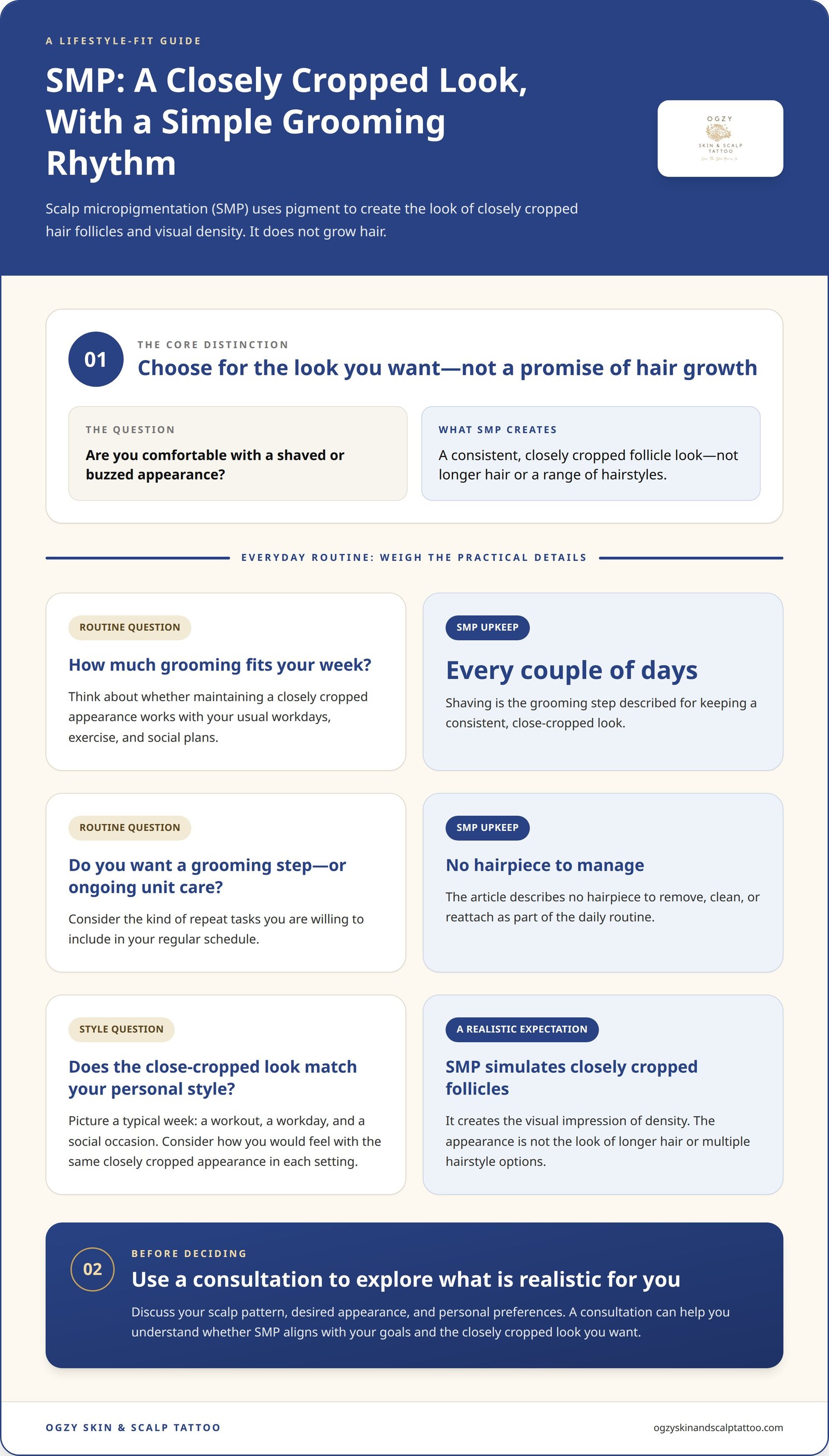
SMP uses precision pigment deposits to replicate the appearance of closely cropped hair follicles. It creates a consistent, closely cropped look without requiring you to style longer hair. If you’re comfortable with a shaved or buzzed appearance, SMP may be an option to consider.
Your preferred look is an important part of deciding whether SMP feels right for you. I can discuss the appearance you’re hoping to achieve and explain what SMP can realistically create. Choosing an approach that fits your preferences can help you feel comfortable with your everyday look.
SMP and Personal Style
SMP creates the visual impression of closely cropped hair, rather than the appearance of longer hair or a range of hairstyles. That distinction matters if you’re considering SMP and have a particular style in mind.
Your scalp pattern and desired appearance are important to discuss before treatment. During a consultation, I can explain how precision pigment deposits simulate follicles and create a closely cropped appearance. Results vary, so a consultation is the best way to explore what may be realistic for you.
Expectations and Provider Selection
SMP involves pigment placed in the scalp to create the look of density. Consider whether a closely cropped appearance aligns with your preferences before deciding if SMP is right for you.
At Ogzy Skin & Scalp Tattoo in Austin, I discuss your scalp pattern, desired look, and how personalized SMP treatments may fit your routine. I explain how precision pigment deposits simulate follicles and create a closely cropped appearance. A consultation gives us the opportunity to talk through your goals and what SMP can realistically achieve.
| Option | Daily appearance | Active routine | Flexibility |
|---|---|---|---|
| SMP | Closely cropped follicle look | Consider how the look fits your routine | Creates a closely cropped appearance |
| SMP consultation | Discuss your desired appearance | Talk through your preferences | Explore whether SMP suits your goals |
Consider SMP if a closely cropped look aligns with your preferences. A consultation can help you understand how the approach may fit your desired appearance.
To decide whether SMP fits your lifestyle, picture a typical week that includes a workout, workday, and social occasion. Consider whether a closely cropped appearance feels right in each situation. This can help you weigh your personal style and expectations as you explore SMP.
Daily maintenance and time requirements
Daily upkeep is a practical part of choosing between scalp micropigmentation (SMP) and a hair system. An SMP vs. hair system for daily wear comparison should account for time spent getting ready, recurring cleaning, and appointments, not just the finished appearance.
To maintain a consistent, closely cropped look with SMP, you’ll typically shave your head every couple of days. If you already prefer a shaved style, this can become a familiar grooming step. There’s no hairpiece to remove, clean, or reattach as part of your daily routine.
A hair system involves more unit care. Daily care is estimated at 30-60 minutes, though the routine varies. Weekly upkeep may involve removing the system, cleaning it, and re-adhering it. Most systems require cleaning and reattachment every one to two weeks, so those tasks recur even when your weekday schedule is busy.
Hairline growth underneath can also mean adjustments every 1-2 weeks. Some wearers plan salon visits every fortnight for maintenance. That creates a calendar commitment as well as time at home. If you travel or have a tightly scheduled workweek, consider where those appointments and cleaning steps would fit.
- SMP: Shave every couple of days to maintain a consistent close-cropped look.
- Hair system: Set aside time for daily care, periodic cleaning, reattachment, and possible salon maintenance.
Imagine getting ready for an early workday. With SMP, shaving may be the main appearance-related task. With a system, your routine may also involve caring for the unit and planning its next cleaning or attachment maintenance. The difference isn’t simply more or less care, but the type and timing of that care.
The SMP vs. hair system for daily wear decision can become clearer when you map each task onto a typical week. Include grooming, cleaning, adjustments, and appointments. If repeated unit care doesn’t suit your schedule, SMP’s shaving routine may fit better. If you prefer longer hair and are comfortable with regular maintenance, a hair system may feel more worthwhile.
Choose an option based on a routine you can realistically maintain over time. Mark shaving days, cleaning periods, and appointments on a calendar, then see which pattern fits your work, social plans, and preferences.
A separate estimate puts daily wig care at 25-45 minutes, in addition to weekly cleaning. Treat that figure as a planning input rather than assuming it replaces the broader daily-care estimate for a hair system. The useful question is whether that time can be accommodated alongside the weekly cleaning and the recurring removal, cleaning, and reattachment already considered. When comparing options, keep each task visible instead of allowing a daily estimate to obscure the less frequent work. A routine that seems manageable on an ordinary day may feel different when cleaning or an appointment also needs to fit. Thinking through those overlaps can help you judge whether the care pattern is sustainable for your own week. The aim is not to make every day identical, but to choose an approach whose regular tasks remain workable as your schedule changes.
Exercise, swimming, and weather considerations
Exercise, swimming, and sleep affect SMP and hair systems differently. With scalp micropigmentation, activity and water fit into daily life once treatment has fully healed across all 3 sessions. A bonded hair system has adhesive to consider during sweat, swimming, and ordinary wear.
For SMP, the main lifestyle distinction is its closely cropped appearance, not an attached unit. After healing across all 3 sessions, swimming and exercise are unrestricted. That can simplify plans for a swim or workout, since there’s no hairpiece bond to manage during those activities. The look remains a shaved head or close crop, rather than longer hair.
A hair system or toupee brings different considerations. Sweat, swimming, and everyday life can break down adhesive, and frequent workouts may mean rebonding every 1-2 weeks. Think about your actual routine: regular pool visits and strenuous training may make attachment maintenance more noticeable. A day with a workout followed by swimming can also mean planning around the bond, rather than treating water and exercise as separate considerations.
Weather adds another practical consideration. On a hot, humid travel day, you may sweat more, making a hair system’s adhesive part of your planning. SMP doesn’t rely on an adhesive bond, though its close-cropped appearance may not match your preferred style. Consider whether you’d rather manage hair-system upkeep or maintain a shaved-head look while travelling.
Sleeping in a hair system depends on its type. Bonded systems can be worn while sleeping, but clip-in systems can’t. This distinction matters if you want your hairpiece attached overnight or prefer to remove it before bed. Include your usual bedtime routine when comparing options, not just exercise and swimming.
- SMP: Once fully healed across all 3 sessions, swimming and exercise are unrestricted.
- Bonded system: Sweat and swimming can affect adhesive; frequent workouts may mean rebonding every 1-2 weeks.
- Sleep: Bonded systems can stay on overnight; clip-in systems cannot.
For example, a frequent swimmer who prefers a shaved look may value SMP’s lack of adhesive upkeep after healing. Someone who wants longer hair may accept planning around a bonded system. Compare your workout, pool, travel, and sleep routines together; that gives a clearer picture than considering exercise alone.
Hair-system costs and replacement cycles
Compare the full commitment, not only the first appointment. A hair system has ongoing upkeep and replacement needs, while SMP involves a different initial process and may need future maintenance. Since prices vary and aren’t included here, weigh the recurring tasks and replacement cycle instead of relying on a single upfront figure.
A hair system typically needs replacing every three to six months, depending on its quality and how often it’s worn. Each replacement is a recurring part of the decision, alongside adhesive, cleaning, and maintenance appointments. Frequent wear may affect how soon a unit needs replacing, so include the cycle in your longer-term planning.
SMP doesn’t involve replacing a hair unit. It uses pigment to create the appearance of closely cropped follicles rather than adding hair that needs replacement. Future touch-ups may be considered, but their timing and cost vary. This distinction matters: an initial SMP treatment and recurring hair-system expenses are different kinds of spending.
For a useful five-year comparison, list every expected expense category without assuming a total:
- Hair system: initial fitting, recurring replacement, adhesive, cleaning, and maintenance appointments.
- SMP: initial treatment and any future touch-up you choose to pursue.
This step-by-step view is more useful than comparing the price of one unit with an SMP treatment alone. It captures ongoing expenses that can be missed in an initial estimate. Confidence matters too, so consider whether a shaved appearance suits you or retaining hair length feels essential.
Consider two scenarios. With a hair system, account for each three-to-six-month replacement cycle and its related care. With SMP, consider whether its closely cropped look suits you, and treat future touch-ups as a possibility rather than a fixed schedule.
Before deciding, list the costs relevant to your situation and compare the categories over five years. Include replacement, upkeep, and appointments for a hair system, alongside SMP’s initial treatment and possible later maintenance. This gives you a clearer framework without treating a general estimate as your personal quote.
The better fit depends on what you value most: flexibility in hair length, fewer recurring tasks related to a hair unit, or an everyday look that feels comfortable. Compare replacement cycles with the routine you’re willing to maintain, then weigh the full commitment rather than only the first step.
Natural appearance and colour matching
SMP creates the appearance of closely cropped follicles. Across different hair-loss patterns and colors, the result is designed for a close-cropped look rather than the length, texture, and movement of longer hair.
SMP Appearance and Hairstyle Options
SMP uses precision pigment deposits to replicate the appearance of closely cropped follicles. It can suit a shaved or buzzed look, including areas where thinning changes the visible pattern. It doesn’t reproduce the texture or movement of longer hair. Someone seeking a defined, close-cropped appearance may find SMP more aligned with their style.
Color matching helps the pigment work with your scalp and surrounding hair. The goal is a natural-looking impression, not individual strands. SMP doesn’t conceal the fact that the scalp is pigmented in every condition, so lighting and hair length can affect how the result appears.
SMP Appearance and Color Matching
SMP creates the appearance of closely cropped follicles by placing pigment on the scalp. The approach is designed to suggest a close-cropped look, rather than provide visible hair length or styling options. Matching the pigment to your scalp and surrounding hair helps create a cohesive appearance.
Placement affects how the SMP result appears. A pigment pattern that contrasts with the surrounding scalp or hair can draw attention. SMP avoids a hairpiece edge but provides a closely cropped look rather than the styling range of longer hair.
Consider how the look you want appears in everyday settings: in a bright bathroom mirror, outdoors in daylight, and during a close conversation. With SMP, consider whether follicle-like pigment suits your preferred hair length and how the color and placement look with your surrounding hair.
Hair color changes over time, and the color of surrounding hair can affect how SMP appears. SMP’s appearance comes from pigment and closely cropped follicles, not strands that can be restyled. Lighting and hair length can also affect how natural the result looks.
Choose SMP for a deliberate, closely cropped appearance. It creates the look of density through pigment, rather than adding hair length, movement, or varied styling options.
SMP creates the appearance of a shaved or buzzed look with hair length of 0.5-3mm. It cannot reproduce the texture, movement, or fuller three-dimensional appearance of longer hair. That difference can help set expectations: pigment can suggest follicles, but it does not create strands that catch light or shift as you move. Consider whether that more limited visual effect fits the look you want in everyday settings.
Ogzy Skin & Scalp Tattoo: Scalp Micropigmentation
Ogzy Skin & Scalp Tattoo offers personalized Scalp Micropigmentation (SMP) treatments in Austin to create a carefully designed, closely cropped appearance. Precision pigment deposits simulate hair follicles and create the appearance of density. SMP doesn’t grow hair or add strands, so it suits people drawn to a shaved or buzzed style.
During a consultation, I can discuss the scalp areas you’d like addressed, your existing hair pattern, and the appearance you want. These details support a realistic conversation about personalized SMP treatments, pigment placement, and how a closely cropped effect may suit your features. Your preferred hairstyle matters: SMP is designed to resemble closely cropped follicles, not recreate a longer haircut.
It may help to consider a few personal questions before deciding:
- Desired look: Do you feel comfortable with a shaved or buzzed appearance?
- Daily routine: Would you prefer a low-maintenance look?
- Expectations: Are you seeking the appearance of density rather than hair growth?
These questions aren’t a test. They keep the conversation focused on your priorities. SMP isn’t the right match for every hairstyle goal, particularly if you want longer hair, visible movement, or the ability to restyle strands. SMP focuses on creating the appearance of density with a follicle-like visual effect.
I provide personalized SMP treatments with attention to your overall scalp pattern and the look you want day to day. A consultation is the best way to discuss what may be realistic for your scalp and goals. Appearance and suitability vary from person to person.
If you’d like to explore SMP in Austin, you can book a consultation with Ogzy Skin & Scalp Tattoo. The studio is at 13130 Pond Springs Rd #1105, Austin, TX 78729.
Frequently Asked Questions
How long does SMP last compared with a hairpiece?
SMP can remain visible for years, while a hairpiece is replaced as it wears. Touch-ups are typically considered every three to five years, though individual timing varies. Hair systems typically need replacing every three to six months, depending on quality and wear. These are different maintenance cycles: one involves pigment refinement, while the other involves replacing a physical unit.
What is the main difference between SMP and a hair system?
SMP uses scalp pigment to create the appearance of closely cropped follicles; a hair system is a unit of human or synthetic hair attached to a base. This distinction shapes the look you can choose. SMP suits a close-cropped style, while a system offers hair length and more styling options. Consider which appearance feels most like you in everyday settings.
How should I compare the long-term costs of both options?
Compare recurring expenses rather than looking only at the initial appointment. For a hair system, account for replacement units, adhesive, cleaning, and maintenance appointments. For SMP, consider the initial treatment and the possibility of future touch-ups. Your total depends on the unit and upkeep choices you make, so compare the same time period and expense categories for a fair assessment.
How do I decide which option fits my routine?
Start with your preferred hairstyle, then weigh the upkeep you’re willing to maintain. Consider whether a close-cropped look feels right or whether you want hair length and styling flexibility. Next, picture a typical week, including exercise, swimming, travel, and sleep. The right fit should feel workable across those situations, not just during the first days after making a choice.
What are the risks, side effects, and drawbacks of SMP and hair systems?
SMP provides a closely cropped look rather than longer hair, requires shaving every couple of days, and may need future touch-ups. Hair systems require regular cleaning, reattachment, and replacement; sweat and swimming can weaken adhesive, and clip-in systems can’t be worn while sleeping. The article provides no specific list of medical risks or side effects.

Article by
Opal Z
Opal is the owner and practitioner behind OGZY Skin & Scalp Tattoo in Austin, Texas. With more than three years in business and a longtime background in the aesthetics industry, she specializes in corrective and restorative treatments designed to address concerns that traditional aesthetics often overlook.
Her work focuses on scar and stretch mark revision, scar camouflage, scalp micropigmentation (SMP), hair regrowth treatments, and laser tattoo and permanent makeup removal. Opal works with a wide range of skin tones and takes an individualized approach to every client, considering skin color, texture, scar characteristics, treatment history, and realistic long-term outcomes.
Through OGZY Skin & Scalp Tattoo, her goal is to combine artistry, aesthetics, and technical treatment knowledge to help clients feel more comfortable and confident in their skin.
Love the skin you’re in.