
Sensitive skin doesn’t automatically rule out laser tattoo removal, but it does make thoughtful treatment planning important. For tattoo removal for sensitive skin in Georgetown, sessions are generally spaced several weeks apart to give the treated skin time to heal.
It’s understandable to want a clear schedule while feeling cautious about how your skin may respond. A consultation can help you understand the factors that may shape your treatment plan and spacing between visits.
This guide explains what affects session timing, why removal is gradual, and how tattoo color, size, depth, and age shape the process. You’ll also learn what to discuss at a consultation to understand a personalized plan for your tattoo and skin.
Key Takeaways
- Skin sensitivities or conditions can be discussed during a consultation when considering the treatment approach.
- Session spacing gives treated skin time to heal, while tattoo color, size, depth, and age help shape the overall plan.
- Sun exposure and aftercare can be part of a discussion about the removal process.
- A skin assessment considers details that help set realistic expectations for the removal process.
Is Laser Tattoo Removal Safe for Sensitive Skin?
In Georgetown, Texas, tattoo removal for sensitive skin involves considering your sensitivities, ink colors, and skin response when discussing laser treatment. Ogzy Skin & Scalp Tattoo offers laser tattoo removal using Nd:YAG laser technology. A consultation covers your tattoo, skin, goals, and questions. Discuss any concerns with a qualified professional.
Clinic Experience With Sensitive Skin
When considering tattoo removal for sensitive skin in Georgetown, ask how the consultation will address your skin history and the treatment area. Share any sensitivities or skin conditions, then discuss your concerns with a qualified professional.
A consultation also considers the tattoo itself. Its size, depth, age, and ink colors are relevant to the discussion, as is your skin’s response. Discuss your concerns with a qualified professional to learn what may be suitable for you.
Ink Colors and Treatment Suitability
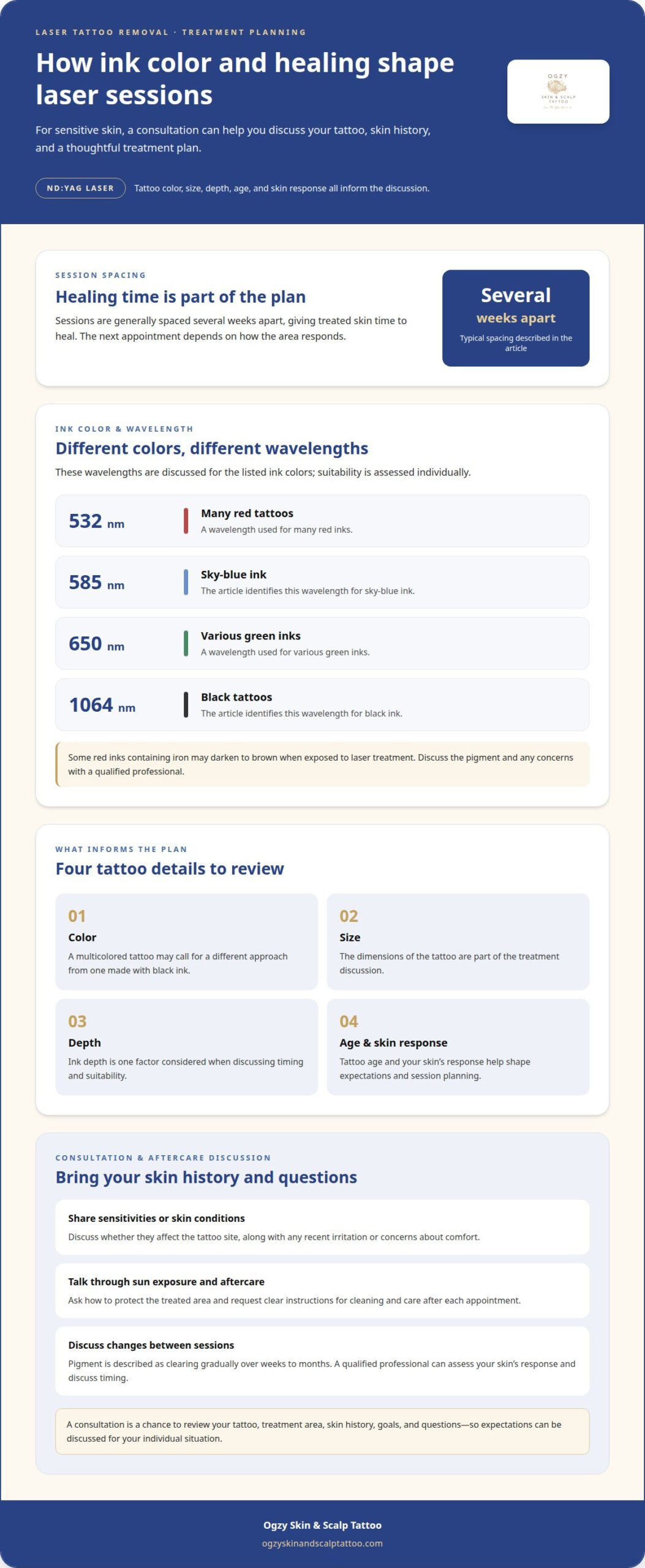
Laser wavelengths interact with different ink colors. A 532 nm wavelength is used for many red tattoos, 650 nm for various green inks, 585 nm for sky-blue ink, and 1064 nm for black tattoos. A qualified professional can discuss your tattoo’s colors and treatment suitability with you.
Some red inks containing iron may darken to brown when exposed to laser treatment. Eyebrow tattoos need particular care: a qualified professional can discuss the pigment and any concerns with you. Eyeliner tattoos are removed by laser only, and you should discuss your concerns with a qualified professional.
Cryogen Cooling and Discomfort
People may have questions about comfort during laser tattoo removal. Discuss your concerns with a qualified professional, including any sensitivities or questions about the session and the treatment approach.
You may also have questions about what to expect after treatment. Discuss your concerns with a qualified professional rather than relying on general aftercare directions.
You may have questions about the timing of sessions and how the tattoo may change between appointments. Discuss your concerns with a qualified professional, who can talk with you about your tattoo and the treatment approach.
If you have questions about preparing for laser tattoo removal or recent irritation or sensitivity, discuss your concerns with a qualified professional. A consultation is an opportunity to talk through your skin history, the tattoo, and any questions you have.
Tattoo removal aftercare and sun avoidance
Aftercare supports healing and helps protect the treated skin following laser tattoo removal. Follow your professional’s instructions for cleaning, sun protection, and comfort measures after each appointment.
Sun Avoidance Guidance During Aftercare
Protect the area from direct sun before and after laser tattoo treatment. Tanned or sunburned skin may be more prone to irritation, so discuss sun exposure during your preparation. According to the Texas Institute of Dermatology, use broad-spectrum sunscreen rated SPF 30 or better at least one week before an appointment.
After treatment, avoid direct sun on the treated area and use sunscreen to protect it. If the tattoo is on an exposed arm, for example, plan how to shield that skin outdoors. Ask the treating professional when sunscreen is appropriate for your healing area.
Professional Aftercare Guidance for Healing
Keep the treated area clean and follow the aftercare instructions for your session. These steps can minimize infection risk. An ice pack may help with discomfort, and keeping the skin moisturized can support healing. Follow the specific directions you receive rather than adding products or steps on your own.
Laser treatment breaks tattoo pigment into particles that the body gradually clears over weeks to months. Healing continues between appointments, so aftercare matters beyond the treatment day. If redness, swelling, or discomfort concerns you, contact the professional who treated the area for guidance.
Scarring Risk and Professional Aftercare Guidance
Skin response varies, and careful aftercare helps protect the treated area as it heals. Keep it clean, avoid direct sun, and follow your treatment instructions. These steps support healing and help minimize infection risk, but they don’t guarantee against scarring or other skin changes.
Redness and swelling usually subside within a few days after laser tattoo removal. Don’t rush into another session while the area is healing; treatments are spaced several weeks apart. The professional can assess your skin’s response and advise when to schedule the next appointment.
Plan the first day around the treated area. Medical Cosmetic advises avoiding exercise, swimming, saunas, and steam rooms for one day after treatment. These activities can expose the skin to heat, moisture, or friction, so follow the timing in your professional’s aftercare instructions.
Before your appointment, share any sensitivity and ask for clear written aftercare instructions. Confirm how to keep the area clean, protect it from sunlight, and manage discomfort. A simple plan helps you follow each step consistently while the skin heals.
Consultation and skin assessment
A consultation helps the professional understand your skin sensitivities and tattoo before treatment. The assessment includes reviewing the treatment area, discussing relevant skin conditions, and planning ways to support comfort.
Skin Assessment During Consultation
The assessment begins with the area being considered for laser treatment. Active irritation or infection there means treatment isn’t appropriate at that time. Tell the professional about any skin sensitivities or conditions, including whether they affect the tattoo site.
The tattoo itself also informs the plan. Its color, size, depth, and age help the professional consider suitability and timing. For example, a multicolored tattoo may call for a different approach from one made with black ink.
Preparing Sensitive Skin for Treatment
Before your appointment, clearly describe any sensitivities and recent irritation at the treatment site. The professional can consider this information when planning the treatment and discussing comfort options, including numbing cream where appropriate.
Preparation also means discussing your skin’s condition on the day. If the area is actively irritated or infected, laser treatment should wait until it is no longer affected. This helps avoid treating compromised skin.
During the consultation, ask how the professional will tailor the session to your skin and tattoo. A useful discussion covers the treatment area, ink colors, expected fading, session spacing, and aftercare. These factors help set a realistic plan without assuming every tattoo responds the same way.
Discomfort is another practical topic. Laser treatment can feel like a rubber band snapping against the skin, and comfort measures may include chilled air or numbing cream. Discuss what may be used before the session begins, especially if you’ve experienced sensitivity during other procedures.
Share relevant details clearly. For example, mention a skin condition affecting the tattoo site, recent irritation, or a prior reaction to numbing products. This helps the professional consider your comfort alongside the treatment approach.
Sun exposure and irritating products also belong in the preparation conversation. The Texas Institute of Dermatology advises avoiding lengthy sun exposure for at least one week before removal. It also recommends broad-spectrum SPF 30 or better during that period. Avoid irritating skin products for at least one day before treatment, as advised by the clinic.
By the end of the consultation, you should understand the next step: whether your skin is ready, what comfort measures are planned, and how aftercare will be explained. Clear answers can make appointments more predictable, while your skin’s response guides decisions as treatment progresses.
Estimated number and spacing of sessions
Laser tattoo removal is planned as a series of appointments, not a single procedure. Sessions are spaced several weeks apart to allow the treated skin to heal before the next visit.
The number of sessions depends on the tattoo’s characteristics and how it responds. Color, size, depth, and age all influence the plan. A small, older black tattoo, for example, presents different considerations from a larger, newer design with several ink colors.
Ink density and placement matter, too. A dense design may need a different approach from lighter, more limited pigment. The professional assesses these details during consultation and reviews how the tattoo changes between sessions.
Spacing is part of the treatment plan, not just a calendar convenience. Your skin needs time between appointments, and the professional considers how it is healing before proceeding. A fixed, closely packed schedule doesn’t account for your skin’s response.
After each treatment, the tattoo may gradually lighten as the body clears broken ink particles. This change takes place over weeks to months, so how the area looks shortly after a session doesn’t show the full fading that may happen before the next one.
For cosmetic goals, clarify what “done” means to you. You may want substantial fading before considering another tattoo, or you may hope to reduce the design’s visibility. These goals can shape how progress is discussed, but neither makes the number of sessions predictable.
Respecting healing intervals matters, including when considering scarring. The professional assesses the treated skin rather than scheduling another session just because time has passed. If redness, swelling, or other changes remain a concern, discuss them before another treatment.
At each appointment, the professional can review fading, your skin’s response, and the tattoo’s remaining pigment. A dark area that persists may need a different assessment from a section that has already lightened. Color differences within one design can also affect how progress is evaluated.
Ask for an explanation of the session interval and what could change it. Useful details include how the professional assesses healing, what progress they look for, and how your cosmetic goal informs decisions. This gives you a clearer framework without relying on a promised finish date.
With several weeks between sessions, the process unfolds gradually. Planning around healing, tattoo features, and visible changes helps keep expectations grounded as each visit contributes to the removal process.
Published estimates can provide context, but they do not replace an assessment of the individual tattoo. Medical Cosmetic says the Kirby-Desai scale estimates the number of tattoo removal sessions within about 2 treatments. Medical Cosmetic spaces tattoo removal sessions 6-8 weeks apart. These details address different parts of planning: an estimated treatment count and the interval between visits. They are reference points, not a promise that every person will follow the same course.
For eyebrow tattoos, Fractured Pigment says removal normally takes 1-3 sessions, depending on the ink used. That range is specific to eyebrow removal and highlights why the ink matters when considering an estimate. Ask the professional how such estimates apply to your tattoo and whether its response after treatment could affect the expected course.
Expected number of sessions
Laser tattoo removal usually involves more than one appointment. The number of sessions depends on tattoo color, size, depth, and age. A small, older black tattoo differs from a large, newer design with several colors. These features help shape an estimate, but they don’t determine an exact session count.
Pigment response adds another variable. Laser treatment breaks ink into smaller particles, which the body clears over weeks to months. Fading can continue between visits, so the area’s appearance immediately after treatment doesn’t show the full change. Assessment considers each part of the tattoo, not just its overall darkness.
Ink density matters, too. A design with closely packed pigment may respond differently from a lightly applied outline. Placement and tattoo depth also influence how the professional approaches each appointment. In a multicolored design, different sections may fade at different rates, making progress uneven across the tattoo.
Your goal also shapes the discussion about sessions. Wanting the tattoo to look lighter differs from aiming for substantial removal. If you’re considering a cover-up later, mention that during the consultation so the professional understands your cosmetic goal. Remaining pigment and visible fading can inform the conversation as treatment progresses.
At each appointment, the professional can assess changes since the previous treatment, including visible fading and the condition of the treated skin. The plan can then reflect how your tattoo responds rather than rely on a fixed session count set beforehand. Skin sensitivity is another consideration.
Comfort planning belongs in the appointment discussion, too. Laser treatment can feel like a rubber band snapping against the skin. Chilled air or numbing cream may be used to support comfort. Tell the professional about your sensitivity before treatment so comfort options can be discussed alongside the plan.
Keep expectations tied to observable changes, not a promised finish date. For example, a black outline may fade differently from colored shading in the same design. The professional can assess each area separately and explain what the changes mean for your next appointment.
A consultation is the clearest way to discuss your tattoo’s features, sensitivity, and goals together. Discuss a personalized tattoo removal plan that accounts for the ink and your skin’s response.
Medical Cosmetic says most tattoos require 6-12 laser removal sessions. Treat that as a broad point of reference rather than a personal forecast: the tattoo’s color, size, depth, age, pigment density, placement, and your goal all affect the discussion. The number of visits for one design may not describe what another person should expect, and different parts of a multicolored tattoo can change at different rates.
At your consultation, ask how the professional will assess progress and what visible changes may support continuing or adjusting the plan. Revisit the estimate as fading and skin condition are assessed at each appointment. If your goal is lightening for a cover-up rather than substantial removal, say so; the intended result helps frame the discussion about future sessions.
Ogzy Skin & Scalp Tattoo: Laser tattoo removal
Ogzy Skin & Scalp Tattoo offers personalized, non-invasive laser tattoo removal using Nd:YAG laser technology. If you have sensitive skin, a consultation can assess your tattoo, discuss your sensitivities, and explain the treatment and aftercare. The medical-grade approach is tailored to your skin, pigment, and goals.
Each personalized plan considers your tattoo’s colors, size, depth, and age. I also consider how your skin responds between appointments, since healing and fading inform session timing. We can discuss comfort measures and what to expect, so you can understand the approach before deciding on your next step.
If you’re exploring laser tattoo removal in Georgetown, Austin, Cedar Park, Leander, or Round Rock, contact Ogzy Skin & Scalp Tattoo to discuss your goals and arrange a consultation.
Choose a thoughtful next step
If you’re considering tattoo removal for sensitive skin in Georgetown, start with a conversation about your goals and comfort. You deserve space to explain your concerns, understand the proposed approach, and decide whether it feels right for you. A consultation is the place to discuss what may be realistic for your tattoo and skin; results vary with skin, tattoo characteristics, and healing.
You don’t need to have every decision made before reaching out. Bring questions about comfort, preparation, or what to expect. A calm, clear discussion can help you move forward with greater confidence, at your own pace.
Ogzy Skin & Scalp Tattoo is located at 13130 Pond Springs Rd #1105, Austin, TX 78729. Contact Ogzy Skin & Scalp Tattoo to discuss your tattoo removal goals and arrange a consultation. Your next step can begin with a simple conversation.
Frequently Asked Questions
What laser technology is used for tattoo removal?
Ogzy Skin & Scalp Tattoo uses Nd:YAG laser technology for personalized tattoo removal. It can be used for unwanted tattoos, permanent makeup, and previous scalp micropigmentation. The suitable approach depends on your pigment, skin, and goals. A consultation can clarify whether laser removal fits the tattoo or cosmetic pigment you want addressed.
Are eyeliner tattoos treated with laser?
Yes, eyeliner tattoos are removed by laser only. Because the tattoo is near the eyes, the treatment area needs careful consideration during consultation. Discuss its location and pigment with the professional so the plan can account for the specific cosmetic tattoo and your concerns.
Can laser treatment temporarily change skin pigment?
Yes, temporary pigment changes can occur after laser tattoo removal. The treated area may become darker or lighter, and these changes typically fade over time. If a change concerns you, contact the professional who treated the area to discuss what you’re seeing and how it relates to healing.
What laser types are used for sensitive skin tattoo removal?
Laser options for sensitive skin are discussed during consultation, with the tattoo’s ink color and other relevant details considered when determining whether treatment is appropriate.

Article by
Opal Z
Opal is the owner and practitioner behind OGZY Skin & Scalp Tattoo in Austin, Texas. With more than three years in business and a longtime background in the aesthetics industry, she specializes in corrective and restorative treatments designed to address concerns that traditional aesthetics often overlook.
Her work focuses on scar and stretch mark revision, scar camouflage, scalp micropigmentation (SMP), hair regrowth treatments, and laser tattoo and permanent makeup removal. Opal works with a wide range of skin tones and takes an individualized approach to every client, considering skin color, texture, scar characteristics, treatment history, and realistic long-term outcomes.
Through OGZY Skin & Scalp Tattoo, her goal is to combine artistry, aesthetics, and technical treatment knowledge to help clients feel more comfortable and confident in their skin.
Love the skin you’re in.