
A certificate matters, but it is only one part of the picture. Choosing a certified SMP practitioner in Round Rock means looking beyond credentials to assess training, healed results, and hygiene practices. Scalp micropigmentation, or SMP, uses precision pigment deposits to create the look of hair density. It does not regrow hair.
It is reasonable to want clear information before choosing a treatment that affects your appearance. CSMP stands for Certified Scalp Micropigmentation Professional, a designation introduced by the Society of Permanent Cosmetic Professionals. Understanding the credential can help you weigh it alongside a practitioner’s experience and portfolio.
This guide explains SMP and CSMP certification, questions to ask in a consultation, and ways to assess portfolios and reviews. It also covers practical hygiene points to look for so you can make a considered choice with greater confidence.
Key Takeaways
- Look beyond a certification: understand the practitioner’s SMP-specific training and experience.
- Use your consultation to discuss pigment, hairline design, treatment planning, and aftercare.
- Review healed portfolio images across different skin tones and head shapes, alongside detailed client feedback.
- Observe whether the treatment space and hygiene practices help you feel informed and comfortable.
- Learn how SMP creates the look of hair density and discuss whether your goals and circumstances suit the process.
What is CSMP Certification?
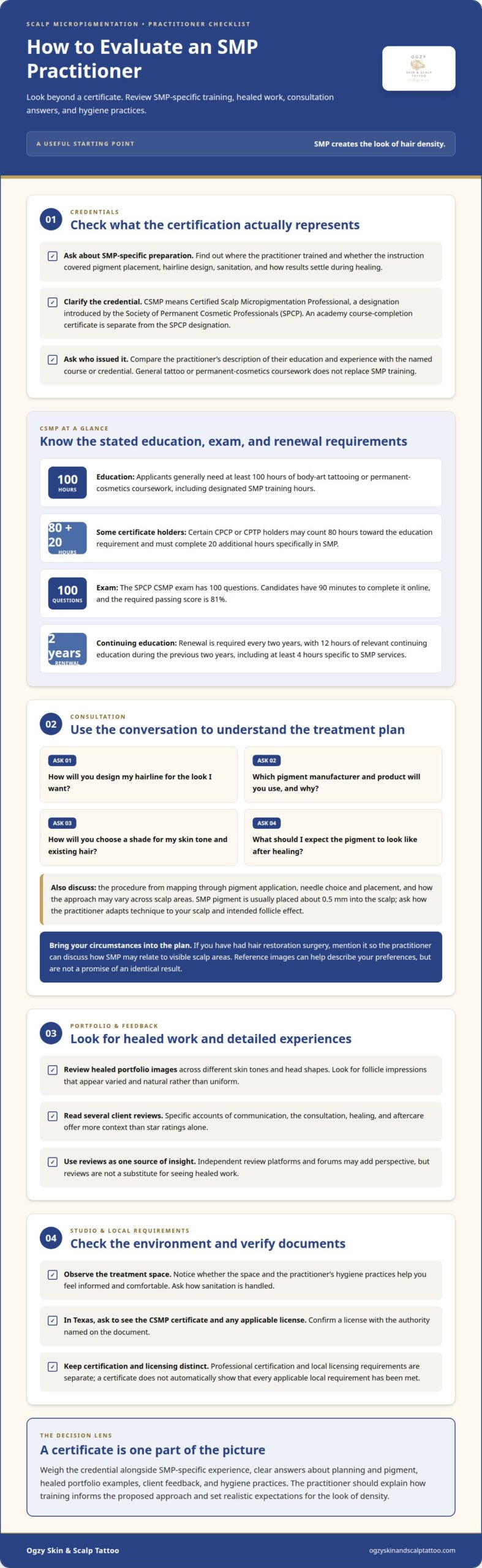
CSMP means Certified Scalp Micropigmentation Professional, a designation introduced by the Society of Permanent Cosmetic Professionals (SPCP). It is specific to scalp micropigmentation, or SMP, rather than a general marker for tattooing. For readers choosing a certified SMP practitioner in Round Rock, this distinction helps separate SMP-focused credentials from broader training.
Ask where the practitioner completed SMP-specific training and what the course covered. A private academy certificate documents completion of that academy’s course, while SPCP’s CSMP is a separate designation. General tattoo or permanent-cosmetics coursework does not replace scalp micropigmentation training. Ask whether instruction covered pigment placement, hairline design, sanitation, and how results settle during healing.
SPCP CSMP applicants generally need at least 100 hours of body-art tattooing or permanent-cosmetics coursework, including designated SMP training hours. Certain CPCP or CPTP certificate holders may count 80 hours toward that education requirement and must complete 20 additional hours specifically in SMP. Ask which credential the practitioner holds, who issued it, and whether SMP-specific coursework formed part of their preparation.
The SPCP CSMP exam consists of 100 questions, and candidates have 90 minutes to complete it online. The required passing score is 81%. SPCP CSMP certification must be renewed every two years, with 12 hours of relevant continuing education during the previous two years, including at least four hours specific to SMP services. These requirements make the designation more informative than a course-completion certificate alone.
In Texas, ask to see the practitioner’s CSMP certificate and any applicable license, then confirm the license with the authority named on the document. SMP qualifications vary by state, so professional certification and local licensing requirements are separate. A certificate can document training or professional qualification, but does not automatically show that every applicable local requirement has been met.
When choosing a certified SMP practitioner in Round Rock, compare the documents with the practitioner’s account of their education and experience. Ask how long they have performed SMP, what client needs they have treated, and how they continue their education. A clear answer should connect a named course or credential to practical SMP skills, not rely solely on general tattoo experience. Notice whether the practitioner explains how training informs pigment selection, hairline planning, and realistic expectations for the appearance of density. This helps you assess credentials as one part of an informed decision, not as the sole measure of expertise.
Consultation questions about process and pigments
A useful consultation connects your goals with a clear treatment plan. Ask how the practitioner will design your hairline, choose pigment, and build the appearance of density across your scalp. For example, a soft hairline may complement your features better than a sharply defined outline.
Ask how pigment choice accounts for your natural hair color, skin tone, and the contrast between them. The goal is a convincing pattern of follicle-like impressions, not a solid block of color. Ask how the shade is expected to look after healing and how the practitioner will keep the result visually balanced.
You can ask specific questions about products without having to assess technical claims yourself. Ask the practitioner to identify the pigment manufacturer and product, explain why it is suitable for SMP, and describe how they select a shade for your treatment.
- What manufacturer and pigment product will you use?
- How will you choose a shade that complements my skin and existing hair?
- How will you design my hairline for the look I want?
- What should I expect the pigment to look like after healing?
Discuss needle choice and placement, too. SMP pigment is usually placed about 0.5 mm into the scalp, keeping it in the upper skin layers. Ask how the practitioner adjusts placement for different areas and explains the role of needle size. Avoid treating a single depth as a universal setting; the practitioner should explain how technique relates to your scalp and the intended follicle effect.
Ask the practitioner to explain the procedure, from mapping through pigment application. A thoughtful plan shows how the proposed hairline, dot pattern, and shade work together. If you have had hair restoration surgery, mention it during planning so the practitioner can discuss how SMP may relate to visible scalp areas.
The answers should make the choices easy to understand. When a practitioner explains why a specific pigment and placement approach fits your goals, you can assess the plan more meaningfully. Bring reference images if they help describe your preferred hairline or density, but use them to guide discussion, not as a promise of an identical result.
How useful are online reviews when researching SMP practitioners?
Online reviews can offer insight into how an SMP practitioner communicates, supports clients, and handles follow-up. Compare specific experiences, not just star ratings. A detailed account of the consultation, healing, and aftercare provides more context than a brief statement of satisfaction.
Independent reviews on review platforms or dedicated forums can offer perspectives beyond testimonials on a practitioner’s website. Read several accounts and look for consistent descriptions of the experience, including how clearly the treatment plan was explained. Reviews are one source of insight, not a substitute for seeing healed work.
A portfolio can help you assess whether a practitioner’s work relates to your features. Look for healed results across different clients, skin tones, and head shapes. Notice whether the follicle impressions look varied and natural rather than uniform. If you have a particular hairline, pattern of hair loss, or scalp scar, look for examples that help you understand how the practitioner approaches similar details.
Ask how long the practitioner has performed SMP and how broad their client experience is. A useful response describes their work and treatment approach clearly, rather than relying only on a credential or polished image. Compare experience, healed portfolios, review detail, and how individualized the consultation feels.
If you live in Round Rock, you can also consider SMP services in nearby Austin. Ogzy Skin & Scalp Tattoo serves clients in Austin, Cedar Park, Leander, Round Rock, and Georgetown. Assess each practitioner’s certification, portfolio, and treatment approach rather than assuming location alone indicates suitability.
Reviews may also offer insight into scheduling and follow-up. Look for comments describing how appointments were arranged and whether communication continued through healing. In your consultation, clarify the appointment sequence and how follow-up is handled. These details help you decide whether the process fits your needs and schedule.
- Prioritize reviews that discuss consultation, healing, and aftercare.
- Look for healed portfolio examples across skin tones and head shapes.
- Compare the practitioner’s experience and treatment approach, not just credentials.
- Use independent reviews alongside portfolio images and direct consultation answers.
No single review tells the whole story. Patterns across independent feedback, healed work, and clear explanations give a more balanced picture of an SMP practitioner. Check that the information makes clear what the treatment can create: the look of density, not hair regrowth. Reviewing these details can help you make a decision that feels informed and aligned with your goals.
Clinic cleanliness and sterile treatment practices
A clean-looking room is only one part of evaluating an SMP appointment. Before signing an agreement, ask to see the clinic and treatment room. Notice whether the space is organized and prepared for your visit, and whether the practitioner can clearly explain their hygiene steps. A calm, specific explanation matters more than polished décor.
Pay attention to how supplies are handled. The practitioner should open prepackaged needles in front of you so you can see the package being opened for your procedure. Ask how other tools and work surfaces are managed between clients. Look for a description of the actual routine, not just a vague claim that the room is sterile.
Barrier protection is another visible part of the process. During treatment, SMP practitioners should use protections such as masks, barrier tape, nitrile gloves, and guards. Observe whether these measures are in place before the procedure begins. If a step is unclear, ask what it protects and how it fits into the treatment.
- Ask to see the treatment room before agreeing to treatment.
- Watch the practitioner open prepackaged needles in front of you.
- Notice whether masks, nitrile gloves, barrier tape, and guards are used.
- Ask how tools and work surfaces are handled between clients.
Credentials deserve a separate look. A CSMP certificate describes a professional credential, while a business license or other required license serves a different purpose. Ask to see the practitioner’s certification and the clinic’s business license, along with any other licenses required by state law. A certificate alone does not explain every aspect of oversight or local requirements.
Ask who will perform your SMP and who is responsible for the treatment space. If the practitioner mentions medical oversight, ask what that means for your appointment and who has each role. Clear answers help distinguish SMP training from medical credentials without treating them as interchangeable.
These observations do not replace understanding the full process, but they help you assess how carefully it is organized. The practitioner should be able to describe each step, from preparing the room to opening the needle package and applying barrier protection. If what happens in the room does not match the explanation, pause and ask for clarification before treatment begins.
What is Scalp Micropigmentation (SMP)?
SMP places pigment impressions in the scalp to create the look of hair density. It can visually soften the contrast between hair and visible scalp, but it does not grow hair. The cosmetic effect depends on design choices, including the hairline and how the impressions complement your appearance.
SMP is a tattoo procedure, so discuss possible risks and suitability during screening. Tell the practitioner about scalp concerns or previous scalp procedures, then ask how they may affect the plan. The consultation should give you time to understand potential concerns and whether treatment suits your circumstances.
The process begins with a consultation, assessment, and treatment plan before pigment is applied. A standardized three-session SMP protocol was described in a 2025 study in the Journal of Cosmetic Dermatology. That study protocol doesn’t establish a personal schedule. The practitioner should explain how your design and scalp shape inform the proposed sessions.
Healing time varies. Ask what to expect after each appointment, what aftercare instructions apply, and how follow-up works. SMP pigment can last 5-10 years, though it fades over time. Your practitioner can explain how fading may affect the appearance and what considerations inform future touch-ups.
Choosing a certified SMP practitioner in Round Rock: consultation planning
Ask whether a patch test is available, how the practitioner plans your hairline, and how your approval fits into the design process.
- How will you adapt the hairline design to my preferences?
- What should I expect during healing and follow-up?
- What aftercare instructions will I receive?
- How will you discuss pigment fading and touch-up decisions?
When choosing a certified SMP practitioner in Round Rock, use the consultation to understand the proposed plan, screening, healing, and booking terms before deciding. A clear discussion helps you consider whether the cosmetic effect and treatment process align with your goals.
Ogzy Skin & Scalp Tattoo
Ogzy Skin & Scalp Tattoo offers expert, personalized Scalp Micropigmentation (SMP) using precision pigment deposits to create the natural-looking appearance of greater scalp density. I’m Opal, a Paramedical Tattoo Artist, and I use consultation to understand your goals before discussing whether SMP may suit you. The treatment creates the appearance of follicle impressions; it does not regrow hair.
If you are weighing credentials, portfolios, and hygiene practices, a one-to-one conversation can connect those details to your situation. We can discuss your preferred hairline, visible scalp areas, previous scalp treatments, and the style you hope to achieve. You can also ask about pigment, treatment steps, healing, and aftercare before making a decision.
A considered plan is personalized to your features and goals. For example, we can discuss how a soft or defined hairline may complement your appearance and how pigment impressions can create a subtle density effect. SMP is non-surgical and does not create growing hair. The consultation is a chance to understand that distinction and set realistic expectations.
You can also ask about the treatment environment and how supplies are prepared. I want you to understand the process, including what happens during treatment and what care follows. If your goals or scalp circumstances call for a different approach, we can discuss that rather than make assumptions. Results vary with individual factors, including skin and healing.
For readers in Round Rock and the Austin area, the studio is at 13130 Pond Springs Rd #1105, Austin, TX 78729. You can review the information available at ogzyskinandscalptattoo.com as you consider your next step.
If you’d like to talk through your goals and questions, contact Ogzy Skin & Scalp Tattoo at a pace that feels right for you.
Frequently Asked Questions
Are you certified to perform SMP?
I’m Opal, a Paramedical Tattoo Artist. A professional title and a specific certification are not interchangeable, so credentials should be described by their exact designation. For any practitioner, distinguish a professional title, a course-completion certificate, and a named certification rather than assuming one establishes another. That distinction helps you understand precisely what a credential represents without relying on inference.
How do I know if an SMP artist is genuinely experienced?
Experience is easier to assess when a practitioner explains their decisions, not just how long they have worked. Ask how they might adapt a proposed hairline if you prefer a softer, less defined edge. Listen for a reasoned explanation of design choices and limitations. A useful discussion addresses your goals rather than steering you toward a preset look.
How to Find Expert SMP?
Consider whether the practitioner can explain the reasoning behind a plan in language you understand. Describe the appearance you hope to create, such as a subtle change around the temples. Notice whether the proposed approach addresses your goal and explains its limits. Expertise shows in thoughtful planning, clear communication, and respect for your preferences.
What should I look for in an SMP practitioner’s before-and-after portfolio?
Look for paired images that help you see what changed, and check whether the framing and lighting are comparable. Consistent presentation makes visual assessment more meaningful than dramatic differences in camera angle or brightness. Consider whether the examples show the finish you prefer, from a softly outlined hairline to a more defined appearance, and whether the design looks balanced.
What questions should I ask during an SMP consultation?
Ask how your preferences will shape the design and whether adjustments are possible before pigment is applied. Clarify how the practitioner will show you the proposed hairline and how your approval fits into planning. You can also ask what information they need about previous scalp procedures or your usual hairstyle. These details make the discussion specific to your choices.

Article by
Opal Z
Opal is the owner and practitioner behind OGZY Skin & Scalp Tattoo in Austin, Texas. With more than three years in business and a longtime background in the aesthetics industry, she specializes in corrective and restorative treatments designed to address concerns that traditional aesthetics often overlook.
Her work focuses on scar and stretch mark revision, scar camouflage, scalp micropigmentation (SMP), hair regrowth treatments, and laser tattoo and permanent makeup removal. Opal works with a wide range of skin tones and takes an individualized approach to every client, considering skin color, texture, scar characteristics, treatment history, and realistic long-term outcomes.
Through OGZY Skin & Scalp Tattoo, her goal is to combine artistry, aesthetics, and technical treatment knowledge to help clients feel more comfortable and confident in their skin.
Love the skin you’re in.