What if the best way to make a scar less noticeable isn’t to erase it, but to help it blend more naturally with your skin? It’s understandable to feel self-conscious about a visible scar or unsure whether treatment could make it more noticeable. The best scar revision treatment options depend on the scar’s type, texture, color, and age. A thoughtful assessment helps match the approach to the feature you want to improve.
This guide compares surgical and non-surgical approaches, from scar excision and laser resurfacing to microneedling, regenerative treatments, and pigment camouflage. You’ll learn what each method may address, what to ask when comparing options, and why no treatment can promise to erase a scar completely. The goal may be improved texture, more natural color blending, or, in some cases, less tightness or itchiness. With clear information and a personalized plan, you can make a more informed next step.
Key Takeaways
- Use a scar’s origin, texture, color, and age to prepare for a professional assessment.
- Ask how microneedling or regenerative methods may fit your goals, and what each approach can realistically change.
- Compare pigment camouflage with no-ink resurfacing to see which better addresses the scar’s visible features.
- Describe where the scar is, how it looks and feels, and what you want to improve before discussing treatment.
- The best scar revision treatment options vary by scar type. Ogzy Skin & Scalp Tattoo offers non-surgical approaches in Central Texas.
Understanding Your Skin: Why Scar Revision Matters in 2026
A scar can be a reminder of surgery, an accident, acne, or a C-section. Each forms as the body repairs injured tissue, and the result can vary in color, height, depth, and flexibility. For a comprehensive overview of scars, explore how this natural healing process can leave different marks.
Scar revision is a personalized approach to making a scar less noticeable or improving its texture. The aim isn’t to erase your history or promise flawless skin. It’s to help the scar sit more naturally with the surrounding area and, when possible, ease discomfort. For some people, the emotional weight is as real as the physical mark. Wanting to change its appearance is valid.
Common Types of Scars and Their Characteristics
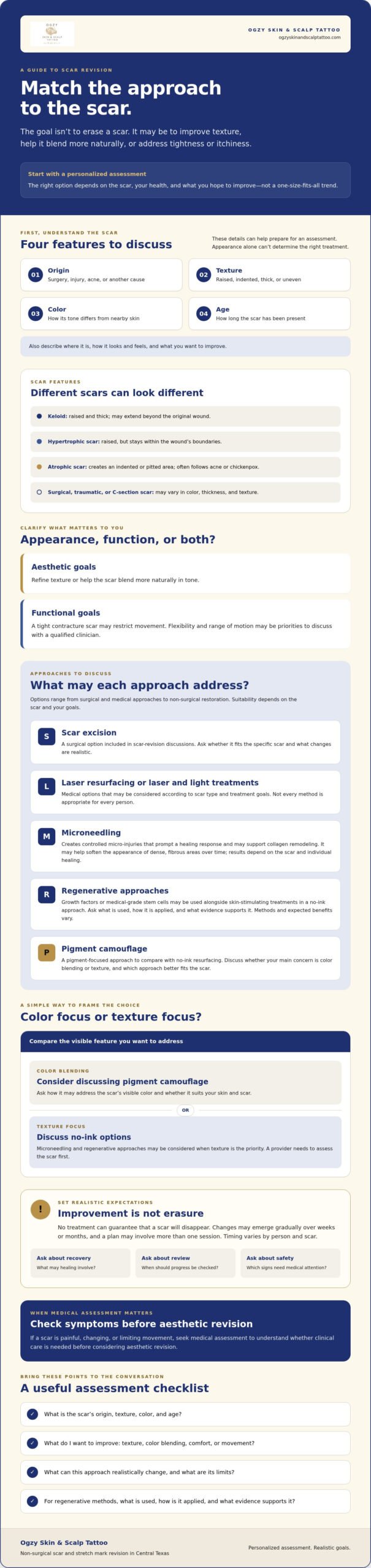
Noting a scar’s features can help you prepare for an assessment, although appearance alone can’t determine the right treatment. Keloids are raised and thick and may extend beyond the original wound. Hypertrophic scars can also be raised, but stay within the wound’s boundaries. Atrophic scars create indented or pitted areas, often after acne or chickenpox. Surgical, traumatic, and C-section scars can vary in color, thickness, and texture.
The Goal of Revision: Functional vs. Aesthetic Improvement
Revision may address function, appearance, or both. A tight contracture scar can restrict movement, so improving flexibility and range of motion may be a priority to discuss with a qualified clinician. Aesthetic goals may include refining texture or helping the scar blend more naturally in tone. Non-invasive restorative approaches sit alongside medical and surgical options. The best scar revision treatment options depend on the scar, your health, and your goals, not on a one-size-fits-all trend.
Ogzy Skin & Scalp Tattoo focuses on non-surgical scar and stretch mark revision in Central Texas. Approaches may include microneedling, growth factors, medical-grade stem cells, or custom pigment camouflage. An evaluation can help clarify which options may suit your concerns and what results are realistic. For scars that are painful, changing, or limiting movement, seek medical assessment to understand whether clinical care is needed before considering aesthetic revision.
Regenerative Scar Revision: The Power of Stem Cells and Microneedling
Regenerative scar revision aims to support the skin’s repair processes rather than simply disguise an uneven surface. Microneedling creates controlled micro-injuries that prompt a healing response and may support collagen remodeling. In scar tissue, this process may help soften the appearance of dense, fibrous areas over time. Results depend on the scar and individual healing.
How Microneedling Triggers Skin Renewal
Professional microneedling gives a trained provider the opportunity to assess the scar and tailor the treatment approach. At-home rollers don’t provide the same individualized assessment, and using them on a scar may irritate the skin or cause unwanted changes. If you’re exploring this approach, read more about microneedling for scars Cedar Park. A qualified provider can help determine whether it suits your scar and skin.
Microneedling isn’t the only option for improving a scar’s appearance. The American Academy of Dermatology also outlines laser and light treatments for scars, which may be considered according to scar type and treatment goals. Not every method is appropriate for every person, so assessment matters.
The Role of Growth Factors and Stem Cells
Growth factors are signaling molecules involved in communication between cells during tissue repair. In a no-ink approach, they may be used alongside skin-stimulating treatments to support the healing environment without adding pigment. Ogzy Skin & Scalp Tattoo offers scar and stretch mark revision using medical-grade stem cells and growth factors. Since the term “stem cell therapy” can describe different methods, ask what is used, how it’s applied, and what evidence supports the approach. It shouldn’t be presented as a universal gold standard. Suitability and expected benefits vary.
A no-ink regenerative approach may appeal if your priority is texture rather than color camouflage, but a provider needs to assess the scar first. Pigment, depth, healing history, and medical factors can all shape the plan. No approach can guarantee that a scar will disappear.
Healing and visible remodeling take time. Changes may emerge gradually over weeks or months, and a treatment plan may involve more than one session. The pace varies by person and scar. Ask what recovery may involve, when progress should be reviewed, and what signs warrant medical attention. If you’re considering non-surgical scar revision in Central Texas, learn more about Ogzy Skin & Scalp Tattoo’s restorative approach.
Paramedical Tattooing vs. Medical Resurfacing: Choosing the Right Path
Scar revision isn’t limited to changing the skin’s surface. Sometimes the main concern is texture; sometimes it’s a pale mark that stands out against the surrounding skin. Paramedical tattooing places custom-blended pigment to help a suitable scar blend more naturally with nearby skin. It isn’t decorative tattooing. Pigment selection and placement are tailored to the scar and skin tone.
Camouflage and resurfacing address different concerns. Pigment can reduce color contrast, but it can’t smooth a raised edge or fill an indentation. Resurfacing approaches, which may include microneedling or clinician-directed laser treatment, focus on texture and other surface characteristics. Some scars may need texture improvement before pigment is considered, since unevenness can affect how naturally the color integrates. Ogzy Skin & Scalp Tattoo offers non-surgical scar revision that may include custom pigment camouflage.
Scar Camouflage: The Art of Skin Tone Matching
Matching a scar involves more than choosing a color that looks close at first glance. A paramedical tattoo artist considers the surrounding skin’s undertones and how the scar differs in tone, then selects pigment intended to create a more cohesive appearance. The goal is subtle integration, not a perfect match in every lighting condition or as skin changes. Ask how color is assessed and whether your scar’s texture and healing stage make camouflage appropriate.
Laser vs. Camouflage: Pros and Cons
Laser treatment may be considered by an appropriate medical provider for concerns such as redness or some raised, uneven scars. Pigment camouflage may be more relevant for a stable, light-colored scar, including some healed C-section lines, when color contrast is the main concern. Neither approach suits every scar, and camouflage won’t reduce height or tightness.
A combined plan may sometimes address more than one concern, such as improving texture before considering pigment. The timing and sequence should be determined through assessment. Applying pigment to an unsuitable or actively changing scar may lead to an uneven result. As you compare the best scar revision treatment options, ask what each method can realistically change, what it won’t address, and whether a staged approach makes sense for your scar.
Assessing Scars: Matching Treatments to Scar Types
Start by observing the scar without trying to diagnose it. Note where it is, how long it has been there, and whether it appears raised, indented, tight, red, darker, or lighter than nearby skin. Consider whether it itches, feels tender, or limits movement. These details help a qualified provider understand your concerns and discuss which approaches may be appropriate.
Age matters because scars can continue changing as they mature. Surgeons commonly recommend waiting 12 to 18 months before considering surgical revision, though timing depends on the scar and individual circumstances. A scar that is still changing may call for a different plan from a stable, older one. Skin tone and response to previous treatments matter, too. The Fitzpatrick scale describes how skin tends to respond to sun exposure. A qualified provider can assess skin type and consider pigment-related risks when discussing treatment.
Revision Strategies for Surgical and C-Section Scars
Surgical and C-section scars can have more than one feature to address. A line may look darker or lighter than surrounding skin, feel firm, or create a “shelf” where tissue sits above or below the incision. Texture-focused approaches may be considered for unevenness, while pigment camouflage may help with color contrast once the scar is suitable. A combination may be discussed, but no single plan fits every scar.
For Austin-area mothers, considering revision can be a personal step toward feeling more at ease with a changed body. A realistic plan should take healing history, comfort, and individual goals into account, without pressure to pursue treatment.
Treating Stretch Marks as a Form of Scarring
Stretch marks are a form of skin scarring, but often differ from a defined surgical scar. They may appear as multiple lines with changes in texture and color across a broader area. Pigment camouflage can reduce contrast in selected cases, but it won’t address texture by itself, and matching pigment across an area can be challenging. No treatment should promise complete removal or a fixed improvement percentage.
For a closer look at approaches for this concern, explore stretch mark revision treatment. The best scar revision treatment options depend on scar age, skin characteristics, and whether your priority is color, texture, or comfort. If you’re in Cedar Park, Austin, Round Rock, Georgetown, or Leander, ask Ogzy Skin & Scalp Tattoo about scar and stretch mark revision and what an assessment may involve.
Restoring Confidence in Central Texas: The Ogzy Skin & Scalp Approach
Scar revision is personal. The right plan should respect both the skin you want to restore and the feelings attached to the scar. In Cedar Park, Ogzy Skin & Scalp Tattoo takes a restorative approach, pairing careful skin tone matching and scar revision techniques with an understanding of each person’s goals. The focus is thoughtful, detail-oriented care aimed at subtle, natural-looking results, rather than a one-size-fits-all promise.
Ogzy specializes in non-surgical scar and stretch mark revision in Central Texas, including the Austin area. Depending on the scar and your goals, approaches may include microneedling, medical-grade stem cells or growth factors, and custom pigment camouflage. Each method addresses different concerns, so an assessment helps establish what may be suitable and what expectations are realistic.
What to Expect During Your Scar Revision Consultation
A conversation about revision should begin with your concerns, not a preset menu. Explain what bothers you most, whether that’s color contrast, uneven texture, or how the scar makes you feel. A technical assessment can then consider the scar’s appearance and healing history alongside your goals. This helps shape a personalized plan and gives you a chance to ask about the approach, process, and limitations before deciding whether to proceed.
Honest expectations matter. Scar revision can aim to make a mark less noticeable, but it can’t promise to erase it or guarantee a particular result. A considerate provider should explain the potential benefits and limits of the options being discussed, so you can make an informed choice without pressure.
Why Choose a Specialist in Cedar Park and Austin?
For residents of Cedar Park, Austin, Round Rock, Georgetown, and Leander, a local provider focused on restorative skin work can make it more practical to discuss a plan and any follow-up it may involve. Ogzy Skin & Scalp Tattoo is owned by Opal, whose work focuses on paramedical tattooing and skin rejuvenation. That focus may be relevant when your priority is helping pigment blend naturally or considering a non-surgical approach.
You don’t have to decide on a treatment before asking questions. If you live in Austin or Round Rock and are considering scar or stretch mark revision, contact Ogzy Skin & Scalp Tattoo to discuss your revision goals. Exploring scar revision options with a provider can be a considered first step toward feeling more comfortable in your skin.
Take the Next Step Toward Skin Renewal
The best scar revision treatment options depend on what you want to address, whether that’s uneven texture, color contrast, or a scar that feels tight. Microneedling and regenerative approaches may support texture-focused care, while paramedical tattooing can help some scars blend more naturally through custom pigment matching. Since scars differ, a personalized assessment can clarify which approach may suit your skin and set realistic expectations.
In Cedar Park and Austin, Ogzy Skin & Scalp Tattoo specializes in non-surgical scar and stretch mark revision. Approaches include microneedling, medical-grade stem cells and growth factors, and custom pigment camouflage. The focus is restorative work aimed at subtle, natural-looking results, not a promise to erase every mark.
If you’re ready to explore your options, contact Ogzy Skin & Scalp Tattoo to discuss your scar revision goals. Ask about an assessment and which approaches may fit your priorities. A first conversation can help you make an informed choice.
Frequently Asked Questions
Is scar revision treatment painful?
Discomfort varies by treatment, scar location, and personal sensitivity. Microneedling may feel prickly or warm, while pigment camouflage can cause temporary tenderness. Ask the provider what sensations to expect and what comfort measures may be appropriate for the specific method. Share relevant health concerns or past reactions before treatment. A clear explanation beforehand can make the experience feel more predictable. Report unexpected or severe discomfort promptly.
How many sessions of scar camouflage will I need?
The number of sessions depends on the scar’s size, color, texture, and how it responds to pigment. A provider can assess the area and explain whether the work may need to be staged, but an exact plan is difficult to determine without evaluating the scar. Ask how progress will be reviewed and whether follow-up or a later adjustment may be appropriate. The goal is natural-looking blending, not an identical match in every lighting condition.
Can all types of scars be treated with paramedical tattooing?
No. Pigment camouflage isn’t suitable for every scar. It may be considered for some healed, lighter scars when color contrast is the main concern, but it won’t correct raised, indented, tight, or changing tissue. Scar maturity, skin tone, texture, and healing history all matter. A qualified specialist should assess the area and explain whether camouflage, a texture-focused approach, or another form of care is more appropriate.
What is the difference between scar revision and scar removal?
Scar revision aims to make a scar less noticeable or improve its texture, color, or comfort. It doesn’t guarantee the mark will disappear. “Scar removal” can imply complete erasure, which isn’t a realistic promise. Even surgical removal creates a new wound that heals with a scar. The best scar revision treatment options depend on the scar and your goals, and a provider should explain likely benefits and limitations before treatment.
How long do the results of pigment camouflage last?
Pigment camouflage results can vary with the scar, skin, pigment placement, and individual healing. The color may soften or change over time, and some people may want a touch-up, but timing isn’t the same for everyone. Ask the specialist how they assess pigment retention and what follow-up they recommend for your case. A realistic plan should account for the fact that scar tissue can hold pigment differently from surrounding skin.
Is there downtime after a microneedling scar revision session?
Some temporary redness, sensitivity, or mild swelling may occur after microneedling, but recovery varies with the treatment and individual response. Before a session, ask the provider what to expect, how long visible effects may last, and what activities or products to avoid while the skin recovers. Follow the aftercare instructions you’re given, and contact the provider if symptoms are unusually severe or persist longer than advised.
Can old scars (10+ years) still be revised?
Yes, an old scar may still be assessed for revision. Its age alone doesn’t determine suitability. Stability, texture, color, location, and your skin’s healing history also matter. A mature scar may be considered for approaches such as texture-focused treatment or pigment camouflage, depending on its features. An assessment can help clarify realistic goals. Revision may make a scar less noticeable, but can’t promise to erase it.
Will my insurance cover scar revision treatments?
Coverage depends on your insurance plan, the treatment recommended, and whether the purpose is considered medically necessary or cosmetic. Policies may treat revision for functional problems differently from aesthetic camouflage, so don’t assume coverage either way. Contact your insurer before booking and ask what documentation or pre-authorization may be needed. Ogzy Skin & Scalp Tattoo provides scar and stretch mark revision in Cedar Park, serving clients in Austin, Leander, Round Rock, and Georgetown.

Article by
Opal Z
Opal is the owner and practitioner behind OGZY Skin & Scalp Tattoo in Austin, Texas. With more than three years in business and a longtime background in the aesthetics industry, she specializes in corrective and restorative treatments designed to address concerns that traditional aesthetics often overlook.
Her work focuses on scar and stretch mark revision, scar camouflage, scalp micropigmentation (SMP), hair regrowth treatments, and laser tattoo and permanent makeup removal. Opal works with a wide range of skin tones and takes an individualized approach to every client, considering skin color, texture, scar characteristics, treatment history, and realistic long-term outcomes.
Through OGZY Skin & Scalp Tattoo, her goal is to combine artistry, aesthetics, and technical treatment knowledge to help clients feel more comfortable and confident in their skin.
Love the skin you’re in.