Inkless scar revision can improve a scar’s appearance, but it doesn’t erase it. If you’re asking whether inkless scar revision works, the realistic answer is that it may make scars or stretch marks less noticeable as the skin heals and remodels. There’s no universal number of sessions: the plan depends on the scar’s characteristics and how the skin responds.
It’s understandable to want a clear session count and a reliable sense of what results may look like. The key distinction is that inkless revision stimulates the scar tissue without adding pigment, while scar camouflage uses customized pigment to help a mature, lighter scar blend with the surrounding skin. This guide explains how inkless treatment works, who may be a suitable candidate, why results vary, and how its aftercare differs from camouflage, so you can better understand which approach aligns with your goals.
Key Takeaways
- Session needs and visible changes vary with the scar’s features and how the skin responds as it heals.
- Scar age, texture, and skin characteristics help determine whether inkless revision may be suitable.
- Plan for healing time and follow aftercare guidance, especially around sun exposure and skin irritation.
- Inkless revision stimulates scar tissue, while camouflage uses pigment to blend a lighter scar with nearby skin.
- A personalized assessment can help clarify which approach best fits your scar and appearance goals.
What is the Inkless tattooing method for treating stretch marks and scars?
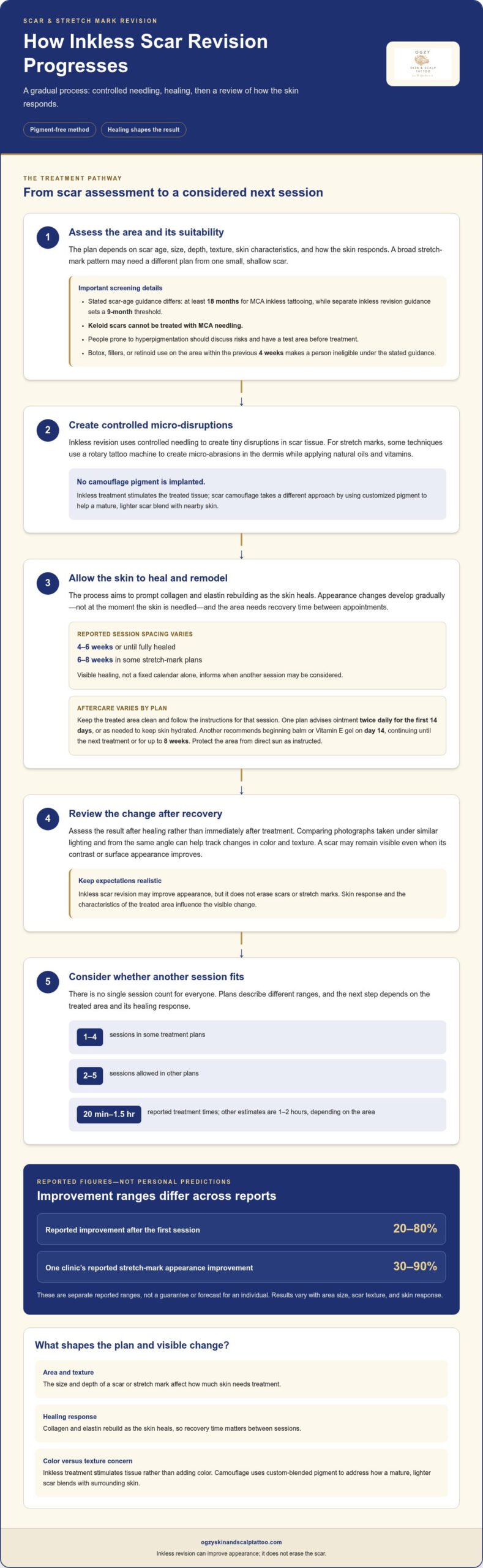
Inkless revision uses controlled needling to create tiny disruptions in scar tissue. This process aims to prompt collagen and elastin rebuilding as the skin heals. For stretch marks, some techniques use a rotary tattoo machine to create micro-abrasions in the dermis while applying natural oils and vitamins. The method stimulates the treated area without implanting camouflage pigment.
Results and session counts vary with the area’s size, scar texture, and skin response. A broad stretch mark pattern may require a different plan from one small, shallow scar. Skin also needs time to heal and remodel between appointments, so sessions aren’t simply repeated back-to-back. The appearance change develops gradually, rather than at the moment the skin is needled.
There isn’t one session count that applies to everyone. Treatment plans describe one to four sessions in some cases, while other plans allow two to five. One clinic reports that inkless stretch mark revision can improve appearance by 30-90%; that range isn’t a prediction for every person. The degree of change depends on the individual area and its response.
Spacing also differs across treatment plans. Some inkless stretch mark sessions are scheduled six to eight weeks apart, while other guidance recommends waiting four to six weeks or until the area has fully healed. The practical step is to let the skin recover before considering another session. Visible healing, rather than a fixed calendar alone, informs the timing.
- Area and texture: The size and depth of a scar or stretch mark affect how much skin needs treatment.
- Healing response: Changes develop as collagen and elastin rebuild, so the area needs recovery time between sessions.
- Appointment length: Reported treatment times range from 20 minutes to 1.5 hours; other estimates are one to two hours, depending on the area.
Sun exposure matters during healing because treated skin needs careful aftercare. Follow the specific aftercare plan for your session, including instructions about protecting the area from direct sun. This is especially relevant when planning inkless stretch mark treatments around outdoor activities or periods of high sun exposure.
So, does inkless scar revision work? It can improve the appearance of scars and stretch marks, but it doesn’t erase them. Compare the treatment’s gradual approach, session spacing, and pigment-free method with your goals. Those details help set realistic expectations before deciding whether to proceed.
Candidate suitability and realistic expectations
Suitability depends on scar age, texture, skin response, and treatment method. Reviewing those details helps set expectations before deciding whether to proceed.
Suitability and Contraindications
Scar age matters: MCA inkless tattooing requires scars to be at least 18 months old, while separate inkless revision guidance sets a 9-month threshold. Keloid scars cannot be treated with MCA needling. People prone to hyperpigmentation or post-inflammatory hyperpigmentation should discuss the risks and have a test area before treatment.
Medical and treatment-area details matter, too. Botox, fillers, or retinoid use on the area within the previous 4 weeks makes a person ineligible under the stated guidance. Before considering treatment, note any history of raised scars, pigment changes, recent procedures, or products used on the skin. These details help distinguish a suitable scar from one that needs another approach.
Effectiveness Across Scar Types
No-ink scar and stretch mark revision may be considered when the goal is to improve the appearance of altered skin texture or stretch marks. Ogzy Skin & Scalp Tattoo also offers Scar Camouflage, which uses custom-blended pigment to blend scars into the natural skin tone. These approaches address different concerns, and neither should be expected to completely remove a scar or stretch mark.
Texture and pigment influence the visual change. A raised or uneven scar presents a different concern from a flat, pale mark, because inkless treatment stimulates tissue rather than adding color. For darker skin types, stretch marks may repigment naturally after one or two MCA needling sessions. That response differs from camouflage, which addresses color directly.
Expected Before-and-After Results
Before treatment, scars may look lighter, darker, or more textured than nearby skin; after healing, the aim is improved appearance, not erased skin. What before-and-after results can people expect from inkless scar revision? Reported improvement after the first session ranges from 20-80%, while individual results depend on scar characteristics and skin response.
Compare photographs under similar lighting and from the same angle to assess changes in color and texture. A scar can remain visible even when its contrast or surface appearance improves. The skin remodels as it heals, so judge the result after recovery rather than immediately after treatment.
For a considered next step, review scar and stretch mark revision in relation to your scar’s age, texture, and pigment. A careful discussion of medical cautions and expectations can help you decide whether inkless treatment aligns with your goals and confidence.
Aftercare and sun protection
Follow the treatment-specific aftercare instructions for the area. Clear guidance helps you care for treated skin as it heals and understand what to expect after your session.
Aftercare Instructions
Keep the treated area clean and follow the recommended ointment routine. One aftercare plan advises applying ointment twice daily for the first 14 days, or as needed to keep skin hydrated. Another recommends beginning balm or Vitamin E gel on day 14, continuing until the next treatment or for up to eight weeks. Use the instructions given for your procedure rather than combining plans.
Activity and clothing can affect comfort during early healing. Guidance advises avoiding activities that cause sweating, including workouts, for eight full days. Avoid tight clothing for two to three days, which can reduce friction against sensitive skin. Wait at least 12 hours after treatment before showering, and avoid Advil or other anti-inflammatory medication for 24 hours afterward, as directed by the treatment guidance.
Swelling may subside within 24 hours, while redness can last several days. Skin may feel dry, tight, itchy, or sensitive for 7-21 days. These changes can make the area uncomfortable; avoid scratching or rubbing it, and follow the specific care instructions instead. If discomfort or skin changes concern you, contact the practitioner who performed the procedure.
Healing and Sun Protection
Healing continues beyond the first few days. Complete healing after inkless revision typically takes four to six weeks, and treated areas may change color over four to twelve weeks. Those timelines explain why the initial appearance shouldn’t be treated as the final result. Give the skin time to recover before judging changes to stretch marks or other scars.
Protect the area from direct sun exposure during recovery. Guidance advises avoiding direct sun for at least four months; another advises avoiding tanning, pools, beaches, hot tubs, and direct sun for at least 120 days. These periods are nearly equivalent, but follow the exact plan provided for your treatment. Sun protection is especially relevant if the treated area is normally exposed outdoors.
Plan practical details around those restrictions. For example, schedule treatment when you can avoid workouts for eight days and protect the area from sun during outdoor activities. Keep the aftercare products and instructions accessible, and note when the area’s redness, sensitivity, or color changes appear. That record can help you follow progress and discuss healing before another session.
Consultation and preparation
A useful consultation connects the scar’s history and appearance with a realistic treatment plan. To identify a qualified inkless scar revision provider near you, look for a specialist who assesses scar characteristics, explains the pigment-free method, and discusses risks and aftercare before treatment.
Bring clear details about the area to your consultation: when the scar formed, whether its appearance has changed, and any treatments or products used there. The practitioner can assess texture, pigment, skin tone, and the appearance of stretch marks, then explain how those features shape the plan. A surgical scar and a pale stretch mark, for example, raise different visual concerns.
Share relevant medical and treatment history openly. Accutane use is a key timing consideration: the guidance says clients should be off it for at least six months before treatment. Also mention a tendency toward hyperpigmentation, previous pigment changes, or any recent Botox, fillers, or retinoids on the treatment area. These details affect eligibility and the discussion of possible skin responses.
Preparation begins before the appointment. The stated guidance recommends avoiding excessive sun exposure or tanning for one week beforehand. It also advises avoiding alcohol and certain blood thinners for 48 hours before the procedure. For one week before treatment, avoid vitamin A, glycolic acids, exfoliation, and benzyl peroxide on the area. Follow instructions from the treating practitioner, particularly for prescribed medication.
- One week before: Avoid tanning and excessive sun exposure; stop the listed topical products on the treatment area.
- 48 hours before: Avoid alcohol and certain blood thinners, following practitioner guidance.
- At the consultation: Discuss scar age, texture, pigment, skin tone, medical history, and treatment goals.
Use the consultation to clarify what each procedure does. No-ink revision uses medical-grade serums to stimulate collagen and elastin production, without adding pigment. Scar Camouflage uses custom-blended pigment to blend the scar into the natural skin tone. Discuss which feature matters most to you and what the selected approach is intended to improve.
For example, someone concerned about a lighter scar blending with nearby skin may want to discuss Scar Camouflage, which uses custom-blended pigment. No-ink revision is a different approach, using medical-grade serums without pigment. A consultation can help connect your concern with the relevant treatment option.
Arrive with a practical record: note the scar’s age, products used during the previous week, and any relevant medication timing. Clear information helps the practitioner evaluate eligibility and personalize preparation. It also gives you a grounded basis for deciding whether the planned treatment aligns with your desired appearance.
Difference between ink-less revision and scar camouflage
No-ink scar revision and Scar Camouflage address different features. No-ink Scar & Stretch Mark Revision uses medical-grade serums, without pigment, to stimulate collagen and elastin production. Scar Camouflage uses custom-blended pigment to help a scar blend into the natural skin tone. One approach focuses on skin remodeling, the other on color.
That difference matters when comparing methods. If a scar stands out mainly because of its color, Scar Camouflage may be the relevant option to discuss. If your goal is to improve the appearance of scar or stretch mark texture, no-ink revision may be worth discussing. The area’s appearance and your priorities are useful starting points.
How does inkless scar revision compare with microneedling, laser treatment, and tattoo camouflage? No-ink Scar & Stretch Mark Revision uses medical-grade serums to support collagen and elastin production, while Scar Camouflage uses custom-blended pigment to address color contrast. Microneedling and laser treatment are separate services with different purposes, so the appropriate discussion depends on your concern.
Scar Camouflage uses custom-blended pigment to reduce the visual contrast between a scar and nearby skin. It is distinct from no-ink revision, which uses medical-grade serums without pigment to stimulate collagen and elastin production. These methods work differently, so the first step is identifying whether you want to address color or skin appearance.
Use a simple decision sequence during a consultation:
- Identify the concern: Is color contrast, texture, or both affecting the scar’s appearance?
- Define the desired change: Blending a lighter scar is different from refining uneven texture.
- Compare the method: Ask whether the proposed treatment stimulates tissue or adds pigment.
- Review healing: Follow method-specific instructions and assess the result after recovery.
Neither approach promises that scar tissue will disappear. No-ink revision supports skin remodeling, while camouflage uses pigment to blend the scar into the natural skin tone. A pale scar and an area with altered texture illustrate why the method should match the appearance goal. Focus your comparison on the feature you want to improve.
Microneedling and no-ink scar revision are distinct services, even though both involve skin-focused treatment. Ogzy Skin & Scalp Tattoo offers Microneedling Skin Rejuvenation, which creates controlled micro-injuries with fine, sterile needles to boost collagen and elastin. Laser Tattoo Removal is another separate service that uses Nd:YAG laser technology to break down unwanted pigment. Compare each treatment’s purpose with your specific concern.
If you’re weighing tissue-focused treatment against pigment blending, explore inkless scar revision options and consider which concern matters most: texture, color, or both.
Ogzy Skin & Scalp Tattoo: Scar and Stretch Mark Revision
Ogzy Skin & Scalp Tattoo offers Scar and Stretch Mark Revision for people seeking to improve the appearance of scars or stretch marks. Its approach may use medical-grade stem cells, growth factors, or custom pigment camouflage, depending on the treatment goal. This makes it a relevant next step if you’re weighing tissue-focused revision against pigment blending and want to explore options suited to your concern.
Consider discussing the scar’s texture, color, and history, along with the change you hope to see. That conversation can help clarify whether no-ink revision or Scar Camouflage better aligns with your concern. The goal is to improve appearance, not promise that a mark will disappear.
Contact Ogzy Skin & Scalp Tattoo to discuss scar and stretch mark revision and your goals.
Take the Next Step Toward a Clearer Plan
Choosing a treatment is also a chance to define what feeling more comfortable in your skin would look like. Before moving forward, decide which change matters most to you: a softer texture, less contrast, or a more even-looking area. Bring that priority into the conversation, so your goals guide the discussion rather than a promise of perfect skin.
If you’re weighing whether inkless scar revision works for your needs, focus on how the no-ink approach relates to your scar’s appearance and your expectations. A consultation with Ogzy Skin & Scalp Tattoo can help you compare no-ink revision with pigment camouflage and decide what to discuss next.
Ogzy Skin & Scalp Tattoo offers Scar and Stretch Mark Revision, Microneedling, and Scalp Micropigmentation (SMP). To discuss your goals and explore a suitable path, contact Ogzy Skin & Scalp Tattoo. You can move forward at a pace that feels right, with a clearer sense of what matters to you.
Frequently Asked Questions
How Many Treatments Will I Need?
There’s no single session count that fits every scar or stretch mark. Treatment plans may involve one to four sessions, while other plans allow two to five. The area’s size, texture, and response to treatment influence how many sessions are considered. For example, a small, shallow mark and a larger area of uneven texture may need different plans. Skin must heal between appointments.
What is the cost per area / per session?
The cost depends on the treatment area, its characteristics, and the approach selected, and is provided after a quote request. A small scar and a broad stretch mark area can involve different treatment needs. The method also matters: no-ink revision and pigment camouflage address different concerns. Ask for a quote based on the specific area and goals, rather than assuming a per-session figure applies to every case.
Who is NOT a good candidate?
People with keloid scars aren’t candidates for MCA needling, and scars must meet the applicable age threshold. MCA guidance sets that at 18 months, while inkless revision guidance gives a 9-month threshold. A history of hyperpigmentation calls for risk discussion and a test area. Botox, fillers, or retinoid use on the treatment area within the previous four weeks affects eligibility; Accutane guidance requires being off it for six months.
Is it painful?
Discomfort varies by treatment area and personal sensitivity. One treatment protocol numbs the area for at least 35 minutes to minimize discomfort. During needling, you may notice pressure or a scratch-like sensation rather than a tattoo pigment application. Skin can feel sensitive afterward, so arrange your day to avoid rubbing or irritating the treated area. Follow the practitioner’s instructions for managing post-treatment sensitivity.
What is the healing process like?
Healing can include redness, swelling, dryness, tightness, itching, or sensitivity. Swelling may subside within 24 hours, while dry or sensitive feelings can last 7-21 days. Redness may continue for several days, and color can shift as the skin heals. Complete healing typically takes four to six weeks. Keep the treated area protected and follow its specific aftercare instructions rather than judging the final appearance immediately.
When Can You See Results?
Changes develop as the skin heals and remodels, not immediately after needling. Collagen levels peak about 14 days after treatment and continue developing for weeks afterward. Some clients notice an improvement after one session, but the treated area may keep changing during recovery. Compare the scar’s appearance after healing, using similar lighting and viewing angles, instead of relying on its look right after the procedure.
What is inkless scar revision and how does it work?
No-ink scar and stretch mark revision uses medical-grade serums, without pigment, to stimulate collagen and elastin production. The aim is to improve the appearance of scars or stretch marks, not erase the mark or color-match it. For color contrast, Scar Camouflage uses custom-blended pigment to blend scars into the natural skin tone.
How many inkless scar revision sessions are usually needed and how far apart?
Plans vary, with reported ranges of one to four sessions for stretch mark revision and two to five for other inkless revision plans. Treatment spacing also depends on healing: one schedule places stretch mark sessions six to eight weeks apart, while other guidance recommends four to six weeks or waiting until the area is fully healed. The skin’s recovery helps determine when another session can be considered.

Article by
Opal Z
Opal is the owner and practitioner behind OGZY Skin & Scalp Tattoo in Austin, Texas. With more than three years in business and a longtime background in the aesthetics industry, she specializes in corrective and restorative treatments designed to address concerns that traditional aesthetics often overlook.
Her work focuses on scar and stretch mark revision, scar camouflage, scalp micropigmentation (SMP), hair regrowth treatments, and laser tattoo and permanent makeup removal. Opal works with a wide range of skin tones and takes an individualized approach to every client, considering skin color, texture, scar characteristics, treatment history, and realistic long-term outcomes.
Through OGZY Skin & Scalp Tattoo, her goal is to combine artistry, aesthetics, and technical treatment knowledge to help clients feel more comfortable and confident in their skin.
Love the skin you’re in.