
Imagine looking in the mirror expecting a boost in confidence, only to see blue-tinted shadows or oversized pigment dots that look anything but natural. It’s a heavy burden to carry, especially when you invested in scalp micropigmentation to feel better about your appearance. If you’re currently wearing a hat to hide a botched procedure, you aren’t alone; more importantly, you aren’t stuck. You can fix bad smp Austin with the right restorative approach, turning a source of anxiety back into a source of pride through meticulous correction.
We understand how disheartening it is to trust an artist with your image and receive results that feel like a setback. It’s completely normal to feel cautious about who touches your scalp next. This guide provides the professional roadmap you need to correct discolored pigments and unnatural hairlines using expert repair strategies right here in Central Texas. We’ll walk you through the essential differences between camouflaging and laser removal, how to identify a qualified specialist, and the technical steps required to finally achieve the undetectable, natural look you deserved from the start. Your journey toward a restored self-image begins with understanding that even the most difficult cases can be refined and made whole again.
Key Takeaways
- Identify common signs of botched work, such as pigment migration and unnatural blue or green shifts, to understand why your current results lack realism.
- Discover the most effective ways to fix bad smp Austin by using a strategic assessment to determine if you need subtle blending or a complete laser reset.
- Understand when high-precision laser removal is necessary to clear over-saturated ink and create a clean, healthy canvas for new follicle simulation.
- Learn how to vet Central Texas specialists by identifying red flags in portfolios and asking the right technical questions during your consultation.
- Explore the psychological benefits of a restorative approach that integrates advanced removal technology with sophisticated aesthetic artistry to reclaim your self-assurance.
Recognizing Botched SMP: Why Your Scalp Tattoo Doesn’t Look Right
Realizing that your scalp procedure hasn’t turned out as expected is a deeply personal and often painful experience. You likely spent hours researching with the hope of finally putting your hair loss concerns behind you. When the results look like a solid “helmet” or a series of smeared blotches instead of natural hair follicles, it feels like a betrayal of your trust and your image. Before you can fix bad smp Austin, you need to understand exactly what went wrong during your initial sessions.
One of the most common complaints involves a shift in color, where the scalp begins to take on an unnatural blue, green, or even purple hue. This happens because of a phenomenon known as the Tyndall effect. When pigment is placed too deep or the wrong type of ink is used, light reflects off the particles through the skin in a way that shifts the perceived color toward the cooler end of the spectrum. To truly understand the baseline of this craft, it helps to know What is Scalp Micropigmentation (SMP) and how it differs from traditional tattooing. While a standard tattoo uses heavy metals and deep placement, a refined scalp procedure requires specialized pigments and a delicate touch in the upper dermis.
The Anatomy of a Botched Result
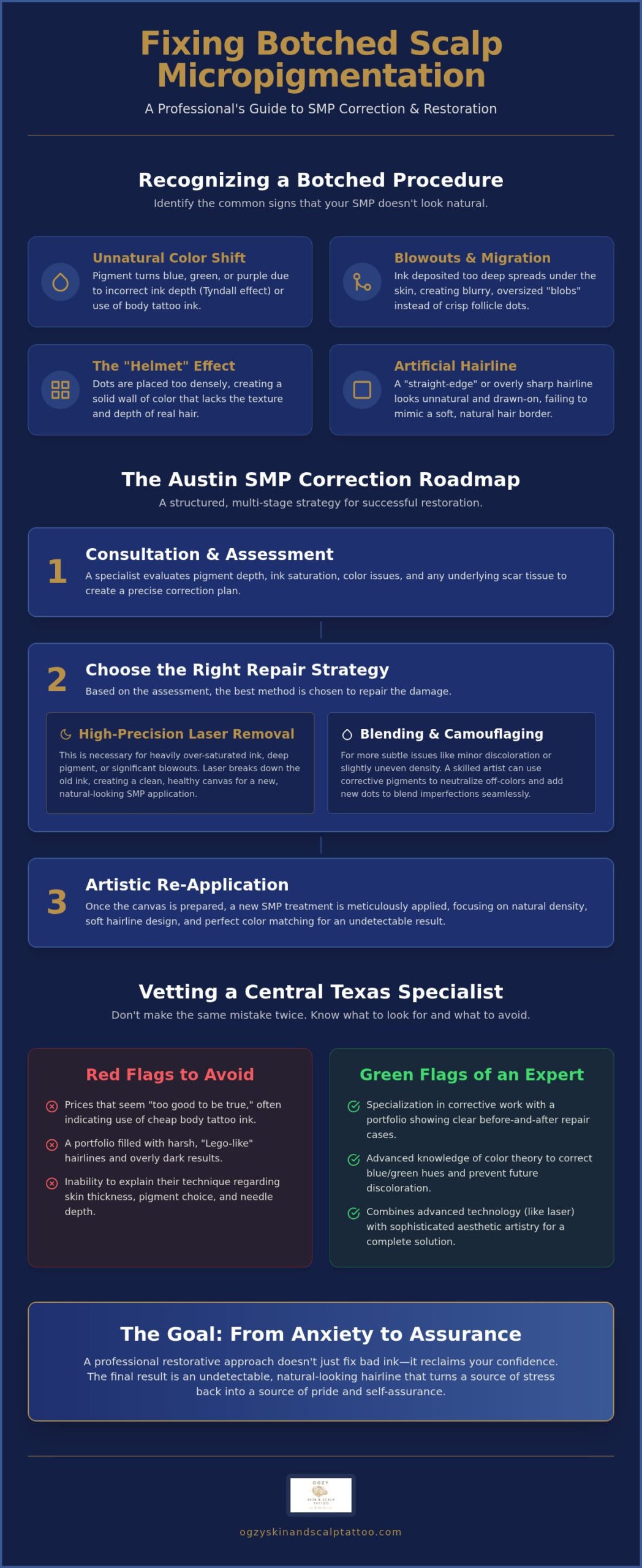
Botched results usually stem from a lack of technical precision and artistic judgment. Common issues include:
- Blowouts: These occur when an artist deposits pigment too deep into the dermis, causing the ink to spread out into a blurry, oversized “blob” rather than a crisp dot.
- Symmetry and Hairline Errors: An inexperienced artist often creates a “straight-edge” or “Lego” hairline that looks incredibly harsh and artificial.
- The Helmet Effect: This happens when dots are placed too close together or the density is too high, leading to a solid wall of color that lacks the depth of natural hair.
Pigment migration refers to the unwanted spreading of ink particles beneath the skin surface, which blurs the crisp edges of individual impressions and destroys the realistic illusion of hair follicles. When these dots merge, the scalp loses its textured appearance, leaving you with a result that looks more like a traditional tattoo than a hair restoration solution.
Why ‘Cheap’ SMP Often Costs More in the Long Run
It’s tempting to choose a provider based on the lowest price, but the scalp is a sensitive and unforgiving canvas. Many discount artists use traditional body tattoo ink, which is designed to be permanent and vibrant but is far too heavy for the scalp. These inks contain large molecules that the body cannot easily process, leading to the permanent discoloration mentioned earlier. Additionally, the skin on the scalp varies in thickness across different zones. An expert understands these nuances, while a novice may apply the same pressure everywhere, leading to inconsistent depth and “bottomless” pigment that is incredibly difficult to remove. If you are looking to fix bad smp Austin, you’ll find that the cost of corrective laser sessions and specialized re-application far exceeds the price of doing it right the first time. Your feelings of regret are valid, but they don’t have to be permanent; restoration is a path toward reclaiming the confidence you were seeking all along.
The Austin SMP Correction Roadmap: How to Fix a Bad Result
Repairing a botched procedure requires more than just a quick fix; it demands a methodical, multi-stage strategy that respects the integrity of your skin. To successfully fix bad smp Austin, we follow a structured roadmap designed to transition your scalp from a source of stress to a natural, undetectable finish. This isn’t about simply hiding the past, but rather refining it through clinical precision and artistic restoration. By viewing the removal and re-application as a single, cohesive journey, we can achieve results that a fragmented approach simply cannot match.
Phase 1: The Consultation and Assessment
The first step in your restoration is a comprehensive evaluation of your current results. We look beyond the surface to assess pigment depth, the degree of saturation, and the presence of any underlying scar tissue from previous sessions. It’s also vital to understand the materials used by your previous artist, as FDA safety regulations for tattoo inks highlight the risks of non-specialized pigments that can lead to adverse reactions or permanent discoloration. During this phase, we set realistic expectations for your timeline. While some minor issues require just two sessions, complex color corrections often involve a series of visits to ensure the skin remains healthy and receptive. In cases where the original pigment has shifted significantly, a patch test allows us to observe how corrective shades interact with your unique skin chemistry before proceeding with the full restoration.
Phase 2: Executing the Repair Strategy
Once we have a clear map of your scalp’s condition, we determine if the existing work needs a full laser reset or a targeted fading approach. If the saturation is too heavy, advanced laser technology can gently break down the old ink, clearing the canvas for more refined work. For those with a harsh, “straight-edge” hairline, we can often soften the transition without full removal by using specialized blending techniques. Adding textural density helps mask patchy areas, creating a three-dimensional effect that mimics real hair growth. The layering technique used in professional corrections involves the strategic application of different pigment shades and dot sizes over multiple sessions to build a realistic sense of depth and movement. This meticulous process ensures that the new work integrates seamlessly with your natural hair patterns. If you’re ready to start this journey, our Austin correction specialists are here to guide you through every step of the restoration process.
This phase is where the “Refined Restorer” philosophy truly shines. We don’t just add more ink; we carefully subtract what doesn’t belong and replace it with precision follicle simulation. By focusing on the transition between your natural hair and the corrected pigment, we ensure that your results look as good in bright sunlight as they do indoors. This level of detail is what allows us to fix bad smp Austin and return the sense of self-assurance you’ve been missing.
Laser Removal vs. Blending: Choosing the Right Repair Strategy
When you decide to fix bad smp Austin, the most critical fork in the road is determining whether to clear the canvas entirely or refine the work that’s already there. Many people fear that laser removal means starting from zero, but in the hands of a specialist, it’s often used as a precision tool for “fading” rather than total elimination. This distinction is vital; creating a lighter, softer base allows for the re-introduction of realistic follicle simulation that looks intentional rather than like a desperate cover-up. Choosing the right path requires a balance of clinical assessment and aesthetic vision.
Attempting to simply “ink over” a heavily saturated or discolored scalp tattoo is a common mistake that often leads to further disappointment. If the skin is already packed with pigment, adding more ink increases the risk of migration, where the new dots blur into the old ones and create an even larger, darker mass. Advanced laser technology offers a sophisticated solution by targeting only the pigment particles without damaging the surrounding skin or existing hair follicles. This selective photothermolysis breaks down the unwanted ink, allowing your body’s natural processes to clear it away safely and effectively.
When to Opt for Laser Tattoo Removal
Laser removal becomes mandatory when the original work is over-saturated, meaning the dots have merged into a solid field of color. If your SMP appears “bottomless” or lacks any visible skin between the impressions, adding more pigment will only worsen the “helmet” effect. For our Austin area clients, we prioritize safety protocols that respect the sensitivity of the scalp. The goal of fading is to reach a point where the old, dark work no longer dictates the shape of your new hairline. By lightening the previous mistakes, we reclaim the ability to design a soft, feathered transition that blends seamlessly with your natural features.
The Case for Camouflage and Blending
Camouflage is an artistic strategy reserved for minor corrections, such as slightly adjusting a hairline shape or neutralizing “off-colors” like blue or orange. Using sophisticated color theory, we can apply specific corrective pigments to counteract warmth or coolness, restoring a more natural tone to the scalp. However, we’re always mindful of the “stacking” effect. Layering too much ink over time can lead to a loss of detail and eventual pigment migration. The “Refined Restorer” approach focuses on doing as little as possible to achieve the greatest impact, ensuring the skin remains healthy and the results stay crisp for years to come. Having both laser removal and SMP artistry under one roof in Cedar Park means your repair plan is coordinated by a single expert who understands exactly how much fading is required to fix bad smp Austin and deliver a truly undetectable result.
Vetting a Scalp Micropigmentation Specialist in Central Texas
Rebuilding trust after a disappointing experience is perhaps the most difficult part of the restorative journey. When you set out to fix bad smp Austin, you aren’t just looking for another artist; you’re looking for a specialist who understands the delicate chemistry of correction. Repairing botched work requires a higher level of technical skill than a standard procedure because the artist must navigate existing pigment, potential scar tissue, and skin that has already been through trauma. Choosing the right partner in this process means looking past flashy marketing and focusing on clinical precision and transparent results.
While many providers in the Austin area hold a standard tattoo license, this credential primarily covers safety and sanitation rather than the aesthetic artistry of follicle simulation. True correction specialists often have advanced paramedical training. This background is vital because it involves a deep understanding of how skin heals and how different pigments interact with various types of tissue. This same level of specialized expertise is what we apply to our Scar and Stretch Mark Revision Treatment in Austin, ensuring that every procedure respects the unique biological canvas of the individual.
Portfolio Red Flags to Watch For
A portfolio should be a window into an artist’s technical consistency, but it can also hide significant flaws if you don’t know what to look for. Be cautious of “copy-pasted” hairlines that look identical across every client; a skilled restorer designs a hairline that complements your specific bone structure and age. If a portfolio only features photos taken immediately after a session, you aren’t seeing the full story. It is essential to request photos of 12-month healed results to confirm that the pigment has remained stable, crisp, and true to color long after the initial inflammatory response has subsided. Overly edited or filtered photos are another major warning sign, as they are often used to mask pigment blowouts or unnatural color shifts that would be obvious in a raw, macro (close-up) shot.
Local Consultation Checklist
Before committing to a repair plan, schedule a consultation and come prepared with specific questions that address your unique concerns. Ask the artist directly about their experience with fix bad smp Austin cases specifically, rather than just general applications. Verify that the facility is clean, professional, and properly licensed within Williamson or Travis County. A trustworthy specialist will be honest about what can be achieved through blending versus what requires laser fading. They should provide a clear, multi-session roadmap that prioritizes the long-term health of your scalp over a quick, temporary fix. If you’re ready to see the difference that specialized training and an empathetic approach can make, we invite you to view our portfolio of successful restorations and discover how we can help you reclaim your confidence.
The Ogzy Restoration Method: Reclaiming Your Confidence in Cedar Park
The Ogzy Restoration Method isn’t just a technical checklist; it’s a mission-driven commitment to healing and renewal. When you come to us to fix bad smp Austin, we recognize that you’re carrying more than just pigment issues. You’re carrying the weight of a previous disappointment and the anxiety of wondering if your look can truly be saved. Our “Refined Restorer” philosophy ensures we treat you as a whole person, focusing on the psychological restoration of your confidence alongside the meticulous physical correction of your scalp. We believe that every client deserves a result that feels like a natural extension of themselves, not a constant reminder of a past mistake.
One of the most significant advantages of our Cedar Park studio is the seamless integration of advanced laser technology and aesthetic artistry. Most clinics require you to visit a separate laser center for removal, which often leaves the SMP artist guessing about the state of your skin and the depth of the remaining ink. By handling both laser tattoo removal and the subsequent re-application in-house, we maintain absolute control over the entire canvas. We know exactly how much pigment was removed, how the tissue responded, and precisely when the skin is perfectly primed for new, realistic follicle simulation. This coordinated approach is the most reliable way to fix bad smp Austin and ensure your results are best-in-class.
A Personalized Path to Restoration
We prioritize the biological health of your scalp over a hurried “patch-up” job that might fail within months. Our clinic adheres to medical-grade standards, ensuring a sterile and professional environment for every session. We utilize our deep understanding of skin physiology, including specialized growth factor knowledge, to support the scalp’s natural healing process during the repair phase. This focus on skin integrity ensures that the custom pigment matching we perform stays true to your natural hair color. By respecting the skin’s limits, we prevent the migration and blurring that often plague lower-quality procedures, delivering a finish that remains crisp and sophisticated for years.
Taking the First Step Toward Correction
Your first visit to our studio is a collaborative consultation where transparency is our highest priority. We’ll provide an honest assessment of your current work and a clear, detailed estimate of the sessions required to reach your goals. We don’t believe in high-pressure tactics; instead, we offer a steady, reassuring path toward your personal transformation. Your journey from a botched result to a refined, undetectable finish is a partnership, and we’re dedicated to being your compassionate guide every step of the way. Book your correction consultation at Ogzy Skin & Scalp Tattoo today and let’s begin the process of restoring your self-assurance and your natural look.
Your Path to a Refined and Natural Restoration
You’ve learned that a botched procedure doesn’t have to be your permanent reality. By recognizing the signs of over-saturation and understanding the clinical precision of laser fading, you’ve already taken the first step toward true restoration. The journey to fix bad smp Austin is a specialized process that combines professional safety with aesthetic mastery, ensuring that your second chance at a natural hairline is handled with the care it deserves.
As a specialist in paramedical tattooing and skin rejuvenation, we provide a unique advantage by offering advanced laser technology and realistic follicle simulation in a single, coordinated environment. This integrated approach eliminates the guesswork and prioritizes your long-term skin health while rebuilding your self-assurance. Don’t let a past mistake dictate how you feel about your image any longer. Schedule Your Professional SMP Repair Consultation in Austin today to discover how we can transform your results. We’re here to help you move forward with a look that is subtle, sophisticated, and entirely yours.
Frequently Asked Questions
Can bad scalp micropigmentation really be fixed?
Yes, nearly any botched procedure can be corrected through professional fading or artistic camouflage. The process often involves lightening the existing pigment to create a fresh canvas for realistic follicle simulation. By combining clinical precision with aesthetic artistry, we can restore the natural appearance of your scalp and erase the signs of a poor procedure.
How much does SMP correction cost in Austin?
Pricing for correction work is highly individualized and depends on the extent of the previous damage and the number of sessions required. Factors such as pigment depth, the degree of discoloration, and whether you need full laser removal will influence the total investment. Since every case is unique, a detailed consultation is necessary to provide an accurate estimate based on your specific needs.
Does laser removal for SMP cause permanent hair loss?
No, advanced laser technology specifically targets the pigment particles without harming the surrounding hair follicles. The laser energy passes safely through the skin, leaving your natural hair growth intact while breaking down the unwanted ink. This selective approach ensures that your scalp remains healthy and ready for a more refined application once the old pigment has faded.
How many sessions will I need to fix my botched scalp tattoo?
Most correction plans require between three and five sessions, though this varies based on the depth and saturation of the original work. We prioritize skin health and long-term results, so we’ll provide a clear timeline during your initial assessment to fix bad smp Austin effectively. Each session builds upon the last to create a seamless and undetectable finish.
Is it better to fade bad SMP with laser or just cover it up?
Fading with laser is almost always the superior option for over-saturated or discolored work because it prevents the “stacking” of ink. Covering up a dark, botched procedure often leads to a heavy “helmet” look that lacks the subtlety of natural hair follicles. Lightening the old work first provides the artistic freedom to design a soft, realistic hairline that won’t blur over time.
What should I do if my SMP has turned blue or green?
If you notice a blue or green shift, you should seek a specialist who understands color theory and the Tyndall effect. This discoloration usually occurs when pigment is placed too deep or traditional tattoo ink is used. Targeted laser sessions are typically the most effective way to neutralize these cooler tones and prepare the skin for a more natural shade of pigment.
How long do I have to wait between laser removal and a new SMP procedure?
You should typically wait six to eight weeks between your final laser session and the start of your new SMP treatment. This recovery period allows the skin to fully heal and gives your immune system time to clear the fragmented pigment particles. Rushing this process can compromise the crispness of your new follicle impressions, so patience is key for a flawless result.
Can you fix a scalp tattoo that has a harsh, straight hairline?
Yes, a harsh hairline can be corrected by breaking up the solid line with softer, textured impressions that mimic natural hair growth patterns. We use sophisticated blending and layering techniques to fix bad smp Austin and create a feathered transition that looks realistic even in direct sunlight. This restores the subtle, age-appropriate look that was missing from the original work.