
Changes in your hairline or scalp coverage can affect how you feel about your appearance. It’s natural to want clear, realistic information before deciding what approach may suit you.
This guide explains how to think about microneedling sessions for hair growth, what to ask when considering treatment, and why the right schedule depends on the protocol and your scalp’s response. It also distinguishes hair-growth treatments from cosmetic options that change the appearance of scalp density.
Key Takeaways
- Separate the goal of encouraging hair growth from creating the appearance of greater scalp density; these are different outcomes.
- Scalp micropigmentation uses realistic follicle simulations to create the look of density, not to regrow hair.
- Consider how your current hair pattern and desired cosmetic result affect whether scalp micropigmentation may suit you.
- A consultation can help you understand what appearance changes are realistic for your scalp and goals.
1. Can Scar Revision Combine Different Approaches?
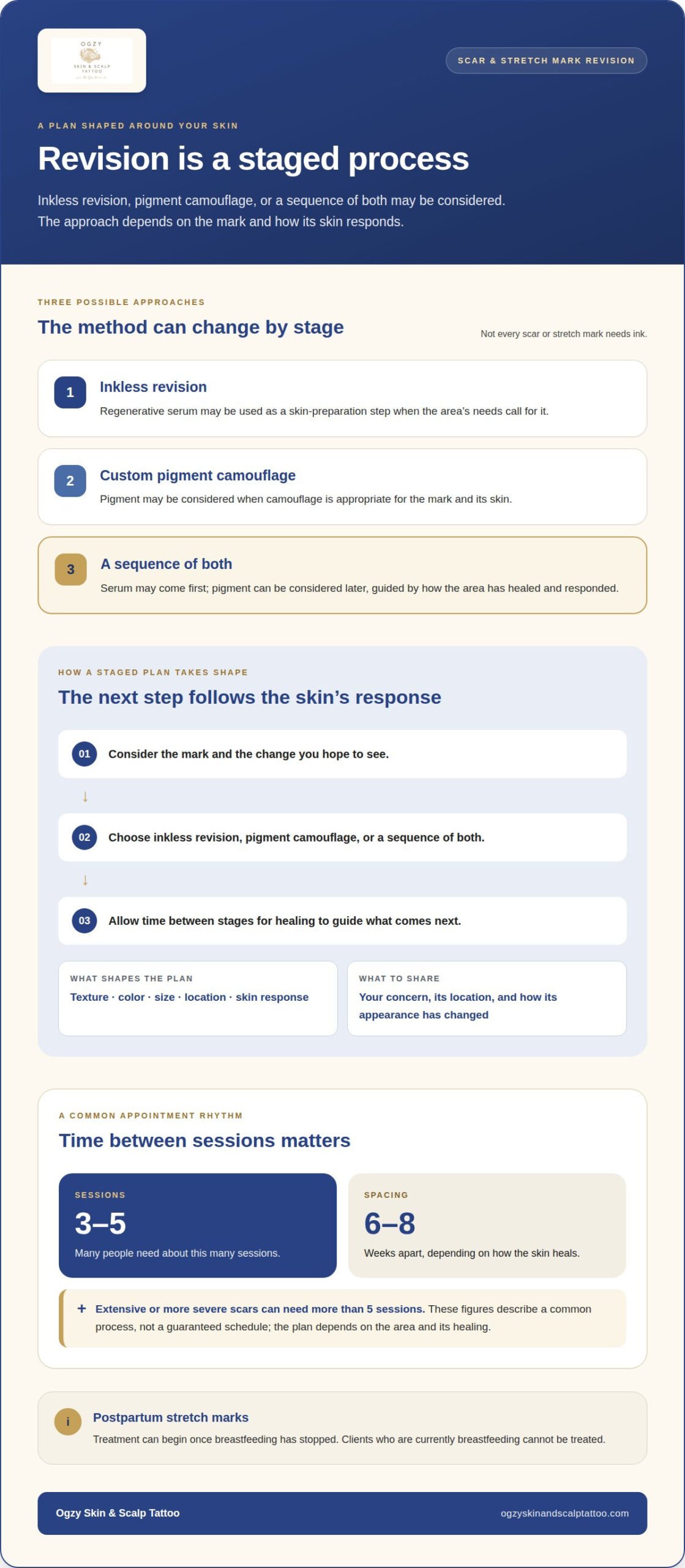
Scar and stretch mark revision can use an inkless approach, custom pigment camouflage, or both in sequence. The choice depends on the area’s appearance and how its skin responds. Pigment is not always the first step: the skin may be treated with regenerative serum before camouflage is considered. This staged approach allows the plan to reflect the specific skin rather than treating every mark the same way.
Combining approaches means following a progression, not applying every method at once. The scar’s texture, color, size, and location help shape the plan. For example, a stretch mark that needs skin preparation may be treated with serum first, with pigment considered later if camouflage is appropriate. Some marks may not need ink. The aim is to soften or blend their appearance using a method suited to the area.
Revision usually takes multiple appointments because the skin needs time between stages. Many people need about 3 to 5 sessions, spaced 6 to 8 weeks apart depending on how the skin heals. Extensive or more severe scars can need more than 5 sessions. These figures describe a common process, not a guaranteed schedule for every scar or stretch mark.
Spacing matters when approaches are combined. A later appointment allows the skin’s healing and response to guide the next step. Treatment may continue with serum or move on to pigment, depending on the area’s condition. Scheduling extra sessions sooner does not replace the time the skin needs to heal between appointments.
Before starting, identify the concern you want addressed and the change you hope to see. Share details about the scar or stretch mark, including its location and how its appearance has changed. A consultation can help determine whether inkless revision, pigment camouflage, or a sequence of both fits your goals. Treatment for postpartum stretch marks can begin once breastfeeding has stopped; clients who are currently breastfeeding cannot be treated.
2. Why do microneedling for hair loss?
If your concern is the appearance of thinning hair, scalp micropigmentation (SMP) offers a cosmetic way to create the look of greater density. It deposits pigment to simulate realistic hair follicles, creating the impression of closely cropped hair or a more consistent-looking scalp. SMP does not stimulate follicles or make hair grow.
SMP may suit people with thinning hair, baldness, receding hairlines, or scalp scars. The design depends on the area you want to address. A receding hairline calls for attention to its shape, while a thinning area may need pigment placement that blends with the surrounding hair pattern.
The goal is a natural-looking visual effect, not a biological change. Because pigment simulates follicles, your existing hair and scalp remain central to the result. A realistic plan considers the contrast between scalp and hair, the pattern of thinning, and the outline you want to create. SMP does not restore hair or change the cause of hair loss.
Before choosing a cosmetic approach, describe the areas that draw your attention and the look you hope to achieve. You may want a more defined hairline, less visible scalp through thinning areas, or camouflage for a scalp scar. Each goal affects where pigment is placed and how the overall design is shaped.
Photos can help you explain your preferences during a consultation. Bring images showing your hairline and scalp from the angles that matter to you, such as the front and crown. Discuss how you usually wear your hair, since styling and length affect the look you want. Clear examples keep the conversation focused on your personal aesthetic priorities.
Scalp micropigmentation is a cosmetic option when your priority is the appearance of density. It is not a treatment intended to change hair growth. Be clear about whether you want a visual adjustment or support for hair growth. A consultation can help you understand what SMP can realistically create in the area you want to address.
Microneedling is separate from SMP’s cosmetic pigment approach. After scalp microneedling, the page advises waiting a few minutes before applying anything to the scalp and avoiding washing hair for at least 4 hours. It also advises avoiding harsh exfoliants, retinols, and high-concentration serums for a few days before and after microneedling.
The page-cited wound-healing discussion states that wounds heal within 4–6 weeks. The page quotes a study reporting that redness on Caucasian skin decreases by 50% 4–6 hours after treatment. It also advises waiting 2–3 days after microneedling before using hot tools or styling spray. These aftercare points relate to microneedling, not to SMP’s visual effect.
3. Combining microneedling with PRP or topical products
Combining scalp microneedling with another approach may affect the treatment plan, but different combinations are not interchangeable. Minoxidil is a topical product, while PRP means platelet-rich plasma. Finasteride and exosome-based products are also discussed in hair-loss treatment contexts. Each combination affects what is used, when it is used, and how progress is assessed.
Does microneedling work better with minoxidil or other hair-loss treatments? One study reported a greater increase in hair count with microneedling plus minoxidil than with microneedling alone. That finding does not show that every combination works better for every person, or that PRP, finasteride, and exosomes produce the same response.
Bao et al. reported a hair-count increase of 23.4 hairs per cm² with microneedling alone and 38.3 hairs per cm² with microneedling plus minoxidil. These figures describe the outcomes reported in that study, not a promised result or a direct comparison with PRP or exosomes. They also don’t establish that a higher needle depth or greater treatment frequency would improve progress.
Combining microneedling with a topical product requires attention to timing. Microneedling temporarily disrupts the scalp’s surface, which can affect how products interact with the treated area. Do not assume a topical should be applied immediately after a session. Follow the protocol’s specific timing instructions, especially for minoxidil or another product you use routinely.
Combination treatment also requires a clear way to track your response. Keep notes on session dates, product use, and visible changes, such as the appearance of your hairline or a thinning area. Consistent photos in similar lighting make gradual changes easier to compare. Avoid changing several parts of your routine at once, so you can better assess what may be associated with progress.
PRP and finasteride are different additions from a topical product such as minoxidil. Including them does not remove the need to plan microneedling depth, frequency, and recovery together. Exosome-based products are another distinct category, not a synonym for PRP or minoxidil. Evidence about one combination should not be treated as evidence for all three.
Before combining approaches, write down the products and treatments already in your routine. Share the list with the professional overseeing your protocol, including how often you use each topical. Clarify the order of treatment, when products should resume, and what scalp changes should prompt a pause. A planned combination is easier to assess than adding applications in response to slow progress.
4. Expected timeline for visible results
Visible changes in scalp hair take time, so the first appointment is not a useful measure of progress. The initial activation period is typically eight to twelve weeks, while fuller results may appear within three to six months. These timelines set expectations, but they do not mean everyone will see the same changes on the same schedule.
Some people notice early improvement around the third session. That is an observation, not a deadline. Hair changes can be gradual, and a single look in the mirror may not reveal a subtle shift across a thinning area. Compare the same part of the scalp in similar lighting rather than relying on memory or changing hairstyles.
Research sessions have been conducted over 20 weeks, which gives a sense of why assessment can span several months. Microneedling’s proposed role involves a controlled repair response in the scalp; visible changes are not immediate simply because the treatment has taken place. The timeline for repair and the timeline for a noticeable difference are separate parts of the process.
Temporary redness belongs to the short-term recovery window, not the hair-change timeline. Mild redness and sensitivity commonly fade within 24–48 hours. Redness fading doesn’t show whether hair density has changed, just as a scalp feeling normal doesn’t confirm visible progress. Keep those observations separate when you review each stage.
Growth factors are often discussed when explaining how scalp repair may relate to follicles, but that proposed mechanism does not provide a calendar for visible change. One report places peak microneedling proliferation after two months. Around three months, baby hairs or thicker changes near the hairline may become noticeable; by six months, the scalp may feel stronger, healthier, and more balanced. These are checkpoints, not promises.
To track progress, record a baseline before your first session. Photograph the same areas at consistent intervals, using similar lighting, angles, and hair placement. Note session dates and changes to your routine. This makes gradual shifts easier to assess than checking daily.
Using an at-home roller does not make the timeline predictable or justify more frequent treatment. The key factors remain the chosen protocol, your scalp’s response, and the time allowed between sessions. To judge progress, use the planned review points rather than expecting an immediate visible change. Hair growth is gradual, and a timeline alone cannot predict an individual outcome.
5. Microneedling’s proposed role in stimulating hair growth
Microneedling’s proposed role begins with controlled contact between a needle and scalp tissue. The treatment creates tiny, deliberate channels that prompt a local repair response. Researchers have explored whether this response may support conditions around hair follicles. That proposed pathway helps explain interest in the treatment, but does not establish a single mechanism for hair regrowth.
Collagen is one part of the proposed repair process. With 1.5 mm needles, new collagen formation has been described from a depth of 0.6 mm upward toward the basal membrane. This describes a tissue response, not proof that collagen alone stimulates hair growth. Follicles, scalp condition, needle depth, and treatment method all shape the context.
Needle depth has also been compared directly. One clinical study found that 0.6 mm microneedling outperformed 1.6 mm microneedling for hair count and thickness. That result challenges the assumption that a deeper needle necessarily produces a stronger effect. It does not establish 0.6 mm as the best depth for every person or every protocol.
Increased absorption offers another proposed explanation. Microneedling may increase the absorption of topical products, which is why some protocols combine it with products such as minoxidil. Channels in the scalp can change how a topical interacts with the skin. Timing matters: follow the protocol’s instructions for when to apply a product rather than assuming immediate application improves its effect.
The practical takeaway is to treat depth, product use, and frequency as connected decisions. A 0.5 mm needle is not automatically suitable simply because it sounds gentler; needle choice depends on the intended method and treatment plan. More passes or more frequent sessions don’t prove that follicles receive greater stimulation. A controlled approach gives tissue time to recover between treatments.
Microneedling’s proposed role is more specific than “needling makes hair grow.” It involves a possible repair response, potential changes in topical absorption, and study findings that vary by depth. The best protocol for hair loss has not been established, so one study cannot define a universal course. Focus on evidence, scalp response, and realistic expectations rather than assuming a particular depth guarantees hair regrowth.
If you’re considering a structured approach to hair concerns, explore hair-growth treatment options and discuss how the plan aligns with your goals.
Ogzy Skin & Scalp Tattoo: Scar and Stretch Mark Revision
Ogzy Skin & Scalp Tattoo offers Scar and Stretch Mark Revision for people seeking to soften the appearance of scars or stretch marks. For hair-loss concerns, scalp micropigmentation (SMP) is a separate cosmetic option. It deposits pigment to create the look of greater density, but does not stimulate follicles or regrow hair.
If your priority is the appearance of thinning hair, SMP may be worth discussing; if you are concerned about a scar or stretch mark, revision may be a better fit. A consultation with Ogzy Skin & Scalp Tattoo in Austin can help clarify what is realistic for your skin and desired result.
For a calm next step, contact Ogzy Skin & Scalp Tattoo to discuss your goals.
Choose a Plan That Fits Your Goal
Before committing to a course, decide what progress would mean to you. Is your priority a measurable change in hair, a cosmetic change in how your scalp looks, or a clearer understanding of your options? Naming your goal can focus conversations about treatment choices and help you avoid judging progress by someone else’s experience.
The question of how many microneedling sessions for hair growth is best treated as a planning question, not a promise. Keep expectations grounded in the specific approach being discussed, and make room to reassess whether it still aligns with your goals. If your concern is the appearance of thinning rather than hair growth itself, explain that distinction before choosing a cosmetic option.
If you’d like to talk through your aesthetic goals and possible next steps, contact Ogzy Skin & Scalp Tattoo. A thoughtful decision starts with understanding what matters most to you.
Frequently Asked Questions
Why do microneedling for hair loss?
Microneedling is studied as a way to stimulate a scalp response that may support hair follicles. Its relevance depends partly on why hair is thinning: the approach isn’t effective when loss is caused by issues such as nutrition or thyroid problems. Identifying the pattern and likely cause of hair loss matters before interpreting treatment results. A change in appearance alone doesn’t explain what caused the thinning.
What Is Scalp Microneedling and How Does It Work?
Scalp microneedling uses a device with fine needles to create controlled contact with the scalp. Needle lengths described in the literature range from 0.25 mm to 2.5 mm, so protocols can differ substantially. For example, the depth used in one study may not match another study’s method. The device and depth are parts of the protocol, not details to choose based only on a home roller.
Can I Combine Microneedling With Other Treatments?
Some protocols combine microneedling with topical products such as minoxidil or other treatments such as PRP. The combination needs a planned order and product timing. Do not assume a topical product should be applied directly after needling; the protocol should specify when it belongs in your routine. Record product use and session dates so changes can be assessed without confusing multiple adjustments.
How Long Do Results Last?
There is no single duration that applies to everyone. Maintenance treatment is described at intervals of three to six months, depending on the patient’s response. This is a maintenance approach, not a guarantee that visible changes will last for a fixed period. Track changes consistently and distinguish maintenance planning from the initial treatment course, since those phases serve different purposes.
How Many Sessions Are Needed and What Results Can You Expect?
Protocols commonly describe four to six sessions spaced one month apart, while studies have averaged nine to ten sessions. These are different treatment patterns, not a single required number. Expected changes may include differences in hair count or thickness, but individual results vary. The phrase how many microneedling sessions for hair growth has no one-size-fits-all answer because protocols and responses differ.
How often should you do it?
Professional schedules vary: some guidance describes sessions every two to four weeks, while deeper needle treatments require more time between sessions. The right interval depends on needle depth and the scalp’s response. Do not shorten the gap because progress feels slow. A treatment calendar should account for recovery and planned topical products rather than treating frequency as an isolated decision.
Is It Painful?
The sensation can vary with needle depth, device, and individual sensitivity, so there is no single description that applies to everyone. Before a session, clarify the planned depth and how pressure will be controlled. Pain is not a measure of whether treatment is working. If the sensation changes sharply during a procedure, speak up rather than trying to tolerate it silently.
What treatment protocol is best?
No single best protocol for hair loss has been established. Studies have tested different needle depths and schedules, so compare the full approach rather than one detail. Consider the suspected cause of hair loss, needle depth, session spacing, topical use, and how progress will be reviewed. A protocol should make these choices clear and avoid treating greater depth or frequency as automatically better.

Article by
Opal Z
Opal is the owner and practitioner behind OGZY Skin & Scalp Tattoo in Austin, Texas. With more than three years in business and a longtime background in the aesthetics industry, she specializes in corrective and restorative treatments designed to address concerns that traditional aesthetics often overlook.
Her work focuses on scar and stretch mark revision, scar camouflage, scalp micropigmentation (SMP), hair regrowth treatments, and laser tattoo and permanent makeup removal. Opal works with a wide range of skin tones and takes an individualized approach to every client, considering skin color, texture, scar characteristics, treatment history, and realistic long-term outcomes.
Through OGZY Skin & Scalp Tattoo, her goal is to combine artistry, aesthetics, and technical treatment knowledge to help clients feel more comfortable and confident in their skin.
Love the skin you’re in.