
Bad SMP isn’t always beyond repair. Learning how to avoid SMP looking fake starts with understanding the details behind a natural-looking result: a hairline suited to your features, balanced density, varied follicle impressions, and carefully placed pigment. Unsatisfactory SMP may be addressed through correction, laser removal, or both.
If the hairline looks too sharp, the pigment too dark, or the impressions too uniform, those concerns are understandable. Fresh work can also look different from healed results, so review healed examples rather than judging only the immediate finish.
This guide covers hairline design, pigment, density, follicle detail, and how to assess healed results. It also explains options for addressing unsatisfactory SMP, helping you make a more informed decision about what to do next.
Key Takeaways
- Look for a hairline shaped to suit the person’s age, with a soft transition rather than a rigid edge.
- Natural-looking density is carefully balanced; excessive darkness or pigment can make the scalp appear painted.
- Compare healed results, not only fresh work, and notice whether follicle impressions vary naturally in size, shape, and spacing.
- Learn why pigment placement matters and what can contribute to blue or grey discoloration over time.
- Unsatisfactory SMP may be addressed through correction, laser removal, or a combination of both.
1. Age-appropriate hairline design
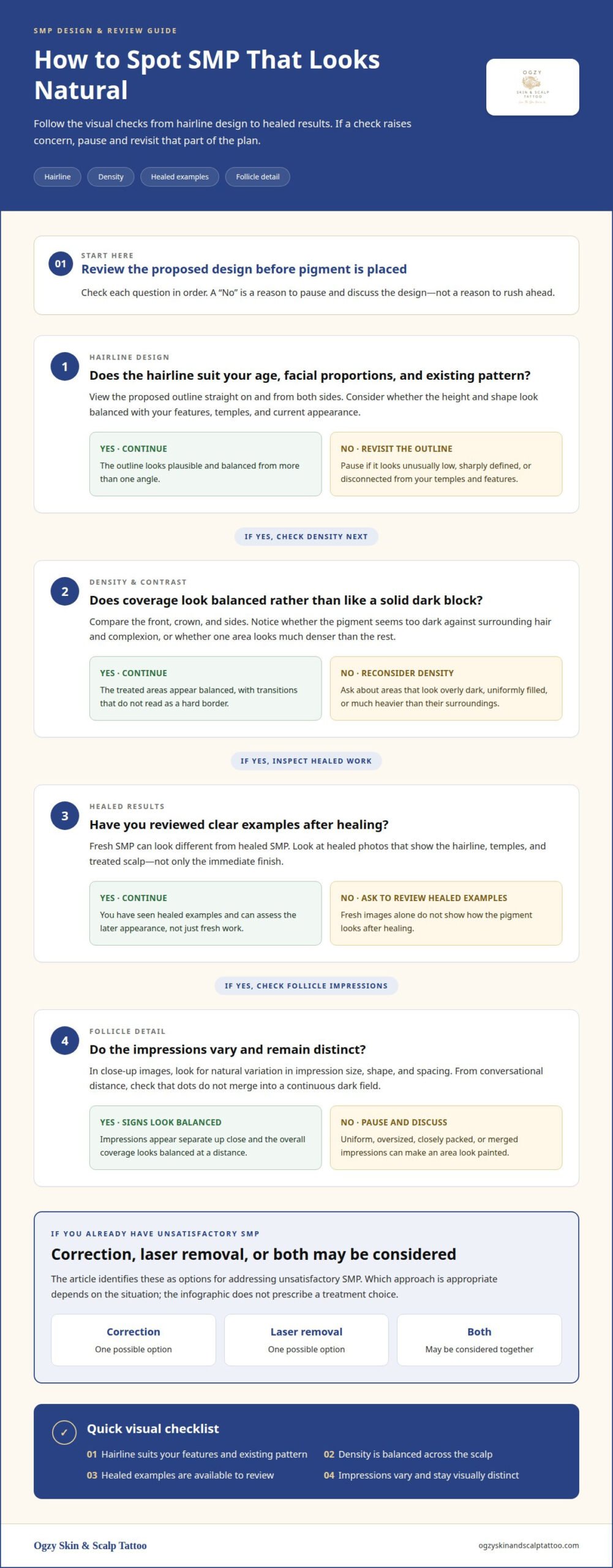
Choose a natural-looking SMP hairline by considering your age, facial proportions, and how your appearance may change over time. The design should suit you now without seeming disconnected from how you may look later. For example, a low, sharply drawn edge may not fit your established appearance. The goal is a believable frame, not simply the lowest possible hairline.
Age matters: a hairline designed without future changes in mind may look less harmonious over time. Ask to see the proposed outline before pigment is placed. View it straight on and from both sides. Consider whether its height and shape suit your features now, rather than looking like a separate design drawn across your forehead.
Pay attention to the front edge. A natural-looking SMP hairline has subtle irregularities and a gradual transition into the forehead, rather than a solid line. In a sample design, look for slight, intentional variation. A perfectly straight, sharply defined border can look stamped on, especially when the rest of the scalp has softer follicle impressions.
Consider shape as well as placement. A rounded outline, a flatter front, or a gently receding shape can create different impressions. Look at your existing temples and hairline pattern. For example, placing the front edge far ahead of the temples may look inconsistent from an angled view. Check the outline from the front and sides before deciding.
Use a simple review process during design discussions. First, view the proposed hairline from a comfortable distance, not only close to the mirror. Then compare its height with your facial features and current appearance. Finally, examine the contour from more than one angle. These steps can reveal whether the design looks balanced or unusually low, rigid, or sharply outlined.
Be clear about your preferences, while staying open to a shape that better suits your face. A reference image can show the softness or contour you like, but it shouldn’t replace a personalized design. Ask why the suggested outline fits your age and existing pattern. A thoughtful explanation should connect the front edge, temples, and overall shape, not focus only on lowering the hairline.
For a natural-looking result, choose a design that looks plausible now and accounts for future changes in your appearance. Subtle irregularity, a gradual forehead transition, and balance with the temples are useful visual checks. If the outline looks like a solid stripe or sits far forward compared with your features, pause and revisit the design before treatment begins.
If the hairline feels too low or sharply defined, reconsider it before pigment is placed. An SMP hairline should take your age and possible future changes into account. Keep the discussion focused on whether the proposed shape looks believable alongside your existing pattern, rather than choosing an outline solely for its immediate effect. A considered design can remain appropriate as your appearance changes.
2. Avoiding excessive darkness and density
Natural-looking SMP depends on balance, not maximum coverage. Dot size and pigment density affect how the scalp looks both up close and from a distance. If impressions are too large, too dark, or packed too closely, the result can look painted rather than like separate follicles. Density should suit the treatment area and the appearance you want.
Assess the front, sides, and top of the scalp as one design. For example, a very dark front edge paired with lighter impressions behind it may look like a hard border. A broad area with uniform density can also look flat instead of like a closely shaved scalp. Look for transitions between treated and untreated areas, not only the overall darkness.
How to avoid SMP looking fake with balanced density
Review healed examples in clear lighting. Fresh pigment can look different from healed SMP, so immediate results alone don’t show the later appearance. Study close-ups for distinct impressions, then step back to assess whether the coverage looks balanced. A phone image viewed at its original size can help show whether individual dots merge into a solid-looking field.
Use these visual checks when assessing density:
- Look for visible separation between follicle impressions in close-up images.
- Check whether the front, crown, and sides appear consistent without looking uniformly filled.
- Notice whether the pigment seems too dark against surrounding hair and complexion.
- View results at conversational distance, where an overly dense area may read as a block.
These checks don’t provide a formula for choosing one shade or dot size. The right balance depends on the individual scalp, existing hair, and intended look. A shaved appearance may call for a different visual balance than blending with thinning hair. In either case, impressions should suggest follicles rather than form a continuous dark surface.
During planning, describe the effect you want in practical terms. You might prefer softer coverage at the temples or a gradual blend where existing hair remains. Then review the proposed density across the treatment area. If one section looks much darker than its surroundings, ask how that contrast may look after healing. Keep the discussion focused on the visual result, not simply on adding more pigment.
Prioritize restrained density and separation between impressions. If you’re considering SMP, an SMP density consultation can help you discuss a balanced design for your scalp.
3. Checking healed results before choosing a clinic
Fresh SMP can look different from healed SMP, so review healed examples before deciding. Ask to see clear photos after healing that show the hairline, temples, and treated scalp. A fresh image can show the initial design, but not how the pigment looks later.
How many SMP sessions are needed for a realistic result? There’s no single session count for everyone. The treatment area, existing coverage, desired density, and appearance after healing all shape the plan.
Compare examples from different angles. A straight-on photograph may hide a hard edge at the temples, while a side view can show how the hairline meets the forehead. Look for a gradual transition, subtle irregularities, and follicle impressions that remain distinct rather than blending into a solid band.
Check the conditions around each image, too. Consistent lighting makes it easier to compare the scalp across photographs. Close-ups show pigment detail, while a view from conversational distance helps you judge the overall effect. If every example is tightly cropped, it may be hard to assess how the design fits the person’s face.
Before treatment, ask the SMP artist questions directly related to the result:
- Can I see healed examples with a similar hairline or treatment area?
- How will you shape the hairline to suit my features and existing pattern?
- How will you keep the impressions from looking overly dark or uniform?
- What changes should I look for when reviewing healed work?
Listen for clear answers that relate to your scalp and the examples shown. An explanation, for instance, should address how the temples connect with the front edge, not only the desired darkness. See whether the artist can point out subtle transitions and variations in healed photographs.
Ask about the session plan, too. A useful answer explains which factors shape the number of appointments, such as the treatment area and its appearance after healing. Don’t treat a number alone as proof of quality. The aim is a considered plan, not simply the fewest visits or the fullest-looking coverage.
Make your preferences specific. You might want a softer temple shape or a less pronounced front edge. A reference image can clarify what you like, but the artist should explain how it relates to your features. Healed examples and focused questions help you assess the work before deciding.
Use healed results as the more useful basis for judging the finished appearance, and distinguish them from images taken immediately after treatment. When an artist presents both, ask which examples show healed work and what differences to expect between stages. This helps you assess SMP after healing instead of relying on the first impression of fresh pigment.
If examples aren’t clearly labelled, ask for clarification before comparing them. Focus on healed images when considering whether the artist’s approach matches your preferences. You can also review them alongside the areas and design details discussed during consultation. That keeps your decision grounded in how SMP looks after healing.
4. Natural variation in follicle impressions
Follicle impressions are the small pigment marks that create SMP’s shaved-hair appearance. Their pattern matters as much as overall coverage. If every mark has the same size, shape, and spacing, the scalp can look patterned or artificial. Look for subtle differences: a few smaller impressions beside larger ones, with spacing that doesn’t repeat like a grid.
Imagine a row of identical dots printed across the scalp. The eye quickly spots the repetition, especially near the front edge or temples. Natural-looking work avoids that stamped effect. Individual impressions can vary slightly in shape and placement while still forming a coherent pattern. The variation should feel deliberate, not chaotic or uneven.
Check close-up images for repeated sequences. For example, if each impression looks equally round and sits the same distance from its neighbors, ask how the pattern varies. Then view the same area from farther away. The marks should read as a soft follicle effect, not separate dots in visible rows.
The pattern can look different across scalp areas. At the hairline, carefully placed impressions help soften the edge. Across a broader area, repeated marks may stand out more when viewed together. Compare the front, side, and top in healed examples, looking for consistent detail without a mechanical pattern. A balanced result maintains visual flow while allowing individual marks to differ.
When reviewing photographs, look for these details:
- Impressions that vary subtly in shape and apparent size.
- Spacing that doesn’t form straight rows or repeated clusters.
- A front edge that blends into the scalp rather than showing a dotted outline.
- Close-up and wider views that show the same natural-looking pattern.
To help SMP look natural as it heals, follow your artist’s aftercare instructions. Once healed, don’t try to adjust individual impressions yourself; changing one area can affect how its pattern relates to nearby pigment.
Ask specific questions about the pattern. You might ask how the artist avoids repeated spacing or how impression size will suit the treatment area. A clear explanation should refer to your design, such as the transition at your temples or the distribution across the crown. This conversation helps you understand the intended detail before treatment.
SMP creates the look of density through pigment, not growing hair. The individual impressions therefore contribute much of its visual character. Look for variation subtle enough to feel cohesive, yet noticeable enough to avoid a uniform, printed appearance. In healed results, the pattern should hold together from a distance and show refined detail up close.
5. Pigment depth and blue or grey discoloration
Pigment placement affects how SMP looks as it heals and ages. If pigment is implanted too deeply, it can behave like a traditional tattoo and appear blue or grey over time. That shift can make follicle impressions look less like subtle scalp detail and more like visible tattoo marks.
For natural-looking SMP, pigment color should complement your hair and skin tone. A suitable shade creates a balanced impression beside your existing hair, rather than looking sharply dark or disconnected from your complexion. Assess the overall effect in healed examples, not only the pigment color immediately after treatment.
During a design discussion, ask how the artist considers placement and color together. Pigment shade alone doesn’t determine the appearance; placement depth matters, too. For example, a color that seems suitable in a sample may look different if placed too deeply. Ask the artist how they plan to create a soft follicle effect.
Look closely at healed photos for signs of discoloration. Compare the impressions with surrounding hair and scalp, and notice whether they appear brown, blue, or grey. Lighting can affect how a photograph looks, so compare multiple images when possible. Don’t rely on a single close-up to judge healed color.
Questions about pigment can help you understand the approach:
- How do you select a shade that relates to my hair and skin tone?
- How do you assess pigment placement for a natural follicle appearance?
- Can I review healed examples that show pigment color clearly?
- What would you consider if an area appears blue or grey?
Listen for an explanation that connects shade, placement, and your desired appearance. If a healed example looks blue or grey, ask what may have contributed to that color. Clear, specific answers help you understand the visual considerations before treatment begins.
If your existing SMP looks discolored, don’t try to camouflage it with additional pigment yourself. Adding pigment may change the surrounding appearance without addressing the underlying concern. An assessment can take the existing color, placement, and treatment area into account before discussing next steps.
For a focused discussion of pigment shade and placement, book an SMP consultation. A careful review of your scalp and healed results can help clarify what approach may suit your desired appearance.
Ogzy Skin & Scalp Tattoo: Scar and Stretch Mark Revision
Ogzy Skin & Scalp Tattoo offers Scalp Micropigmentation (SMP) to create the look of greater scalp density. If you’re concerned about an uneven hairline, overly dark pigment, or impressions that look too uniform, a focused consultation gives you a chance to discuss what you’re seeing and the appearance you want.
If your existing SMP doesn’t look the way you hoped, bring clear photos of the area in different lighting and from several angles. We can discuss your concerns and whether SMP correction or laser tattoo removal may be appropriate. The right approach depends on the pigment and its placement, so a consultation can help you understand the options.
You’re welcome to contact Ogzy Skin & Scalp Tattoo or visit ogzyskinandscalptattoo.com to arrange a consultation.
Choose a result that feels like you
A considered SMP decision is about more than changing how your scalp looks. It’s about choosing an approach that feels comfortable with your features, style, and everyday life. Take time to identify what matters most, whether that’s a softer outline, a subtle impression of density, or understanding your options before deciding.
Knowing how to avoid SMP looking fake can help you approach a conversation with clear preferences, without becoming fixed on a specific result. Your questions and comfort level matter. A consultation gives you space to discuss the look you want and what may be realistic for your situation.
At Ogzy Skin & Scalp Tattoo, I offer Scalp Micropigmentation (SMP) with a focus on realistic follicle simulation. If you’re ready to discuss your goals, contact Ogzy Skin & Scalp Tattoo to arrange a consultation. The studio is at 13130 Pond Springs Rd #1105, Austin, TX 78729. Take the next step at a pace that feels right for you.
Frequently Asked Questions
Can bad SMP be corrected or removed?
Yes. Unwanted SMP may be addressed through correction, laser removal, or a combination of both. The right option depends on the existing pigment and what you want to change. For example, an issue with shape may call for a different approach than an unwanted color. Have the work assessed before adding pigment so the next step accounts for the existing result.
What is the most natural SMP hairline?
A natural-looking hairline is tailored to your features and suits your appearance. Rather than choosing a shape from a photo alone, consider how the outline relates to your temples and overall face. Share your preference, such as a softer or more defined impression, and discuss how the design can be adapted to you.
Why can SMP look blue or grey?
SMP may appear blue or grey over time if pigment is implanted too deeply. If you notice a color change, describe where it appears and whether it looks different in varied lighting. Clear photos can help you explain the concern during an assessment. Don’t assume that adding a different shade will address an underlying placement or color issue.
What should I ask before choosing an SMP artist?
Ask to review healed portfolio examples and discuss how the artist approaches your goals. You might ask how they plan for the treatment area and which details they consider when designing the result. Look for answers that address your questions directly. A thoughtful conversation can help you understand the proposed approach and decide whether it suits your preferences.

Article by
Opal Z
Opal is the owner and practitioner behind OGZY Skin & Scalp Tattoo in Austin, Texas. With more than three years in business and a longtime background in the aesthetics industry, she specializes in corrective and restorative treatments designed to address concerns that traditional aesthetics often overlook.
Her work focuses on scar and stretch mark revision, scar camouflage, scalp micropigmentation (SMP), hair regrowth treatments, and laser tattoo and permanent makeup removal. Opal works with a wide range of skin tones and takes an individualized approach to every client, considering skin color, texture, scar characteristics, treatment history, and realistic long-term outcomes.
Through OGZY Skin & Scalp Tattoo, her goal is to combine artistry, aesthetics, and technical treatment knowledge to help clients feel more comfortable and confident in their skin.
Love the skin you’re in.