
What if the most powerful tool for reclaiming your confidence wasn’t a surgery or a daily pill, but a series of meticulously placed pigment deposits that even your closest friends couldn’t detect? You’ve likely spent hours in front of the mirror, worried that a thinning crown or a receding hairline is the only thing people notice during a conversation. It’s natural to feel a mix of hope and hesitation when considering scalp micropigmentation, especially with the anxiety of ending up with an unnatural “helmet” look or pigment that shifts to a blue tint over time. Understanding how to choose smp artist Georgetown means looking for a specialist who balances clinical authority with the delicate touch of a refined restorer.
We understand that you’re seeking more than just a procedure; you’re looking for a way to feel like yourself again. This guide provides the essential criteria for selecting a specialist who offers a safe, clinical environment and the artistic precision necessary for life-changing results. We’ll walk through how to evaluate portfolios for seamless integration and why technical expertise is your best defense against the harsh Texas sun. You’ll gain the clarity needed to distinguish professional follicle simulation from traditional tattooing, ensuring your journey toward a restored hairline is both safe and empowering.
Key Takeaways
- Learn why the artist’s understanding of skin physiology is more critical than the equipment used to ensure your results age gracefully and maintain their detail.
- Discover how to analyze a professional portfolio to identify soft, natural hairlines and avoid the unnatural “helmet” look that often comes from inexperienced practitioners.
- Master how to choose smp artist Georgetown by verifying clinical standards and compliance with Texas Department of State Health Services regulations for a safe experience.
- Prepare for your consultation with five essential questions designed to reveal an artist’s ability to match your unique hair color and facial structure.
- Understand the value of a “refined restorer” who focuses on seamless pigment integration and provides an empathetic, clinical environment for your transformation.
Why the Artist Matters More Than the Technology
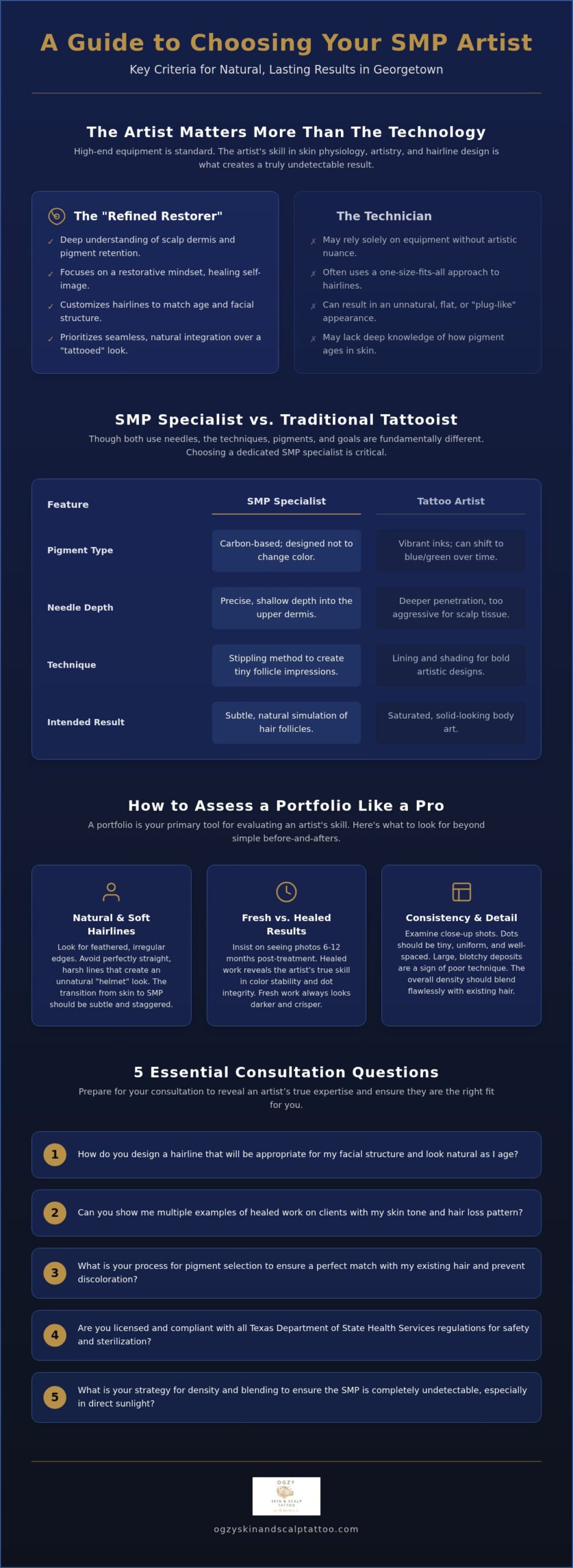
High-end equipment and medical-grade pigments are essential, yet they are merely tools in the hands of a creator. When you’re researching how to choose smp artist Georgetown, remember that you aren’t just buying a service; you’re investing in a permanent aesthetic transformation that sits at the intersection of clinical science and fine art. A skilled artist possesses a deep understanding of skin physiology, specifically how the dermis of the scalp accepts and retains pigment over time. Without this specialized knowledge, pigments can migrate or blur, leading to results that look more like a solid tattoo than natural hair. Choosing the right partner means finding someone who rejects a one-size-fits-all approach, as flat, generic hairlines are the quickest way to reveal the procedure to the world.
The Difference Between a Tattooist and an SMP Specialist
It’s a common misconception that traditional tattooing and scalp micropigmentation are the same. While both involve needles and ink, the technical requirements differ significantly. You might ask, What is Scalp Micropigmentation? At its core, it’s a specialized discipline using carbon-based pigments designed specifically not to change color or expand under the skin. Traditional tattooists often use aggressive depths and vibrant inks that are far too heavy for the delicate tissue of the scalp. An SMP specialist utilizes a precise stippling method to mimic individual hair follicles, carefully controlling the depth to ensure the pigment remains crisp and subtle rather than turning into a saturated, unnatural blotch.
Understanding the Restorative Mindset
The most effective artists operate with a restorative mindset, viewing their work as a mission to heal your self-image. They don’t just see a bald spot; they see an opportunity to rebuild a frame for your face that looks natural from every angle. This process requires a compassionate partner who listens to your history and understands your goals. Your artist should help you find a hair loss confidence solution that feels authentic to your age and facial structure. Personalized hairline design is the hallmark of a true professional. It involves mapping out a transition that defies close-up inspection, allowing you to walk into any room with a renewed sense of pride and ease. By focusing on the emotional outcome, a dedicated specialist ensures the physical results are nothing short of life-changing.
How to Assess an SMP Portfolio Like a Pro
A portfolio is more than a simple gallery of before and after photos; it’s a record of an artist’s technical consistency and artistic range. When you’re learning how to choose smp artist Georgetown, the gallery should be your primary diagnostic tool. Look for a diverse representation of clients across the Fitzpatrick scale and various Norwood hair loss patterns. If a portfolio only showcases one skin tone or a single type of receding hairline, the artist may lack the versatility required to handle your unique scalp physiology. You want to see evidence that the practitioner can tailor their technique to the individual, ensuring a seamless integration with your existing hair.
Pay close attention to the “softness” of the hairlines. A common anxiety for many seeking scalp micropigmentation is the dreaded “helmet” look, which occurs when the transition from skin to simulated hair is too abrupt or perfectly straight. A refined restorer understands that natural hairlines are irregular. Look for feathered edges and a staggered dot placement that mimics the subtle randomness of nature. Consistency is also vital. Examine the dot size and spacing across different sessions; the impressions should be uniform and tiny, never looking like large, blotchy deposits.
Fresh vs. Healed Results: What to Look For
Fresh work is often misleading because the pigment is still sitting in the upper layers of the skin, making it look dark and exceptionally crisp. Healed results show the true story of how the pigment has settled into the dermis. You should ask to see photos of work from six months to a year post-treatment to verify that the color hasn’t shifted or blurred. Macro or close-up photography is essential here. These shots allow you to confirm that the artist maintains Clinical and Safety Standards, resulting in distinct follicle simulations rather than a muddy, solid appearance. If you’re ready to see what a truly personalized restoration looks like, you can explore our portfolio of natural results to see the difference for yourself.
Spotting Red Flags in Online Galleries
Digital manipulation is a significant concern in the aesthetic industry. Beware of portfolios where every “after” photo features identical, bright lighting that washes out skin texture; this is often used to hide poor blending or pigment migration. You should be able to see pores, wrinkles, and natural skin variations. If a gallery feels too perfect or generic, a quick reverse image search can help you ensure the work hasn’t been stolen from another artist. Video testimonials provide another layer of security. Watching how light hits the scalp from different angles in a video proves that the results are realistic and three-dimensional, rather than a clever trick of photography.
Verifying Professional and Clinical Standards in Texas
Safety and artistic excellence are inseparable components of a successful restoration. When you’re researching how to choose smp artist Georgetown, your first priority should be ensuring the facility adheres to the stringent guidelines set by the Texas Department of State Health Services (DSHS). In Texas, scalp micropigmentation is regulated under tattoo licensing, which means the artist must operate within a permitted studio that undergoes regular health inspections. A professional environment should feel clinical yet welcoming, mirroring the standards of a high-end medical office rather than a traditional tattoo parlor. This commitment to hygiene is your primary defense against cross-contamination and infection.
A clean, clinical environment is easy to identify if you know what to look for during your visit. The artist should use single-use, sterile needles that are opened in your presence and disposed of in a biohazard sharps container immediately after the session. All surfaces should be covered with protective barriers, and the practitioner must wear fresh gloves throughout the procedure. These technical details might seem secondary to the aesthetic outcome, but they reflect the artist’s overall dedication to your well-being and the integrity of their craft. A specialist who respects the clinical process is far more likely to respect the delicate artistry required for your hairline.
Pigment Science and the Texas Sun
Georgetown’s intense UV levels present a unique challenge for scalp micropigmentation. Central Texas sun exposure can cause inferior, non-specialized pigments to break down rapidly, leading to the dreaded “blue-tint” or “green-fade” that many clients fear. A local specialist understands these environmental factors and selects pigments specifically formulated for longevity in high-heat climates. Medical-grade SMP pigments are formulated with high-purity carbon and iron oxides that resist photochemical degradation to prevent shifting into unnatural blue or green hues. By choosing an artist with local Georgetown expertise, you ensure your aftercare plan accounts for the local climate, protecting your investment from the harsh Texas sun.
Licensing and Insurance
Beyond the facility permit, the individual practitioner’s credentials tell the story of their professional journey. You should never hesitate to ask for proof of a current bloodborne pathogens certification, which must be renewed annually to ensure the artist is up-to-date on sterilization protocols. Understanding how to choose smp artist Georgetown also involves looking into the artist’s training pedigree. Ask who they studied under and how many hours of supervised clinical work they completed before practicing independently. Finally, verify that the clinic carries professional liability insurance specifically for paramedical tattooing. This coverage is a hallmark of a legitimate business that takes full responsibility for the safety and satisfaction of its clients.
The Consultation: 5 Questions to Ask Your Georgetown Artist
The initial meeting is the most revealing part of learning how to choose smp artist Georgetown. It’s a vital bridge between your current hair loss anxiety and your future self-assurance. A professional consultation should never feel like a high-pressure sales environment; instead, it should be a collaborative, clinical dialogue where your concerns are met with genuine empathy and technical expertise. This is your opportunity to move beyond digital portfolios and see if the practitioner’s philosophy aligns with your restorative goals. Use this time to gauge their bedside manner and their commitment to your personal transformation.
To ensure you’re partnering with a true specialist, come prepared with these five targeted questions:
- How do you determine the best hairline shape for my unique facial structure? A skilled artist will explain how they map out a hairline based on your bone structure and age, avoiding a generic or overly aggressive “straight-edge” look.
- What is your specific process for matching my natural hair color and skin tone? Look for a detailed explanation of custom pigment blending that ensures seamless integration with your existing follicles.
- What is your protocol for clients with sensitive skin or the complexities of scar and stretch mark revision? This reveals whether they have the paramedical experience necessary to work with compromised or delicate tissue.
- How many sessions will my specific case require to achieve a dense, natural look? Most successful restorations require two to four sessions to build depth and realism safely.
- What does your post-treatment support and touch-up policy look like for the coming years? A dedicated provider views themselves as a long-term partner in your journey toward renewed confidence.
Evaluating the Artist’s Communication Style
Pay close attention to whether the artist truly listens to your story or simply pushes a standard template. A compassionate guide will tailor their approach to your emotional needs and physical reality. They should be willing to discuss various paths to restoration, including hair regrowth without surgery options if scalp micropigmentation is not the only viable solution for your specific stage of thinning. If the conversation feels rushed or impersonal, it may be a sign that they value the transaction over the transformation.
Setting Realistic Expectations
Trust is built on honesty rather than over-promising. An ethical specialist will be transparent about the “settling” period, where the pigment softens and adapts to your skin over the first few weeks. They’ll also emphasize the necessity of multiple appointments to achieve a three-dimensional effect that defies close-up inspection. Understanding the long-term maintenance required, especially in our sunny Texas climate, is essential for a result that remains life-changing for years to come. If you’re ready to have these questions answered in a supportive, professional setting, you can schedule your personalized consultation today.
Why Ogzy Skin & Scalp Tattoo is the Georgetown Choice
When you’ve finally mastered the nuances of how to choose smp artist Georgetown, the search for excellence often leads to a studio that prioritizes the person behind the procedure. Led by Opal, a specialist with a profound dedication to the art of paramedical restoration, Ogzy Skin & Scalp Tattoo represents the gold standard for Central Texas residents. We understand that for our neighbors in Georgetown, Round Rock, and Austin, the goal is a result that stands up to the bright Texas sun and the closest scrutiny. Our work is rooted in the belief that aesthetic refinement is a catalyst for psychological healing, providing a bridge to the self-assurance you thought was lost. By focusing on the seamless integration between simulated follicles and your natural skin, we ensure your results are subtle, sophisticated, and entirely yours.
The Ogzy Difference: Art Meets Empathy
What sets our practice apart is a deep commitment to the restorative journey, moving beyond the technical application of pigment to offer a truly personalized experience. We don’t believe in templates; instead, we develop treatment plans tailored to your specific hair loss history and facial structure. Our clinical environment is designed to prioritize your safety, privacy, and comfort, offering a serene space where you can feel at ease. We specialize in complex cases that require a higher level of precision, including:
- Alopecia concealment for a full, buzzed-look appearance.
- Scalp scar camouflage following hair transplants or injuries.
- Density fills for thinning crowns and receding hairlines.
- Custom pigment matching for diverse skin tones and hair colors.
This specialized expertise allows us to handle the most delicate skin types with the clinical authority and warm bedside manner you deserve. We treat every session as a partnership, ensuring you’re informed and empowered at every stage of the process.
Your Journey Starts with a Conversation
The path to a renewed self-image begins with a simple, no-pressure dialogue at our nearby studio. Booking your consultation is a straightforward process designed to fit into your busy schedule, allowing us to assess your scalp health and discuss your goals in detail. To get the most out of your first appointment, it’s helpful to bring photos of your natural hairline from several years ago and a list of any questions you have about the process. We’re here to provide clarity and hope, helping you navigate the technical and emotional aspects of your transformation. Ready to restore your confidence? Schedule your consultation with Ogzy today and take the first step toward a life-changing result.
Take the First Step Toward Your New Image
Reclaiming your confidence is a journey that begins with a single, informed decision. You now understand that selecting a specialist involves more than just looking at equipment; it requires a deep evaluation of artistic subtlety and rigorous clinical standards. By focusing on healed portfolios and asking the right questions during your consultation, you’ve mastered the essentials of how to choose smp artist Georgetown. This meticulous process ensures that your results are not only safe but also indistinguishable from natural hair follicles, even upon close inspection.
At Ogzy Skin & Scalp Tattoo, we’re proud to be your local partner in this restorative transformation. As a licensed paramedical tattoo artist specializing in realistic follicle simulation, Opal provides the technical precision and empathy needed for a truly life-changing experience. We’re honored to serve the communities of Georgetown, Round Rock, and Austin, helping our neighbors walk with a renewed sense of pride and self-assurance.
Your path to a refined self-image is closer than you think. Book Your Free SMP Consultation Near Georgetown today and discover how we can help you redefine your hairline and your outlook. We look forward to being a supportive part of your success story.
Frequently Asked Questions
Is scalp micropigmentation the same as a regular head tattoo?
Scalp micropigmentation is a specialized paramedical procedure that differs significantly from a traditional tattoo. While a tattooist uses vibrant inks and deeper penetration, an SMP specialist employs carbon-based pigments and a shallow stippling technique to mimic individual hair follicles. This precision prevents the pigment from blurring or shifting into unnatural colors, ensuring a subtle and realistic result that integrates seamlessly with your existing hair.
How long does SMP last before needing a touch-up in the Texas sun?
You can generally expect your results to remain vibrant for three to five years before a refresh is necessary. In our local climate, the intense UV exposure from the Texas sun can cause pigments to fade more quickly if the scalp isn’t protected. Applying a high-SPF sunscreen daily is the best way to maintain the clinical crispness of your follicle simulation and protect your investment in your self-image.
Can SMP hide scars from a previous hair transplant?
Yes, scalp micropigmentation is an excellent solution for camouflaging both FUE and FUT surgical scars. By meticulously depositing pigment into the scar tissue to match your natural hair color and density, a specialist can make even prominent scars nearly invisible. This restorative approach allows you to wear your hair shorter with confidence, effectively hiding the evidence of previous hair transplant procedures.
What should I look for in SMP reviews for Georgetown artists?
When researching how to choose smp artist Georgetown, focus on reviews that highlight long-term satisfaction and the artist’s ability to create soft, natural hairlines. Look for specific mentions of the clinic’s cleanliness and the practitioner’s willingness to listen to personal concerns. Authentic testimonials often describe the emotional impact of the transformation, which is a strong indicator of a compassionate and skilled professional.
Is the SMP procedure painful for most clients?
Most clients find the procedure to be quite tolerable, often describing the sensation as a light rhythmic tapping or a mild scratch. Because the needles are much smaller and the depth is shallower than a decorative tattoo, the pain level is significantly lower. Many people even find the process relaxing once they realize the discomfort is minimal, allowing them to focus on the exciting outcome.
How do I know if an artist is using the correct SMP pigment?
You should ask your artist directly about the chemical stability and purity of their pigments. The correct SMP pigments are medical-grade, carbon-based, and designed specifically for the scalp’s unique physiology. These specialized pigments are formulated to resist shifting into blue or green tones, ensuring that your restored hairline ages gracefully and maintains its natural appearance for years to come.
Can women benefit from scalp micropigmentation for thinning hair?
Women frequently use scalp micropigmentation to address diffuse thinning and create the appearance of a fuller head of hair. By adding density to the part line and temples, the procedure reduces the visible contrast between the scalp and the hair. This non-surgical solution is incredibly effective for women seeking a subtle, refined way to reclaim their confidence without the need for daily topical treatments.
What is the average cost of SMP in the Georgetown area?
The investment for a restoration depends entirely on the extent of the area being treated and the complexity of the work required. Whether you need a simple density fill or a full scalp reconstruction, a personalized consultation is the only way to receive an accurate assessment. A professional specialist will provide a transparent breakdown of the sessions needed to achieve your specific goals for a renewed self-image.