
What if feeling confident after scar treatment isn’t a switch that flips when a procedure is complete? You may have hoped that taking action would quiet self-consciousness, yet still find yourself wondering whether others notice your scar or comparing your appearance with what you expected. That gap doesn’t mean you’ve failed to make progress. Emotional adjustment can take time, and scar treatment doesn’t guarantee a particular appearance or feeling.
Learning to feel confident after scar treatment can start with setting realistic expectations and choosing small, practical ways to feel more at ease in daily life. This guide explores how to recognize personal progress, respond to worries about other people’s reactions, and give yourself room to adjust. It also explains how to prepare for a conversation about your goals and appearance-focused options, including skin-focused scar revision or pigment camouflage. The aim isn’t to tell you how you should feel, but to help you decide what comfort and confidence mean for you.
Key Takeaways
- Confidence is personal comfort and agency, and it may develop on a different timeline than changes in scar appearance.
- Set realistic expectations and discuss your individual progress rather than relying on guaranteed or one-size-fits-all results.
- Explore practical ways to feel confident after scar treatment, including manageable daily goals, personal boundaries, and support from someone you trust.
- Compare personal coping strategies, emotional support, and a professional scar-revision conversation to consider what may suit your needs.
- Clarify your goals and, if useful, learn about Ogzy’s scar and stretch mark revision options in Austin, Cedar Park, Leander, Round Rock, and Georgetown.
Why Feeling Confident After Scar Treatment Can Take Time
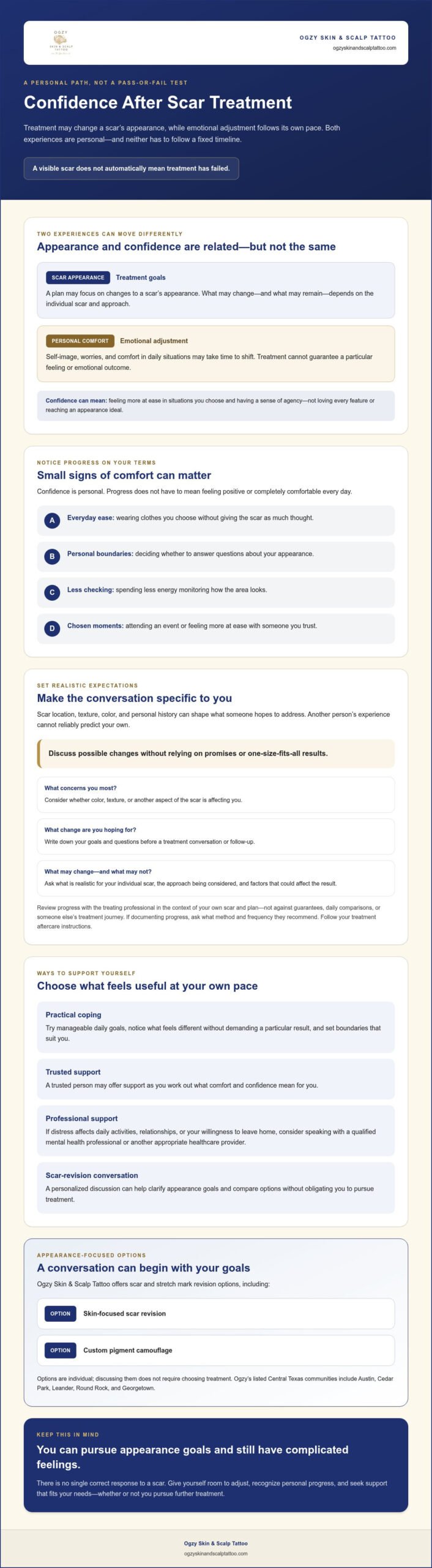
Treatment and self-confidence don’t always change at the same pace. You might choose to address a scar and still feel self-conscious in certain clothes, situations, or conversations. That response doesn’t mean you’ve failed to make progress, or that you need to feel grateful, positive, or completely comfortable every day.
Confidence can mean feeling more at ease in situations you choose and having a sense of agency over how you respond to concerns about your appearance. It doesn’t require loving every feature or reaching a particular appearance ideal. Treatment goals relate to changes in a scar’s appearance, while emotional outcomes are personal and can’t be guaranteed by treatment.
Scars form through the body’s repair process, and their characteristics can differ. For background on the biological process of wound repair, including common scar types, see Wikipedia. How a scar looks, how it changes, and how you feel about it are individual experiences. A visible scar doesn’t automatically mean treatment has failed.
What does feeling confident after scar treatment mean?
For one person, confidence might mean wearing short sleeves without giving the scar much thought. For another, it could mean attending an event, setting a boundary when someone asks a personal question, or spending less energy checking how the area looks. These are meaningful forms of comfort, even if the scar remains visible.
Your feelings may depend on the setting and your personal history. A scar that feels easy to discuss with a trusted friend may feel more sensitive in public. There’s no single correct response, and confidence isn’t a test you pass or fail.
Why can emotional adjustment continue after treatment?
Changes in skin and changes in self-image aren’t the same thing. Even when you notice a difference in a scar, familiar habits such as hiding the area, anticipating questions, or worrying about judgment may take time to shift. Your emotional response may also vary from one day or situation to another. That doesn’t erase the steps you’ve taken.
Notice what feels different without demanding a particular result. If distress is affecting daily activities, relationships, or your willingness to leave home, consider speaking with a qualified mental health professional or another appropriate healthcare provider. You deserve support for the emotional impact, whether or not you pursue further treatment. It’s possible to feel confident after scar treatment while still having complicated feelings about a scar.
Set Realistic Expectations for Scar Appearance and Personal Progress
Scar appearance and treatment plans are individual. A scar’s location, texture, color, and personal history can shape what someone hopes to address. The most suitable approach depends on the person and their goals, so another person’s experience, even with a scar that seems similar, can’t reliably predict your own.
Realistic expectations help you weigh possible changes without relying on promises. Before treatment or a follow-up, discuss what the approach is intended to address, what may remain unchanged, and what factors could affect the result. Review progress with the treating professional in the context of your own scar and plan, rather than measuring it against a guarantee.
Which changes should you discuss with your provider?
A little preparation can make a conversation more useful. Write down what concerns you most, the change you hope to see, and any questions you want answered. For example, you might want to discuss how the scar’s color or texture affects you, while recognizing that different concerns may call for different approaches.
Ask what outcomes are realistic for your individual scar and the approach being considered. If you’re exploring scar revision in Austin, a personalized conversation can help you clarify goals and compare options without obligating you to pursue treatment. Ogzy Skin & Scalp Tattoo offers scar and stretch mark revision options, including skin-focused revision and custom pigment camouflage. You can review its scar and stretch mark revision options as a starting point for questions.
How can you track progress without constant comparison?
Frequent checking can make it harder to notice changes calmly. If your treating professional recommends documenting progress, ask which method to use and how often. Follow that guidance rather than relying on daily comparisons, online photos, or someone else’s treatment journey. Images may be edited, taken in different lighting, or show a different scar and approach.
Follow the aftercare instructions provided for your treatment. Generic online advice may not fit your individual plan, so check with your provider before changing how you care for the area or adding steps.
Appearance is only one way to reflect on progress. You might also notice whether you feel more comfortable choosing clothes, spending time with others, or directing your attention away from the scar. These observations don’t replace a professional assessment, but they can help you understand what matters to you as you work toward feeling confident after scar treatment.
Compare Ways to Support Confidence Alongside Scar Revision
There’s no single route to feeling more comfortable with a scar. Personal coping strategies can help with everyday situations, emotional support can address distress, and a scar-revision consultation can clarify appearance-focused options. These approaches serve different purposes, and choosing one doesn’t mean the others aren’t useful.
| Option | Purpose | Questions to consider | Factors affecting suitability |
|---|---|---|---|
| Personal coping strategies | Make specific daily situations feel more manageable. | What setting feels difficult? What small change might help? | Your comfort, preferences, and the situations you want to approach. |
| Trusted or qualified emotional support | Offer space to talk through feelings, self-image, or worry about judgment. | Would I feel safe sharing this with someone I trust? Would professional support be helpful? | The level of distress and the kind of support that feels appropriate to you. |
| Scar-revision consultation | Discuss appearance-related goals and learn about possible approaches. | What options may suit my scar and goals? What should I realistically expect? | Your individual scar, priorities, and the provider’s assessment of suitable options. |
When might a scar-revision consultation help clarify options?
A consultation gives you space to describe what concerns you, explain the change you hope for, and ask questions before deciding whether to proceed. Ogzy Skin & Scalp Tattoo offers scar and stretch mark revision options that include skin-focused revision using medical-grade stem cells and growth factors, as well as custom pigment camouflage matched to natural skin tone. These approaches aren’t suitable for everyone, so discuss whether an option aligns with your individual goals. For more detail, read the scar and stretch mark revision guide.
What support can complement appearance-focused treatment?
Emotional support has a different purpose from changing a scar’s appearance. A trusted person may help you feel heard, while a qualified mental health professional can offer support if distress feels significant or starts affecting daily life. You can explore these forms of support whether or not you choose a procedure.
If you’re researching a specific procedural option, Ogzy also shares information about microneedling for scars in Cedar Park. Use that information to prepare questions, then discuss individual suitability with an appropriate provider. Comparing options this way can help you decide what kind of support feels useful as you work toward feeling confident after scar treatment.
Build Everyday Confidence While Respecting Your Own Pace
Confidence doesn’t have to mean feeling fearless or never thinking about your scar. Try a gentle three-step check-in: name what feels difficult, choose one manageable goal, then notice what helped. Your goal might be staying present during a conversation, wearing an outfit you enjoy, or accepting support from someone you trust. Keep it small enough to feel like a choice, not a test.
What small steps can make social situations feel more manageable?
If questions about your scar make you uneasy, decide in advance whether you want to respond, change the subject, or say nothing. A short phrase can help, such as “I’d rather not talk about it” or “I’m doing well, thanks for asking.” You don’t owe anyone an explanation, and you can change your response depending on the person or setting.
Choose clothing and activities based on your comfort and preferences, not an obligation to hide or reveal your scar. You might wear what feels good that day, bring a trusted person to an event, or give yourself permission to leave early. You don’t need to disclose a scar to prove you’re accepting it, and concealing it doesn’t invalidate your experience. Your boundaries can shift as your comfort changes.
How can you avoid making confidence another standard to meet?
Notice specific moments of ease without turning them into a demand to feel positive all the time. Perhaps you enjoyed an activity without thinking about your scar, or felt comfortable asking a friend for support. Those moments matter, even if self-consciousness returns later. You don’t need to pursue exposure, disclosure, or constant self-acceptance as measures of progress.
If appearance concerns become persistently distressing or interfere with daily life, consider talking with a qualified mental health professional. Support can help you work through difficult feelings without requiring you to change how you feel about your scar on a schedule.
If exploring an appearance-focused option feels right for you, a conversation can help clarify your goals and whether scar and stretch mark revision options may be suitable. It’s entirely your choice. You can discuss your scar-revision goals with Ogzy without treating a procedure as a requirement for confidence. Your pace is yours, and small steps count.
Explore a Personalized Scar-Treatment Next Step in Central Texas
You can take what you’ve learned at your own pace: clarify what matters to you, compare options that may be suitable, and decide whether a professional conversation would be useful. Asking questions doesn’t commit you to treatment, and choosing not to pursue treatment is valid, too. The aim is to make an informed decision that reflects your concerns, not someone else’s expectations.
Ogzy Skin & Scalp Tattoo offers scar and stretch mark revision options, including skin-focused revision and custom pigment camouflage matched to natural skin tone. Individual suitability and possible outcomes depend on your circumstances, so a discussion can help you understand what may be appropriate without assuming a particular approach is right for everyone. Ogzy serves Austin, Cedar Park, Leander, Round Rock, and Georgetown.
What should you bring to a scar-revision consultation?
A few notes can help you make the most of a conversation. Write down what concerns you about the scar, which appearance changes matter most to you, and what you’re hoping to understand. You may want to ask:
- What approach might be suitable for my scar and goals?
- What should I expect from the process and aftercare?
- What uncertainties, limitations, or alternatives should I consider?
Ask for clear explanations if anything feels uncertain. You deserve time to understand the information and consider how each option fits your priorities before making a decision.
How can you decide whether to take the next step?
There’s no need to decide on the spot. Take time to reflect on what you’ve learned, seek another appropriate opinion if you want one, and proceed only if you feel informed and comfortable. A consultation is a chance to discuss your concerns and learn about possible options, not a commitment to treatment. Your path toward feeling confident after scar treatment may include a professional conversation, personal support, practical changes in daily life, or a combination that feels right to you.
If you’d like to discuss your individual concerns and scar-revision options with Ogzy, talk with Ogzy about scar revision.
Take the Next Step at Your Own Pace
Learning to feel confident after scar treatment doesn’t require a perfect result or a particular emotional response. Confidence can grow through realistic expectations, practical choices that support your comfort, and the right kind of support for your needs. If you’re considering treatment, clarifying your goals and asking questions can help you decide whether exploring options feels useful.
Ogzy offers scar and stretch mark revision options, including skin-focused approaches and custom pigment camouflage. A conversation can help you discuss your individual concerns and learn what options may be suitable, without making treatment a requirement for feeling more at ease. Ogzy serves Austin, Cedar Park, Leander, Round Rock, and Georgetown.
If you’d like to explore your goals, talk with Ogzy about your scar-revision goals. Take the time you need. Your next step should feel informed, personal, and right for you.
Frequently Asked Questions
Is it normal not to feel confident immediately after scar treatment?
Yes, confidence may take time to adjust, even after you’ve pursued treatment. Changes in a scar’s appearance and changes in how you feel about it are different experiences, and there’s no required emotional timeline. You might feel more comfortable in some situations than others, or have days when self-consciousness returns. That doesn’t mean you’ve failed to make progress. Give yourself room to notice what you need without demanding an immediate change in how you feel.
How can I feel more confident when my scar is still visible?
You can feel confident after scar treatment without needing your scar to disappear or feeling positive about it every day. Start by identifying a situation that feels difficult, then choose one manageable step, such as wearing clothing you like, asking a trusted person for support, or preparing a brief response to questions. You don’t owe anyone an explanation, and you can choose whether to reveal or cover your scar based on your own comfort.
Can scar revision improve confidence as well as appearance?
Scar revision may address appearance-related goals, but it can’t guarantee a change in confidence or emotional wellbeing. People respond to scars in personal ways, and feeling at ease may involve practical coping strategies or emotional support as well as decisions about treatment. Consider what you hope to change and ask a provider what options may be suitable for your individual scar. You can pursue a consultation to learn more without committing to treatment.
What should I do if I am disappointed with my scar treatment results?
Share your concerns with the professional who provided your treatment, and ask them to review your progress in relation to your goals and treatment plan. Write down what feels different from what you expected, and bring any provider-approved progress documentation if you have it. Avoid changing aftercare or pursuing another procedure based only on online comparisons. A clear conversation can help you understand what can be assessed and whether any next steps are appropriate.
How do I choose between scar revision and pigment camouflage?
Start by describing what you’d most like to address, then ask a qualified provider which options may fit your individual scar and goals. Ogzy Skin & Scalp Tattoo offers scar and stretch mark revision options that include skin-focused approaches using medical-grade stem cells and growth factors, as well as custom pigment camouflage matched to natural skin tone. Suitability varies. Ogzy serves Austin, Cedar Park, Leander, Round Rock, and Georgetown, where you can discuss options without assuming either is right for you.
When should I ask a professional about my scar after treatment?
Contact your treating professional if you’re unsure whether your scar’s appearance or changes are expected, have questions about aftercare, or feel disappointed with progress. They can assess your situation in the context of the treatment you received and explain whether further evaluation is appropriate. If emotional distress about the scar is persistently affecting daily life, consider speaking with a qualified mental health professional, too. You deserve support for both practical concerns and how the experience is affecting you.

Article by
Opal Z
Opal is the owner and practitioner behind OGZY Skin & Scalp Tattoo in Austin, Texas. With more than three years in business and a longtime background in the aesthetics industry, she specializes in corrective and restorative treatments designed to address concerns that traditional aesthetics often overlook.
Her work focuses on scar and stretch mark revision, scar camouflage, scalp micropigmentation (SMP), hair regrowth treatments, and laser tattoo and permanent makeup removal. Opal works with a wide range of skin tones and takes an individualized approach to every client, considering skin color, texture, scar characteristics, treatment history, and realistic long-term outcomes.
Through OGZY Skin & Scalp Tattoo, her goal is to combine artistry, aesthetics, and technical treatment knowledge to help clients feel more comfortable and confident in their skin.
Love the skin you’re in.