
If you’re wondering how to improve appearance of stretch marks, start by identifying what you’d most like to change: color contrast, texture, or both. Stretch marks often soften and fade over time, but their age, color, and texture can affect how noticeable they are and which approaches may be suitable. A realistic aim is gradual refinement, not guaranteed removal.
There isn’t one best plan for everyone. Newer red or purple marks can look different from older white or silvery ones, and options that aim to change texture have a different purpose from pigment camouflage. Home care can support skin comfort, but it isn’t the same as an appearance-focused treatment.
This guide explains why stretch marks change, compares practical approaches and their limits, and offers a framework for thinking through your options. Ogzy Skin & Scalp Tattoo provides scar and stretch mark revision for people in Austin, Cedar Park, Leander, Round Rock, and Georgetown, with approaches focused on healthier-looking skin or custom pigment camouflage matched to natural skin tone.
Key Takeaways
- Match your approach to what you want to change, rather than expecting one option to address every concern.
- Separate skin comfort from appearance goals: moisturizers may support comfort, but they don’t erase stretch marks.
- Compare topical, energy-based, microneedling, and camouflage approaches by their intended goals, without assuming one is right for everyone.
- Describe your marks, clarify your goal, consider relevant skin factors, and weigh the options against those priorities.
- Explore personalized stretch mark revision in the Austin area, including approaches focused on healthier-looking skin or custom pigment camouflage.
What stretch marks are, and what appearance changes are realistic
Stretch marks are common, and wanting them to look less noticeable is understandable. These narrow bands form when skin stretches or shrinks quickly, affecting the structures that help support it. They can appear as lines or streaks, sometimes slightly raised or indented, and may feel different from the surrounding skin. Their presence doesn’t mean you’ve done anything wrong; they’re a visible response to changes in the body.
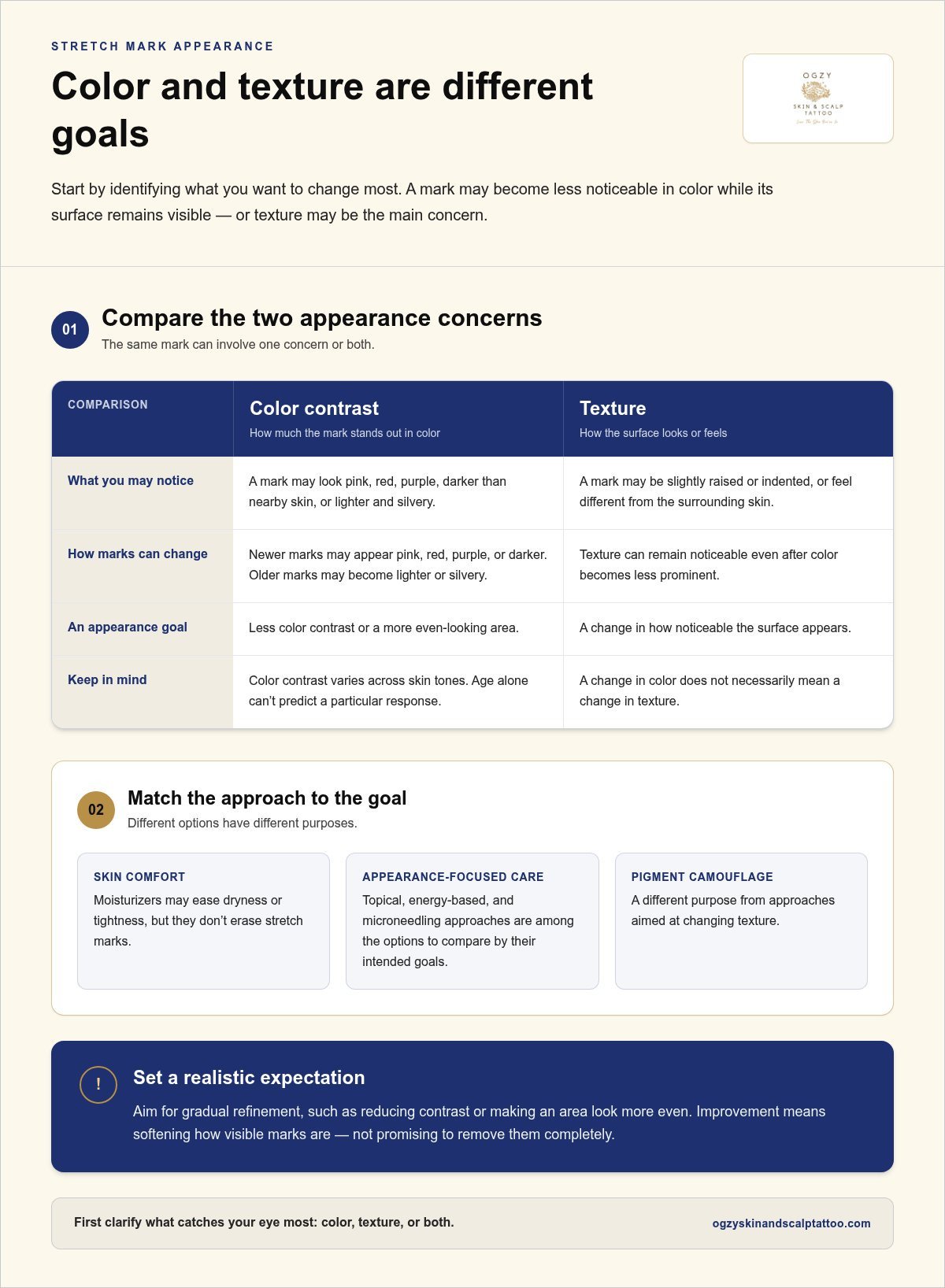
Appearance can change over time. Newer marks may look pink, red, purple, or darker than nearby skin, while older ones may become lighter or silvery. How much the color stands out varies across skin tones. Texture matters, too: a mark may remain visible because its surface is slightly raised or indented, even after its color becomes less prominent. General information about stretch marks describes their development and common forms.
Why stretch marks form and where they commonly appear
Stretch marks can develop during rapid growth, pregnancy, weight changes, or muscle growth, when the skin changes faster than its supporting structures can adapt. Common locations include the abdomen, hips, thighs, breasts, upper arms, and back. Family history and hormonal factors may also influence who develops them, so similar body changes don’t lead to the same pattern for everyone.
You might notice several lines in one area after a growth spurt, or marks across the abdomen or hips during pregnancy. Their placement and appearance provide context, but neither alone determines what change is realistic or which approach might suit you. It can help to observe the marks without treating them as a measure of health, effort, or personal worth.
What “improve the appearance” can mean
Improvement may mean less color contrast, a more even-looking area, or a change in how noticeable the texture appears. These are separate goals: a mark can become less distinct in color while its surface remains visible, or texture can be the main concern even when the color blends fairly well. Newer and older marks can look different, but age alone can’t predict a particular response.
Improving stretch marks means softening how visible they are, not promising to remove them completely. A practical goal might be reducing contrast in a chosen area or making its overall appearance feel more even, while recognizing that marks may remain. If you’re researching how to improve appearance of stretch marks, begin by naming what catches your eye most: color, texture, or both. That distinction makes comparisons more specific and useful.
How to improve stretch mark appearance: everyday steps and their limits
Everyday care can support skin comfort, but it helps to separate that from changing established stretch marks. A moisturizer may ease dryness or tightness; it shouldn’t be presented as a way to erase marks. If your main goal is a visible change in color or texture, supportive routines and appearance-focused treatments are different options with different aims.
What creams, oils, and lotions can, and cannot, do
Hydration can make skin feel softer and more comfortable, especially if it feels dry or irritated. That benefit can matter on its own, but it doesn’t mean a product has removed a stretch mark. Evidence and individual results vary, so be cautious with claims that a cream, oil, or lotion will reliably fade or eliminate marks. MedlinePlus on stretch marks offers medical background on causes and home care to help put product claims in context.
Before buying a product, look beyond polished before-and-after images and absolute wording. Ask what outcome is being claimed: improved comfort, a temporary change in how skin looks, or a lasting change to the mark itself? “Guaranteed removal” is a red flag, not a realistic standard. If you’re pregnant or breastfeeding, check ingredient guidance with a clinician before using a product, since some ingredients may not be appropriate during these periods.
An improvement claim describes a possible change in visibility; it isn’t proof that stretch marks can be removed. Choose care based on your goal, not on a promise that sounds too good to be true.
Habits that support comfortable, healthy-looking skin
Keep daily care gentle. Use products that feel comfortable on your skin, and avoid aggressive rubbing, harsh scrubbing, or unverified remedies that could cause irritation. More friction doesn’t mean more progress. If a product stings or your skin becomes increasingly uncomfortable, stop using it and seek medical advice if the reaction concerns you.
Gradual body changes may reduce sudden stretching, but they can’t guarantee that stretch marks won’t develop. Growth, pregnancy, and other changes aren’t always controllable, and marks aren’t a sign that you’ve failed to care for your skin. A realistic routine supports comfort without asking you to prevent every change your body may experience.
Stretch marks are usually a cosmetic concern, but a sudden, unexplained change in your skin or other concerning symptoms deserves medical advice rather than experimentation with creams. If your priority is a visible appearance change, learn how professional approaches differ from home care. Ogzy’s scar and stretch mark revision options include approaches focused on healthier-looking skin and custom pigment camouflage.
Professional stretch mark treatments compared: what each approach aims to change
Compare professional options by starting with the concern you want to address. Some approaches aim to affect color or texture; camouflage focuses on reducing contrast. None is a universal solution. Suitability depends on your skin, the marks’ characteristics, and an individual professional assessment. The aim is a considered plan, not a promise of complete removal.
| Approach | Intended goal | Considerations |
|---|---|---|
| Topical treatments | May be considered to affect the appearance of some marks, particularly their color or texture. | Results vary, and the product and skin factors matter. |
| Energy-based treatments | Light or laser approaches may aim to address visible color or texture. | Possible irritation or pigment changes depend on the approach and individual skin. |
| Microneedling | May aim to support collagen-related changes and improve the look of texture. | Suitability and response vary; professional assessment helps guide decisions. |
| Pigment camouflage | Aims to reduce color contrast by matching pigment to surrounding skin. | Matching and suitability are individualized, and the underlying mark remains. |
Treatments that aim to affect color or texture
Topical, light-based, laser, and microneedling approaches use different methods and have different intended effects. A professional can consider whether the main concern is color contrast, surface texture, or both, then discuss what an approach aims to change. Irritation and pigment changes are possible considerations, and their likelihood can depend on the method and individual skin. No category guarantees a particular result.
Compare options by purpose and fit rather than by a simple ranking. A treatment intended to address texture isn’t interchangeable with one designed to reduce color contrast. Ogzy Skin & Scalp Tattoo’s scar and stretch mark revision uses medical-grade stem cells and growth factors to support healthier-looking skin. For more detail about medical-grade scar revision approaches, consider how the intended goal relates to your own concern.
Camouflage approaches and appearance goals
Pigment camouflage aims to reduce contrast between a mark and surrounding skin rather than change the mark itself. Custom pigment matching is central to this approach, and suitability depends on the person and the area being treated. At Ogzy Skin & Scalp Tattoo, custom pigment camouflage is matched to natural skin tone, with the aim of blending the mark more seamlessly, not erasing it.
If you’re weighing camouflage against an approach intended to affect skin texture, decide which change matters most to you. Start with your goal, then consider the marks and skin involved. Readers exploring stretch mark camouflage tattoo versus laser can use that distinction to frame the options without assuming one is best for everyone. This makes it easier to choose a direction that reflects your priorities.
How to choose an approach for your stretch marks and skin
A clear goal can make treatment choices feel less overwhelming. Separate what you see from what you feel: color contrast, surface texture, and discomfort are different concerns, and may call for different conversations. Your marks’ age and location, your skin tone, and your health history can also help shape what may be suitable. There’s no single plan that fits everyone.
Match the approach to your main concern
Use this four-step framework to organize your thinking before discussing options:
- Describe the marks. Note their color, approximate age, location, and whether the surface looks raised, indented, or relatively smooth. Include whether several areas are involved.
- Name your main goal. Is the priority reducing color contrast, changing the appearance of texture, easing discomfort, or addressing more than one concern? Being specific helps keep the discussion focused.
- Consider your skin and circumstances. Skin tone, mark characteristics, and the area being considered may influence which approaches are appropriate. Pregnancy, breastfeeding, medication use, and medical history are relevant factors to discuss.
- Discuss the options and their limits. Ask what each approach aims to change, what it may not change, and what care is involved afterward. Agree on an observable goal, such as softer contrast or a more even-looking area, rather than expecting complete disappearance.
These details matter because a color-focused goal isn’t the same as a texture-focused one. A mark that draws attention mainly because it contrasts with surrounding skin presents a different concern from one that feels uneven to the touch. Skin tone, location, and whether marks are newer or older can also inform the discussion, without guaranteeing how a particular approach will work.
The same treatment plan may not suit every person because marks, skin, health factors, and appearance goals differ. A thoughtful choice starts with those differences, not with a promise that one method works for everyone.
Prepare for a safe, useful consultation
Bring a concise account of relevant health history and medications, and mention if you’re pregnant or breastfeeding. These details can help inform a careful discussion about suitability and timing. If marks appeared suddenly without an obvious cause, or come with other unusual symptoms, seek medical evaluation rather than treating the change as a purely cosmetic concern.
It can also help to write down questions ahead of time. Ask what kind of change an approach is intended to support, what its limitations are, what aftercare involves, and what signs should prompt follow-up. Clear answers help you compare options without feeling rushed into a decision. Ogzy provides scar and stretch mark revision focused on healthier-looking skin or custom pigment camouflage for people in the Austin area.
Exploring personalized stretch mark revision in the Austin area
After comparing possible goals, a personalized discussion can help turn general information into a considered next step. Ogzy Skin & Scalp Tattoo provides scar and stretch mark revision for people in Austin, Cedar Park, Leander, Round Rock, and Georgetown. The approach is tailored to the marks, skin, and kind of change a person hopes to explore, with an emphasis on healthier-looking skin or camouflage rather than guaranteed erasure.
Two revision pathways with different aims
One pathway uses medical-grade stem cells and growth factors to support healthier-looking skin. Another uses custom pigment camouflage matched to natural skin tone, with the aim of softening visual contrast. These approaches have different purposes: one focuses on skin appearance, while the other focuses on blending the mark with surrounding skin. Neither promises that marks will disappear.
The more appropriate direction depends on individual considerations, including the marks’ appearance, the person’s skin, and the change they want to prioritize. Someone most concerned about contrast may have a different goal from someone focused on the look of skin texture. A tailored discussion helps clarify those priorities and keep expectations grounded in what each approach is intended to do.
Ogzy’s scar and stretch mark revision guide provides more context about the approaches. Consider bringing questions about your main concern, the appearance you hope to refine, and the limitations to keep in mind. A useful conversation leaves room for those questions and helps you understand the options without pressure to pursue a particular path.
Take a comfortable next step with Ogzy
It’s okay to take time deciding. You don’t need to arrive with a treatment choice already made; begin with what you notice most and what would feel like a meaningful, realistic change. A personalized conversation can focus on your priorities, skin, and questions, helping you understand how revision approaches relate to your goal.
If you’re considering how to improve appearance of stretch marks, first decide whether you’re seeking support for healthier-looking skin, pigment camouflage, or a clearer understanding of both. The aim is thoughtful refinement, not a guarantee of complete removal. Explore stretch mark revision with Ogzy when you’re ready.
Choose a next step that feels right for you
Your next step doesn’t need to be a commitment to treatment. It can simply be deciding what you’d like to understand better and which change would feel meaningful to you. A thoughtful plan for how to improve appearance of stretch marks begins with your priorities, realistic expectations, and room to make an informed choice at your own pace.
Scar and stretch mark revision is Ogzy’s primary service, with options tailored to different appearance goals. Custom pigment camouflage is matched to natural skin tone, with the aim of blending contrast rather than promising erasure. A personalized discussion can help you explore what you hope to refine and which approach aligns with that goal.
When you’re ready, explore personalized stretch mark revision with Ogzy. You deserve to make this choice with clarity and care, and to move forward only when it feels right.
Frequently Asked Questions
Can stretch marks ever disappear completely?
Stretch marks can become less noticeable, but complete disappearance isn’t a reliable expectation. Even when color contrast softens, some visible texture or difference from surrounding skin may remain. If you’re considering treatment, define success in a way you can observe, such as a subtler appearance in a particular area, rather than expecting flawless skin. A careful plan focuses on possible refinement, not a guarantee of removal.
How long does it take for stretch marks to fade?
There isn’t a fixed timeline for fading. Changes can happen gradually, and how noticeable marks remain varies with their age, color, and your skin. Rather than judging day to day, you might note their appearance periodically under similar lighting and conditions. That can help distinguish gradual natural change from differences in lighting, posture, or how the skin is stretched.
Do creams or oils improve the appearance of stretch marks?
Creams and oils can moisturize skin and may make dryness feel more comfortable, but they shouldn’t be counted on to remove established marks. Evidence for appearance changes varies, and marketing claims can outpace what a product can promise. If you use a topical product, follow its directions and stop if it irritates your skin. During pregnancy or breastfeeding, ask a clinician about ingredients before applying treatment products.
Is microneedling or laser treatment better for stretch marks?
Neither is universally better; the approaches differ, and suitability depends on your skin and the marks being treated. Microneedling is intended to encourage collagen-related changes, while laser approaches use energy to address visible skin features. Both require a discussion of expected changes, limitations, and possible risks, including irritation or pigment changes. A useful comparison focuses on your specific goal, not a blanket ranking of methods.
Can I treat stretch marks while pregnant or breastfeeding?
Some cosmetic treatments and topical ingredients may not be appropriate during pregnancy or breastfeeding, so don’t begin a treatment plan without discussing it with a clinician. This is especially important for prescription products or procedures that affect the skin. Bring the product name or treatment details to the conversation, along with any medications you use. A clinician can help you consider safety and whether waiting is the more appropriate choice.
What causes stretch marks to appear suddenly?
They may become noticeable after a period of rapid growth, pregnancy, weight change, or muscle growth, though sometimes the cause isn’t obvious. If marks appear suddenly without a clear explanation, or occur alongside other unusual changes or symptoms, seek medical advice rather than assuming they’re only a cosmetic concern. A clinician can review your health history and medications and help assess whether further evaluation is appropriate.
Are stretch mark treatments suitable for every skin tone?
Not every approach is suitable for every person or skin tone. Some treatments can carry a risk of pigment changes, so skin characteristics should be part of the assessment and plan. Camouflage has a different aim: custom pigment is matched to natural skin tone to reduce contrast. Ogzy offers stretch mark revision options tailored to individual appearance goals in Austin, Cedar Park, Leander, Round Rock, and Georgetown.

Article by
Opal Z
Opal is the owner and practitioner behind OGZY Skin & Scalp Tattoo in Austin, Texas. With more than three years in business and a longtime background in the aesthetics industry, she specializes in corrective and restorative treatments designed to address concerns that traditional aesthetics often overlook.
Her work focuses on scar and stretch mark revision, scar camouflage, scalp micropigmentation (SMP), hair regrowth treatments, and laser tattoo and permanent makeup removal. Opal works with a wide range of skin tones and takes an individualized approach to every client, considering skin color, texture, scar characteristics, treatment history, and realistic long-term outcomes.
Through OGZY Skin & Scalp Tattoo, her goal is to combine artistry, aesthetics, and technical treatment knowledge to help clients feel more comfortable and confident in their skin.
Love the skin you’re in.