
What if the experience is less about enduring pain and more about knowing what to expect? If you’re asking, “is scalp micropigmentation painful,” it’s understandable to feel cautious, especially if needles make you anxious or your scalp is sensitive. People describe SMP as a light scratching, tapping, pricking, or buzzing sensation, but comfort varies from person to person and across different areas of the scalp.
You don’t have to guess what to discuss before your appointment. This guide explains sensations people report, why sensitivity can vary, and how an existing scar or a sensitive area may affect your experience. You’ll also find practical questions to raise with your specialist. At Ogzy Skin & Scalp Tattoo, Scalp Micropigmentation (SMP) uses precision pigment deposits to replicate natural hair follicles. A consultation is a chance to talk through your concerns and personalized SMP goals before deciding whether treatment is right for you.
Key Takeaways
- Wondering “is scalp micropigmentation painful”? Sensations vary, and descriptions like light scratching or tapping don’t predict exactly what you’ll feel.
- SMP uses precision pigment deposits to create the appearance of natural hair follicles. It does not create hair growth.
- Sensitivity can differ across people and scalp areas, so a hairline, temple, or scar may feel different without predicting everyone’s experience.
- Prepare by writing down your questions, noting any scalp sensitivities or scars, and explaining what you want to understand before treatment.
- An Ogzy Skin & Scalp Tattoo consultation in Austin is an opportunity to discuss your concerns and personalized SMP goals.
Is Scalp Micropigmentation Painful? A Realistic First Look
There isn’t one answer that fits everyone. If you’re asking, “is scalp micropigmentation painful,” the most accurate answer is that the sensation varies from person to person. Some people describe light scratching or tapping, but those are individual accounts, not a promise of what your appointment will feel like. Your experience may be milder, more noticeable, or simply different from someone else’s description.
Scalp Micropigmentation, or SMP, uses precision pigment deposits to replicate the appearance of natural hair follicles. It can create the cosmetic impression of closely cropped hair or added density, depending on your treatment goal. It does not produce hair growth. For a general overview of its purpose and technique, see What is Scalp Micropigmentation?
What might SMP feel like during a session?
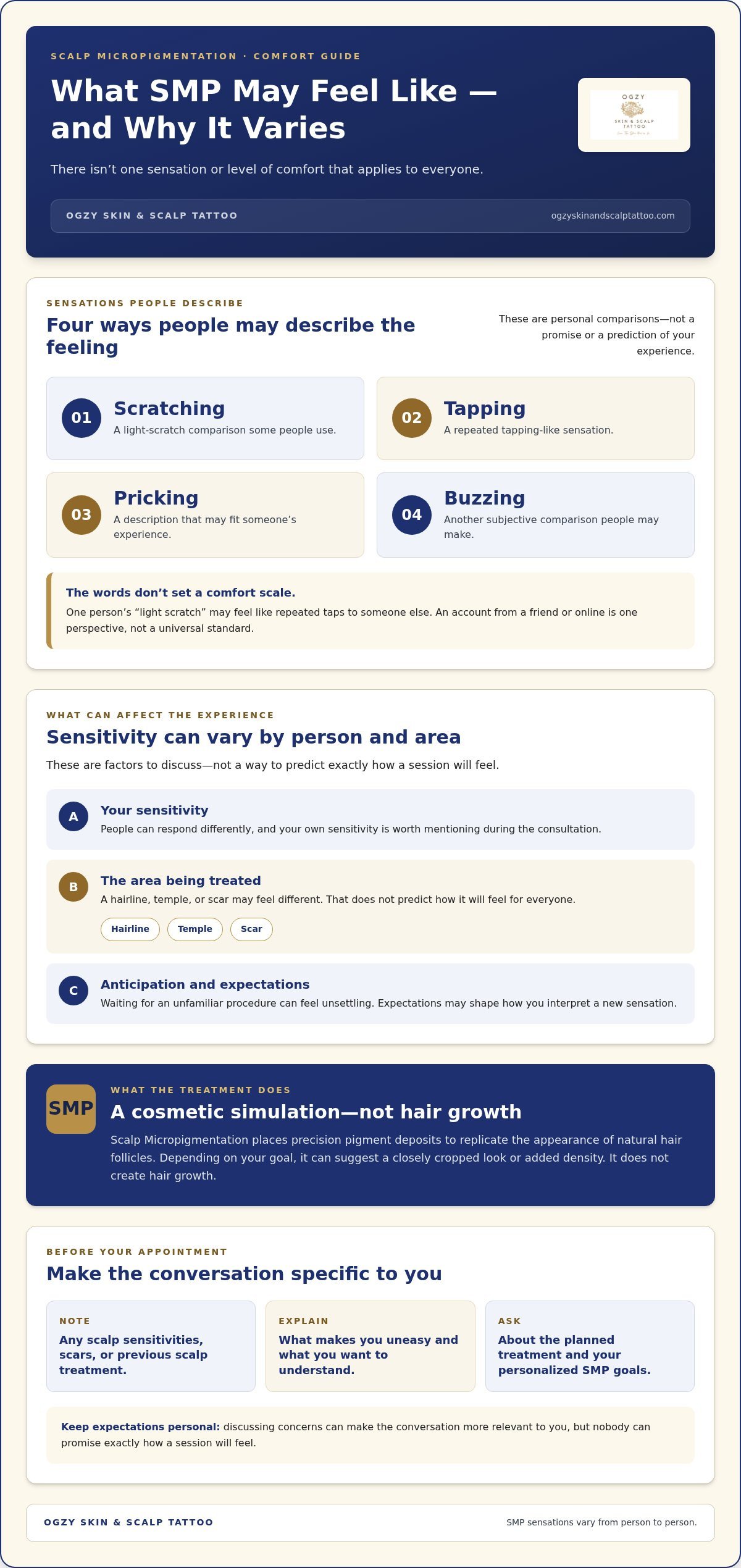
People may describe sensations during SMP as scratching, tapping, pricking, or buzzing. These comparisons can help you picture the range of experiences, but they’re subjective. One person’s “light scratch” might feel like repeated taps to someone else, so the words aren’t a reliable forecast of your personal comfort.
It can also be difficult to separate the sensation itself from the anticipation beforehand. Waiting for an unfamiliar procedure may feel unsettling, especially if needles or scalp sensitivity are already on your mind. That concern is worth raising without assuming treatment will be overwhelming. Knowing that experiences vary is more useful than expecting either no discomfort or a particular level of pain.
Why a personal account cannot predict your experience
A story shared by a friend or online describes what that individual remembers, not what every client will feel. People have different sensitivities and expectations, and treatment areas can differ too. Even two people describing the same sensation may mean different things by “uncomfortable.” Treat a personal account as one perspective, not a universal standard.
Your expectations may shape how you interpret an unfamiliar feeling. If you’re anticipating sharp pain, a repetitive sensation might still catch you off guard. If you expect only mild contact, a more noticeable feeling may surprise you. Neither response means you’re overreacting. It reflects that the sensation and your interpretation of it are personal.
You don’t need to settle your concerns alone before speaking with a specialist. At a consultation, explain what makes you uneasy, ask about the planned treatment, and share any relevant sensitivity or previous scalp treatment. Clear questions help make expectations more specific, even though nobody can promise exactly how a session will feel. Asking about discomfort is a reasonable part of deciding whether SMP feels right for you.
How SMP Works and Why Its Sensation Can Differ From Person to Person
Understanding the purpose of each pigment deposit can make the process feel less mysterious. Scalp Micropigmentation uses precision pigment deposits to replicate the appearance of natural hair follicles. Depending on your treatment goal, the visual effect can suggest a closely shaved look or the appearance of added density. SMP is a cosmetic simulation, not a way to create new hair or change how hair grows.
What happens when pigment is placed in the scalp?
During SMP, pigment is deposited in carefully considered points across the scalp to create a pattern that resembles tiny follicles. Placement and design are guided by the appearance you’re seeking. The process creates a visual impression through a series of pigment deposits, rather than filling an area with strands of hair.
This distinction matters when setting expectations. SMP can change how the scalp appears, but it doesn’t make follicles grow or restore hair. Ogzy Skin & Scalp Tattoo provides this non-surgical treatment to create a natural-looking cosmetic effect. The appearance of the finished result doesn’t tell you what the process will feel like, and technical details shouldn’t be treated as a reliable measure of personal comfort.
Why the same procedure may feel different to different people
There’s no single sensation that applies to every client. Individual sensitivity can differ, and the same person may notice different sensations in different circumstances. Expectations can also shape perception. Someone who feels tense about a procedure may be especially alert to each new sensation, while another person may find it easier to focus elsewhere. These are possible influences, not a prediction of how your session will go.
Descriptions such as scratching, tapping, or buzzing are personal comparisons, not a clinical benchmark. Two people may use different words for similar feelings, or the same word for experiences that aren’t quite alike. An online account can offer a point of reference, but it can’t tell you exactly what you’ll feel. Asking “is scalp micropigmentation painful” is a reasonable starting point. A useful conversation makes room for your concerns rather than treating someone else’s account as a promise.
The treatment area and your personal response both matter, so a general explanation can only go so far. If you have a particular sensitivity, a history of scalp treatment, or feel uneasy about the process, mention it during your consultation. That context helps make the discussion relevant to you. At Ogzy Skin & Scalp Tattoo, you can discuss personalized SMP goals as part of your consultation.
Which Scalp Areas and Personal Factors May Affect SMP Discomfort?
Sensitivity isn’t necessarily the same across the entire scalp, and one person’s response may differ from another’s. Some people mention the temples, hairline, or scar tissue as areas that feel different. Treat these as individual accounts, not a map of which spots will hurt. They can’t predict how any particular client will feel.
It’s more useful to think about possible influences than fixed rules. Your personal sensitivity, expectations, and the area being treated may affect how you perceive a sensation. None of these factors determines your experience in advance, but sharing relevant context gives your specialist a clearer picture of your concerns.
Can the hairline, temples, or scalp scars feel different?
Some people describe the hairline or temples differently from other parts of the scalp, and scar tissue also comes up in individual accounts. A scar’s presence alone doesn’t establish whether the area will be more or less sensitive. Its history and your own response are personal, so don’t treat someone else’s experience as a prediction for yours.
During your consultation, mention any scalp scars, previous procedures, or areas you already know to be sensitive. You don’t need to determine how they’ll feel before bringing them up. Sharing this information makes the conversation about your treatment area and expectations more relevant, without assuming a particular sensation or outcome.
How personal sensitivity shapes the experience
Pain tolerance isn’t a fixed scale that can reliably forecast how you’ll respond. Two people may experience similar sensations but describe them differently. Your own response may also depend on what you expect and where treatment is taking place. If “is scalp micropigmentation painful” is tied to a specific worry, such as sensitivity around a scar, name that concern rather than relying on a general description.
Use the comparison below as a conversation guide, not a diagnostic tool. It separates factors worth discussing from things that can’t be promised in advance.
| May influence how sensation is perceived | Can’t be predicted from that factor alone |
|---|---|
| Your personal sensitivity and expectations | An exact pain level or response |
| The area being treated, such as the hairline or temples | That one area will definitely feel worse than another |
| A scalp scar or relevant treatment history | Whether scar tissue will feel more or less sensitive |
| Another person’s account of their session | How your own appointment will feel |
If you feel anxious, say so plainly. Ask questions about your treatment plan and share anything about your scalp that may be relevant. You don’t need to arrive with a conclusion or request a particular solution. An honest conversation is a useful first step toward setting expectations that reflect your concerns.
How to Prepare for an SMP Appointment When You Feel Anxious
You don’t need to arrive with every concern resolved. Preparing a few questions can turn a general worry about discomfort into a clear conversation about your scalp and treatment goals. If you’re wondering “is scalp micropigmentation painful,” say so directly. Your specialist can discuss the planned approach and what to expect without promising a particular sensation.
What to discuss before your SMP session
Start with what feels most uncertain, whether that’s the idea of needles, a sensitive spot, a scar, or not knowing how the appointment will unfold. Mention any previous SMP, too. These details make the discussion specific to you, rather than relying on another person’s account or a general description of treatment.
- Name the concern. Explain what makes you anxious and what you most want clarified about discomfort.
- Point out relevant areas. Share where your scalp feels sensitive, including the hairline or temples if those areas concern you.
- Describe scalp history. Mention scars, previous scalp procedures, or earlier SMP so they can be considered in the conversation.
- Ask about the plan. Invite your specialist to explain the treatment goals and what you may notice during the appointment. Keep in mind that individual sensations can’t be guaranteed.
Before your SMP appointment, share what worries you, any sensitive areas or scars, your previous SMP history, and the questions you have about the treatment plan. Keep this checklist on your phone or bring it with you. A few points written down can make it easier to speak up when you feel nervous.
How to communicate during treatment
Clear communication doesn’t end when the appointment begins. If the sensation differs from what you expected or you feel uneasy, tell your specialist what you’re noticing. You don’t have to find the perfect word. Saying “this feels different than I expected” is enough to start a conversation.
No one can promise exactly how a session will feel. Speaking up gives your specialist a chance to understand your experience and discuss your concerns as treatment proceeds. You’re not being difficult by asking a question or describing discomfort. That information is part of a thoughtful, personalized discussion.
If you’d like to talk through your concerns and SMP goals before treatment, book an SMP consultation with Ogzy. You can share what matters to you and discuss a treatment plan with the specialist.
Discuss SMP Comfort and Your Treatment Plan With Ogzy in Austin
A consultation is a chance to discuss more than the look you hope to achieve. Share what makes you anxious, describe any sensitive areas or scalp history, and ask questions about the treatment plan. Ogzy Skin & Scalp Tattoo is based in Austin, Texas, and offers personalized SMP designed around natural-looking results. The conversation can clarify your goals and expectations, but it can’t guarantee a particular level of comfort or a specific result.
What a personalized SMP conversation can clarify
SMP uses precision pigment deposits to replicate the appearance of natural hair follicles. During a consultation, explain the look you have in mind, such as a follicle-simulation effect, and discuss how that goal relates to your treatment plan. You can also raise questions about areas of concern, scars, previous SMP, and what you may experience during treatment.
Clear expectations matter. A consultation gives you space to talk through what you hope SMP will achieve and what remains uncertain, without assuming that someone else’s experience will match yours. Ogzy Skin & Scalp Tattoo has also been featured in Voyage Austin, but your own goals and questions should remain central to the discussion.
If you’re looking for information relevant to the surrounding area, the Scalp Micropigmentation Cedar Park TX guide may also be useful as you learn about SMP and consider your next steps.
What to know before booking a consultation
Before scheduling, note the booking requirements: A valid credit card is required to book a consultation. $50 fee applies for cancellations within 24 hours or no-shows. Knowing these details in advance helps you plan and avoid surprises.
It may help to bring a short list of questions so you don’t have to remember everything in the moment. Note what you want to understand about discomfort, which scalp areas concern you, whether a scar or previous SMP is relevant, and what kind of follicle-simulation look you’re considering. The conversation can then focus on details that matter to you, rather than broad assumptions about how everyone experiences treatment.
If you’re considering SMP in Austin, Cedar Park, Leander, Round Rock, or Georgetown, booking a consultation with Ogzy is a practical next step for discussing your concerns, personal goals, and treatment expectations. Bring your questions, take time to understand the plan, and make an informed decision about whether SMP feels right for you.
Take the Next Step at Your Own Pace
You don’t need to feel completely certain before starting a conversation. If you’re still asking, “is scalp micropigmentation painful,” let that question guide what you want to understand next rather than pressure you to decide right away. Write down the concern you most want addressed, then bring it to a consultation. A thoughtful discussion can help you consider whether SMP aligns with your goals and what you need to feel informed about moving forward.
It’s also okay to take time after the conversation to reflect. Confidence doesn’t have to mean having no questions. It can mean knowing what matters to you and feeling comfortable asking about it. Your next step can be simple: share your concerns, hear about a personalized treatment plan, and decide what feels right for you.
Discuss your SMP goals and questions with Ogzy in Austin. You deserve to make your decision with clarity and care.
Frequently Asked Questions
Does scalp micropigmentation hurt more than a regular tattoo?
There’s no universal answer about whether SMP feels more or less uncomfortable than a regular tattoo. If you’re asking “is scalp micropigmentation painful compared with a regular tattoo,” your own sensitivity and the area treated matter more than a broad comparison. SMP uses precision pigment deposits to replicate natural hair follicles, but that method alone can’t predict sensation. During a consultation, discuss what you’re comparing it with and what concerns you about the planned treatment.
Is numbing cream used during scalp micropigmentation?
Don’t assume numbing cream will be used or apply a product independently based on someone else’s experience. Raise the question during your consultation before the appointment. For example, explain that you’re concerned about sensitivity and ask how comfort-related questions fit into your treatment plan. A direct conversation can address your concern without relying on general advice from online accounts.
Which part of the scalp is most sensitive during SMP?
No single scalp area is the most sensitive for everyone. Some individual accounts mention the hairline, temples, or areas close to bone, but those reports don’t establish what you’ll feel. If you’re concerned about a particular spot, describe its location during your consultation. Mention any scars, previous procedures, or prior SMP in the same area so your specialist can consider that context when discussing your treatment plan.
Can scalp micropigmentation be done over a hair transplant scar?
Yes, SMP can be used to create the appearance of natural hair follicles in areas affected by hair-transplant scars. A scar may respond or feel differently from nearby scalp, so another client’s experience can’t predict yours. During a personalized consultation, discuss the scar’s location, your goals for its appearance, and any concerns about sensation. This conversation helps clarify the proposed approach without promising a particular result or experience.
How long does discomfort last after scalp micropigmentation?
There isn’t a set timeframe that can be promised for everyone. Individual responses and post-session sensations vary, so ask your specialist what you might expect after your specific treatment and what guidance applies to your plan. If you’re arranging work or other commitments, mention your schedule and ask what to keep in mind afterward. Follow the personalized guidance you’re given rather than assuming another person’s experience will match yours.
Do I need a credit card to book an SMP consultation with Ogzy?
Yes. A valid credit card is required to book a consultation with Ogzy Skin & Scalp Tattoo in Austin. $50 fee applies for cancellations within 24 hours or no-shows. Review these booking details before scheduling. The consultation gives you time to discuss your SMP goals, questions about the treatment plan, and concerns about how it may feel, so you can decide on your next step with clearer expectations.

Article by
Opal Z
Opal is the owner and practitioner behind OGZY Skin & Scalp Tattoo in Austin, Texas. With more than three years in business and a longtime background in the aesthetics industry, she specializes in corrective and restorative treatments designed to address concerns that traditional aesthetics often overlook.
Her work focuses on scar and stretch mark revision, scar camouflage, scalp micropigmentation (SMP), hair regrowth treatments, and laser tattoo and permanent makeup removal. Opal works with a wide range of skin tones and takes an individualized approach to every client, considering skin color, texture, scar characteristics, treatment history, and realistic long-term outcomes.
Through OGZY Skin & Scalp Tattoo, her goal is to combine artistry, aesthetics, and technical treatment knowledge to help clients feel more comfortable and confident in their skin.
Love the skin you’re in.