A pale surgical scar can sometimes be blended, not erased. A medical tattoo for surgical scars in Round Rock is generally considered only when the scar is fully healed and stable; surgical scars typically need 12 to 18 months to heal before tattooing. This approach may help camouflage hypopigmented scars, which look lighter than the surrounding skin.
It’s understandable to want a lasting color difference to feel less noticeable while wondering whether scar tattooing is right for you and what healing involves. This guide explains how medical tattooing for surgical scars works, why scar maturity matters, and how pigment is selected and applied to blend with surrounding skin. You’ll also learn what to expect from recovery and why results develop gradually, helping you consider your options with clearer expectations.
Key Takeaways
- Look for a scar that is flat, pale, painless, and no longer changing before considering camouflage.
- Learn how skin-tone assessment and careful pigment layering help blend lighter scars with surrounding skin.
- Understand what aftercare involves and why results may emerge gradually across multiple sessions.
- See how scar texture can affect the treatment plan, including when microneedling may be considered.
- Explore which hypopigmented surgical scars may be suitable for camouflage and what to discuss before treatment.
Is it safe to get a tattoo over a surgical scar?
In Texas, medical-purpose tattooing is still body-art tattooing and must meet applicable safety requirements. Consider the treatment setting and infection-control practices; “paramedical” describes the purpose, not a separate safety standard.
Choosing an Artist Experienced With Scar Tissue
An artist experienced with scar tissue can assess how its texture and pigment response may differ from nearby skin. This matters because scar camouflage requires careful placement and color selection, particularly over a breast incision or another area with an uneven surface.
Before choosing, review healed examples of scar work and discuss your scar’s history, texture, and color. Ask how the treatment area will be approached and what aftercare involves. Healed examples are more useful than fresh results because they show how pigment settled after recovery.
Scar Maturity and Treatment Suitability
A mature scar is generally flat, pale, painless, and stable, rather than red, raised, or changing color. Scar camouflage is intended for healed tissue, not an incision that is still inflamed or changing. These signs can help distinguish a settled scar from one that needs more time.
Timing matters because deeper tissue beneath a surgical scar can continue remodeling for up to 18 months. Redness may fade by about three months, and a scar may flatten around six months, but those changes don’t mean the tissue has finished healing. People with a history of keloid scarring should consult a dermatologist before tattooing.
Treatment Timing After Scar Maturation
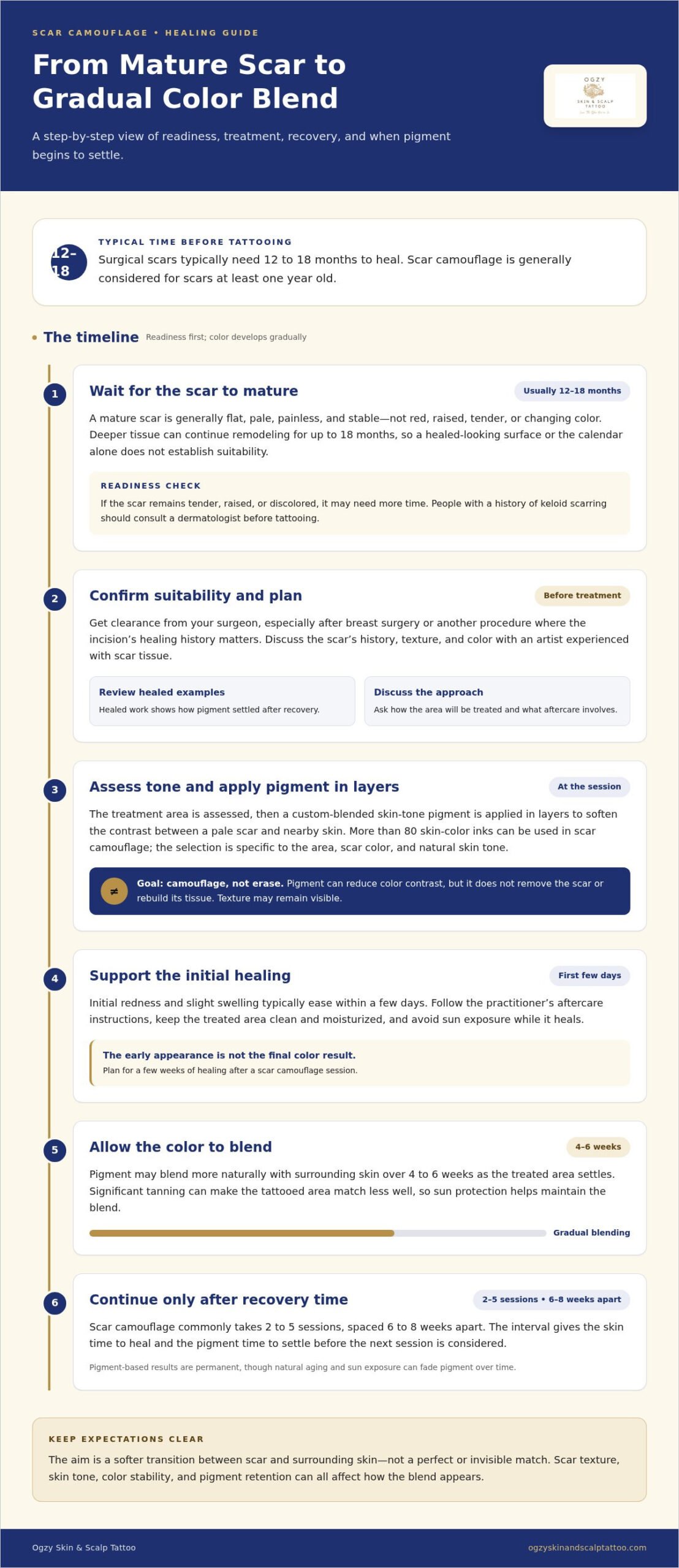
Surgical scars typically need 12 to 18 months to heal before tattooing, and scar camouflage is generally considered for scars at least one year old. A scar that looks healed on the surface can still be changing underneath, so the calendar alone doesn’t establish suitability.
Get clearance from your surgeon before treatment, especially after breast surgery or another procedure where the incision’s healing history matters. If a scar remains tender, raised, or discolored, it may not yet be mature enough for camouflage.
Expected Improvement and Its Limits
Scar camouflage places pigment to reduce the contrast between a scar and surrounding skin. It can make a pale, hypopigmented scar less noticeable, but it doesn’t remove the scar or rebuild its tissue. The aim is camouflage, not a change to the incision’s shape or depth.
Texture can affect how evenly pigment appears, so an indented or raised scar may remain visible even when its color blends more closely. Skin tone, scar color, and stability all shape the approach. Aftercare matters too: significant tanning can make the treated area match less well, so sun protection helps maintain the blend.
What Is Medical Tattooing for Scars?
For medical tattooing for surgical scars in Round Rock, skin-tone pigment can reduce the contrast of a pale scar. The treatment area is assessed first, then a custom-blended pigment is applied in layers to help create a gradual transition.
Pigment Matching and Skin-Tone Blending
Pigment matching means choosing a color that complements the skin around a scar. A shade that looks close in one area may stand out against different surrounding skin, so matching takes more than a quick visual comparison.
The practitioner considers natural skin tone and the scar’s existing color before blending pigment. For example, a lighter tummy tuck incision may need a different blend from a pale breast surgery scar. The aim is a softer transition, not a perfect or invisible match.
Medical tattooing is especially useful for hypopigmented scars, where tissue has lost pigment and looks lighter than nearby skin. More than 80 skin-color inks can be used in scar camouflage. The selection process focuses on the specific treatment area, rather than choosing one shade for every scar.
Factors Affecting Pigment Results
Pigment results depend on the chosen color, the scar’s appearance, and how the treated skin retains pigment. Scars can differ from surrounding skin in both tone and texture, so these factors shape the outcome.
Natural skin aging and sun exposure can fade pigment over time. Significant tanning can also make the tattooed area match less well, so sun protection helps maintain the blend. Changes in a scar’s color after surgery or other trauma can affect how closely the pigment appears to match.
Layered application allows the practitioner to build pigment gradually across the scar. Each layer helps create a controlled blend rather than placing one dense shade over the entire area. Pigment-based results are permanent, but natural fading can change their appearance over time.
Think through the desired color and the permanence before treatment. If you’re also considering unwanted tattoo pigment, laser tattoo removal is a separate option to learn about. For scar camouflage, the central goal is a subtle transition between the treated tissue and nearby skin, not a seamless result that erases the scar.
Is there downtime after the treatment?
Scar camouflage involves an initial surface-healing period, followed by gradual color blending. A consultation helps plan treatment around the scar’s condition and the time needed between procedures.
Prepare by arriving with the scar fully healed and following the practitioner’s pre-treatment directions. After tattooing, follow the aftercare instructions, keep the treated area clean and moisturized, and avoid sun exposure while it heals. These steps support recovery and help protect pigment as the skin settles.
Plan for a few weeks of healing after a scar camouflage session. Initial redness and slight swelling typically ease within a few days, but the treated area takes longer to recover. Pigment may blend more naturally with surrounding skin over 4 to 6 weeks, so the early appearance isn’t the final color result.
Scar camouflage commonly takes 2 to 5 sessions, spaced 6 to 8 weeks apart. That interval gives the skin time to heal and the pigment to settle before the next treatment is planned. A touch-up may also be needed weeks after an initial session, depending on how the color appears after recovery.
Comfort is part of treatment planning. Topical anesthetic cream is applied at least 30 minutes before scar camouflage treatment. The amount of time needed and the approach can vary with the treatment area and the scar’s texture, so discuss comfort concerns during the consultation rather than waiting until the procedure begins.
Microneedling may be considered before pigment application when scar texture needs attention. Sessions are typically spaced several weeks apart to allow time for recovery. The scar should heal after texture-focused treatment before pigment camouflage begins; combining approaches does not mean performing them simultaneously.
During a consultation, discuss the surgical scar’s history, current texture, and color contrast. These details help shape a plan for session spacing, comfort measures, and aftercare. If the area is still healing, planning should wait until the scar is mature; tattooing a changing scar can interfere with a stable blend.
After each session, keep the treated area clean and moisturized as directed, and protect it from sun exposure. Significant tanning can make tattooed skin match the surrounding area less well. Allow the skin to heal before judging the blend or arranging another session. Progress is gradual, not an instant color match.
Expected healing timeline
Healing follows two separate timelines: recovery from surgery and recovery after scar camouflage. A surgical wound’s surface typically closes in about two weeks, while deeper tissues continue healing. That milestone doesn’t mean the scar is ready for pigment. Tattooing should wait until the scar has matured, and the treated area then needs its own recovery period.
Immediately after camouflage, redness and slight swelling typically subside within a few days. This early response is part of initial healing, not a reliable preview of the final appearance. For example, a pale breast incision may look more flushed just after pigment application, then appear calmer as the skin recovers. Follow the artist’s aftercare instructions during this stage.
The treated skin takes a few weeks to heal. Keep the area clean and moisturized as directed, and avoid sun exposure while it recovers. Significant tanning can make the tattooed area match the surrounding skin less well. Sun protection helps maintain a natural-looking blend beyond the initial aftercare period.
Color blending takes longer than the initial surface recovery. Scar camouflage pigment is described as blending naturally with surrounding skin after 4 to 6 weeks. That interval gives the reader a more realistic point for assessing color than the first days after treatment. A skilled artist considers the healed appearance, because early redness can make pigment look uneven.
Assess texture and color separately. A scar’s surface may remain indented or raised even when pigment softens its color contrast. A flat, pale incision and an uneven scar present different visual challenges. Camouflage addresses pigment difference; it doesn’t replace scar tissue or change an incision’s shape. Realistic expectations start with understanding that distinction.
Use each healing stage to notice how the treated area changes. In the first few days, focus on redness, slight swelling, cleanliness, and the instructed moisturizer. Over the following few weeks, allow the skin to heal before judging texture or color. At 4 to 6 weeks, the blend offers a more useful view of the result than an immediate post-treatment check.
Healing also depends on protecting the area from tanning and following aftercare consistently. If the treated scar sits beside skin that tans significantly, the contrast can shift as surrounding skin darkens. A realistic assessment considers both the scar and nearby skin, rather than judging pigment in isolation. Allowing the full recovery period gives a clearer view of the blend.
Medical tattooing to camouflage hypopigmented scars
Hypopigmented scars have lost pigment, leaving lighter areas against the surrounding skin. Medical tattooing adds carefully selected color to soften that contrast, focusing on camouflage rather than removing scar tissue or changing the incision itself.
Several types of healed surgical scars may be considered, including lighter tummy tuck scars, breast lift scars, and other surgical incisions. A breast augmentation incision can also leave a visible color difference; suitability depends on the scar’s condition and its contrast with nearby skin.
The distinction matters: a scar can be fully healed yet remain pale, drawing attention through color rather than raised or indented texture. Pigment camouflage addresses that color difference. It doesn’t fill a depression, flatten raised tissue, or recreate the skin’s original structure, so texture may remain noticeable.
During assessment, the tattoo artist considers the surrounding skin tone and the scar’s lighter appearance. Custom-blended pigment is selected to complement natural skin color and applied in layers, helping create a gradual transition instead of a sharp border. A pale abdominal incision and a light breast scar, for example, may need different blends, even on the same person.
Color matching is more complex than choosing a shade that looks similar at first glance. Skin tone varies across the body, and a scar may respond differently from nearby skin. Sun exposure and natural skin aging can fade pigment over time. Significant tanning can make the treated area match less well, so sun protection helps maintain the blend.
Camouflage is best suited to a stable, healed scar with persistent pigment loss. It isn’t intended for an incision that is still changing or inflamed. An artist reviews the scar’s color and texture together and sets realistic expectations: blending can reduce contrast, but an exact match or invisible scar isn’t the goal.
If a pale surgical scar remains a visual concern, explore scar camouflage treatment options and consider how pigment blending could address its color contrast. The clearest starting point is identifying whether color, texture, or both contribute to the scar’s appearance.
Ogzy Skin & Scalp Tattoo: Scar and Stretch Mark Revision
Ogzy Skin & Scalp Tattoo offers Scar & Stretch Mark Revision for people considering options for a healed surgical scar or stretch mark. No-ink revision uses medical-grade serums, while Scar Camouflage uses custom-blended pigment to reduce visible color contrast. Microneedling may be considered when skin texture is part of the concern.
A useful next step is to discuss what you’d like to change and how your scar looks now. This conversation can help connect your concern with an appropriate revision approach and clarify the process, without treating camouflage as scar removal or promising a particular result.
To explore Scar & Stretch Mark Revision, contact Ogzy Skin & Scalp Tattoo or visit ogzyskinandscalptattoo.com.
Take the Next Step Toward Feeling More at Ease
Choosing whether to pursue medical tattooing for surgical scars in Round Rock is a personal decision. Take time to consider what you want to change, what you’re comfortable with, and how a subtle shift in appearance might support your confidence. A thoughtful conversation can help clarify your priorities without rushing you toward treatment.
Ogzy Skin & Scalp Tattoo offers Scar & Stretch Mark Revision and Microneedling for scar-related concerns. Scalp Micropigmentation (SMP) is also available, but addresses a different goal. The right conversation starts with the area you want to address and the outcome that matters most to you.
If you’re ready to discuss scar revision and explore a considered next step, contact Ogzy Skin & Scalp Tattoo. You can move forward at your own pace, with a clearer sense of the options that fit your goals.
Frequently Asked Questions
What is Scar Camouflage?
Scar Camouflage is paramedical tattooing that uses custom-blended pigment to soften a scar’s color contrast with nearby skin. It differs from no-ink scar revision, which uses medical-grade serums rather than pigment. A pale line on the abdomen, for example, may be treated with a tone selected to blend with the surrounding area. Camouflage changes color appearance, not the scar’s underlying shape or texture.
Does a tattoo hurt more over scar tissue?
Sensation varies from person to person and across different scar areas. Scar tissue may feel less sensitive than nearby skin, or more sensitive, depending on the scar and its history. A topical anesthetic cream is applied at least 30 minutes before scar camouflage treatment. Share any concerns during planning, especially if the area remains tender, so comfort measures can be discussed before the session begins.
How long does the treatment last?
Pigment-based scar camouflage is considered permanent, but sun exposure and natural skin aging can fade the color over time. As the surrounding skin changes, the softened contrast may change too. Tanning, for instance, can deepen nearby skin color while the treated area remains lighter. Sun protection supports a more consistent blend, and periodic touch-ups may help maintain the appearance.
How many sessions are needed?
Scar camouflage commonly takes 2 to 5 sessions, with treatments spaced 6 to 8 weeks apart. The number depends on how the pigment settles and how much blending the area needs. A small, pale mark and a broader patch of pigment loss may require different treatment plans. Allowing time between appointments lets the skin recover before the next layer is considered.
Indications: Who is a Good Candidate?
A good candidate has a fully healed, stable scar with a persistent color difference, especially a lighter hypopigmented area. The scar should be flat, pale, and painless rather than inflamed or still changing. Someone with a keloid history should consult a dermatologist, and anyone considering treatment over a surgical scar should get their surgeon’s clearance. Both texture and color affect suitability.
What is medical tattooing for surgical scars?
Medical tattooing for surgical scars in Round Rock places skin-tone pigment into a healed scar to reduce contrast with nearby skin. It may be considered for lighter tummy tuck scars, breast lift scars, or other surgical incisions. The practitioner assesses the scar and surrounding tone before selecting a custom pigment blend. This is camouflage, not surgical repair: it doesn’t remove the scar or restore the tissue’s original texture.
How many sessions are needed for surgical scar tattooing?
Surgical scar camouflage commonly requires 2 to 5 sessions, generally spaced 6 to 8 weeks apart. The plan depends on the treated area and how the pigment settles as the skin heals. For example, a larger pale incision may need a gradual approach rather than one dense application. A later touch-up can refine the blend after the initial pigment has settled.
When can you get a tattoo over a surgical scar?
Wait until the scar is fully healed and stable; surgical scars typically need 12 to 18 months before tattooing. A flat, pale, painless scar is a more suitable sign than one that remains raised, tender, or changes color. The deeper tissue can continue remodeling for up to 18 months, so surface closure alone doesn’t mean the scar is ready. Get surgeon clearance first.

Article by
Opal Z
Opal is the owner and practitioner behind OGZY Skin & Scalp Tattoo in Austin, Texas. With more than three years in business and a longtime background in the aesthetics industry, she specializes in corrective and restorative treatments designed to address concerns that traditional aesthetics often overlook.
Her work focuses on scar and stretch mark revision, scar camouflage, scalp micropigmentation (SMP), hair regrowth treatments, and laser tattoo and permanent makeup removal. Opal works with a wide range of skin tones and takes an individualized approach to every client, considering skin color, texture, scar characteristics, treatment history, and realistic long-term outcomes.
Through OGZY Skin & Scalp Tattoo, her goal is to combine artistry, aesthetics, and technical treatment knowledge to help clients feel more comfortable and confident in their skin.
Love the skin you’re in.