
Natural-looking SMP in Austin is created gradually, rather than in a single sitting. Scalp Micropigmentation uses precision pigment deposits to replicate natural hair follicles, with each session building on the pattern. Staging the work allows the practitioner to assess how the pigment settles before refining the result.
A clear timeline helps you decide whether SMP suits your needs, especially if hair loss or a visible scalp scar affects how you feel about your appearance. The treatment area, your preferred look, and how your scalp responds all shape the plan.
Learn why SMP is usually completed over multiple sessions, what influences the treatment timeline, and what to look for when reviewing a practitioner’s work. You’ll also see how SMP can create the appearance of fuller coverage or camouflage scalp scars, and how design choices help the result look natural against your hair color and skin tone.
Key Takeaways
- Gradual pigment placement gives the practitioner room to refine hairline shape and density between sessions.
- Use before-and-after photos to assess how a practitioner’s work looks across different hairlines, skin tones, and treatment areas.
- SMP may help create the appearance of density for thinning hair and camouflage certain scars; the right approach depends on the area and goal.
- Your treatment timeline is shaped by the size of the area, your desired look, and how your scalp responds between appointments.
- Learn what details support a natural-looking result, including pigment selection and the way the finished work blends with existing hair.
Why I don’t do Scalp Micropigmentation in one session?
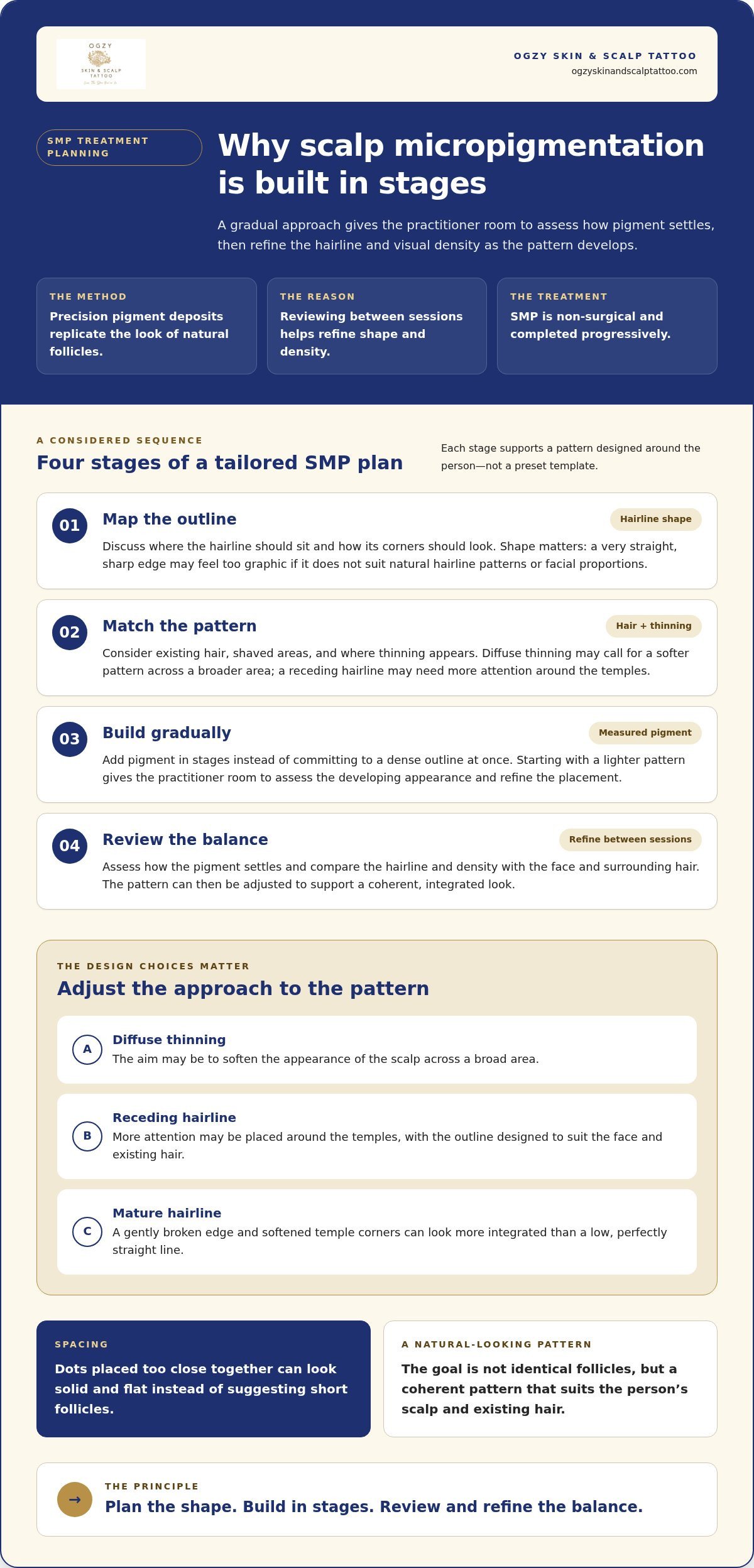
A natural-looking result is built gradually, not drawn on all at once. Scalp Micropigmentation uses precision pigment deposits to replicate natural hair follicles, with each session adding to the overall pattern. Staging the treatment gives the practitioner a chance to review the developing appearance and refine the hairline and visual density. SMP is non-surgical.
A hairline frames the face, so its shape matters as much as pigment placement. A straight, sharply defined edge-up can look striking, but may seem too graphic if it doesn’t suit your natural hairline or facial proportions. A softer, irregular outline can better suggest the varied edge of closely cropped follicles. The design should reflect your preferred look, rather than follow a preset template.
Density also calls for a measured approach. Pigment dots placed too close together can create a solid, flat appearance instead of suggesting short follicles. A practitioner can start with a lighter pattern and assess whether more pigment is needed to balance thinning areas. For example, diffuse thinning may call for softening the appearance of the scalp across a broad area, while a receding hairline may need more attention around the temples.
- Map the outline: Discuss where the hairline should sit and how its corners should look.
- Match the pattern: Consider existing hair, shaved areas, and the distribution of thinning.
- Build gradually: Add pigment in stages so the pattern can be refined, not rushed.
- Review the balance: Compare the hairline and density with the face and surrounding hair.
A mature hairline makes customized design especially important. A low, perfectly straight line may conflict with your age, facial structure, or remaining hair. A gently broken edge with softened temple corners can look more integrated. For natural-looking SMP in Austin, the aim isn’t to make every follicle identical, but to create a coherent pattern that suits you.
Multiple sessions support this careful process. Pigment is deposited in stages, allowing the practitioner to refine shape and density as the treatment progresses. Reviewing the result between appointments helps avoid committing to a dense outline too quickly. That restraint matters for both subtle hairline work and a sharply defined finish. A considered plan starts with your preferred look, then adapts pigment placement to complement your scalp and existing hair.
Evaluating practitioner experience and client reviews
Evaluate technique, healed results, and hygiene practices together. In Texas, requirements can depend on how SMP is classified and performed, so no single credential demonstrates artistic skill. Look for disposable needles and equipment for each client, then review work that resembles your hair color and treatment goals.
Practitioner Experience
Experience shows in the details. Review before-and-after photos of previous treatments, including clear views of hairlines, temples, and thinning areas. Look for balanced spacing, soft transitions, and pigment that complements surrounding hair, rather than a dense, uniform pattern.
Compare examples that match your needs. A shaved scalp calls for a different approach from longer hair with visible thinning. Blonde and red hair also call for careful pigment selection. Hair color alone doesn’t determine the shade; skin tone and the desired contrast matter, too. Look for examples with similar coloring and treatment areas to yours.
During a consultation, explain the look you want and any concerns, such as a receding hairline or patchy density. Notice whether the practitioner clearly discusses design choices, including how the proposed hairline fits your features. A considered plan should address both the shape and how it transitions into existing hair.
Client Results and Reviews
Photos show visible outcomes, while reviews can describe the client experience. Look for specific details about whether the practitioner listened to preferences, explained session planning, and communicated after treatment. A useful review explains the client’s goals and experience, rather than relying only on general praise.
Look for consistency across several examples. One polished image can’t show how a design works across different skin tones, hair colors, or degrees of hair loss. Review pictures from multiple angles and, where available, healed results. This helps you assess whether the hairline looks soft from the front and remains coherent at the temples.
- Compare like with like: Find results that resemble your hair color, skin tone, and treatment area.
- Study the details: Notice hairline shape, dot spacing, and transitions around existing hair.
- Read for specifics: Prioritize reviews that explain the process and the client’s actual goals.
- Discuss your preferences: Bring examples to a consultation and describe what feels natural to you.
For a closer look at how SMP treatment planning can account for individual hairlines and pigment choices, use your consultation to discuss your goals and concerns. A clear conversation helps connect portfolio examples to the design you’re considering.
SMP for different types of hair loss and scar camouflage
Scalp Micropigmentation can create the appearance of fuller coverage across several hair-loss patterns. It can address pattern baldness, receding hairlines, thinning hair, alopecia, and scalp scars, including hair-transplant scars. The design depends on the concern: a shaved scalp calls for an even follicle pattern, while diffuse thinning may call for pigment among existing hair.
For pattern baldness, the treated area may cover a broad part of the scalp. A receding hairline usually focuses on the front and temples, where shape affects the overall impression. For thinning hair, pigment can soften the contrast between visible scalp and existing strands. With alopecia, the treatment pattern and coverage depend on the areas you want to camouflage.
Scalp scar camouflage needs its own design plan. A hair-transplant scar may be linear or irregular, and it may be hidden by surrounding hair or exposed by a close shave. SMP uses precision pigment deposits to replicate natural hair follicles and blend the scar visually with nearby follicles. The practitioner considers the scar’s outline, surrounding hair direction, and contrast with the adjacent scalp.
Scalp scars vary in size, location, and appearance, so one pattern won’t suit every mark. A narrow line at the back of the head, for example, may need a different placement strategy from a wider patch near the crown. The goal is visual integration, not scar removal. Mapping the area first helps show where pigment should transition into natural hair or existing SMP.
- Identify the concern: Note whether the goal is coverage for thinning, a receding hairline, alopecia, or a scar.
- Map the area: Mark the boundary and observe nearby hair direction and density.
- Plan the transition: Blend the pattern from the treated area into surrounding follicles.
- Set the visual goal: Decide whether you want a closely shaved appearance or subtle density support.
Before choosing a design, describe how you usually wear your hair. If you keep a close shave, you may want broader coverage than someone styling longer hair over thinning areas. For a transplant scar, explain where it shows with your usual haircut. These practical details connect the treatment map to your everyday grooming.
SMP changes the scalp’s appearance, but doesn’t recreate growing hair. Matching the design to the specific concern, such as diffuse thinning or a transplant scar, makes the planned coverage more coherent. A clear discussion of the treatment area and your preferred look gives the design a useful starting point.
Session durations and treatment timelines
SMP is a non-surgical treatment that uses precision pigment deposits to replicate natural hair follicles. A consultation connects your goals with a treatment plan. The treatment area, existing hair, desired density, and your scalp’s response all influence the timeline.
Possible risks include irritation, infection, sensitivity, or pigment that heals differently than intended. Because SMP uses fine needles, discuss your medical history, scalp condition, and aftercare needs during planning.
A consultation is the practical first step. Describe whether you want to address a receding hairline, diffuse thinning, or a scalp scar. Explain your usual hairstyle and the density you want to create. The practitioner can assess the treatment area, discuss design choices, and outline how the work may be staged. Bring specific concerns, such as a visible crown or a transplant scar beneath a close haircut.
Session duration depends on the size of the treatment area and the detail required. A small thinning area needs a different plan from broader scalp coverage. SMP is commonly completed over multiple sessions so pigment can be added gradually and the developing pattern reviewed. Time between appointments allows the scalp to settle before further refinement.
Plan around treatment stages rather than expecting one appointment to complete every detail. The first stage establishes a foundation; later work can build density or refine transitions. The pace depends on the treatment area, your preferred appearance, and how the pigment settles. A practitioner can map these factors during a consultation and explain how they shape your schedule.
- Describe your goal: Identify the area and appearance you want, such as subtle crown coverage.
- Map the treatment: Review the boundaries, hairline, and density needs.
- Discuss stages: Clarify how the plan progresses and what each appointment addresses.
- Allow recovery time: Follow the recommended aftercare between sessions.
Pricing depends on the case and is provided after a quote request. Factors include the treatment area, design complexity, and planned sessions. Ask what each quoted stage includes, so you can understand how initial pigment placement and later refinement fit into the overall plan.
Personalized planning also accounts for existing hair and how you style it. Someone who keeps a close shave may want a different coverage pattern from someone with longer hair and visible thinning. SMP creates the appearance of follicle density; it doesn’t regrow hair. Hair Regrowth Treatment addresses a different goal, so clarify which outcome matters most when choosing a plan.
Natural-looking scalp micropigmentation
A natural appearance depends on more than pigment shade. The dot pattern, spacing, hairline, and contrast with the scalp all contribute. SMP uses precision pigment deposits to replicate natural hair follicles. A convincing design considers how the impressions look together, rather than treating each dot as an isolated mark.
Pigment color should complement both your natural hair color and skin tone. A shade chosen only to resemble dark hair, for example, may look too stark against lighter skin. Blonde and red hair also call for a considered color choice, since natural hair may create less contrast with the scalp. The goal is visual harmony with your overall coloring, not an exact match to one strand.
Pattern matters as much as shade. An overly uniform layout can look artificial, while variation in placement helps suggest the irregularity of natural follicles. A soft hairline transition can look more natural than a sharply drawn border. The design should also connect with existing hair, whether you want a close-shaved appearance or added visual density.
- Review the outline: Check that the hairline suits your face and usual hairstyle.
- Assess the color: Consider natural hair color and skin tone together.
- Look at the pattern: Notice whether follicle impressions appear balanced, not stamped in rows.
- Consider the transition: Check how treated areas meet existing hair or a scar.
Use these details when discussing your design. Someone with a shaved head may want a consistent follicle effect across the scalp. If you have thinning hair, you may prefer to soften the contrast between visible scalp and strands. If you’re addressing a scar, the focus may be blending its appearance into nearby follicles. Each goal calls for attention to a different area and transition.
Aftercare and maintenance also affect how pigment looks over time. With proper care and maintenance, SMP pigment can retain its color and shape for several years. Disposable needles and equipment for each client are important hygiene considerations. Ask how the treatment plan accounts for your scalp, the intended design, and care after each session.
For natural-looking SMP in Austin, use a consultation to review pigment choices, hairline design, and the look you want in everyday settings. Discuss a natural-looking scalp design and how its details can complement your hair and skin tone.
Ogzy Skin & Scalp Tattoo: Scar and Stretch Mark Revision
Ogzy Skin & Scalp Tattoo offers Scar & Stretch Mark Revision, including no-ink treatment with medical-grade serums and scar camouflage with custom-blended pigments. For scalp hair loss or scalp scar camouflage, Scalp Micropigmentation uses precision pigment deposits to replicate natural hair follicles. Microneedling Skin Rejuvenation and Hair Regrowth Treatment address different concerns related to skin and hair appearance.
If you’re considering treatment, start by identifying the area you want to address and the change you hope to see. A focused conversation can connect your concern, whether it’s a scalp scar, thinning hair, or a stretch mark, with a relevant option. Contact Ogzy Skin & Scalp Tattoo in Austin to discuss your goals and treatment options.
Take the Next Step Toward a Look That Feels Like You
Choosing a treatment is also a chance to define what confidence looks like in your everyday life. Consider what you want to feel more comfortable with, from how your hairline looks in natural light to how a scalp scar appears with your usual hairstyle. Those priorities can guide a focused conversation about design and treatment options.
For natural-looking SMP in Austin, a personal discussion can turn your preferences into a considered plan. Ogzy Skin & Scalp Tattoo offers Scalp Micropigmentation (SMP), Scar & Stretch Mark Revision, and Microneedling Skin Rejuvenation. Each service addresses a different concern, so the right starting point depends on the area you want to address and your goals.
Take the next step at your own pace. Contact Ogzy Skin & Scalp Tattoo to discuss your goals and explore a suitable path forward. You deserve an approach that respects your preferences and helps you feel more at ease in your own appearance.
Frequently Asked Questions
What does natural-looking scalp micropigmentation (SMP) look like?
Natural-looking SMP resembles closely cropped follicles, with a pattern suited to your overall appearance. Look for a soft hairline, balanced spacing, and pigment that doesn’t form an obvious solid block. A shaved look should appear consistent across the scalp, while density work should blend with existing hair. The goal is a coherent follicle simulation, not the appearance of drawn-on hair.
How do SMP providers in Austin create a natural hairline and match pigment to skin tone?
The hairline is designed around your features, existing hair, and preferred style, with pigment selected to complement your hair color and skin tone. A useful consultation includes reviewing the proposed outline from different angles and discussing how it will look with your usual haircut. Bring a reference photo if you have one, but use it as a guide rather than a template to copy exactly.
Which Austin SMP clinics have natural-looking before-and-after results?
Ogzy Skin & Scalp Tattoo offers SMP in Austin. When reviewing results, look for before-and-after examples that clearly show the treatment area, including the hairline and temples. Compare cases with hair color, skin tone, and goals similar to yours. Notice whether the images show consistent, believable follicle patterns rather than relying on one dramatic photo or broad claims.
How much does scalp micropigmentation cost in Austin, Texas?
The treatment area and design needs affect where a case falls within that range. Ask for a quote that explains how your specific goals shape the plan. For SMP, a 25% deposit is required at booking, with the balance due at the first session.
How many SMP sessions are needed, and how long does each session take?
SMP is generally completed over multiple sessions, while the number and duration depend on the treatment area and design. Treating a small thinning area differs from creating coverage across a larger scalp, so your appointment schedule is personalized. During planning, ask what each stage addresses and how time between visits fits your calendar. This helps you plan around work, travel, and regular grooming.
How long does SMP last, and when are touch-ups needed?
With proper care and maintenance, SMP pigment can retain its color and shape for several years. Touch-up timing depends on how the pigment changes and whether you want to maintain the same appearance. Keep track of changes in color or definition and discuss them during a follow-up. Your hairstyle and how much scalp remains visible can also affect when a refresh feels worthwhile.
How should I compare Austin SMP providers and verify their experience?
Compare portfolios, client reviews, and the provider’s explanation of your proposed design. Review before-and-after photos from previous treatments, especially examples resembling your hairline, coloring, or treatment area. Look for clear discussion of goals and concerns, plus disposable needles and equipment for each client. In Austin, consider whether the practitioner can explain why a particular hairline and pigment choice suit your individual features.
What should I do before and after an SMP appointment?
Before your appointment, write down your goals, note any previous scalp treatments, and bring reference images of your preferred style. Ask for preparation and aftercare instructions tailored to your treatment plan rather than assuming every scalp needs the same routine. After the appointment, follow those instructions and contact the practitioner if you have questions about your care. Keep your plan available between sessions for easy reference.

Article by
Opal Z
Opal is the owner and practitioner behind OGZY Skin & Scalp Tattoo in Austin, Texas. With more than three years in business and a longtime background in the aesthetics industry, she specializes in corrective and restorative treatments designed to address concerns that traditional aesthetics often overlook.
Her work focuses on scar and stretch mark revision, scar camouflage, scalp micropigmentation (SMP), hair regrowth treatments, and laser tattoo and permanent makeup removal. Opal works with a wide range of skin tones and takes an individualized approach to every client, considering skin color, texture, scar characteristics, treatment history, and realistic long-term outcomes.
Through OGZY Skin & Scalp Tattoo, her goal is to combine artistry, aesthetics, and technical treatment knowledge to help clients feel more comfortable and confident in their skin.
Love the skin you’re in.