Scar camouflage is about restoring appearance, not simply adding color. A paramedical tattoo artist in Georgetown may use custom-blended pigment to help scars blend with the surrounding skin. But ink isn’t always the first step: no-ink scar and stretch mark revision uses medical-grade serums instead.
If you’re considering scar or stretch mark care, it’s reasonable to want a natural-looking result and to understand how the process works before deciding. Scarred skin can respond differently from unscarred skin, so training, healed examples, and a thoughtful assessment of your skin matter.
This guide explains what paramedical tattooing can involve, what to look for when assessing an artist’s training and credentials, and why revision may take multiple sessions. You’ll also learn how ink and inkless approaches differ, what to consider when choosing local or traveling care, and when a consultation can help clarify what may be realistic for your scar.
Key Takeaways
- Paramedical tattooing can support scar camouflage and pigment restoration, with an approach tailored to the area and the skin.
- When assessing an artist, look for relevant training, safety practices, and healed examples on skin tones similar to yours.
- Scarred or radiation-treated skin may respond differently during tattooing, so experience with the specific tissue matters.
- Local care can make follow-up easier, while a traveling specialist may require more planning around sessions and healing.
- Scar revision often builds gradually; learn how inkless preparation and pigment may fit into a personalized plan.
1. What Is a Paramedical Tattoo Artist?
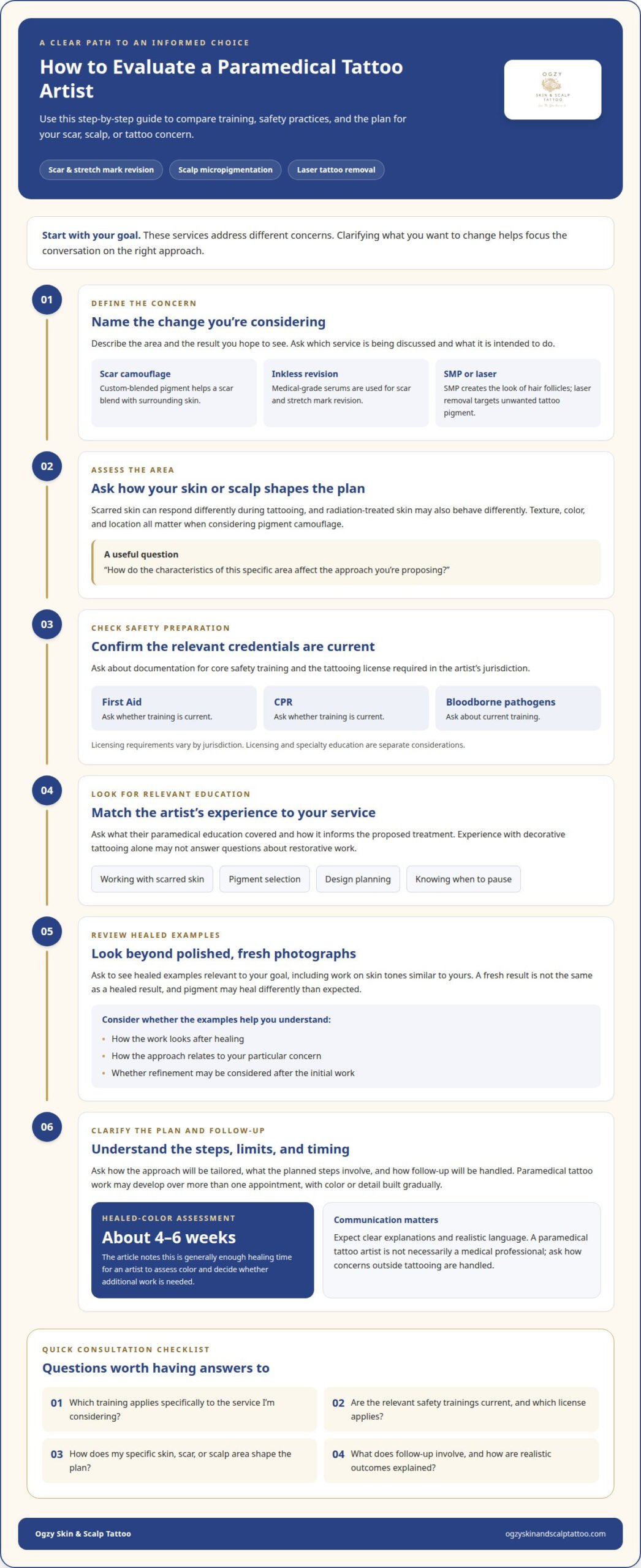
A paramedical tattoo artist in Georgetown can use different techniques for different visual concerns. Scar camouflage uses custom-blended pigment to blend a scar with natural skin tone. No-ink scar and stretch mark revision uses medical-grade serums, while SMP creates the look of hair follicles and laser tattoo removal targets unwanted pigment. Start by identifying what you want to change.
For scars and stretch marks, revision may use an inkless approach, pigment camouflage, or both at different stages. SMP uses pigment to create the look of hair follicles on the scalp. Laser tattoo removal targets unwanted tattoo pigment. These approaches don’t perform the same function, even when one specialist offers them all.
Scarred skin can respond differently during tattooing, and radiation-treated skin may also behave differently. The scar’s texture, color, and location help shape the conversation about whether pigment camouflage is appropriate. For example, a flat, pale scar presents a different visual concern from a darker scar. The area should be assessed on its own characteristics.
Before treatment, ask which service addresses your concern and how it works. Ask how the approach will be tailored to the scar or scalp area, what the planned steps involve, and how follow-up will be handled. Healed examples relevant to your goal can also help you understand the kind of work being discussed.
Possible considerations include pigment healing differently than expected and needing refinement after the initial work. Scarred or radiation-treated skin may respond differently during tattooing. Discuss how the artist considers those differences and what outcomes are realistic for your skin and goals.
Paramedical tattoo work often develops over more than one appointment, with color or detail built gradually. A fresh result isn’t the same as a healed result. Paramedical tattoos generally take about 4–6 weeks to heal enough for an artist to assess color and decide whether additional work is needed. Follow-up gives you and the artist a chance to review the settled appearance.
For your consultation, describe the area you want addressed and the change you hope to see. Whether you’re considering scar camouflage, no-ink revision, SMP, or laser tattoo removal, understanding each service’s purpose helps focus the discussion.
2. Artist training, credentials, and licensing
Choosing a paramedical tattoo artist in Georgetown means looking beyond polished photographs. Ask about experience with the specific restorative service you’re considering, not only decorative tattooing. Scar tissue can differ in texture and pigment response, so relevant examples can help you assess whether the artist’s work aligns with your goals.
Start with core safety preparation. A paramedical tattoo artist should have current First Aid and CPR training, bloodborne pathogen training, and any local or state tattooing license required in their jurisdiction. Ask to see documentation and confirm that training is current. These credentials support safer practice, but they don’t establish expertise with every scar type.
Next, ask what the artist’s paramedical education covered. Useful topics include working with scarred skin, pigment selection, design planning, and recognizing when tattooing isn’t the right next step. Ask for a clear explanation of how those lessons shape the proposed treatment. Specific answers are more informative than a broad claim of experience.
Training should also include a clear understanding of professional boundaries. Paramedical tattoo artists aren’t necessarily medical professionals. Ask how the artist handles concerns that fall outside tattooing, such as a scar that appears to be changing. A responsible response distinguishes cosmetic tattoo work from medical assessment and explains when another type of care is appropriate.
During a consultation, use focused questions to understand the artist’s preparation:
- Which training applies specifically to scar or pigment restoration?
- Are First Aid, CPR, and bloodborne pathogen training current?
- Which local or state tattooing license applies to the artist’s practice?
- How does the artist decide whether to proceed, adapt the plan, or pause?
Look for answers that connect the proposed treatment to your specific concern. The artist should explain how the service works, what steps are involved, and what kind of change it is intended to create. Make sure you understand the plan before deciding whether it suits your goals.
Licensing requirements can depend on the artist’s jurisdiction, so ask which local or state requirement applies in Georgetown, Texas. The relevant license is a separate consideration from specialty training. Both matter: licensing addresses the applicable tattooing rules, while additional education helps develop skills for restorative work.
Notice how the artist communicates. Clear explanations, realistic language, and direct answers help you make an informed choice. Ask for plain language if anything is unclear. You should understand the proposed treatment, how it relates to your goals, and what its limits are.
3. Choosing a local artist or traveling specialist
For scar revision, scalp micropigmentation (SMP), or laser tattoo removal, compare how location affects the full appointment process. A nearby studio may make follow-up visits easier to arrange. A traveling specialist may require you to plan around the dates they’re in town and how later appointments will fit your schedule.
Georgetown residents can consider care in Georgetown or nearby communities, including Austin, Cedar Park, Leander, and Round Rock. The practical choice depends on your treatment goal and the arrangements needed for follow-up. For example, scar revision may involve several visits, while laser tattoo removal also requires a treatment plan that accounts for later appointments.
To choose an artist for scars, stretch marks, SMP, or tattoo removal, focus on the specific service and examples of relevant work. For scars, look for healed examples of similar areas. For SMP, review scalp work. For laser removal, ask how the treatment plan addresses the unwanted pigment.
Travel can add planning details. Before choosing a traveling specialist, understand where appointments will take place and how follow-up is arranged if you need another visit. For a local artist, consider whether the location and appointment schedule work for you. Either way, clear communication about the steps and visit planning helps you make an informed decision.
Reviews from Georgetown and nearby communities, including Austin, Cedar Park, Leander, and Round Rock, can offer perspective on communication, scheduling, and follow-up. Read comments about the specific service you’re considering rather than relying only on a general rating. Reviews describe individual experiences, so compare them with relevant work examples and the information shared during a consultation.
Look for specific details in reviews. A description of how the artist explained an SMP plan or arranged scar-revision follow-up gives more context than a brief rating. Reviews can help you understand the appointment experience, but they don’t replace reviewing examples related to your goals.
Use these points to compare practical fit:
- Does the artist show examples for the service you’re considering?
- Can you understand the proposed appointment and follow-up arrangements?
- Will travel or a local location fit your schedule for future visits?
- Do reviews describe the specific service and communication experience?
A local option may make repeat visits simpler, while a traveling specialist may suit your plans if appointments align. For Georgetown-area readers, weigh the service-specific work, communication, and visit logistics together. That comparison can help you choose care that feels manageable from the first appointment through follow-up.
4. Definition of paramedical and restorative tattooing
“Restorative” describes the visual purpose of the work: refining how an area looks rather than adding decorative artwork. “Paramedical tattooing” often refers to tattoo techniques used for that purpose. These terms describe an approach, not a medical diagnosis or a promise that skin will return to an earlier state.
Scar camouflage focuses on blending a scar with the surrounding skin using custom-blended pigment. No-ink scar and stretch mark revision is a separate approach that uses medical-grade serums, without pigment, to stimulate collagen and elastin production. The right option depends on the concern and the area being treated.
Scalp micropigmentation (SMP) has a different visual aim. Precision pigment deposits replicate the appearance of natural hair follicles and create the look of density on the scalp. SMP doesn’t create hair. Unlike scar camouflage, it creates a follicle-like appearance rather than blending a scar.
Laser tattoo removal has another purpose. Nd:YAG laser technology breaks down unwanted pigment to fade tattoos, permanent makeup, and scalp micropigmentation. It doesn’t create a restorative appearance and isn’t the same process as scar revision or SMP.
The goal matters. Before discussing a technique, identify what you want to change: a scar’s contrast, the look of scalp density, or unwanted tattoo pigment. This distinction helps focus the conversation on the service that matches your concern.
Restorative work has clear limits. A cosmetic treatment changes appearance; it doesn’t reconstruct tissue or replace medical assessment. If your goal is scar camouflage, describe the contrast you’d like to soften. If you’re considering SMP, explain the scalp appearance you want to create. If unwanted tattoo pigment is the concern, discuss removal.
The treatment plan should match the goal. Scar camouflage uses custom-blended pigment to blend the scar with natural skin tone. SMP uses precision pigment deposits to replicate natural hair follicles. Laser removal uses Nd:YAG technology to break down unwanted pigment. Each service follows a different process.
Understanding these terms can help you describe your priorities without needing to know the technical method in advance. Explain what you hope to change, then ask how the proposed service addresses that appearance. The purpose and limits of the treatment should be clear to you.
5. Scar camouflage and pigment restoration
Scar camouflage uses pigment to soften the difference between a scar and nearby skin. It’s a visual blending approach, not a way to remove the scar. The artist considers the scar’s color, texture, and location before deciding whether pigment is appropriate.
Ink isn’t always the first step. No-ink scar and stretch mark revision uses medical-grade serums to stimulate collagen and elastin production, without pigment. Scar camouflage is a separate option that uses custom-blended pigment to blend the area with natural skin tone.
A useful consultation clarifies the proposed sequence. Ask whether the plan begins inkless, includes pigment, or may combine both approaches. For example, the artist may recommend preparation first, then assess the area again before discussing color camouflage. That distinction helps you understand what each stage is intended to address.
Pigment restoration also depends on the concern being treated. Hyperpigmentation is addressed only when it comes from a scar. Scars and stretch marks can be treated on most body areas, including under the eyes, but the location and skin characteristics shape the plan.
Pigment tattooing used to cover a scar, sometimes called scar-covering dermatography, requires a tailored approach and may involve more than one session. Gradual work allows pigment to be built up over appointments instead of treating the first application as the final appearance.
Ask these practical questions before deciding:
- Will the approach begin with regenerative serum, pigment, or both?
- What is each stage intended to do for this scar?
- How will the artist evaluate the area before adding pigment?
- What follow-up will help assess healed color and detail?
For postpartum stretch marks, treatment can be considered after breastfeeding has stopped; clients who are breastfeeding can’t be treated. Sharing that detail during a consultation helps shape an appropriate conversation about timing and the available approach.
The key point is that scar care isn’t simply about matching a color. No-ink scar and stretch mark revision uses medical-grade serums without pigment, while scar camouflage uses custom-blended pigment. A consultation can help clarify which approach addresses your concern and what may be realistic for your skin and goals.
If you’re considering scar or stretch mark camouflage, book a consultation to discuss your options.
Ogzy Skin & Scalp Tattoo: Scar and Stretch Mark Revision
Ogzy Skin & Scalp Tattoo offers no-ink scar and stretch mark revision using medical-grade serums, as well as scar camouflage using custom-blended pigment. The approaches serve different purposes, and not every concern calls for pigment. In a consultation with Opal, you can discuss your goals, the area you’d like addressed, and which approach fits your priorities.
For scars or stretch marks that affect how you feel in your skin, a consultation is a practical next step. Visit Ogzy at 13130 Pond Springs Rd #1105, Austin, TX 78729, or contact Ogzy Skin & Scalp Tattoo to discuss scar and stretch mark revision.
Take the Next Step With a Clear Goal
Before choosing a paramedical tattoo artist in Georgetown, consider what you’d most like to change: the contrast of a scar, its visibility in certain clothing, or how it looks in everyday settings. A clear goal can make your consultation more focused. Describe what draws your attention and what a subtle change would mean to you.
You don’t need to arrive with a fixed treatment plan. Bring your questions, describe the area, and discuss which approach aligns with your priorities. A consultation can help you understand what may be realistic for your skin and scar.
If you’re ready to discuss scar or stretch mark revision, contact Ogzy Skin & Scalp Tattoo. The studio is at 13130 Pond Springs Rd #1105, Austin, TX 78729. Take the next step at your own pace, with a clearer sense of what you want to explore.
Frequently Asked Questions
What Is a Paramedical Tattoo Artist?
A paramedical tattoo artist uses tattooing to create a restorative visual effect, such as blending pigment across a scar. For someone considering scar camouflage, the consultation should clarify the treatment goal, the area involved, and whether inkless preparation comes before pigment. Ask how the proposed approach differs from decorative tattoo design, and whether healed examples show work similar to your concern.
How Many Sessions Will You Need?
Scar and stretch mark revision commonly involves about 3 to 5 sessions, spaced 6 to 8 weeks apart, depending on how your skin heals. More extensive or severe scars can need more than 5 sessions. These are general expectations, not a guaranteed schedule. Your artist can explain how the area’s condition and healing will guide decisions about later appointments.
How does the process differ from more design-based tattooing in the traditional sense?
Restorative tattooing focuses on the appearance of a specific area rather than creating decorative artwork. Scar camouflage uses custom-blended pigment to blend a scar with natural skin tone, while decorative tattooing adds chosen imagery. Discuss the visual goal and how the pigment will be adapted to the area and surrounding skin.
What Kind of Results Are Realistic?
Realistic goals focus on softening contrast or reducing the appearance of a scar, rather than removing it. Skin, scar type, and healing influence how pigment appears. For example, a color blend that looks subtle on one person may heal differently on another. Discuss the visual change you hope to see and review healed examples, not only freshly completed work.
Is paramedical tattooing regulated or licensed in Texas?
Licensing requirements depend on the jurisdiction, so ask which tattooing license applies to the artist’s practice in Texas. You can also ask to review current First Aid and CPR training and bloodborne pathogen training. These credentials are separate from specialized restorative tattoo education. Confirming the applicable requirements helps you understand the artist’s professional preparation without assuming a specialty title replaces licensing.
What happens during a paramedical tattoo consultation and treatment process?
A consultation typically begins with your goals and the area you want addressed, followed by a discussion of a suitable approach. At Ogzy Skin & Scalp Tattoo, a valid credit card is required to book a consultation. Ask what to expect at each visit and how follow-up will be coordinated.
Risks and side effects of paramedical tattooing
Scarred or radiation-treated skin may respond differently during tattooing, and pigment may heal differently than expected. Refinement may be needed after the initial work.
Paramedical tattoo artist reviews near Georgetown Texas
Reviews from Georgetown and nearby Austin, Cedar Park, Leander, and Round Rock can offer insight into communication, scheduling, and follow-up. Look for comments about the specific service you’re considering, and compare them with relevant healed examples and consultation details.

Article by
Opal Z
Opal is the owner and practitioner behind OGZY Skin & Scalp Tattoo in Austin, Texas. With more than three years in business and a longtime background in the aesthetics industry, she specializes in corrective and restorative treatments designed to address concerns that traditional aesthetics often overlook.
Her work focuses on scar and stretch mark revision, scar camouflage, scalp micropigmentation (SMP), hair regrowth treatments, and laser tattoo and permanent makeup removal. Opal works with a wide range of skin tones and takes an individualized approach to every client, considering skin color, texture, scar characteristics, treatment history, and realistic long-term outcomes.
Through OGZY Skin & Scalp Tattoo, her goal is to combine artistry, aesthetics, and technical treatment knowledge to help clients feel more comfortable and confident in their skin.
Love the skin you’re in.