
What if thinning hair could be addressed by supporting the follicles you still have, rather than going straight to surgery? If your crown is thinning or your hairline is receding, it’s understandable to want fuller-looking hair without the worry of surgical scarring. A regenerative hair regrowth treatment uses approaches such as medical-grade stem cells and growth factors to support the scalp and existing follicles, though results depend on the cause of hair loss and the follicles’ condition.
So, can regenerative treatments help you grow hair back? They may support thicker, fuller-looking hair where viable follicles remain, but they can’t create new follicles in completely bald areas, and outcomes aren’t guaranteed. The terminology can also be confusing: “stem cell” and “growth factor” treatments aren’t all the same, so it’s sensible to ask what a treatment contains and what evidence supports it.
This 2026 guide explains how regenerative options work, how they compare with other non-surgical approaches, and what to consider when assessing medical credibility and realistic expectations. You’ll also learn how a restorative focus on scalp health may fit into a personalized plan, with the goal of improving density while avoiding transplant surgery and its recovery.
Key Takeaways
- Learn how a regenerative hair regrowth treatment uses biological signals to support a healthier scalp environment and fuller-looking hair.
- Understand how regenerative approaches differ from surgical restoration, including the practical tradeoffs to consider.
- Discover what to discuss when assessing treatment ingredients, your hair-loss pattern, and realistic expectations.
- Get a preview of the treatment journey, from identifying your concerns to learning how the approach may be tailored.
- Explore Ogzy’s restorative approach and local service context for Cedar Park, Round Rock, and Georgetown residents.
What is Regenerative Hair Regrowth Treatment?
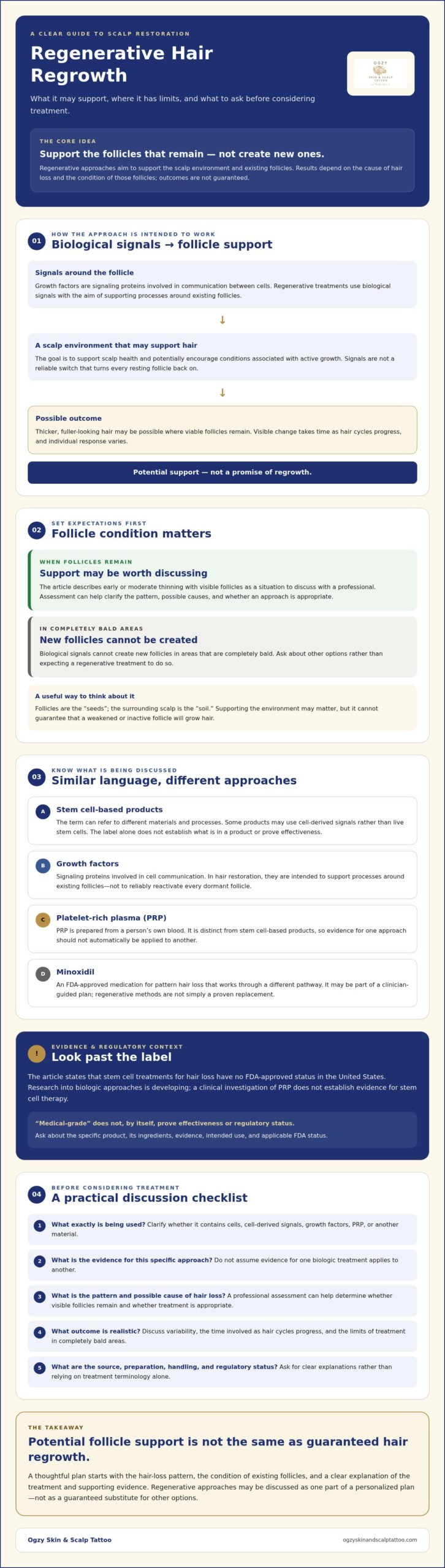
A regenerative hair regrowth treatment aims to support existing hair follicles by delivering biological signals to the scalp. Rather than concealing thinning, the approach focuses on the scalp environment and the follicles that may still produce hair. The goal is thicker, fuller-looking hair, not the creation of new follicles in areas that are completely bald.
The word “regenerative” can describe different approaches, so ask what a treatment actually contains. Some use growth factors or other biologic materials; Platelet-rich plasma (PRP), for example, is prepared from a person’s own blood and is distinct from stem cell-based products. These terms aren’t interchangeable. As of 2026, stem cell treatments for hair loss have no FDA-approved status in the United States, so view claims carefully and discuss evidence and risks with a qualified medical professional.
That context makes 2026 a useful point to take stock, not a guarantee of a breakthrough. Interest in biologic approaches continues, but separating established options from investigational ones matters. Minoxidil remains an FDA-approved medication for pattern hair loss; regenerative methods are not simply a proven replacement.
How Regenerative Therapy Differs from Traditional Solutions
Topical treatments such as minoxidil work through a different pathway and may be part of a clinician-guided plan. Regenerative approaches focus on signals around the follicle. Stem cell terminology can be especially confusing: a product described as stem cell-derived may contain signaling substances rather than live stem cells. Ask precisely what is being used and what evidence supports it.
A restorative perspective considers scalp and hair together. The “soil and seed” analogy helps: follicles are the seeds, while the surrounding scalp is the soil that supports their function. Improving the scalp environment may matter, but it can’t guarantee that a weakened or inactive follicle will grow hair.
The Role of Growth Factors in Scalp Health
Growth factors are signaling proteins involved in communication between cells. In hair restoration, they’re intended to support processes around existing follicles, sometimes described as helping a follicle shift from a resting phase toward active growth. Think of them as potential signals, not fuel that reliably switches every dormant follicle back on.
“Medical-grade” alone doesn’t establish a product’s effectiveness or regulatory status. Ask about its ingredients, source, intended use, evidence, and applicable FDA status. Over-the-counter serums also vary, so compare specific formulations rather than assuming clinical language means proven results.
This approach may be worth discussing if you have early or moderate thinning and visible follicles remain. A professional assessment can help identify the pattern and possible causes of hair loss, clarify whether regenerative treatment is appropriate, and set realistic expectations. If an area is completely bald, ask about other options rather than expecting biologic signals to create new follicles.
The Science of Stem Cells and Growth Factors for Hair
Hair follicles rely on signals from the cells around them. Stem cell-based products and growth factors are discussed in regenerative care because they may influence this local cell-to-cell communication. The aim is to support the scalp environment and existing follicles, not to create new follicles or guarantee that a resting follicle will resume growth. In a regenerative hair regrowth treatment, understanding what’s applied and how it’s delivered matters as much as the terminology.
Hair grows in cycles, including periods of active growth and rest. Biological signals may help create conditions that support a shift toward growth, but the response varies, and visible changes take time as hair cycles progress. Research is still developing: for example, this National Cancer Institute clinical trial investigates platelet-rich plasma for hair loss. PRP is not the same as stem cell therapy, so evidence for one approach shouldn’t automatically be applied to another.
The Power of Medical-Grade Stem Cells
“Stem cell” can refer to different materials and processes. Some treatments use cells; others use cell-derived signals, such as growth factors. Source, preparation, concentration, and handling can all affect what a product contains, so the label alone doesn’t prove effectiveness. Ask a provider to explain exactly what is being used, what evidence supports it for hair loss, and what its regulatory status is. As of 2026, no stem cell treatment for hair loss is FDA-approved in the United States.
The scalp-first idea is restorative: support the tissue around follicles rather than focusing on hair alone. Cellular changes aren’t immediately visible, and there’s no reliable universal timeline for results. A careful provider should explain what changes may be monitored and when to reassess, without promising a particular outcome.
Microneedling: A Delivery Approach
Professional microneedling uses fine needles to create controlled microchannels in the skin. This may support collagen production as part of the skin’s repair response, while also providing a route for selected topical products. The channel depth, technique, and product suitability matter; microneedling doesn’t make every serum appropriate for scalp use or prove that a product will regrow hair.
At-home derma-rollers can be difficult to use consistently and hygienically, and pressure or technique may vary. Professional application allows the scalp to be assessed and the procedure tailored, with aftercare explained. If you’re exploring a restorative, scalp-first plan, you can learn more about Ogzy’s hair regrowth treatment and discuss which approach may suit your needs.
Regenerative Hair Regrowth vs. Surgical Transplants
These approaches address hair loss in different ways. A transplant surgically moves follicles from one area of the scalp to another. Regenerative treatment aims to support existing follicles and the scalp environment without transplant surgery. Neither option suits everyone, and regenerative treatments can’t create new follicles where none remain.
Recovery also differs. Transplants involve surgical healing, and the recovery experience depends on the procedure and individual. Non-surgical treatments avoid transplant incisions, but that doesn’t mean there’s no aftercare or that everyone can return to normal activities immediately. Ask a provider what recovery involves for the specific method being considered.
Scarring is another consideration. FUT, sometimes called the strip method, can leave a linear scar, while FUE can leave small dot scars where follicles were removed. A non-surgical approach avoids those transplant scars, though any procedure involving the skin has potential risks. For people concerned about visible marks, a discussion of healing, candidacy, and realistic outcomes can help clarify the tradeoffs.
Think about long-term value rather than assuming one option is automatically more cost-effective. Surgical restoration may involve a substantial initial commitment; non-surgical approaches may require ongoing maintenance or repeat sessions. Compare the full plan, including follow-up, upkeep, and what happens if hair loss progresses. Specific costs vary, so request details for the treatment being considered.
When to Choose Regenerative Treatment
A regenerative hair regrowth treatment may be worth discussing for early thinning or diffuse hair loss when follicles are still present. It can appeal to people who prefer to avoid surgery and its associated incision scars, but suitability depends on the cause and pattern of hair loss. Learn more about hair regrowth without surgery, then ask a qualified provider whether your scalp and goals are a match.
Can Regenerative Therapy Complement Other Treatments?
Some people explore regenerative care after a transplant, but whether it’s appropriate should be discussed with the clinician who performed the surgery. Growth factors shouldn’t be assumed to improve transplant success. Microneedling and biologic products may be offered together in some treatment plans, but the rationale and evidence should be explained for each specific combination.
Scalp micropigmentation (SMP) serves a different purpose: it creates the appearance of density through carefully placed pigment rather than biologically regrowing hair. Regenerative treatment focuses on supporting existing follicles; SMP is an aesthetic simulation. Depending on personal goals, readers can explore scalp micropigmentation in Cedar Park to understand how the approaches differ.
What to Expect During Your Treatment Journey
A regenerative hair regrowth treatment should begin with understanding your hair-loss pattern, scalp condition, and goals, not with a one-size-fits-all protocol. The exact process depends on the method and products selected, so ask what each step involves and what results are realistic for your situation.
The Initial Consultation at Ogzy
A thorough discussion can help clarify whether the focus should be biological regrowth, the appearance of density, or another approach. You may be asked about when thinning began, where it’s most noticeable, and what changes you’ve observed. A scalp assessment can help guide treatment planning, but it shouldn’t be treated as a diagnosis of the underlying cause of hair loss.
Before proceeding, ask how your hair type and pattern inform the plan, what biologic materials will be used, and how progress will be evaluated. Because responses vary, a responsible discussion should cover limitations as well as potential benefits. Thicker, fuller-looking hair may be the goal, but no specific outcome or timeline can be promised.
During the Session
If the treatment plan includes microneedling, the provider works across the selected scalp areas using a device with fine needles. People may describe the sensation as prickling, pressure, or vibration, but comfort varies by person and technique. Ask what you can expect, how discomfort is managed, and whether the procedure is appropriate for your scalp. The provider should explain how any biologic product is applied and why it’s included in your plan.
After the session, the scalp may look temporarily flushed or feel sensitive. Don’t assume there’s a universal “golden window” for absorption or apply extra products in hopes of improving results. Follow the specific aftercare instructions you’re given, including guidance on washing, scalp products, sun exposure, and when to resume your usual routine.
Aftercare and Long-Term Scalp Maintenance
Keep the first day simple: avoid improvising with new products, and contact your provider if you’re unsure what’s safe for your scalp. Your instructions should reflect the procedure and products used. Ask when to expect follow-up, what signs of progress will be tracked, and how the plan may be adjusted over time. Repeated sessions may be discussed, but their timing and suitability should be individualized rather than assumed.
For people in the greater Austin area, including Cedar Park and Round Rock, Ogzy Skin & Scalp Tattoo offers hair regrowth treatment using medical-grade stem cells and growth factors. Ask Ogzy about its hair regrowth treatment and what a scalp-focused plan may involve.
Why Central Texas Chooses Ogzy for Scalp Restoration
Choosing a hair restoration provider is personal. For residents across the greater Austin area, including Cedar Park and Round Rock, Ogzy Skin & Scalp Tattoo offers a local option focused on non-surgical restoration. Its work brings biological approaches using medical-grade stem cells and growth factors together with scalp micropigmentation (SMP), which creates the appearance of density rather than regrowing hair. These methods serve different goals, so understanding the distinction can help you ask more informed questions.
Owned by Opal, a specialist in paramedical tattooing and skin rejuvenation, Ogzy takes a restorative perspective: consider the scalp as well as the hair, and tailor the approach to the person. A regenerative hair regrowth treatment aims to support existing follicles, while SMP uses carefully placed pigment to simulate density. Neither approach is right for everyone, and a thoughtful discussion should include realistic expectations, limitations, and which method aligns with your priorities.
The Ogzy Difference: Empathy and Expertise
Hair loss can affect how comfortable you feel in everyday situations. A supportive provider should make room for those concerns without turning them into pressure to proceed. Ask what a recommended treatment involves, what evidence supports it, and what alternatives may be worth considering. Look for clear answers rather than promises of a particular result.
Natural-looking outcomes depend on matching the technique to your hair pattern, scalp, and desired level of change. If you’re considering SMP, ask how pigment placement is planned to blend with your existing hair and how the aesthetic result differs from biological regrowth. For local perspectives, review current, verifiable client feedback and note whether it describes the service you’re considering; testimonials can’t predict your individual outcome.
Ogzy also offers microneedling and scar revision. If you’re exploring care for a scar, learn more about microneedling for scars in Cedar Park. Each concern calls for its own assessment and treatment plan.
Your Path to Renewed Confidence
Restoration isn’t only about appearance. Feeling more at ease with your reflection can matter, too, and it’s reasonable to take time to decide what feels right. Before choosing a service, bring questions about your hair-loss pattern, the materials or techniques involved, potential risks, aftercare, and how progress will be assessed.
If you’re in Cedar Park, Round Rock, Georgetown, or the wider Austin area, you can explore Ogzy’s hair restoration options and learn more about the approaches available. Start with clear information, then choose a path that fits your needs and expectations.
Take the Next Step Toward Fuller-Looking Hair
Choosing a hair restoration path starts with understanding what each approach can and can’t do. Regenerative treatments focus on supporting existing follicles and scalp health, while scalp micropigmentation creates the appearance of density. Neither can promise the same result for every person, so realistic expectations and a personalized assessment matter.
A regenerative hair regrowth treatment may be one option to discuss if you’re seeking non-surgical care. Ogzy Skin & Scalp Tattoo specializes in medical-grade stem cells and growth factors, with a restorative approach tailored to Central Texas residents. Microneedling is also among the services offered, though the right plan depends on your needs and the details of the treatment.
If you’re in Cedar Park or the greater Austin area, take the next step by asking questions about your scalp, treatment options, and likely outcomes. Book your regenerative hair restoration consultation in Cedar Park to explore whether Ogzy’s approach may suit you. A clear, thoughtful conversation can help you move forward with greater confidence, at your own pace.
Frequently Asked Questions
Is regenerative hair regrowth treatment permanent?
No, a regenerative hair regrowth treatment shouldn’t be considered a permanent cure for hair loss. It may support existing follicles, but the underlying cause of thinning can continue, and results vary from person to person. A provider can explain whether maintenance or other care may be appropriate for your situation. Ask how progress will be assessed and what factors could affect the longevity of any changes.
How many sessions of regenerative therapy will I need?
There’s no single session count that suits everyone. The number and spacing of sessions depend on the treatment used, your scalp and hair-loss pattern, and how you respond. During an assessment, ask what course is being proposed, why it’s recommended, and when progress will be reviewed. Be cautious of a fixed session plan presented as a guarantee, since individual results can’t be predicted precisely.
Does the stem cell hair treatment hurt?
It can cause some discomfort, especially if microneedling is part of the treatment, but the sensation varies by person and technique. People may describe needling as prickling, pressure, or vibration. Before the session, ask what procedure and products will be used, what you may feel, and how comfort is addressed. Share any scalp sensitivity or relevant health concerns with the provider before treatment begins.
Can I combine regenerative treatment with Scalp Micropigmentation?
Potentially, but the two approaches have different purposes and shouldn’t be treated as interchangeable. Regenerative treatment aims to support existing follicles, while Scalp Micropigmentation (SMP) creates the appearance of density with pigment. A provider can help you consider whether both fit your goals and discuss appropriate timing. Ask how each may affect the scalp and what to expect from biological regrowth versus visual simulation.
Is this treatment safe for all hair and skin types?
No treatment should be assumed suitable for every person or scalp. Suitability depends on factors such as your health, scalp condition, hair-loss cause, and the specific products and techniques involved. Ask for the ingredients and evidence behind any biologic product, and discuss possible risks and aftercare. In the United States, stem cell treatments for hair loss aren’t FDA-approved as of 2026, so clarify the product’s regulatory status.
How soon will I see results from growth factor hair therapy?
There’s no reliable timeline that applies to everyone. Hair grows in cycles, so changes, if they occur, may take time to become noticeable, and response depends on factors such as the cause of hair loss and whether follicles remain. Ask your provider when to review progress and what will be monitored. Avoid relying on guaranteed timelines or before-and-after claims as a prediction of your own results.
Is there any downtime after a microneedling hair session?
Some people experience temporary scalp redness or sensitivity after microneedling, but the response and recovery vary. Ask the provider what to expect for the specific technique used and when to resume washing, exercise, sun exposure, or your usual scalp products. Follow the aftercare instructions rather than applying additional serums or products on your own. Contact the provider if a reaction concerns you or doesn’t improve as expected.
Can this treatment help with alopecia or severe thinning?
It depends on the type and cause of alopecia and whether viable follicles remain. Regenerative approaches aim to support existing follicles; they can’t create new ones in completely bald areas, and severe thinning may need a different strategy. Seek an appropriate medical assessment to understand the cause before choosing treatment. Ogzy serves Austin, Cedar Park, Leander, Round Rock, and Georgetown, offering hair regrowth treatment and SMP for different restoration goals.

Article by
Opal Z
Opal is the owner and practitioner behind OGZY Skin & Scalp Tattoo in Austin, Texas. With more than three years in business and a longtime background in the aesthetics industry, she specializes in corrective and restorative treatments designed to address concerns that traditional aesthetics often overlook.
Her work focuses on scar and stretch mark revision, scar camouflage, scalp micropigmentation (SMP), hair regrowth treatments, and laser tattoo and permanent makeup removal. Opal works with a wide range of skin tones and takes an individualized approach to every client, considering skin color, texture, scar characteristics, treatment history, and realistic long-term outcomes.
Through OGZY Skin & Scalp Tattoo, her goal is to combine artistry, aesthetics, and technical treatment knowledge to help clients feel more comfortable and confident in their skin.
Love the skin you’re in.