
Melanin is not a barrier to clearing your skin; it is a call for higher clinical precision. For too long, individuals with deeper complexions have been told that laser tattoo removal dark skin was either too risky or simply impossible without causing permanent discoloration or scarring. You likely feel a deep sense of hesitation if you’ve seen others deal with patchiness or if a generic clinic previously turned you away. It’s completely understandable to be protective of your skin’s health, especially when an unwanted tattoo carries an emotional weight you’re finally ready to release.
We’re here to change that narrative by focusing on the restorative power of specialized technology. This 2026 guide reveals how the 1064 nm Nd:YAG laser serves as the clinical gold standard for Fitzpatrick IV through VI skin, bypassing surface melanin to shatter ink while avoiding heat damage. You’ll discover the specialized protocols that prioritize your long-term skin health, the science behind preventing pigmentary changes, and how a dedicated specialist can help you reclaim your self-assurance. We’ll walk through the specific laser settings required for safety and the methodical steps involved in achieving a clear, natural-looking result.
Key Takeaways
- Learn why the 1064nm Nd:YAG laser is the clinical gold standard for safely bypassing surface melanin to target deep ink without damaging the epidermis.
- Understand how modern technology makes laser tattoo removal dark skin a safe and effective reality by prioritizing photoacoustic energy over bulk heating.
- Discover the truth about hyperpigmentation and keloids, including the specific clinical protocols used to prevent permanent skin discoloration or ghosting.
- Master essential pre-treatment and aftercare steps, such as strict sun avoidance and immediate cooling, to preserve your natural skin health and tone.
- Find out why choosing a specialist who understands skin at a cellular level is vital for successfully restoring your skin in the Austin area.
Can You Safely Remove Tattoos from Dark Skin?
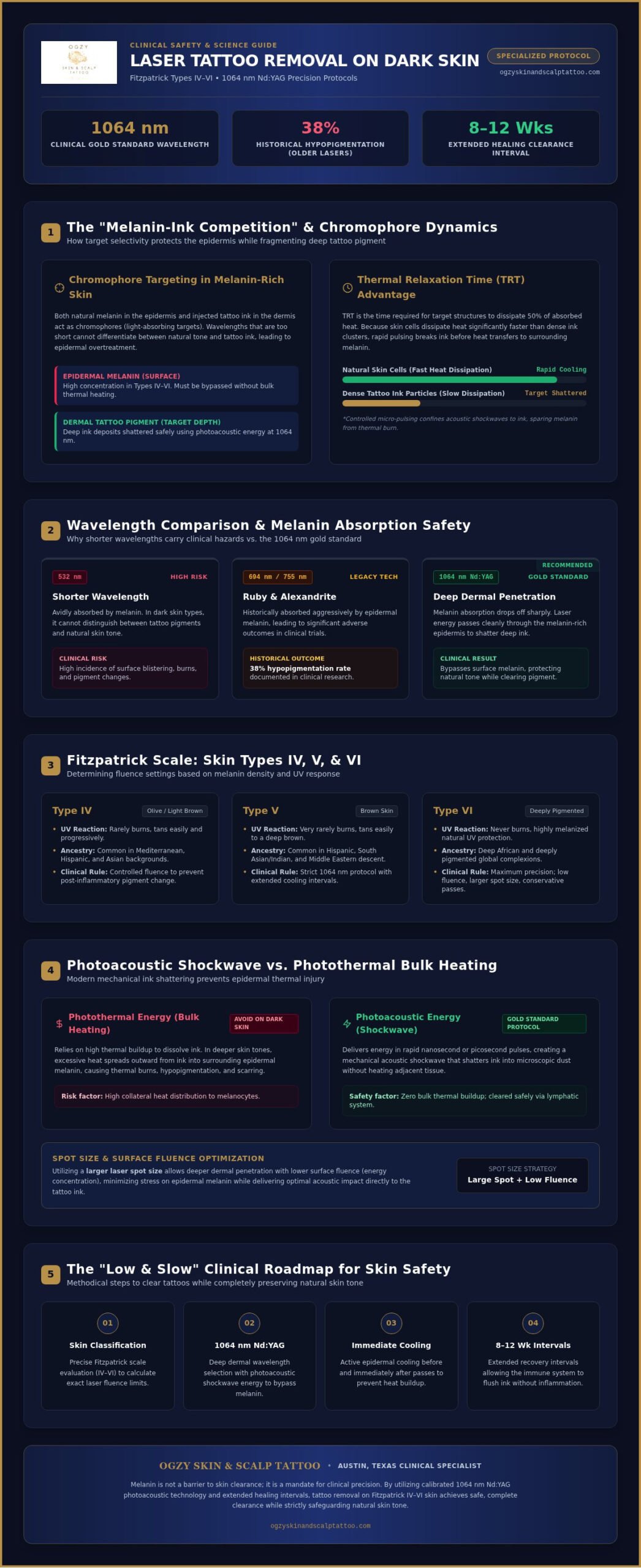
Yes, you can achieve clear, healthy skin through laser treatments, even with high levels of melanin. For years, many people with deeper complexions were told to avoid lasers due to the high risk of scarring or permanent pigment loss. Those fears were grounded in the limitations of older technology like Ruby (694 nm) or Alexandrite (755 nm) lasers. These specific wavelengths are aggressively absorbed by melanin, which led to a 38% hypopigmentation rate in darker skin types during historical clinical trials. Today, the 1064 nm Nd:YAG laser has revolutionized the industry. By utilizing a wavelength that largely bypasses the epidermis, we can safely perform laser tattoo removal dark skin without compromising your natural tone.
Success depends on your specialist’s ability to manage the delicate “melanin-ink competition.” During the laser tattoo removal process, the primary goal is to target the ink while leaving the surrounding skin undisturbed. This requires a sophisticated “low and slow” clinical approach. We use conservative energy settings and extended healing intervals, often 8 to 12 weeks, to ensure your body’s immune system clears the fragmented pigment without triggering inflammatory responses.
The Fitzpatrick Scale: Identifying Your Skin Type
The Fitzpatrick Scale is the foundation of laser safety, categorizing skin by its reaction to UV light and its concentration of melanin. For individuals of Mediterranean, Hispanic, Asian, or African descent, skin typically falls into Types IV, V, or VI. Knowing your exact type is essential because it dictates the energy levels, or fluence, used during your session.
- Type IV: Olive or light brown skin that rarely burns and tans easily.
- Type V: Brown skin that very rarely burns and tans to a deep brown.
- Type VI: Deeply pigmented skin that never burns and is highly protective against UV.
If settings are too aggressive for these types, the laser might trigger a defensive response. A tailored plan ensures the energy is high enough to shatter ink but low enough to keep your natural pigment intact.
Ink vs. Melanin: The Battle for Laser Energy
Lasers target “chromophores,” which are specific light-absorbing molecules. In your skin, both the tattoo ink and your natural melanin act as chromophores. If a laser wavelength is too short, it can’t distinguish between the two, leading to “over-treatment” where the skin’s natural color is accidentally lifted. Thermal relaxation time refers to the period required for a target to dissipate 50% of its heat; because skin cells cool much faster than ink particles, precise pulsing allows the laser to shatter pigment without causing thermal damage to the surrounding melanin. By respecting these cellular limits, we provide a safe path for laser tattoo removal dark skin that focuses on restoration and long-term skin health.
The Science of Safe Wavelengths: 1064nm and Beyond
Precision is the cornerstone of successful laser tattoo removal dark skin. While multiple wavelengths exist, the 1064 nm Nd:YAG wavelength remains the undisputed clinical gold standard for Fitzpatrick Skin Types IV through VI. The physics are simple: melanin absorption drops off sharply at 1064 nm. This allows the laser light to pass through the melanin-rich epidermis like a ghost, reaching the deeper dermal layer where the ink resides. By bypassing the surface pigment, we minimize the risk of epidermal heating, which is the primary cause of burns and subsequent scarring in deeper skin tones.
Beyond the wavelength itself, the delivery method matters immensely. Modern protocols prioritize photoacoustic energy, which uses a mechanical shockwave to shatter ink, rather than photothermal energy, which relies on heat. Whether using picosecond or high-end nanosecond technology, the goal is to fragment pigment so finely that the body’s lymphatic system can sweep it away naturally. Following FDA guidelines on laser tattoo removal, specialists also adjust the “spot size” of the laser beam. A larger spot size allows for deeper penetration with lower surface fluence, ensuring the energy is concentrated on the tattoo rather than the surrounding tissue architecture.
Why 532nm and 694nm Wavelengths are Risky
Shorter wavelengths, such as 532 nm (used for red and orange) and 694 nm (Ruby lasers), are avidly absorbed by melanin. When these lasers hit dark skin, they cannot distinguish between the tattoo and your natural color. This often results in immediate blistering or long-term hypopigmentation, creating white “ghost” patches where the natural pigment has been destroyed. Removing multi-colored tattoos on deep skin tones requires a highly specialized approach; often, we must prioritize skin integrity over total color removal, or utilize extremely conservative passes over several years to protect the skin’s health.
Pulse Duration and Thermal Damage
Protecting your skin requires shattering the ink without “cooking” the surrounding cells. Ultra-short pulses, measured in billionths or trillionths of a second, are essential because they limit the time heat is in contact with the skin. This prevents the “bulk heating” that leads to post-inflammatory hyperpigmentation. We also advocate for a “low and slow” recovery rhythm. While lighter skin might heal in six weeks, we find that 8 to 12 week intervals are critical for melanin-rich skin. This extended time allows your macrophages to clear fragmented pigment while giving your melanocytes ample time to rest and stabilize. If you are looking for a tailored approach that respects your unique biology, consulting with a restorative specialist can provide the clarity you need for a safe transformation.
Debunking Myths: Hyperpigmentation, Keloids, and Ghosting
A common misconception persists that laser tattoo removal dark skin will inevitably lead to permanent scarring or keloids. This fear often prevents people from seeking treatment, leaving them burdened by ink they no longer want. Melanin is resilient; it just needs a precise hand. While it’s true that melanin-rich skin is more reactive to heat, modern clinical protocols have reduced the incidence of permanent scarring to under 4.5%. When a specialist uses the correct photoacoustic settings, the goal isn’t just to remove ink. We aim to restore the skin to its natural, healthy state. Knowing your skin can heal provides immense psychological relief.
Hyperpigmentation, or temporary darkening of the treated area, is a frequent part of the healing journey. Clinical data suggests that between 22% and 44% of patients with deeper skin tones experience this reaction. It’s rarely permanent. Instead, it’s a temporary inflammatory response that typically resolves within two to four months. By following American Academy of Dermatology recommendations for post-treatment care, we manage these tonal shifts effectively. Sun avoidance is your best ally during this phase.
Managing the Risk of Keloid Scarring
For our clients in Cedar Park, safety begins with a thorough screening for keloid history. If you are prone to raised scars, we approach your treatment with extra caution. Test patches are a non-negotiable first step. We treat a small, inconspicuous area and monitor it for several weeks to see how your melanocytes respond. If your skin shows sensitivity, we adjust the protocol. We lower the fluence and extend the time between sessions. This conservative path ensures we shatter the ink without triggering aggressive collagen production.
Hypopigmentation vs. Ink Residue
Distinguishing between “ghosting” and residual tattoo pigment requires a trained eye. Ghosting, or hypopigmentation, appears as a white or light patch where natural melanin has been displaced. In contrast, residual ink looks like a faint grey or blue shadow deep beneath the surface. While true hypopigmentation can be challenging to reverse, restorative treatments like microneedling for scars Cedar Park can help stimulate melanocyte migration to re-pigment the area. We prioritize a smooth, even texture that looks and feels like your natural skin.
Your Roadmap to Clear Skin: Preparation and Aftercare
The journey to a clear canvas involves more than just the minutes spent under the laser. For those seeking laser tattoo removal dark skin, the preparation and recovery phases are where your results are truly secured. It’s about creating a stable environment for your melanocytes so they don’t overreact to the treatment. Avoiding the sun for at least four weeks prior is ten times more critical for deeper complexions because UV exposure activates the very pigment-producing cells we want to keep dormant during the procedure. When your skin is in a calm, un-tanned state, the laser can focus entirely on the ink without being distracted by active surface melanin.
Once the session ends, the “cooling phase” begins. We prioritize immediate temperature control to prevent the skin from holding onto latent heat, which is a major trigger for post-inflammatory hyperpigmentation. Using chilled air during the session and gentle cooling packs afterward keeps the tissue architecture calm and prevents the “bulk heating” effect. For a detailed breakdown of these specialized protocols, you can explore our guide on Laser Tattoo Removal Aftercare in Cedar Park.
The 48-Hour Critical Window
The first two days after your session are vital for preventing adverse pigment reactions. You should avoid anything that raises your internal body temperature, including hot showers, saunas, or heavy cardiovascular exercise. We also advise against using topical creams containing retinols, AHAs, or heavy fragrances, as these irritants can trigger a defensive melanin response. A healthy healing response looks like slight swelling or a “frosted” appearance that subsides quickly. If you notice persistent darkening or unusual blistering, it’s a sign that the skin needs more soothing intervention and a slower approach in the next session.
Long-Term Skin Restoration
Total skin renewal is a marathon, not a sprint. Medical-grade sun protection is a non-negotiable part of your daily routine to prevent dark spots while the ink fades over the coming months. We often find that integrating stretch mark revision treatment techniques can further refine the skin’s texture, ensuring that the area where the tattoo once lived is as smooth and supple as the surrounding tissue. Proper hydration remains your secret weapon for lymphatic ink clearance, as a well-hydrated system moves shattered pigment particles out of the body more efficiently. If you’re ready to start your journey with a specialist who understands your skin’s unique needs, book your restorative consultation today to develop a tailored plan for your transformation.
Why Ogzy Skin & Scalp Tattoo is Austin’s Choice for Dark Skin
Finding a specialist who understands the cellular nuances of melanin shouldn’t be a gamble. In the Austin metro area, Ogzy Skin & Scalp Tattoo has become the trusted destination for individuals who seek more than a standard clinical procedure. We view your skin as a canvas for restoration, not just a surface to be treated. For residents in Austin, Cedar Park, and Round Rock, we provide a sanctuary where laser tattoo removal dark skin is performed with the meticulous detail of an artist and the precision of a technician. Our mission is to transform the emotional distress of an unwanted tattoo into the quiet confidence of clear, healthy skin.
The journey from ink regret to skin confidence is a personal one. It requires a partner who respects the history of your skin while working toward its future. At our studio, we combine sophisticated technology with a warm, reassuring approach that makes you feel understood and hopeful. We recognize that for many, an unwanted tattoo is a visible reminder of a past chapter they’re ready to close. We’re here to help you turn that page safely, ensuring your natural pigment remains protected throughout the entire process.
Restoring More Than Just Skin
Our expertise extends beyond traditional body art. We specialize in the delicate correction of cosmetic tattoos, including microbladed brows and migrated scalp micropigmentation that may have turned an unnatural shade over time. Our deep background in providing hair loss confidence solutions informs our gentle, skin-first philosophy. We understand that a botched SMP procedure or an unwanted tattoo can deeply impact how you present yourself to the world. By using advanced laser technology to clear old pigment, we create the opportunity for a refined, natural-looking result. A consultation at our Cedar Park studio is the first step toward reclaiming your skin’s natural beauty and your personal confidence.
A Partner in Your Transformation
Opal’s commitment to restorative care is personal and mission-driven. She acts as a dedicated guide, walking you through every stage of the fading process with empathy, transparency, and a reassuring bedside manner. We don’t believe in “one size fits all” protocols that ignore individual skin reactivity. Instead, we develop customized treatment plans that prioritize the long-term health of your melanocytes over the speed of removal. This methodical approach ensures that your journey with laser tattoo removal dark skin is seamless, safe, and tailored to your specific goals. If you’re ready to partner with a specialist who values your unique biology and understands skin at a cellular level, schedule your consultation for safe laser removal in Cedar Park and begin your transformation today.
Step Into a Clearer Future for Your Skin
Your skin’s health is a lifelong priority, and an unwanted tattoo shouldn’t compromise that. We’ve established that laser tattoo removal dark skin is not only possible but remarkably safe when performed with the correct 1064nm wavelength and a restorative mindset. By choosing a specialist who understands the cellular behavior of melanin, you ensure that your ink is shattered while your natural pigment remains protected. This methodical, “low and slow” approach is the foundation of our work in the Austin, Cedar Park, and Round Rock areas, where we prioritize your long-term skin health above all else.
Whether you’re looking to clear a traditional tattoo or correct a cosmetic procedure, you deserve a partner who values your skin’s integrity as much as you do. Our expertise in Fitzpatrick IV through VI skin tones provides the clinical safety you need for a successful transformation. Don’t let hesitation hold you back from the skin confidence you deserve. When you’re ready to begin your personal restoration, Book Your Safe Skin Consultation at Ogzy Skin & Scalp Tattoo. We’re here to help you reclaim your image and look forward to the clear skin ahead.
Frequently Asked Questions
Is laser tattoo removal more painful on dark skin?
Laser tattoo removal is not inherently more painful for dark skin, though individual sensitivity always varies. Most clients describe the sensation as similar to a quick rubber band snap or the original tattooing process. At our Cedar Park studio, we prioritize your comfort by utilizing advanced cooling techniques and topical numbing agents to manage heat. Our goal is a restorative experience that minimizes distress while effectively targeting the ink beneath your natural pigment.
How many sessions will it take to remove a tattoo from dark skin in 2026?
Most clients require between 6 and 10 sessions for complete clearance, though fading for a cover-up may take fewer visits. For laser tattoo removal dark skin, we often extend the intervals between sessions to 8 or 12 weeks. This “low and slow” approach allows your immune system to safely clear fragmented pigment while giving your melanocytes ample time to rest; this significantly reduces the risk of long-term pigmentary changes or textural issues.
Will my skin look ‘ashy’ or white after the laser treatment?
You may notice a temporary “frosting” or white appearance immediately after the laser hits the ink, which usually subsides within minutes. This is a normal clinical reaction to gas bubbles being released in the skin. Permanent “ashy” or white patches, known as hypopigmentation, are avoidable when using the 1064 nm wavelength. We carefully calibrate our settings to bypass surface melanin, ensuring your natural skin tone remains intact once the healing process is complete.
Can you remove colorful tattoos (blue, green, red) from dark skin safely?
Black and dark grey inks are the safest and most effective to remove from melanin-rich skin. Bright colors like red, orange, and yellow require shorter wavelengths that are more aggressively absorbed by your natural pigment. While some fading is possible, we often advise against targeting certain bright colors on Fitzpatrick V and VI skin to prevent permanent scarring. We will evaluate your specific ink colors during a consultation to determine the safest path forward.
What is the risk of hyperpigmentation after laser removal?
Transient post-inflammatory hyperpigmentation (PIH) occurs in approximately 22% to 44% of patients with deeper skin tones. This darkening is a temporary response to the laser’s energy and typically resolves on its own within two to four months. We manage this risk by using conservative energy settings and providing strict aftercare protocols. Consistent sun protection and avoiding skin irritants are your best defenses against long-term tonal shifts during the restoration process.
How much does laser tattoo removal cost in Cedar Park?
The investment for your treatment depends on several factors, including the size of the tattoo, the density of the ink, and the total number of sessions required for your specific goals. Because every skin journey is unique, we provide personalized quotes during your initial consultation at our Cedar Park studio. To make your transformation more accessible, we offer flexible financing options through Cherry and CareCredit, allowing you to focus on your skin’s restoration.
Can I get a new tattoo or SMP over the area once it’s removed?
Yes, you can absolutely get a new tattoo or scalp micropigmentation (SMP) once the treated area has fully healed. We typically recommend waiting three to six months after your final laser session to ensure the skin architecture has completely stabilized. This creates a healthy, clear canvas for a new artist to work on. Whether you are clearing a botched SMP procedure or fading an old tattoo for a cover-up, we ensure the tissue is restored first.
How do I know if my laser technician is qualified to treat dark skin?
A qualified specialist should demonstrate a deep understanding of the Fitzpatrick Scale and the specific physics of the 1064 nm Nd:YAG laser. Ask to see healed results specifically for laser tattoo removal dark skin to verify their expertise with melanin-rich complexions. At Ogzy Skin & Scalp Tattoo, Opal combines paramedical expertise with advanced laser certification to provide a restorative experience. You should feel that your provider is a partner in your journey, prioritizing safety over speed.

Article by
Opal Z
Opal is the owner and practitioner behind OGZY Skin & Scalp Tattoo in Austin, Texas. With more than three years in business and a longtime background in the aesthetics industry, she specializes in corrective and restorative treatments designed to address concerns that traditional aesthetics often overlook.
Her work focuses on scar and stretch mark revision, scar camouflage, scalp micropigmentation (SMP), hair regrowth treatments, and laser tattoo and permanent makeup removal. Opal works with a wide range of skin tones and takes an individualized approach to every client, considering skin color, texture, scar characteristics, treatment history, and realistic long-term outcomes.
Through OGZY Skin & Scalp Tattoo, her goal is to combine artistry, aesthetics, and technical treatment knowledge to help clients feel more comfortable and confident in their skin.
Love the skin you’re in.