
Can unwanted scalp micropigmentation be faded or removed without making things worse? If your SMP no longer feels right, it’s understandable to wonder how much laser treatment can change and whether your scalp could look irritated or uneven afterward. Scalp micropigmentation removal is best approached as a staged pigment plan, not a one-size-fits-all procedure.
Before deciding what comes next, it helps to understand the difference between lightening pigment and pursuing more extensive removal. Your skin type, the pigment used, and the result you hope to achieve all shape the discussion. This guide explains how laser treatment may help fade or remove unwanted SMP and what to consider when setting a goal.
You’ll also learn what happens during treatment, why progress can vary, and what to discuss about scalp sensitivity, recovery, and possible skin changes. Ogzy Skin & Scalp Tattoo uses advanced laser technology and tailors treatment plans to your skin type, pigment, and aesthetic goals. Whether you’re in Austin, Cedar Park, Leander, Round Rock, or Georgetown, a clear goal can help you make a more informed decision.
Key Takeaways
- Scalp micropigmentation removal can aim to lighten unwanted pigment or pursue more extensive removal, depending on your goals and assessment.
- Laser treatment targets pigment, but the plan and visible change can vary with your skin, pigment, and aesthetic aims.
- Clarify whether you want fading, removal, or a possible future correction before discussing your treatment plan.
- Bring details about previous SMP sessions and any known pigment information to make your assessment more useful.
- Ogzy offers advanced laser treatment for unwanted SMP, with plans tailored to individual needs in Austin, Cedar Park, Leander, Round Rock, and Georgetown.
Scalp Micropigmentation Removal: Why People Reconsider Their SMP
It’s understandable to reconsider a cosmetic treatment that changes how your scalp looks. Your preferences can shift, and a result that once felt right may now seem too dark, too defined, or out of step with your appearance. Wanting a change doesn’t mean the original treatment was necessarily unsafe or that you made a mistake. Your goals may simply be different now.
Scalp micropigmentation removal is treatment intended to fade or remove pigment placed in the scalp. The goal isn’t always to erase every trace. You might want a softer appearance, a more substantial reduction, or to create room for a later aesthetic change.
SMP and SMP removal are different processes. Scalp micropigmentation uses small pigment impressions to create the appearance of hair follicles. Removal treatment is intended to reduce or clear unwanted scalp pigment. The goal may be gradual fading rather than complete removal.
Common reasons people seek scalp micropigmentation removal
People may reconsider SMP because the result looks darker or denser than they prefer, or because the pigment appears uneven across the scalp. A hairline that once felt suitable may no longer match their style or appearance goals. Others simply feel differently about having visible scalp pigment. These concerns are personal and don’t need to be justified by a dramatic problem. A change in preference is a valid reason to explore options.
Start by defining what you want to change
Before an assessment, describe the change you’d like to see. “Less noticeable” can mean different things, so consider whether you want softer pigment, a lighter overall appearance, or more extensive removal. Note the areas or features that feel out of balance, such as the shape of the hairline or the density of pigment at the front of the scalp.
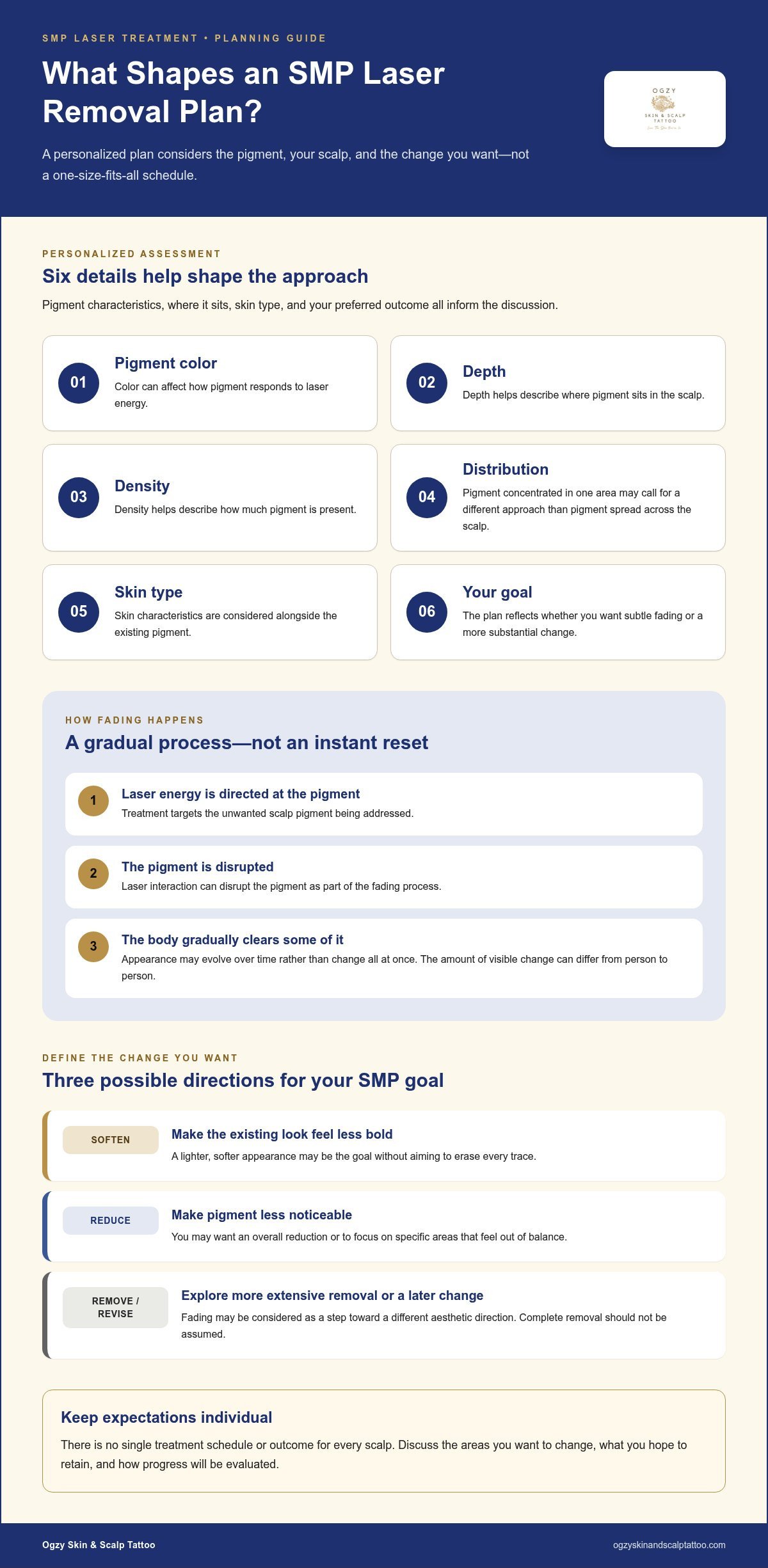
- Softer pigment: You’d like the existing look to feel less bold.
- Less visible pigment: You want to reduce how noticeable the SMP is overall or in specific areas.
- Removal: You’re interested in reducing the pigment more extensively.
- A later aesthetic change: You want to explore fading as a step toward a different look.
These descriptions don’t lock you into a particular outcome. They give you a useful starting point for discussing your skin, the pigment, and possible next steps. The more clearly you describe what you want to change and what you hope to retain, the more focused the assessment can be.
How Laser Scalp Micropigmentation Removal Works
Laser treatment targets pigment in the scalp, with the aim of fading unwanted SMP over time. It doesn’t make pigment disappear in an instant. Treatment begins a gradual process, and the body clears treated pigment over time. As a result, your scalp’s appearance may evolve between appointments rather than change all at once.
The scalp needs an individualized approach. SMP pigment can vary by location, shade, and how densely it was applied. Skin characteristics matter too. An assessment considers these details alongside your goal, whether you’re seeking a subtle reduction or a more substantial change. There isn’t one treatment schedule or outcome for everyone, and complete removal shouldn’t be assumed.
What happens to pigment during laser treatment?
During treatment, laser energy is directed at the pigment being addressed. The interaction can disrupt that pigment, after which the body gradually clears some of it. Fading is therefore a process to monitor, not an immediate visual reset. The amount of change can differ from person to person. An assessment helps set realistic expectations based on your scalp and desired result.
Why every SMP removal plan can be different
Several details inform a personalized plan. Pigment color can affect how it responds to laser energy, while depth and density help describe how much pigment is present and where it sits. Distribution matters too: pigment concentrated in one area may call for a different approach from pigment spread across the scalp. Skin type and the amount of fading you want are also relevant.
“Pigment color, depth, density, and skin type all help shape a laser plan, because each scalp presents a different starting point and treatment goal.”
These factors aren’t a checklist for predicting an exact result on your own. They’re details to review during an assessment, where the existing pigment and your aesthetic goals can be considered together. Identify the areas that concern you and what feels most important to change. Then discuss what may be achievable, how progress will be evaluated, and whether your goal is fading or more extensive removal.
Ogzy Skin & Scalp Tattoo uses advanced laser technology for unwanted SMP and tailors treatment plans to skin type, pigment, and aesthetic goals. If you’re considering laser tattoo removal for unwanted SMP, an assessment can help you discuss the change you want and realistic possibilities for your scalp.
Full Removal, Fading, or Correction: Which SMP Goal Fits?
Before considering treatment, separate the change you want from the method used to pursue it. You may want the existing pigment to feel less prominent, hope to remove as much as possible, or be thinking about a different aesthetic direction later. These goals can overlap, but they aren’t interchangeable. No responsible plan should promise the same result for every pigment or scalp.
The most suitable goal depends on the SMP you have now and the change you want to see. Use this comparison to put your thoughts into words before an assessment:
| Goal | Intended visual change | Planning considerations | Question to discuss |
|---|---|---|---|
| Fading | Make the existing pigment look softer or less noticeable, rather than aiming for a clear scalp. | The assessment considers which areas or features you’d like to retain and which you’d prefer to lighten. Fading is a goal to discuss, not a guaranteed endpoint. | Which parts of the current look would I like to keep, and which feel too prominent? |
| Pursuing removal | Reduce unwanted pigment more extensively. | The discussion should account for the existing pigment and your skin, as well as realistic expectations for the degree of change. | What level of reduction may be realistic for my current SMP? |
| Considering future correction | Explore whether reducing pigment could be part of a later change in appearance. | Removal or fading is a separate consideration from any future cosmetic treatment. The scalp and remaining pigment need their own assessment before deciding what comes next. | What would need to be considered before making a separate decision about future SMP? |
When a softer result may be the goal
You might not want to start over or remove all visible pigment. Perhaps the overall look still feels personal, but the hairline seems too defined, or one area draws more attention than you’d like. Describe what you hope to retain as clearly as what you want changed. That distinction can help Ogzy assess whether fading is a meaningful aim for you.
When removal or later rework is being considered
If you’re considering scalp micropigmentation removal, be specific about whether you’re pursuing broader pigment reduction or exploring a possible future change. Wanting removal doesn’t automatically mean another SMP treatment will be appropriate. Any later cosmetic treatment is a separate decision to make after the scalp has been assessed, with its own goals and considerations.
Ogzy Skin & Scalp Tattoo uses advanced laser technology for unwanted SMP, with plans tailored to skin type, pigment, and aesthetic goals. If you’re ready to explore realistic options, explore Ogzy’s laser tattoo removal service.
Preparing for an SMP Removal Assessment and Treatment Plan
A little preparation can make an assessment more focused. You don’t need every detail or a fixed decision. For scalp micropigmentation removal, start with what you’d like to change, then discuss your treatment history, skin, pigment, and realistic options with Ogzy.
- Define your goal. Consider whether you want the SMP to look softer, less visible in certain areas, or reduced more extensively. Describe the change you hope to see rather than expecting a specific result.
- Gather your treatment history. Note when and where your SMP was applied, how many sessions you remember having, and any known information about the pigment. Bring records or details from earlier appointments if you have them.
- Attend an assessment. Ogzy can review the current appearance of your scalp, your skin type, and your goals. Photos that show the area clearly may help document what you’re seeing and support the discussion.
- Discuss a tailored plan. Talk through suitability, the intended degree of fading or removal, possible limitations, and how progress will be reviewed. Aftercare guidance should be specific to your treatment and provided by the treating professional.
What information can help make the assessment useful?
Share what you know, even if some details are uncertain. The location of the original SMP, when it was applied, and any known pigment information can give context to the current result. Explain which areas feel out of balance and what you’d prefer to look different. Photos can provide a useful reference for that conversation, but they don’t replace an assessment.
Questions to discuss before beginning
Clear questions can help you understand the plan before deciding how to proceed. Consider discussing:
- How do my skin type and existing pigment affect suitability and the approach?
- What degree of fading or removal is a realistic goal for my SMP?
- What changes might I notice between appointments, and how will progress be reviewed?
- What limitations should I understand before treatment begins?
- What aftercare guidance will apply to my treatment?
Aftercare is part of planning, not an afterthought. Ogzy’s laser tattoo removal aftercare guide offers additional context, while the treating professional can explain the instructions that apply to your individual treatment.
Ogzy Skin & Scalp Tattoo offers advanced laser tattoo removal for unwanted SMP, with plans tailored to skin type, pigment, and aesthetic goals. Explore SMP removal options with Ogzy and take a considered next step toward the change you want.
Explore Scalp Micropigmentation Removal with Ogzy in Central Texas
If your SMP no longer reflects how you want to look, you don’t need to arrive with every answer. Ogzy Skin & Scalp Tattoo offers advanced laser tattoo removal for unwanted scalp micropigmentation. An assessment is an opportunity to discuss what feels out of step, what you’d like to change, and what may be realistic for your scalp. You can explore your options before deciding whether to move forward.
A tailored approach to unwanted scalp pigment
No two SMP results are identical, so Ogzy customizes treatment plans around your skin type, pigment, and aesthetic goals. Start with the outcome you have in mind, whether you’re hoping to soften the appearance or pursue more extensive removal. The existing pigment and your skin are considered when discussing an approach, rather than assuming one plan fits everyone.
Explain what you notice most. Perhaps the pigment feels too strong in one area, or you’d prefer a broader reduction across the scalp. Share details about earlier SMP sessions and any pigment information you know. This context helps make the assessment more specific, while a realistic discussion distinguishes what you hope for from what may be achievable. Treatment isn’t a promise of complete removal or a particular number of sessions.
If you’re reviewing how scalp micropigmentation is originally designed and applied, Ogzy’s Cedar Park scalp micropigmentation guide provides context about the treatment itself. Understanding the original procedure may help you describe what you’d like to change, especially if your concern relates to the shape, density, or overall look of your existing result.
Take a clear, comfortable next step
Use an assessment to bring your questions, not to commit to an outcome on the spot. Discuss your SMP history, the areas that concern you, whether you’re considering fading or more extensive removal, and how progress and aftercare would be addressed. It’s reasonable to raise questions about suitability and limitations. The aim is a clearer understanding of your options, with a plan shaped around your skin, pigment, and goals.
Ogzy serves people in Austin, Cedar Park, Leander, Round Rock, and Georgetown. If you’re considering scalp micropigmentation removal, an assessment can help you understand what may be possible without pressure to begin treatment. Discuss your scalp micropigmentation removal goals with Ogzy.
Move Forward at Your Own Pace
You don’t have to decide on a final outcome before exploring scalp micropigmentation removal. A useful next step is to clarify what you’d like to feel different and learn which options may fit. That conversation can turn a broad concern into a more considered choice, without asking you to commit before you’re ready.
Give yourself room to weigh the possibilities. You may leave with a clearer sense of what to ask, what matters most to you, and whether you want to take another step. Your preferences are central to the process, and it’s reasonable to move at a pace that feels comfortable.
If you’re ready to talk through your goals and possible next steps, begin a conversation with Ogzy. A thoughtful discussion can help you understand your options, and you can decide what feels right from there.
Frequently Asked Questions
Can scalp micropigmentation be completely removed?
Complete removal may be possible for some people, but it can’t be guaranteed. The visible result depends on factors such as the existing pigment and how your scalp responds to treatment. Some people may find that their goal is better described as substantial fading rather than a completely clear appearance. During an assessment, discuss what “removed” means to you and what changes may realistically be achievable.
How many laser sessions does scalp micropigmentation removal take?
There isn’t one session count that applies to everyone. The number depends on the pigment, the area being treated, your skin, and whether you’re aiming for softening or more extensive removal. Progress is assessed over time, so a plan may be adjusted as the appearance changes. Discuss how your treatment plan will be reviewed rather than relying on a fixed estimate from someone else’s experience.
Is laser removal suitable for every scalp micropigmentation treatment?
No, suitability needs to be assessed for each person and treatment. The pigment’s characteristics, its placement, and your skin type can all inform whether laser treatment is appropriate and what approach may be considered. Share relevant health or treatment history during your assessment. Ogzy works with people in Austin, Cedar Park, Leander, Round Rock, and Georgetown to discuss unwanted SMP and realistic options based on individual goals.
Does scalp micropigmentation removal hurt?
The sensation can vary from person to person and across different areas of the scalp, so it’s difficult to predict exactly how treatment will feel for you. Some people describe laser treatment as uncomfortable, while others experience it differently. Before beginning, tell Ogzy about any concerns with scalp sensitivity and discuss what sensations to expect, what comfort measures may be appropriate, and how to communicate during treatment.
Can laser treatment leave marks or scars on the scalp?
Skin changes are possible with laser treatment, and no one can responsibly promise that a particular scalp will have no marks or scarring. Your skin type, treatment history, and the plan being considered are relevant to a personalized discussion of risks. Discuss what changes to watch for, which aftercare instructions apply to you, and how to get guidance if your skin’s response concerns you.
Can I get new scalp micropigmentation after laser removal?
Possibly, but future SMP should be treated as a separate decision, not an automatic next step. The scalp’s condition and any pigment that remains need to be considered before discussing another cosmetic treatment. If you’re hoping to make a new design possible, mention that goal during your removal assessment. Ogzy can discuss how it relates to the current treatment plan without promising that rework will be suitable.
Will scalp micropigmentation removal affect my natural hair?
Laser removal is directed at unwanted pigment, not intended as a hair-removal treatment, but you shouldn’t assume the surrounding hair will be unaffected in every case. The treatment area, your scalp, and the approach planned all matter. Discuss how natural hair in or near the area may respond, and raise any concerns about thinning or sensitive spots before proceeding. Ogzy can address your situation during an assessment.

Article by
Opal Z
Opal is the owner and practitioner behind OGZY Skin & Scalp Tattoo in Austin, Texas. With more than three years in business and a longtime background in the aesthetics industry, she specializes in corrective and restorative treatments designed to address concerns that traditional aesthetics often overlook.
Her work focuses on scar and stretch mark revision, scar camouflage, scalp micropigmentation (SMP), hair regrowth treatments, and laser tattoo and permanent makeup removal. Opal works with a wide range of skin tones and takes an individualized approach to every client, considering skin color, texture, scar characteristics, treatment history, and realistic long-term outcomes.
Through OGZY Skin & Scalp Tattoo, her goal is to combine artistry, aesthetics, and technical treatment knowledge to help clients feel more comfortable and confident in their skin.
Love the skin you’re in.