
What if the best scar removal plan isn’t about making a scar disappear, but helping it feel less noticeable? It’s understandable to hope for a clean slate or worry that the wrong approach could draw more attention to the area. In practice, scar revision aims for individualized improvement, not erasing the skin’s history.
The right approach depends on the scar’s visible features and what you’d most like to change. Some options focus on blending color differences; regenerative approaches are intended to support healthier-looking skin. Pigment camouflage can soften contrast, but it doesn’t remove scar tissue. If you’re exploring scar and stretch mark revision in Austin, understanding these differences can help you set clear goals.
This guide explains what scar revision can and can’t do, how approaches differ, and how to prepare for a personalized discussion. You’ll come away with practical questions to help you consider possible goals and next steps.
Key Takeaways
- Think of scar removal as improving a scar’s appearance, not necessarily erasing it completely.
- Notice the scar’s color, texture, size, and location, then decide which change would feel meaningful to you.
- Compare revision approaches by their purpose. The right option depends on the scar’s characteristics and your goals.
- Before discussing scar revision, make notes about the scar’s history, previous treatments, and the changes you hope to see.
- Explore how personalized scar and stretch mark revision in Austin may involve regenerative approaches or custom pigment camouflage.
What Does Scar Removal Really Mean? Set Realistic Goals for Scar Revision
The phrase “scar removal” can sound like a promise that a mark will vanish completely. A more useful way to think about treatment is scar revision: a tailored effort to improve how a scar looks, without guaranteeing that it can be erased or returned to unmarked skin.
Scar revision aims to refine a scar’s appearance; it doesn’t promise to eliminate every trace of it. That distinction helps set expectations while leaving room for meaningful change. The decision to pursue revision is personal. A visible scar may affect how you feel in certain clothes, settings, or photographs, while another person may see it as part of their story. Neither response is wrong, and you don’t need to change your appearance to meet anyone else’s expectations.
What does scar revision involve?
Scar revision describes approaches intended to improve one or more aspects of a scar’s appearance. You might want to soften the look of uneven texture, reduce contrast between the scar and surrounding skin, or create better visual blending. These are distinct goals, so the approach should relate to the concern you want to address. For example, pigment camouflage focuses on blending color differences; it doesn’t remove scar tissue.
Cosmetic improvement is different from restoring skin to its original state. A plan can aim to make a scar feel less prominent or draw less attention, but the skin’s history may still be visible. Clear expectations make it easier to weigh possible approaches without treating complete erasure as the only worthwhile outcome.
Why can scars look and behave differently?
Scars vary in color, texture, size, and location. Their history matters, too: how a scar formed and what treatments it has already received can help shape a discussion about possible next steps. Individual skin characteristics are also part of planning. That’s why an approach that makes sense for one person may not suit another.
A description or photograph alone can’t establish which approach is appropriate or predict the result. A personalized discussion can consider the scar’s visible features alongside your priorities. Is color contrast the main concern? Is texture more noticeable? Does the scar’s placement affect how it feels in daily life? Naming what matters most gives the conversation a clear starting point.
There’s no single standard for success. For one person, a subtle change in color contrast may feel worthwhile; another may prioritize a different feature or decide not to pursue revision. The goal is an informed choice based on the scar’s characteristics and your preferences, not an unrealistic promise of perfect or unmarked skin.
What Affects Scar Revision Results? Understand the Factors Before Choosing
Two scars can look similar at first glance yet raise different concerns. Planning isn’t based on one label or visible detail alone; it considers the scar’s features, the surrounding skin, its location, and the change you want to explore. Treatment choice depends on the individual scar’s characteristics and your goals.
Which scar characteristics matter when planning revision?
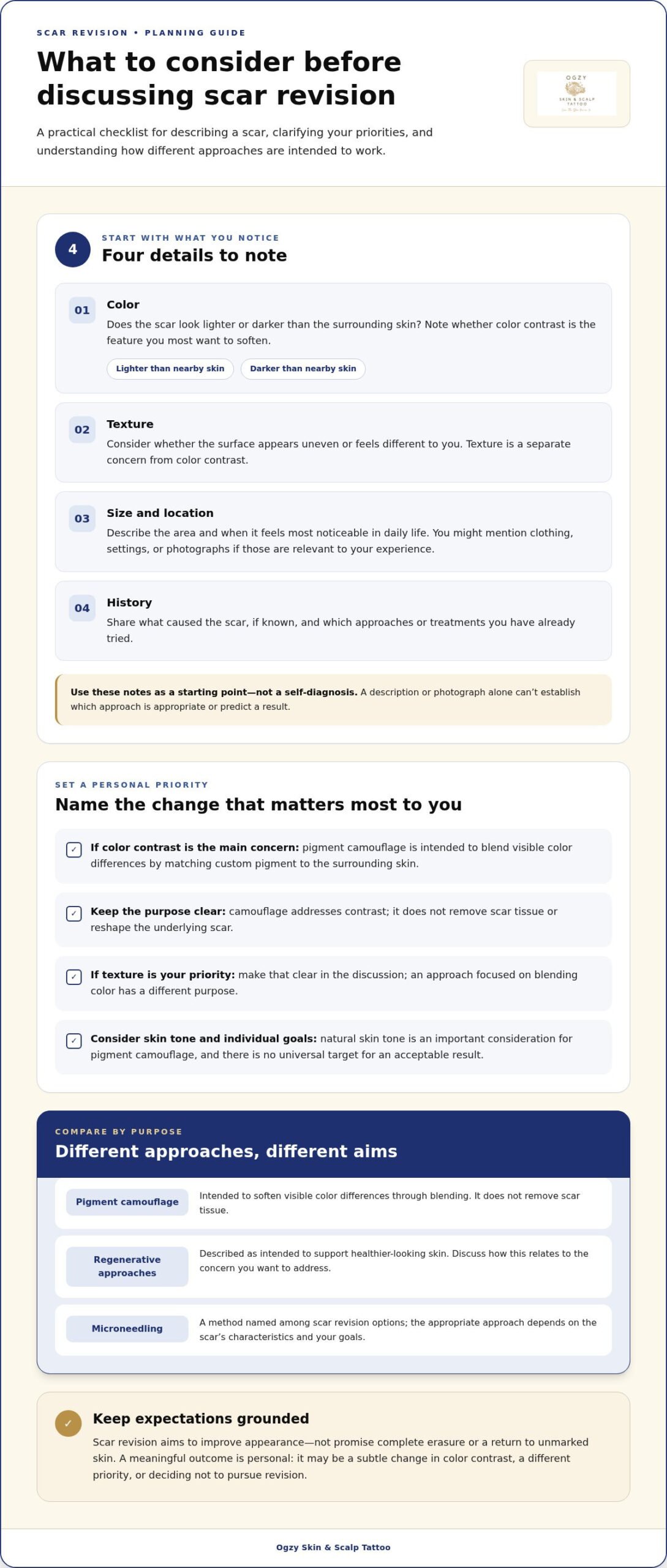
Start by identifying what draws your attention. Is it a difference in color, an uneven surface, the scar’s size, or how it stands out in a particular area? Color contrast and texture are separate aesthetic concerns. An approach aimed at blending color may not address texture in the same way. The scar’s history and previous treatments can also help shape the discussion.
- Color: Consider whether the scar looks lighter or darker than the surrounding skin.
- Texture: Note whether the surface appears uneven or feels different to you.
- Size and location: Describe the area and when the scar is most noticeable in daily life.
- History: Share what caused the scar, if known, and any approaches you’ve already tried.
These observations are useful starting points, not a way to diagnose the scar or determine candidacy on your own. Some clinical terms describe particular scar patterns, but a reader can’t reliably classify a scar from a brief description or photo. A professional discussion can focus on its appearance, history, and your priorities without relying on a self-diagnosis.
How do skin tone and personal goals shape the approach?
Natural skin tone is an important consideration for pigment camouflage. Custom pigment is matched to the surrounding skin to help blend visible color differences. Camouflage addresses contrast; it doesn’t remove or reshape the underlying scar. If texture is your main concern, keep in mind that color blending has a different purpose.
Start with the outcome you care about most. You might want a color difference to feel less noticeable, or you may be more focused on the scar’s surface. You can also decide that no change feels right for you. There’s no universal target for an acceptable result, and an individualized plan shouldn’t assume every scar or skin tone will respond in the same way. Avoid relying on a fixed timeline or assumed outcome before discussing your specific concerns.
If you’re considering scar removal options in Austin, bring notes about the scar’s features, history, previous treatments, and the change you hope to see. You can also explore personalized scar and stretch mark revision as part of learning about possible approaches.
Scar Revision Methods Compared: Microneedling, Regenerative Approaches, and Camouflage
Scar revision isn’t a one-method-fits-all process. An approach intended to support the look of skin may have a different purpose from one designed to blend a color difference. Comparing each option’s aim can help you describe what you’d like to change and understand what a method is, and isn’t, intended to address.
| Approach | General aim | Key expectation |
|---|---|---|
| Microneedling | A professional skin-rejuvenation approach | Discuss whether it aligns with the scar’s appearance and your goals; don’t assume it will erase a scar. |
| Regenerative approaches | Support healthier-looking skin using approaches that may include growth factors and medical-grade stem cells | Results aren’t guaranteed, and the approach should be considered in light of individual characteristics. |
| Custom pigment camouflage | Blend selected color differences by matching pigment to natural skin tone | It can address visual contrast, but doesn’t remove scar tissue or necessarily change texture. |
These descriptions are a starting point, not a ranking. The right discussion depends on the scar and your priorities. Focus on which concern an approach is intended to address and what it may not change.
When might microneedling or regenerative approaches be discussed?
Microneedling is a professional skin-rejuvenation approach. Whether it makes sense to discuss for a particular scar depends on the scar’s appearance, its history, and your goals. It shouldn’t be treated as a universal solution or a promise of a specific change.
Regenerative approaches may include medical-grade stem cells and growth factors, with the aim of supporting healthier-looking skin. That wording describes an intended focus, not a guaranteed outcome or a promise that a scar will disappear. The details of an individual approach should be discussed in relation to the scar itself.
When might pigment camouflage be considered?
Custom pigment camouflage may be relevant when color contrast is a key concern. Pigment is matched to natural skin tone with the aim of blending a selected color difference. It doesn’t remove the scar, and it may not address an uneven surface. If texture is your primary concern, color blending alone may not meet that goal.
The phrase scar removal can suggest that one technique should work equally well for every scar. In reality, the method should match the concern: texture-focused goals and color-blending goals aren’t interchangeable. For more detail on available approaches, read the scar revision methods explained in the medical-grade scar revision guide.
How to Prepare for a Scar Revision Discussion in Austin
A little preparation can make it easier to explain what’s bothering you and what you hope might change. You don’t need to arrive with a diagnosis or know which approach is right. A clear description of your concerns gives the discussion a practical starting point.
What should you bring up when discussing a scar?
Before discussing scar removal, jot down a few details so you don’t have to rely on memory:
- Your main concern: Is color contrast, uneven texture, size, or the scar’s location most noticeable to you?
- The scar’s history: Note what caused it, if you know, and any changes you’ve observed over time.
- Previous treatments: Share what you’ve tried and how you felt about the experience or appearance afterward.
- Your desired change: Describe what “less noticeable” would mean for you, while keeping expectations open to discussion.
- Your questions: Ask what an approach is intended to address, what it may not change, and which individual factors matter.
For example, you might explain that the color difference catches your eye more than the surface, or that texture is your priority. These details clarify what you’d like to address without assuming a particular technique or outcome is suitable. If you’re in Austin, Cedar Park, Leander, Round Rock, or Georgetown, bring the same notes to a discussion about personalized scar and stretch mark revision.
If microneedling is one approach you’re curious about, explore this microneedling for scars guide for more context before deciding what questions to bring.
What should a personalized plan make clear?
A useful plan connects the scar’s characteristics to your stated goal. It should explain the intended aesthetic focus, such as supporting a healthier-looking appearance or blending selected color differences, and clarify what the approach isn’t designed to do. For example, pigment camouflage aims to blend color contrast; it doesn’t remove the scar itself.
Planning should account for individual skin and scar characteristics rather than assume one method fits everyone. Ask how your priorities inform the approach, what limitations to keep in mind, and which details still need discussion. A thoughtful conversation can set expectations without promising complete erasure, a guaranteed result, or a fixed timeline.
Ready to take a considered next step? Explore personalized scar revision with Ogzy Skin & Scalp Tattoo and bring your questions and goals into the conversation.
Explore Personalized Scar Revision with Ogzy Skin & Scalp Tattoo
Learning about scar removal can help clarify what you hope to change, but choosing an approach is a personal decision. At Ogzy Skin & Scalp Tattoo, scar and stretch mark revision is tailored to the area’s appearance and characteristics, with attention to your concerns and the kind of result you hope to explore. The goal is thoughtful refinement, not a promise that every trace of a scar will disappear.
What scar revision approaches does Ogzy offer?
Ogzy offers regenerative approaches featuring medical-grade stem cells and growth factors, intended to support healthier-looking skin. These approaches don’t come with a guaranteed result; what may be appropriate depends on the individual scar and the goals being discussed.
Another option is custom pigment camouflage, with pigment matched to natural skin tone. This approach focuses on blending selected color differences so the area may look more visually integrated with the surrounding skin. Camouflage doesn’t remove scar tissue, and it may not address texture. The distinction matters: an approach centered on color blending has a different purpose from one focused on supporting healthier-looking skin.
Neither option is a universal answer. A personalized discussion can connect the scar’s visible features with an approach’s intended aesthetic goal and make its limitations clear. Natural-looking refinement may be a meaningful aim, but complete scar removal or a particular outcome can’t be promised.
What are the next steps for Austin-area readers?
A discussion may be useful if a scar or stretch mark draws your attention, if you’re weighing color blending against a regenerative approach, or if you’d like help articulating a realistic goal. Bringing notes about the area’s history, previous treatments, and the change you hope to see can make it easier to talk through options and expectations.
Ogzy Skin & Scalp Tattoo serves Austin and nearby communities, including Cedar Park, Leander, Round Rock, and Georgetown. Learn more about the scar and stretch mark revision service in Austin to understand the approaches and how personalized planning fits into the process.
If you’re ready to explore a considered next step, explore personalized scar revision with Ogzy.
Take the Next Step Toward a Personalized Plan
Scar removal is best approached with realistic goals: revision may improve a scar’s appearance, but complete erasure can’t be promised. The scar’s features and your priorities guide the discussion, while different approaches serve different purposes. For example, custom pigment camouflage is intended to blend color differences, while regenerative approaches aim to support healthier-looking skin.
Ogzy Skin & Scalp Tattoo focuses on scar and stretch mark revision, with personalized options that include regenerative approaches and custom pigment camouflage matched to natural skin tone. A thoughtful plan starts with what you hope to change and makes the approach’s purpose and limitations clear.
If you’re considering revision in Austin, Cedar Park, Leander, Round Rock, or Georgetown, explore the options and prepare the questions that matter to you. Explore personalized scar revision with Ogzy and take your next step at a pace that feels right. A clearer understanding can help you move forward with confidence, whatever you decide.
Frequently Asked Questions
Is scar removal permanent?
Scar revision aims to improve a scar’s appearance, not guarantee complete or permanent erasure. The degree and kind of visible change can vary based on the scar’s characteristics, the approach, and individual factors. Skin can also change over time, which may affect how a treated area looks. A discussion about scar removal is an opportunity to clarify the intended goal and limitations before deciding whether to proceed.
Can scars be completely removed?
A scar can’t be guaranteed to disappear completely. Many revision approaches focus on making a scar less noticeable by addressing features such as color contrast or overall appearance. That may still feel worthwhile, but the scar’s history can remain visible. It’s reasonable to hope for improvement while keeping expectations grounded. A personalized discussion can help define what change may be a meaningful goal for you.
What is the best treatment for removing a scar?
There isn’t one best method for every scar. The options to discuss depend on visible features such as color and texture, the scar’s location and history, and what you’d most like to change. For example, custom pigment camouflage aims to blend selected color differences, while regenerative approaches have a different intended focus. Individualized planning helps align an approach with your goals without promising a particular result.
How does scar camouflage work?
Scar camouflage uses custom pigment matched to natural skin tone to help blend selected color differences between a scar and surrounding skin. Its purpose is visual blending, not removing or reshaping scar tissue, so it may not address uneven texture. Whether it’s suitable depends on the scar’s appearance and individual characteristics. Discussing your main concern, such as color contrast, can help clarify whether camouflage fits your goals.
Can microneedling improve the appearance of scars?
Microneedling is used in professional skin-rejuvenation contexts, but that doesn’t guarantee a particular change in a scar’s appearance. The scar’s features, history, and your priorities matter when discussing whether this approach may align with your goals. Avoid assuming it will erase a scar or suit every person. A personalized discussion can help distinguish general skin-rejuvenation use from expectations for your specific scar.
Does scar revision work on every skin tone?
Skin tone is one consideration in planning scar revision, but it doesn’t by itself determine which approach is suitable or predict an outcome. For custom pigment camouflage, matching pigment to natural skin tone is part of the goal of blending color differences. The scar’s appearance and individual characteristics also matter. A personalized discussion can clarify the intended approach and its limitations without making universal claims about safety or results.
How do I explore scar revision near Austin, Texas?
Ogzy Skin & Scalp Tattoo serves Austin, Cedar Park, Leander, Round Rock, and Georgetown with scar and stretch mark revision. Personalized options include regenerative approaches using medical-grade stem cells and growth factors, or custom pigment camouflage matched to natural skin tone. Each approach has a different aim, and outcomes aren’t guaranteed. Read about the scar and stretch mark revision service in Austin to explore the options.

Article by
Opal Z
Opal is the owner and practitioner behind OGZY Skin & Scalp Tattoo in Austin, Texas. With more than three years in business and a longtime background in the aesthetics industry, she specializes in corrective and restorative treatments designed to address concerns that traditional aesthetics often overlook.
Her work focuses on scar and stretch mark revision, scar camouflage, scalp micropigmentation (SMP), hair regrowth treatments, and laser tattoo and permanent makeup removal. Opal works with a wide range of skin tones and takes an individualized approach to every client, considering skin color, texture, scar characteristics, treatment history, and realistic long-term outcomes.
Through OGZY Skin & Scalp Tattoo, her goal is to combine artistry, aesthetics, and technical treatment knowledge to help clients feel more comfortable and confident in their skin.
Love the skin you’re in.