
Scar revision financing in Georgetown depends on the treatment you choose. Ogzy Skin & Scalp Tattoo offers non-surgical scar and stretch mark revision, with Cherry payment plans and CareCredit among its accepted payment methods.
Before deciding how to pay, clarify what treatment you’re considering. Ogzy’s scar and stretch mark revision is non-surgical; its approach and payment options differ from surgical scar revision performed by a plastic surgeon.
This article explains the factors that can influence surgical scar revision costs, the payment methods that may be available, and what to understand about financing terms, approval timing, and 0% APR eligibility. You’ll also learn how non-surgical scar revision differs, so you can better understand which questions matter for your situation.
Key Takeaways
- Separate surgical scar revision from non-surgical scar revision, since the treatment approach affects what goes into planning.
- Look beyond the procedure itself: the technique, facility needs, anesthesia, and follow-up requirements can shape a surgical estimate.
- Before choosing a payment method, review its terms, repayment schedule, and any conditions tied to promotional APR offers.
- Approval timing and eligibility depend on the financing plan and application, so understand the process before scheduling treatment.
- A personalized scar revision consultation can help clarify which approach may suit your scar and what the next steps involve.
Payment methods for cosmetic services
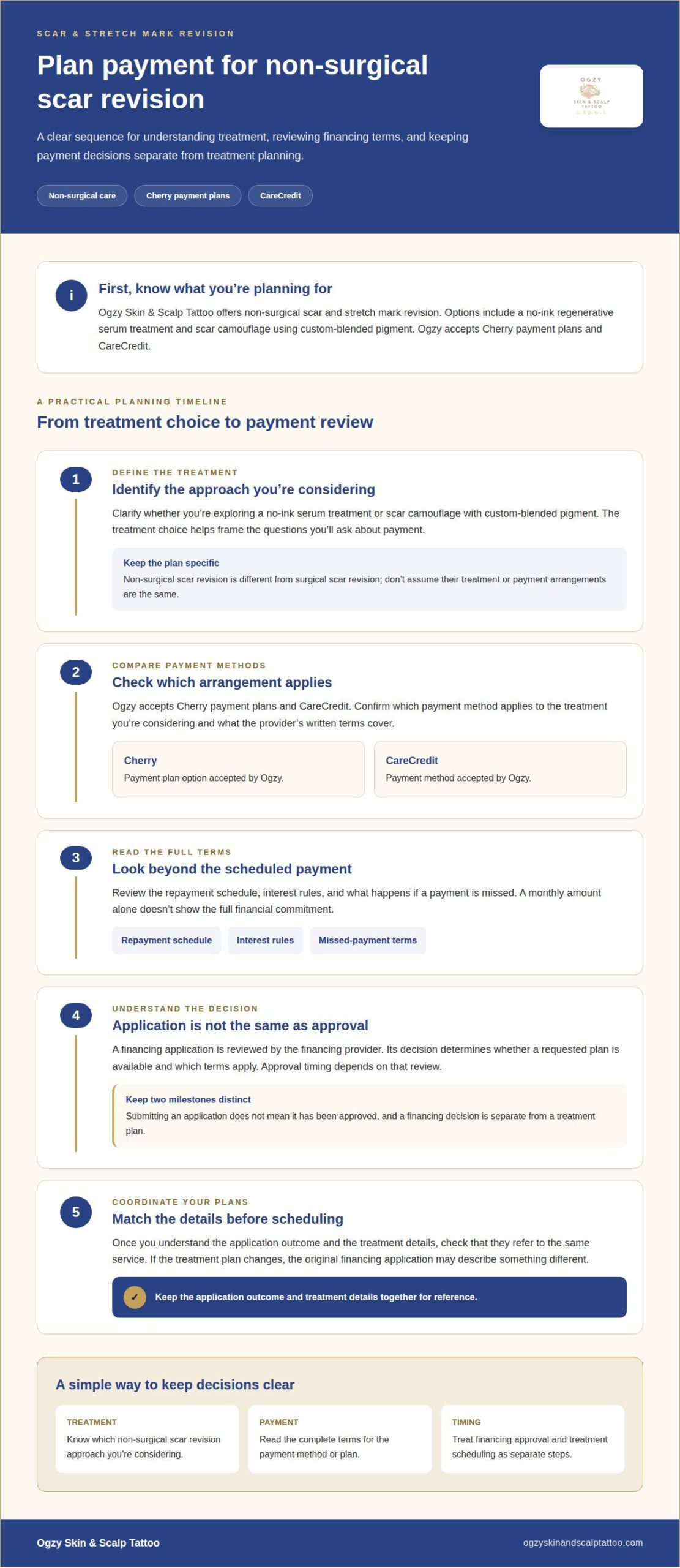
Start by distinguishing surgical scar revision from non-surgical treatment. Ogzy Skin & Scalp Tattoo offers non-surgical scar and stretch mark revision, including a no-ink serum treatment and scar camouflage with custom-blended pigment. The clinic accepts Cherry payment plans and CareCredit. For scar revision financing in Georgetown, first identify which treatment you’re considering and which payment arrangement applies.
For plastic surgery, financing can spread payments over time rather than requiring the entire amount at once. The plan’s terms matter: review the repayment schedule, interest rules, and consequences of missing a payment before deciding. A plan’s monthly amount alone doesn’t show its full financial commitment. Read the complete terms and consider how the schedule fits your budget.
Paying directly is another way to handle a cosmetic procedure, while a credit card may be an option where the practice accepts it. Availability varies by practice, so these are categories to distinguish, not promises that every surgeon accepts each method. For example, a patient comparing surgery with an injectable appointment should treat them as separate transactions unless the provider’s written payment terms say otherwise.
Insurance is a separate question from financing. Most health insurance plans don’t cover scar revision surgery, related complications, or another surgery intended to revise a scar’s appearance. That distinction can help you avoid treating a financing plan as insurance coverage. Financing is a way to pay for a procedure; insurance coverage concerns whether a plan pays for care. Each serves a different purpose.
Cosmetic injectables also shouldn’t be automatically grouped with surgical scar revision. An injectable appointment doesn’t involve the same procedure components as surgery, so its payment arrangement may differ. Before committing to either type of treatment, identify the service, what the quoted plan includes, and whether the payment terms apply to one visit or a broader treatment plan. Those details make comparisons clearer without assuming that the same option fits every service.
Use this simple framework to organize your options:
- Direct payment: Confirm what the practice accepts and when payment is due.
- Credit card: Consider the card’s own repayment terms separately from the treatment plan.
- Patient financing: Review the full agreement, not only the scheduled payment.
- Insurance: Treat coverage as a separate issue; most plans exclude scar revision surgery.
For a surgical procedure, the surgeon’s experience and your comfort with that surgeon matter alongside the final cost. Payment flexibility can help with planning, but it shouldn’t replace careful consideration of the procedure and the person performing it. A clear comparison begins with the treatment type, the written payment terms, and what each arrangement actually covers.
When choosing a plastic surgeon for scar revision, consider the surgeon’s experience and whether you feel comfortable with them, alongside the cost. Dr. Baker may recommend waiting a year or more after an injury or surgery before deciding on revision. Steroid injections to help prevent a hypertrophic scar from reforming may continue at intervals for up to two years after surgery.
Application and approval timing
Financing approval and treatment scheduling are separate steps. An application gives the financing provider information to review; its decision determines whether the requested plan is available to you. Approval timing depends on that review, so avoid treating a planned procedure date as proof that financing is ready. Keep the application decision and the treatment schedule as two distinct milestones.
Begin by identifying the procedure you’re considering. A surgical scar revision and a cosmetic injectable appointment are different treatments, and an application should reflect the service being planned. For example, if you’re considering surgery, use the surgical treatment details when reviewing financing terms. A plan designed for one service shouldn’t be assumed to apply to another.
The financing provider’s review is the central step. Submitted information is assessed against that provider’s approval requirements, and the outcome may affect the plan available to you. Approval, if granted, is not the same as a treatment appointment or a final surgical plan. Keep those decisions separate so you can understand what’s approved before arranging the procedure.
Organize your decisions in this order:
- Define the treatment: Identify whether you’re planning scar revision surgery or another cosmetic service.
- Review the application: Read each requested field and provide accurate information.
- Understand the decision: Note whether the application is approved and which plan terms apply.
- Coordinate scheduling: Align the treatment date with the financing decision and the procedure plan.
- Keep records together: Save the application outcome and the treatment details for reference.
These steps help prevent a common planning mix-up: assuming that an application submission means approval. It doesn’t. For example, a person may submit an application while still deciding which surgical approach to pursue. The financing decision and the surgeon’s treatment plan answer different questions, so one should not stand in for the other.
Timing also depends on what must be resolved before treatment. If the procedure plan changes, the financial arrangement may need another review, because the original application may describe a different service. Keep the selected treatment consistent across the application and scheduling discussions. That simple sequence helps you spot mismatched details before they complicate planning.
Approval timing can’t be reduced to a universal number of days from the information available here. The deciding mechanism is the financing provider’s review of the application and its requirements. Rather than building a treatment schedule around an assumed turnaround, make the approval decision a planning milestone. Then coordinate the procedure date around the confirmed treatment plan and financing terms.
Keep the application status, decision, plan terms, and treatment details together. If approval is pending, treat the treatment date as a separate planning item, not evidence that financing has been approved. This helps keep scar revision financing in Georgetown organized.
Financing terms and approval
When comparing Georgetown providers, consider the surgeon’s experience, your comfort during consultation, and the clarity of the written financing terms. For surgery, review credentials relevant to the procedure and compare each plan’s repayment schedule, annual percentage rate (APR), and payment obligations.
Approval means the financing provider has accepted an application under its terms. It doesn’t determine which treatment is appropriate or whether you’re comfortable with the proposed plan. Keep those decisions separate, even if financing is approved while treatment details are still under discussion.
Read the full agreement before accepting a plan. Check the repayment period, scheduled payment amount, due dates, APR, and conditions tied to promotional terms. APR describes the annual cost of borrowing. Consider all the terms together, rather than relying on the scheduled payment alone.
Check how the plan handles payments. Some financing arrangements use automatic monthly payments, while others follow a different process. Follow the agreement’s instructions for setting up payments, updating payment details, and tracking due dates. Don’t assume automatic withdrawals begin unless the terms say so.
During consultation, ask for the surgical plan to be explained in plain language. The surgeon’s experience and your comfort with that surgeon matter alongside the final cost. A useful discussion connects the proposed procedure with its expected scope, rather than treating financing approval as a recommendation for surgery. Your treatment decision and payment decision should each make sense on their own.
Use a consistent comparison when reviewing terms:
- Provider: Consider the surgeon’s experience with scar revision and your comfort discussing the procedure.
- Consultation: Note whether the proposed approach and its purpose are explained clearly.
- Approval: Read the decision and identify which financing plan it covers.
- Repayment: Review APR, payment schedule, due dates, and automatic payment details.
- Promotional terms: Read the conditions and understand how the plan changes if they aren’t met.
For instance, two plans might show similar scheduled payments but use different APRs or repayment periods. Compare the complete written terms rather than choosing from the payment amount alone. If a promotional offer appears, review its eligibility requirements and end conditions before relying on it. That makes the plan easier to assess against your own budget.
Approval criteria and timing depend on the financing provider’s review. A consultation, a treatment recommendation, and financing approval are separate steps. Keep each outcome clear in your records and base your decision on the written plan and treatment discussed.
0% APR eligibility
A 0% APR offer can make an aesthetic procedure easier to plan, but eligibility depends on the financing plan’s terms and approval process. APR means annual percentage rate, the annualized cost of borrowing. With a 0% APR promotion, the agreement defines when that rate applies and what happens afterward. Read the written terms rather than assuming every applicant receives the same offer.
Approval and promotional eligibility are related, but they aren’t necessarily identical. A financing application may be approved without qualifying for a specific promotional offer. The financing provider’s decision and the plan presented in your agreement determine what applies. For example, don’t assume that an approved application automatically means 0% APR.
Review a promotion’s conditions before accepting it. Check the promotional period, required payment schedule, due dates, and any conditions for keeping the stated APR. The agreement should also explain what happens when the promotional period ends. A headline rate doesn’t describe the full repayment arrangement.
Use this practical review when considering a 0% APR plan:
- Confirm the offer: Identify the APR shown in your actual approval and agreement.
- Read the time limits: Find when promotional terms begin and end.
- Understand payment rules: Check the scheduled amount, due dates, and payment method.
- Review the ending terms: See how the agreement handles any remaining balance after the promotion.
- Keep the paperwork: Save the approval and complete agreement for reference.
When comparing financing offers for surgical scar revision, don’t rank them by APR alone. Compare the promotional conditions, payment schedule, repayment period, and terms after the promotion. Read the agreement for eligibility and repayment details before deciding.
Automatic payments can also be part of a financing arrangement. Cherry sets up automatic monthly payments for the financing plan the customer chooses. If your agreement uses automatic payments, understand how the amount and due dates match the plan’s terms. Keep track of the schedule, especially if the offer includes promotional conditions.
Before accepting an offer, make sure the financing paperwork matches the treatment you’re planning. Surgery and non-surgical scar revision may involve different payment arrangements. Confirm that the agreement describes the intended service, then review the promotional terms and full repayment schedule.
No general credit score, application detail, or approval timeline can establish eligibility across every plan. The financing provider assesses the application, and the offer’s written conditions explain whether 0% APR applies. Use the actual agreement to understand the rate, eligibility conditions, and repayment obligations.
Scar revision cost factors
Surgical technique affects the estimate because scar revision procedures differ in scope and setting. Options may include keloid excision, Z-plasty, contracture surgery, skin grafting, or flap surgery. These approaches address different concerns and involve different planning, resources, and follow-up.
Review the estimate as a set of components, not only as one total. Medical examinations and tests, facility or hospital charges, anesthesia, prescriptions, post-surgery garments, the technique, and procedure time may all contribute. An itemized estimate helps connect each charge to the planned care. For instance, a garment listed in the estimate is distinct from the surgeon’s fee.
Facility needs can vary by procedure. Skin grafting and flap surgery are more likely than other scar surgeries to take place in a hospital as inpatient procedures using general anesthesia. Ask how the proposed approach affects the setting and which related services the estimate includes.
Recovery is another practical consideration when comparing surgical approaches. After keloid excision, patients may return to work in a day or two, and stitches are removed in a few days. Z-plasty stitches are also removed a few days after the procedure. Skin grafting or flap surgery may take several weeks or months to heal, and a support garment or bandage may be needed for up to a year.
Discuss expected results and risks in relation to the specific procedure, since they can vary by scar and technique. Final scar revision results may not be apparent for a year or more. Consider the technique, procedure time, facility needs, and recovery requirements together during consultation.
For a clear comparison, organize the estimate around these factors:
- Procedure: Identify the technique and the scar concern it addresses.
- Setting: Note whether the plan involves an outpatient facility or hospital care.
- Anesthesia: Check which anesthesia services are included.
- Recovery items: Identify prescriptions, garments, and follow-up components.
- Time and testing: Review procedure time and examinations or tests included.
A consultation can help connect these details to the proposed treatment and clarify which elements shape its overall scope. If you’re exploring a non-surgical approach to revise a scar or stretch mark, explore scar revision options as another path to discuss.
When discussing your specific scar, ask the clinician how it fits your goals and whether the estimate covers the recommended care. Keloid recurrence may require repeated procedures every few years. Ask how that possibility affects the expected plan and whether any repeat treatment would be included in the current estimate or considered separately. Clarifying what is known about the scar and what may change after treatment can make the estimate easier to interpret. Keep the discussion focused on the proposed technique, setting, and recovery items, and ask that uncertain or potential future care be distinguished from charges for the planned procedure.
Ogzy Skin & Scalp Tattoo: Scar and Stretch Mark Revision
Ogzy Skin & Scalp Tattoo offers non-surgical scar and stretch mark revision. The no-ink treatment uses medical-grade serums, while scar camouflage uses custom-blended pigments matched to your skin tone. The appropriate approach depends on the area and your goals.
Revision is a gradual process. Many people need about 3 to 5 sessions, spaced 6 to 8 weeks apart depending on how the skin heals; extensive or more severe scars can need more than 5. Results vary by skin, scar type, and healing, so a consultation is the best way to discuss what may be realistic for you.
If you’re considering scar or stretch mark revision, contact Ogzy Skin & Scalp Tattoo to discuss your concern and possible next steps.
Choose a next step that feels clear
Start by asking what information would help you understand your scar and your options. As you consider scar revision financing in Georgetown, take time to decide which approach may suit your concern. A consultation with Ogzy can help clarify its non-surgical scar and stretch mark revision service and the payment options available.
If you’d like to explore scar and stretch mark revision with Ogzy Skin & Scalp Tattoo, contact Ogzy to discuss a consultation. The studio is located at 13130 Pond Springs Rd #1105, Austin, TX 78729. A thoughtful conversation can be a calm first step toward deciding what feels right for you.
Frequently Asked Questions
How much does scar revision cost in Georgetown, Texas?
There isn’t one standard price for every scar revision. Surgical and non-surgical approaches differ, and the treatment plan depends on the scar. Ogzy’s scar and stretch mark revision is non-surgical. A consultation can help determine whether the service may suit your concern and clarify the plan and cost.
What financing plans do Georgetown scar revision clinics offer?
Some plastic surgeons may offer financing for scar revision surgery, but plans vary by practice. Ogzy accepts Cherry payment plans and CareCredit for its services. These are payment options for Ogzy treatments, separate from financing arranged through a surgical practice. Confirm which service each plan covers before comparing arrangements.
Can patients use CareCredit, medical loans, or payment plans for scar revision in Georgetown?
CareCredit and payment plans may be options, depending on the provider and service. Ogzy accepts CareCredit and Cherry payment plans for its services. A medical loan is a separate financing product, not necessarily a clinic’s own plan. For surgery, the surgeon’s practice determines which options it accepts; for non-surgical scar revision, use the payment methods available for that service.

Article by
Opal Z
Opal is the owner and practitioner behind OGZY Skin & Scalp Tattoo in Austin, Texas. With more than three years in business and a longtime background in the aesthetics industry, she specializes in corrective and restorative treatments designed to address concerns that traditional aesthetics often overlook.
Her work focuses on scar and stretch mark revision, scar camouflage, scalp micropigmentation (SMP), hair regrowth treatments, and laser tattoo and permanent makeup removal. Opal works with a wide range of skin tones and takes an individualized approach to every client, considering skin color, texture, scar characteristics, treatment history, and realistic long-term outcomes.
Through OGZY Skin & Scalp Tattoo, her goal is to combine artistry, aesthetics, and technical treatment knowledge to help clients feel more comfortable and confident in their skin.
Love the skin you’re in.