Imagine the freedom of waking up without reaching for a heavy concealer that inevitably rubs off or looks cakey by noon. For many, a scar from a past surgery or trauma feels like an unwanted focal point that defines their appearance in social or intimate settings. It is frustrating when you have healed emotionally, but your skin has not quite caught up. At Ogzy Skin & Scalp Tattoo, we believe that your reflection should mirror your inner confidence, not your past injuries. By utilizing skin tone pigment camouflage scars, we can move past the limitations of makeup and address the root of the visual disconnect.
This article will show you how the fusion of medical precision and artistic craftsmanship can make your scar virtually invisible to the naked eye. We will explore the sophisticated process of custom pigment matching and how paramedical tattooing creates a seamless, multi-dimensional finish rather than a flat patch of color. You are about to learn how this restorative journey can provide long-lasting results that require minimal maintenance, allowing you to finally feel comfortable in your own skin again.
Key Takeaways
- Learn the vital difference between traditional decorative ink and medical-grade camouflage pigments designed to mimic the skin’s natural transparency.
- Discover how identifying your unique undertones-cool, warm, or neutral-is the essential first step in achieving a truly seamless and undetectable restoration.
- Identify whether your specific scar type would benefit most from inkless regenerative treatments or precision skin tone pigment camouflage scars for visual blending.
- Understand the importance of the pigment test and custom “Art of the Mix” process to ensure your results remain stable and natural-looking over time.
- Explore how local expertise in the Austin area combines clinical science with a compassionate, restorative approach to help you reclaim your self-assurance.
What is Skin Tone Pigment Camouflage for Scars?
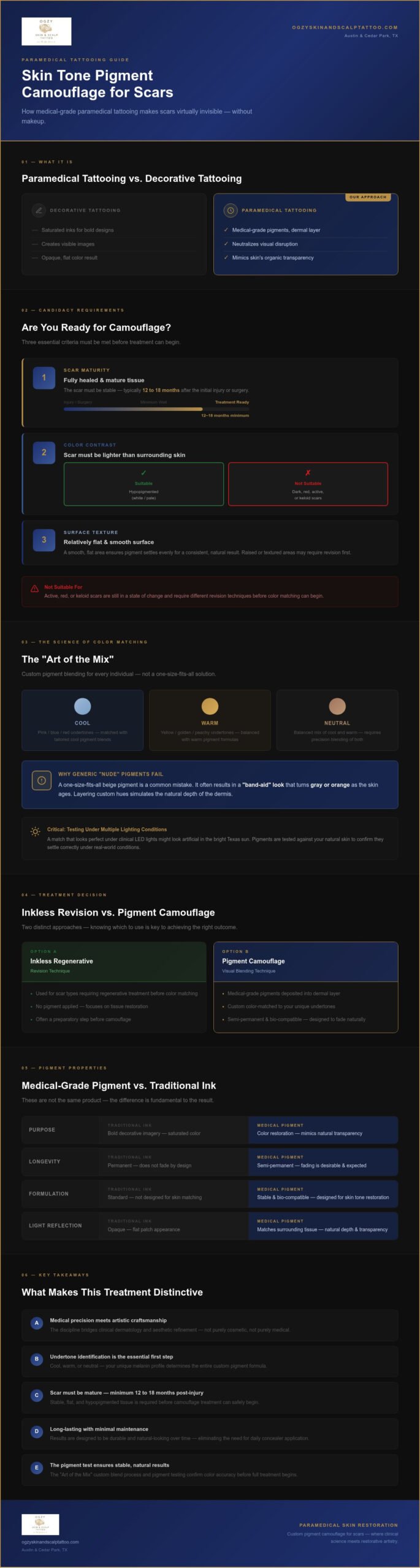
Paramedical tattooing is a specialized restorative discipline that exists at the intersection of medical science and aesthetic artistry. Unlike traditional decorative tattooing, which uses saturated inks to create bold designs, skin tone pigment camouflage scars involves the precise application of medical-grade pigments into the dermal layer. The objective isn’t to create a visible image but to neutralize a visual disruption. We aim to reintegrate the scar tissue into your natural complexion so it no longer commands attention.
The pigments used in this process are fundamentally different from standard tattoo ink. They are formulated to be stable and mimic the skin’s organic transparency rather than appearing like a flat, opaque patch of color. This scientific approach allows the light to reflect off the treated area in a way that matches the surrounding healthy tissue. Beyond the physical change, this is often a deeply emotional journey. It’s about providing a sense of closure for those who feel their identity is tied to a past surgery or traumatic event.
The Role of Paramedical Tattooing
This practice serves as a vital bridge between clinical dermatology and aesthetic refinement. When scar formation and types result in hypopigmentation, the skin loses its natural melanin, leaving behind a white or pale mark that stands out. We address this color loss by custom-blending pigments that mirror your unique undertones. By restoring these missing hues, we create a seamless transition that makes the boundary between the scar and the rest of your skin virtually undetectable to the naked eye.
Who is the Ideal Candidate?
Successful restoration requires the right timing and skin condition. For our clients in Austin and Cedar Park, we look for specific markers of readiness before beginning the camouflage process. Consider the following criteria:
- Scar Maturity: The tissue must be fully healed and mature, which typically takes 12 to 18 months after the initial injury or surgery.
- Color Contrast: The scar should be lighter than the surrounding skin (hypopigmented) rather than dark or red.
- Texture: The area should be relatively flat and smooth to ensure the pigment settles evenly.
It’s vital to understand that active, red, or keloid scars aren’t suitable for pigment camouflage. These types of marks are still in a state of change and require different revision techniques before color matching can be considered. Our goal is to ensure your skin is stable enough to hold the pigment beautifully for years to come, providing a result that feels as natural as it looks.
The Science of Precision Skin Tone Matching
Achieving a perfect match for skin tone pigment camouflage scars isn’t as simple as picking a bottle of “nude” ink. Human skin is translucent; it’s a complex tapestry of layered colors that change depending on blood flow and light exposure. The specialized application of skin tone pigment camouflage scars requires an understanding of how colors interact beneath the skin’s surface. Scar tissue is often dense and lacks the natural pores found in healthy skin. This density changes how light hits the surface, often creating a visual “flatness” that standard pigments can’t solve.
We use the “Art of the Mix” to create a bespoke formula for every ethnicity. This involves balancing primary and secondary colors to match the cool, warm, or neutral undertones of the individual. A one-size-fits-all beige pigment is a common mistake that often results in a “band-aid” look that turns gray or orange as the skin ages. By layering custom hues, we can simulate the natural depth of the dermis and ensure the restoration looks organic from every angle.
Analyzing Your Unique Melanin Profile
We start by evaluating the surrounding healthy skin under various conditions. Lighting is everything; a match that looks perfect under clinical LED lights might look artificial in the bright Texas sun. We test pigments against your natural skin to see how they settle and react to your specific melanin levels. Chromatic harmony in skin restoration is the achievement of a perfect visual equilibrium where the treated scar reflects light identically to the surrounding healthy tissue.
Long-term Stability of Custom Pigments
Medical-grade pigments differ significantly from traditional tattoo ink because they’re designed to be semi-permanent and bio-compatible. While many seek dermatologist-recommended scar treatments for texture, our pigments provide the final color correction. Fading is actually a desirable part of this process. It allows the camouflage to shift naturally as your skin changes over five to ten years, ensuring the transition remains subtle as you age. If you’re ready to see how this precision matching works for your unique profile, a personalized consultation is the best place to start.
Inkless Revision vs. Pigment Camouflage: Which is Right for You?
Deciding on the right path for your skin depends on whether we’re treating texture, color, or a combination of both. Some scars require a structural rebuild, while others simply need their natural hue restored to blend in. It’s about choosing the tool that respects your skin’s integrity and long-term health. Understanding these nuances ensures that you don’t just “cover” the mark, but truly reintegrate it into your natural complexion.
Regenerative Scar Revision (Inkless)
Inkless revision is a sophisticated regenerative process that avoids the use of pigments entirely. Instead, we use medical-grade stem cells and growth factors to trigger a targeted healing response within the tissue. This method is ideal for stretch marks or surgical scars where the texture is the main concern. By combining these potent serums with professional microneedling, we can soften the edges of the scar and encourage the body to repopulate the area with healthy, natural-looking skin cells. It’s a way of asking your body to finish the healing process it started months or years ago.
- Natural Texture: Improves the physical depth and smoothness of indented or raised marks.
- Stem Cell Power: Uses bio-active growth factors to revitalize dormant skin tissue.
- Broad Application: Highly effective for widespread stretch marks where adding pigment might not be practical.
Custom Pigment Camouflage (Ink)
When the scar is flat and mature but remains pale or white, skin tone pigment camouflage scars provides the necessary visual correction. This technique involves layering specialized pigments to mimic the natural translucency of your skin. It’s a meticulous process of building depth so the treated area doesn’t look like an opaque patch, but like an integrated part of your complexion. This is the gold standard for hypopigmented surgical scars that have already reached their final texture but lack the melanin to match the surrounding area.
Often, the most profound transformations come from a hybrid approach. We might begin with inkless revision to smooth the surface and then follow up with skin tone pigment camouflage scars to perfect the color match. Understanding the nuances of Medical Grade Scar Revision: Ink vs No Ink Methods helps you set realistic expectations for your personal journey. Our goal is to partner with you to find the most gentle yet effective route toward reclaiming your self-assurance and feeling comfortable in your reflection once again.
What to Expect: The Paramedical Treatment Journey in Austin
Starting a restorative journey is a significant step toward reclaiming your self-image. At our clinic, we view this process as a collaborative partnership between the specialist and the client. The first phase is always a compassionate consultation where we assess the maturity and texture of your skin. We take the time to listen to your goals and ensure that your tissue is ready for the precision of skin tone pigment camouflage scars. This initial meeting is about building trust and setting a realistic roadmap for your transformation.
Once we determine you’re an ideal candidate, we move to the matching phase. This isn’t a rushed decision; we perform a small pigment test to see how your body interacts with the custom-blended hues. We observe how the color settles over several weeks to ensure the final result will be a seamless extension of your natural complexion. The treatment session itself is often described as a light scratching sensation. While everyone’s pain threshold differs, most clients find the process quite manageable and far less intense than a traditional decorative tattoo.
Healing happens in multiple stages. You’ll notice the treated area looks significantly darker and more saturated during the first few days. don’t worry; this is a normal part of the pigment settling into the dermis. Over the next month, the color will soften and begin to blend. We schedule touch-up sessions to layer the pigment gradually, which is the secret to achieving that virtually invisible, multi-dimensional look.
Preparing for Your Session in Cedar Park
Preparation is vital for a successful outcome. We ask our clients to avoid sun exposure for at least four weeks prior to their appointment because tanned skin makes it impossible to find your true baseline undertones. You should also avoid blood-thinning supplements or medications unless directed by a doctor. Arriving with hydrated, healthy skin ensures the pigment is accepted more readily by the tissue. If you’re ready to take this step, you can book your initial consultation with us today.
Aftercare and Protecting Your Investment
In our intense Texas climate, aftercare is the most important factor in the longevity of your results. UV exposure is the primary cause of pigment shifting, so a high-quality SPF 50 is non-negotiable once the area is healed. We typically recommend a controlled moist healing environment using specialized balms to ensure the pigment remains stable and the skin stays supple during the critical first week of recovery. For more details on the process, explore our specialized Scar and Stretch Mark Revision Treatment in Austin to see how we tailor every plan to the individual.
Reclaiming Your Confidence with Ogzy Skin & Scalp Tattoo
The journey to healing is rarely just about the physical surface. When you live with a visible reminder of a past surgery or injury, it can feel like that scar is speaking for you before you even open your mouth. Reclaiming your reflection is about more than just aesthetics; it’s about restoring the self-assurance that allows you to move through the world without hesitation. Our specialized method of skin tone pigment camouflage scars is designed to respect the unique melanin profile of every client we serve. At Ogzy Skin & Scalp Tattoo, we understand that every mark tells a story, and our mission is to help you write the next chapter; one defined by renewal rather than trauma.
Choosing a local specialist in the Austin and Round Rock area ensures you’re partnering with someone who understands the specific needs of your skin. We aren’t just providing a service; we’re acting as a dedicated guide through your personal transformation. Our commitment to meticulous detail and artistic integrity means we don’t settle for “good enough.” We strive for a finish that is virtually invisible, treating each session with the gravity and care it deserves. By choosing a provider who is personally invested in your success, you ensure that your results are both beautiful and lasting.
A Specialized Approach to Skin Healing
Opal’s expertise in paramedical tattooing is built on a foundation of clinical precision and a deep respect for the skin’s natural biology. We avoid the “quick fix” mentality that can lead to unnatural results or long-term complications. Instead, we focus on restorative outcomes that age gracefully with you. For those whose scars require a focus on texture before color, we often integrate advanced techniques. You can learn more about these preliminary steps in our Microneedling for Scars in Cedar Park: 2026 Guide. This comprehensive approach ensures that by the time we apply the final skin tone pigment camouflage scars, the foundation is as smooth and receptive as possible. We believe in doing things right the first time to protect your skin’s health.
Start Your Transformation
You don’t have to be defined by your skin’s past. Whether you’re in the heart of Austin, the suburbs of Cedar Park, or the historic streets of Georgetown, professional restoration is within reach. We invite you to step into a space where your concerns are heard and your transformation is handled with the highest level of craftsmanship. It’s time to stop hiding behind heavy makeup or layers of clothing. Your journey toward a seamless, natural-looking complexion starts with a single, private conversation. Reach out to us through our contact page to book your restorative consultation and take the first step toward a more confident, unburdened version of yourself. We’re ready to help you rediscover the skin you love.
Embrace the Next Chapter of Your Skin’s Story
Your journey toward visual restoration is about more than just hiding a mark; it’s about reclaiming the self-assurance that belongs to you. We’ve explored how the intersection of medical science and artistic precision allows for results that are virtually invisible to the naked eye. From the initial compassionate consultation in Cedar Park to the final pigment layering, every step is designed to respect your skin’s unique biology. By utilizing advanced skin tone pigment camouflage scars, we ensure a seamless integration that mimics the natural translucency of your complexion.
Our commitment to excellence includes custom pigment matching for all skin types and the option for medical-grade stem cell and growth factor treatments to enhance texture. You don’t have to let a past injury define your reflection any longer. It’s time to experience the profound impact of specialist-led, empathetic care. Take the first step toward your personal transformation today and Schedule Your Restorative Scar Consultation. We’re here to help you feel comfortable, confident, and completely yourself again.
Frequently Asked Questions
How long does skin tone pigment camouflage last?
Typically, the results of skin tone pigment camouflage last between 3 to 5 years before a refresh is needed. Unlike decorative ink, these medical-grade pigments are designed to be semi-permanent so they can shift naturally as your skin ages. Factors like intense sun exposure in the Austin area and your individual metabolic rate will influence longevity. Periodic maintenance sessions ensure the color remains perfectly balanced with your surrounding tissue for a long-term restorative result.
Can you hide a scar that is raised or bumpy?
Pigment alone cannot hide texture. If a scar is raised or bumpy, we first recommend regenerative treatments such as microneedling with medical-grade stem cells and growth factors. These methods help flatten the tissue and improve the physical depth of the mark. Once the surface is smooth and mature, we can then apply skin tone pigment camouflage scars to address the color discrepancy and achieve a seamless finish that blends with your natural complexion.
Does the camouflage tattoo change color when I tan?
The pigments used in camouflage do not contain melanin and will not tan like your natural skin. While the treated area remains the same color, the surrounding skin will darken when exposed to the sun, which can make the camouflage more noticeable. This is why we match the pigment to your natural, non-tanned baseline. Protecting the area with SPF 50 is essential for maintaining the integrity of the work, especially in our sunny Texas climate.
Is the procedure painful for sensitive scar tissue?
Most clients describe the sensation as a light scratching or vibrating feeling. We prioritize your comfort throughout the session and can use topical numbing agents to minimize any sensitivity. Because the needles only penetrate the upper dermal layer, the process is generally much less intense than a traditional decorative tattoo. Many of our Cedar Park and Round Rock clients find the restorative journey to be a relaxing and positive experience that supports their emotional healing.
How many sessions will I need to fully hide my scar?
A full restoration typically requires 2 to 4 sessions spaced several weeks apart. We take a conservative, multi-phase approach to build color in thin, translucent layers. This layering technique is vital for creating a multi-dimensional look that mimics the depth of real skin. Each session allows us to assess how the pigment has settled and make precise adjustments to ensure the final result is virtually invisible to the naked eye and meets your expectations.
What is the difference between this and a regular tattoo?
The primary differences lie in the equipment, pigment composition, and artistic objective. Regular tattoos use heavy, opaque inks intended to stand out, while paramedical restoration uses specialized pigments designed to blend and disappear. Our tools are tuned for the delicate nature of scar tissue, focusing on light refraction and transparency rather than bold color. The goal is to restore what was lost rather than adding a visible design to the body for decorative purposes.
Can camouflage pigments be used on C-section or tummy tuck scars?
Yes, surgical marks like C-section or tummy tuck scars are excellent candidates for this procedure. Once the surgical site has fully matured, which usually takes at least 12 months, we can use skin tone pigment camouflage scars to neutralize the white or pale appearance. This helps many of our clients in the Georgetown area move past the visual reminders of their procedures and reclaim their confidence in social or intimate settings with a refined finish.
What happens if I decide to get laser hair removal over the area later?
You must avoid direct laser treatment over any area that has received pigment camouflage. The intense light from hair removal lasers can cause the medical-grade pigments to darken significantly or oxidize, potentially turning them an unwanted shade of gray or black. Our Austin clients should always inform their laser technician about their paramedical tattoo. If you plan on having laser hair removal, it’s best to complete those sessions before starting your restoration to protect your investment.

Article by
Opal Z
Opal is the owner and practitioner behind OGZY Skin & Scalp Tattoo in Austin, Texas. With more than three years in business and a longtime background in the aesthetics industry, she specializes in corrective and restorative treatments designed to address concerns that traditional aesthetics often overlook.
Her work focuses on scar and stretch mark revision, scar camouflage, scalp micropigmentation (SMP), hair regrowth treatments, and laser tattoo and permanent makeup removal. Opal works with a wide range of skin tones and takes an individualized approach to every client, considering skin color, texture, scar characteristics, treatment history, and realistic long-term outcomes.
Through OGZY Skin & Scalp Tattoo, her goal is to combine artistry, aesthetics, and technical treatment knowledge to help clients feel more comfortable and confident in their skin.
Love the skin you’re in.