
Ink color can matter more than a tattoo’s small size. Black and dark blue often respond differently from pale or layered shades, influencing the treatment plan and the small tattoo removal cost in Georgetown.
This guide explains how laser removal is planned and what to consider before taking your next step.
Key Takeaways
- Estimate the full treatment course, not just a single visit, when planning for tattoo removal.
- Consider ink color and layering: black and dark blue typically respond best, while white, pastel, and layered inks can be more challenging.
- Size matters, but design complexity and how the ink responds also shape the treatment plan.
- Leave time between appointments for the treated area to heal, and follow appropriate aftercare guidance.
- A personalized assessment can help clarify what may affect your removal plan and what to expect along the way.
Estimated total cost of a laser removal course
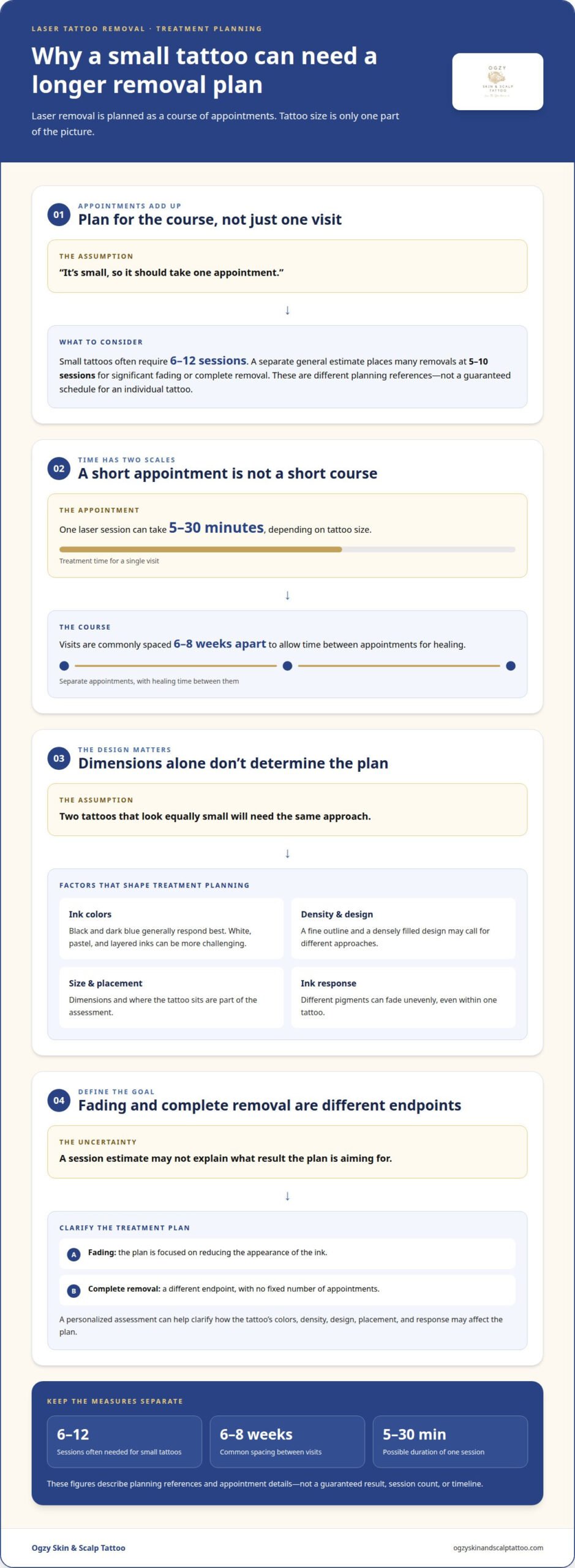
A small design can still involve a course of appointments rather than one treatment. Small tattoos often require 6-12 laser removal sessions, while simple black tattoos may need about 8-12 treatments. The full-course estimate therefore depends on the expected number of visits, not tattoo size alone. A single-appointment quote describes only one step in that larger plan.
To understand an estimate, separate the plan into two parts: the expected number of sessions and the cost assigned to each appointment. Multiplying those figures gives a course estimate, but the final total can change if the tattoo responds differently than expected. A plan focused on fading may also differ from one aimed at complete removal.
Session count is a major variable. The research range for small tattoos is 6-12 sessions, while a separate general estimate places many removals at 5 to 10 sessions for significant fading or complete removal. These ranges describe different treatment expectations. They are planning references, not a guaranteed schedule for any individual tattoo.
Visits are commonly spaced 6-8 weeks apart. That interval affects how the course unfolds over time, even when the appointment count stays the same. For example, a plan involving 6 visits has fewer treatment appointments than one involving 12, but both require spaced visits rather than one continuous appointment.
- Session count: A small tattoo may need 6-12 visits, depending on its response.
- Goal: Fading and complete removal are different treatment endpoints.
- Spacing: Laser visits commonly occur 6-8 weeks apart.
“Full removal” does not correspond to a fixed number of appointments. The tattoo’s size, ink colors, density, and design all shape the work involved. A compact tattoo with simple black ink and a layered, multicolored design can require different treatment plans, even if both are described as small.
Appointment duration adds another practical detail. A laser tattoo removal session can take 5-30 minutes, depending on tattoo size. That is the treatment time for a visit, not the length of the full course. The overall plan includes separate appointments and the 6-8-week spacing between them.
If you’re comparing estimates in Georgetown, look for a clear treatment outline rather than relying on a single-session figure. It should distinguish the expected number of visits from the removal goal and state whether the plan aims for fading or complete removal. That makes estimates easier to compare without assuming every small tattoo follows the same course.
The small tattoo removal cost in Georgetown is shaped by the total course, especially the number of sessions needed. A short appointment does not necessarily mean a short course: 5-30 minutes describes one visit, while 6-12 sessions describes the possible treatment series. Keeping those measures separate helps set realistic expectations for the process.
What is Tattoo Removal?
Laser tattoo removal involves appointments that gradually reduce the appearance of unwanted ink. When budgeting, distinguish the cost of one visit from the overall treatment plan. A per-session estimate covers an appointment, while a course estimate accounts for the planned visits and your intended goal.
In the United States, small tattoo removal is commonly priced by session. The overall plan depends on the tattoo, not simply the word “small.” A fine outline and a densely filled design may need different approaches, even if their visible dimensions are similar. Ask whether an estimate covers the entire tattoo or only a specific area.
For an estimate in Georgetown, clarify the treatment area and your intended result. A plan for fading may differ from one aimed at complete removal. If your design includes separate marks, lettering, or shaded sections, describe each part. A clearly defined scope helps you understand what the estimate covers.
Budgeting also means distinguishing the laser appointment from other possible charges. In some settings, tattoo removal costs may include procedure, facility, anesthesia, prescription, or medical-test expenses. These charges don’t automatically apply to every laser treatment. Review the written estimate to see what’s included and whether anything is listed separately.
For Texas patients, health insurance generally does not cover cosmetic surgery or its complications. Cosmetic tattoo removal may not be covered either, so review your policy terms before relying on insurance for treatment.
Clinics in Georgetown set their own consultation and package policies. Free consultations and package discounts aren’t universal, so compare the stated terms rather than assuming they apply. A package should specify which appointments it includes and how they fit into your treatment plan.
Your estimate depends on the tattoo’s dimensions, colors, density, placement, and removal goal. Ask for a written breakdown that identifies the treatment area, projected course, and included services. A precise figure should come from a quote tailored to your tattoo, not a general estimate for every design.
- Define the goal: Clarify whether you want fading or complete removal.
- Describe the full design: Include separate marks, shading, and lettering.
- Review the scope: Identify included appointments and any separate charges.
A personalized tattoo removal assessment can help you understand how these details shape a plan. Discuss your tattoo removal options and the factors relevant to your case.
Washington estimates offer a regional comparison, but they are not a substitute for a quote based on your specific tattoo.
These are per-session estimates, so consider the projected course as well as the price of an appointment when planning a budget. Budgeting 15-25% above a quoted tattoo-removal treatment total for possible additional costs can provide a cushion; ask which expenses are included in the quote and confirm the anticipated course with the provider.
What colors are hardest to remove?
White, pastel, and layered inks can make laser removal more complex. Black and dark blue generally respond best to laser treatment. Because laser energy interacts with pigments differently, one tattoo may fade unevenly across its design. For example, a small multicolor symbol may need a more involved plan than its dimensions suggest.
Layered colors, pastels, or white ink may increase treatment demands by 30-50%. That range is a planning consideration, not a guaranteed increase for every tattoo. A design with black outlines and pale interior shading may respond differently across those areas. The darker outline could fade more readily while lighter sections remain visible longer.
Ink density also affects the work involved. A densely filled black shape contains more concentrated pigment than a thin outline in the same color. Overlapping colors create layers rather than one uniform shade. These differences can affect how the tattoo changes between appointments, even when it looks small overall.
Placement is another factor in the assessment. The treatment area must be considered alongside the surrounding skin and the tattoo’s position on the body. A small design near a curved or frequently moving area, for example, may need careful positioning during treatment. Placement doesn’t change the ink color, but it can shape how a session is planned.
- Color: Black and dark blue tend to respond best; white and pastel inks can be harder.
- Layering: Overlapping shades may increase treatment demands by 30-50%.
- Density: A filled shape and a fine outline can behave differently.
- Placement: The tattoo’s location helps determine how the treatment area is approached.
Consider a small tattoo with black lettering over a pale blue background. The lettering and background may fade at different rates, so judging progress by one section alone can be misleading. Similarly, a compact pastel design may be challenging to remove despite its small footprint.
The overall design and the way its pigments respond during treatment also affect results. Two tattoos with matching colors can behave differently if one has dense fill and the other has sparse lines. The visible changes after each appointment help show how an individual tattoo is responding.
When comparing treatment plans, describe the complete design rather than calling it simply “small.” Mention every color, any shading or overlap, and the exact placement. Those details help the assessment account for parts that may respond differently. A consultation can clarify what the tattoo’s color, density, and location mean for its removal plan.
Price differences by tattoo size
Size helps define the treatment area, but measurements need context. One published size category defines a small tattoo as under four square inches. That classification is a useful reference, not a universal boundary. A design just below four square inches and a tiny symbol may both fit the category yet need different treatment plans.
Measure the full design, including shaded edges and separate marks. For a rectangular tattoo, multiply its length by its width to estimate the area. A curved or irregular outline may occupy less space than its outer dimensions suggest. The treatment area is assessed from the actual design, not a quick label such as “small.”
Size can affect the work performed during each appointment. A smaller treatment area generally requires less laser coverage than a larger one. However, a small tattoo with several elements may need more careful attention than a single, simple mark. Fine lettering with a shaded emblem, for example, involves different details from a single outline of similar dimensions.
A per-session estimate describes one appointment, not the full removal course. To compare estimates meaningfully, check which area the session covers and whether it includes the whole design. If a tattoo has two separate components, clarify whether both are included in the same treatment area. This distinction is more useful than size labels alone.
A larger tattoo may involve a broader treatment area, while a compact design can still have dense pigment or intricate details. Area is one part of the assessment, not the only one. A four-square-inch design with open linework differs from an equally sized block of solid ink.
- Record the dimensions: Note the length and width in inches.
- Include every element: Count shading, borders, and separated marks.
- Compare the same scope: Confirm that each per-session estimate covers the full design.
Imagine two tattoos measuring three square inches. One is a thin outline; the other has tightly filled shapes and small interior details. Their matching area doesn’t make the treatment work identical. A size category can help with initial planning, while the design explains why two small tattoos may follow different treatment plans.
Use the tattoo’s measured area as a starting point, then describe its layout accurately. Include the number of components, whether the design is filled or outlined, and any portions extending beyond its main shape. These details make a per-session estimate easier to interpret and distinguish treatment coverage from the full course of appointments.
The figure is a per-session reference, not a total removal quote, so compare it only with estimates covering the same treatment scope. Large, colorful, or elaborate tattoos may need more removal sessions with lasers or trichloroacetic acid peels, increasing the cost. Consider measured area alongside color and design complexity when reviewing projected treatment expenses.
Aftercare and healing timeline
Aftercare is part of the laser removal process, not an afterthought. The first 24 hours and the following two weeks have distinct considerations. General aftercare guidance recommends cooling the treated area during the first 24 hours. It also advises avoiding soaking, sun exposure, and friction at the site for at least two weeks.
During the first day, follow the cooling guidance as you plan ordinary activities. If your tattoo is in an area that rubs against clothing, consider how that contact may affect your routine. Avoid unnecessary friction at the treated site and follow the instructions provided for your appointment.
For at least two weeks, avoid soaking the treated area. Plan around activities that submerge the tattoo, distinguishing a brief rinse from prolonged soaking. Avoid sun exposure and friction during this period as well. A tattoo on the wrist, for example, may need extra attention if clothing or accessories repeatedly brush the area.
Location can shape practical aftercare. A small tattoo on the ankle may rub against shoes, while a forearm design may receive more sun during outdoor activities. These examples don’t change the two-week guidance; they can help you notice where everyday contact or exposure may occur.
Build the aftercare period into your calendar before treatment. Mark the first 24 hours for the cooling guidance, then note the two-week period for avoiding soaking, sun exposure, and friction. If work, travel, or planned activities involve those factors, scheduling the appointment around them can make the guidance easier to follow.
- First 24 hours: Follow guidance to cool the treated area.
- At least two weeks: Avoid soaking, sun exposure, and friction at the site.
- Before treatment: Consider how clothing, footwear, and daily activities contact the tattoo.
Healing is part of a course that may involve multiple appointments, so aftercare applies to each treated area and visit. Keep your appointment instructions handy, especially if the tattoo’s location makes friction or sun exposure part of your routine. Don’t add steps that aren’t included in your treatment guidance.
For a small tattoo near a shoe line, consider whether your usual footwear will rub the area during the two-week period. For a forearm tattoo, think about outdoor plans and sun exposure. These practical considerations can help you choose an appointment time that works with the aftercare guidance.
If you’re considering laser tattoo removal, book a consultation to discuss your treatment plan and the aftercare relevant to your tattoo’s location.
Ogzy Skin & Scalp Tattoo: Scar and Stretch Mark Revision
Ogzy Skin & Scalp Tattoo provides laser tattoo removal for people considering a change to an existing tattoo. If removal leaves a scar or raises a stretch mark concern, Scar & Stretch Mark Revision may be a separate option. No-ink revision uses medical-grade serums; custom-blended pigment camouflage is another approach when appropriate.
A consultation is a good opportunity to discuss what may be realistic for your skin and the area involved. Results vary by skin, scar type, and healing, so a personalized conversation can clarify possible next steps without promising a particular outcome.
You’re welcome to visit Ogzy Skin & Scalp Tattoo online or find the studio at 13130 Pond Springs Rd #1105, Austin, TX 78729.
Choose a Next Step That Fits Your Goals
Deciding what to do with a tattoo is personal. You may want to soften its appearance, make room for a future design, or understand your options before deciding. Let your priorities guide the conversation rather than feeling pressured to choose a particular outcome.
When comparing the small tattoo removal cost in Georgetown, focus on how the proposed plan addresses your tattoo and intended goal. A one-to-one discussion can help you understand what may be realistic for your circumstances. Bring your questions about the removal process and the options available to you.
Ogzy Skin & Scalp Tattoo offers laser tattoo removal. For a personal conversation about your next step, contact Ogzy Skin & Scalp Tattoo. The studio is at 13130 Pond Springs Rd #1105, Austin, TX 78729. You can move forward at a pace that feels considered and right for you.
Frequently Asked Questions
Which tattoo removal clinics serve Georgetown, TX, and what are their prices?
Ogzy Skin & Scalp Tattoo provides laser tattoo removal from its Austin studio for people in Georgetown, Cedar Park, Leander, Round Rock, and Austin. An estimate should reflect the tattoo and treatment plan. Before deciding, identify your removal goal and describe the design details so the discussion can focus on your specific case.
What are the risks, side effects, and recovery time for laser tattoo removal?
Possible risks and side effects depend on the treatment and your circumstances, so ask for a clear explanation before proceeding. Discuss what changes may occur at the treated site, what aftercare involves, and whom to contact with concerns. Recovery also depends on the individual treatment area. Don’t rely on a generic timeline in place of instructions tailored to your appointment.
How can I compare tattoo removal providers near Georgetown, Texas?
Compare how clearly each provider explains the treatment goal, the tattoo area being addressed, and the follow-up plan. You can also review whether the provider explains relevant qualifications and provides understandable aftercare information. Keep your questions and treatment details consistent when comparing options. This makes it easier to see whether each plan addresses the same design and intended outcome.

Article by
Opal Z
Opal is the owner and practitioner behind OGZY Skin & Scalp Tattoo in Austin, Texas. With more than three years in business and a longtime background in the aesthetics industry, she specializes in corrective and restorative treatments designed to address concerns that traditional aesthetics often overlook.
Her work focuses on scar and stretch mark revision, scar camouflage, scalp micropigmentation (SMP), hair regrowth treatments, and laser tattoo and permanent makeup removal. Opal works with a wide range of skin tones and takes an individualized approach to every client, considering skin color, texture, scar characteristics, treatment history, and realistic long-term outcomes.
Through OGZY Skin & Scalp Tattoo, her goal is to combine artistry, aesthetics, and technical treatment knowledge to help clients feel more comfortable and confident in their skin.
Love the skin you’re in.