
The stretch mark removal cost in Round Rock depends on the treatment area, the extent of the marks, and the approach used. The price depends on the individual case and is provided after a quote request. Laser treatment is considered cosmetic and isn’t covered by medical insurance, so planning for out-of-pocket expenses matters.
It’s understandable to look for ways to manage costs, especially when a treatment plan may involve more than one session. Comparing only the price of a single visit can be misleading: the number of sessions and any separate expenses affect your overall budget.
This guide explains what can influence laser treatment costs, how sessions relate to progress, and which payment considerations may help you plan. You’ll also learn why the treatment area and type of laser matter, what recovery can involve, and how to weigh cost alongside realistic expectations for improvement. Clear information can make the next step feel more considered and less uncertain.
Key Takeaways
- Compare treatment approaches by what they involve and how they fit your goals, not by a single visit’s price alone.
- Non-ablative laser treatment may involve one to six sessions, with changes developing over several months.
- Review payment terms carefully and don’t assume financing, discounts, or rebates are available.
- Account for possible added expenses, such as recovery-related needs, when planning your overall budget.
- Laser treatment for stretch marks is considered cosmetic, so medical insurance doesn’t cover it.
How much does laser stretch mark removal cost?
For stretch mark removal in Round Rock, the cost depends on the treatment area, the marks’ appearance, and the technique selected. The exact figure is provided in a quote for your case. Compare treatment plans by what they address and how many visits they may involve, not by a single session alone.
Laser resurfacing directs energy into targeted skin areas to encourage renewal where stretch marks have disrupted collagen and elastin. Ablative lasers remove outer skin layers, while non-ablative lasers work beneath the surface without removing those layers. These approaches differ in intensity, recovery, and suitability, so a lower visit count or shorter appointment doesn’t automatically make one a better fit.
ResurFX is a non-ablative fractional laser approach. Rather than treating the entire surface uniformly, fractional delivery creates focused treatment zones while leaving surrounding skin intact. Its wavelength is a device-specific technical detail, and the method matters because it influences how energy reaches the skin. Settings should reflect the individual treatment area and skin characteristics.
Location affects planning. Marks across the abdomen may call for a different approach than a smaller patch on the hips or thighs. Their color, depth, and maturity also shape an assessment. Skin tone is another consideration, since settings must be selected with the person’s skin and intended target in mind. A consultation can help compare these factors before outlining a plan.
Other options include microneedling and microdermabrasion, which use different methods from laser resurfacing. Compare the technique, intended changes, and likely session plan. Microneedling uses fine, sterile needles to create controlled micro-injuries and boost collagen and elastin; microdermabrasion exfoliates the skin’s surface. The area and type of stretch marks matter more than a single advertised treatment.
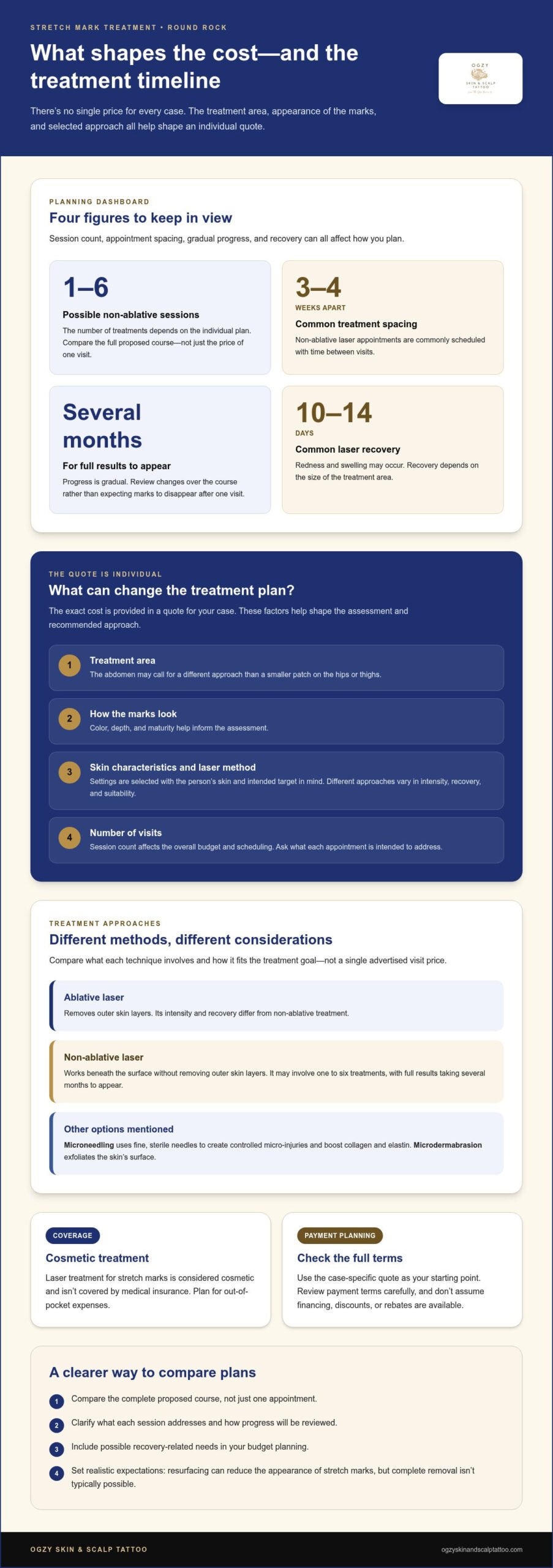
Non-ablative laser treatment may involve one to six treatments, while full results can take several months to appear. The number of visits is therefore an important budget factor, alongside the area treated and laser method. Ask for a plan that explains what each session addresses rather than assuming one treatment will fully remove stretch marks.
After laser resurfacing, redness and swelling may occur, and recovery commonly takes 10 to 14 days, depending on the treatment area’s size. Follow the aftercare instructions provided for your treatment, avoid irritating the area, and protect healing skin as directed. Include recovery needs in your planning, especially if the treated area is broad or visible.
Number of sessions and results
Laser treatment is usually planned as a sequence, not a one-visit decision. Each appointment contributes to the overall course, so the total session count affects scheduling and cost. Compare the complete proposed course rather than judging it by the first appointment. Clarify what progress each visit is intended to address and how the plan will be reviewed.
Spacing matters, too. Non-ablative laser treatments are commonly scheduled three to four weeks apart. That interval gives the skin time between appointments and creates a practical rhythm for follow-up. If you’re planning around work, travel, or a busy season, map the appointments on a calendar before committing. A longer course can require more coordination than a single treatment.
Progress is gradual. Rather than expecting stretch marks to disappear after one visit, look for changes in their visibility across the course. Skin resurfacing can reduce the appearance of stretch marks, but complete removal isn’t typically possible. Set a realistic goal of refinement and reduced visibility, rather than expecting an untouched-looking surface.
Use consistent photos to assess change. Choose the same lighting, distance, and angle each time, and photograph the same area before treatment and during follow-up. For example, compare abdominal marks under similar conditions instead of relying on memory. Note the area’s appearance and the date of each session. These simple records can make gradual changes easier to recognize.
Results from skin resurfacing may last for years, but outcomes depend on the marks treated and the approach used. A useful treatment discussion should clarify the intended improvement, expected session sequence, and how progress will be assessed. Those details also help explain why a plan involving several visits has a different overall cost from a one-time procedure.
Surgery is a separate option, not another laser session. Surgical removal involves a different procedure and recovery, which averages two to four weeks. If you’re weighing treatment paths, consider the nature of the procedure, recovery period, and desired change rather than treating surgery and laser resurfacing as interchangeable.
Before starting, write down your main goal, such as softening the contrast of marks or improving their texture. Then ask how the proposed schedule supports that goal and when progress will be reviewed. If you’re exploring a tailored approach, individualized treatment planning can help clarify the next steps.
Payment plans, discounts, and rebates
Plan around the full treatment proposal, not an assumed promotion. The price for your case depends on the treatment area, the marks being addressed, and the recommended approach; the exact figure is given in a quote for your case. Use that written estimate as the starting point for comparing payment options and deciding what fits your budget.
Before choosing a payment arrangement, separate the total treatment cost from the amount due at each appointment. If installments are offered, review the payment schedule, any fees, and what happens if you pause or change the course. A lower payment today doesn’t necessarily mean a lower total cost. Compare the complete amount and terms, not just the first payment.
Discounts can also make an estimate look different from the final amount. Read any promotion’s terms carefully: check which treatment it applies to, whether it covers one visit or a course, and whether there’s an expiration date. For example, a promotion limited to one appointment may not reduce the cost of later sessions. Don’t base your budget on a discount until its terms match your plan.
Rebates require the same close reading. A rebate may involve eligibility rules, a submission process, or a deadline. Treat it as a possible reduction only after reviewing the specific conditions; don’t subtract it from your planned spending before knowing whether your treatment qualifies. Keep the estimate and any written promotion details together.
For a clear comparison, make a simple worksheet with these items:
- Quoted treatment: record the area and approach included.
- Payment timing: note when each installment or visit payment is due.
- Promotion terms: write down what a discount or rebate covers.
- Remaining balance: calculate the amount you’d pay without assuming future savings.
This method is especially useful when your goals involve more than one treatment area. For example, keep separate estimates for stretch marks on the abdomen and hips if the proposed plans differ. This makes it easier to see which costs relate to each area and prevents a promotion for one part of a plan from obscuring the full budget.
Set a spending limit before committing and compare it with the written treatment plan. If an installment schedule or discount changes the timing, update your budget rather than focusing only on the reduced first payment. A transparent estimate, clear terms, and a realistic payment schedule help you make a considered decision without letting short-term savings dictate the approach.
Additional fees and expenses
A treatment estimate is useful only when it shows what the quoted amount covers. Separate the procedure from related personal expenses, then identify which items are included, optional, or billed separately. For example, a quote for treating the abdomen should make clear whether it covers that area alone or includes additional areas.
Start with the treatment plan. Ask for an itemized estimate that names the treatment area, approach, and planned visits. If the treatment area changes, the plan and cost can change as well. Keep the written estimate with your appointment notes so you can compare the proposed work with the final treatment outline.
Next, account for practical expenses around the visit. Travel, parking, and time away from work can affect your personal budget, even when they aren’t clinic charges. For example, someone traveling across Round Rock may plan transportation separately from the procedure. These expenses depend on your arrangements, not on the treatment itself.
Aftercare also deserves a place in your planning. Follow the instructions provided for your treatment, and determine which recommended supplies you already have and which you need to obtain. Don’t assume every suggested item is included in the treatment price. A list of care steps and supplies helps distinguish necessary preparation from optional purchases.
Use this checklist when reviewing an estimate:
- Area: confirm whether the abdomen, hips, or another target is included.
- Visit details: note what the appointment covers and whether follow-up is part of the plan.
- Care instructions: list supplies or steps that create separate personal expenses.
- Travel: calculate transportation and parking based on your route.
- Time: consider work, caregiving, or other commitments around the appointment.
Keep the categories distinct. A clinic charge differs from transportation costs, and an optional product differs from a required treatment step. This makes comparisons clearer and prevents an attractive procedure estimate from hiding expenses you’ll manage yourself.
Before scheduling, review the estimate alongside your calendar and budget. If the proposed plan treats more than one area, make sure each area appears in the written outline. Save receipts for travel or supplies, and record any change to the treatment plan. A clear record helps you understand what you paid for and which costs were personal extras.
Insurance coverage
Laser therapy for stretch mark removal is considered cosmetic and isn’t covered by medical insurance. If you’re budgeting in Round Rock, plan to pay for laser treatment out of pocket rather than counting on insurance reimbursement. This matters before scheduling, because an expected insurance payment shouldn’t be subtracted from the treatment estimate.
Keep the procedure category clear in your budget. Laser treatment intended to reduce the appearance of stretch marks is cosmetic, even when the marks affect how you feel about your skin. Personal preference or emotional importance doesn’t change the coverage information for this treatment. Separate the amount you expect to pay yourself from other health costs in your household budget.
A practical first step is to review the written treatment estimate and label the laser procedure as an out-of-pocket expense. Then list any separate costs discussed in your plan, such as travel or aftercare supplies, in their own rows. This helps distinguish the treatment charge from personal expenses and avoids assuming insurance will contribute to either.
For example, if you’re comparing a laser plan for the abdomen with one for the hips, keep each estimate distinct. Changing the target area doesn’t make either plan insurance-covered. Comparing separate plans can still help you decide which area to prioritize, but base that decision on your available budget rather than anticipated coverage.
Insurance coverage is different from payment arrangements. A payment plan, discount, or rebate affects how you pay or what you owe, not whether medical insurance covers cosmetic laser treatment. Don’t treat these categories as interchangeable. If you’re reviewing payment terms, write them beside the estimate and keep the insurance assumption separate.
Use this short planning checklist before setting your budget:
- Mark the procedure: identify laser stretch mark treatment as cosmetic and out of pocket.
- Record the estimate: keep the treatment amount separate from travel and aftercare expenses.
- Compare areas: list each target area separately if the treatment plan covers more than one.
- Review payment terms: track any separate arrangement without treating it as insurance coverage.
This approach can prevent a coverage assumption from shaping your decision. For instance, if your budget only works after an insurer pays part of the laser charge, revise it before committing. The coverage rule is straightforward: cosmetic laser treatment for stretch marks isn’t covered by medical insurance.
Keeping that rule visible beside your estimate gives you a clearer basis for planning. Save the written treatment outline, mark which expenses you’ll pay, and revisit the figures if the proposed area or approach changes. A realistic out-of-pocket budget helps you weigh treatment against other priorities without relying on an insurance contribution that doesn’t apply.
Ogzy Skin & Scalp Tattoo: Scar and Stretch Mark Revision
Ogzy Skin & Scalp Tattoo offers Scar and Stretch Mark Revision for people considering options beyond laser resurfacing. Depending on the concern, revision may use medical-grade stem cells, growth factors, or custom pigment camouflage. These approaches differ from laser treatment, so the right discussion starts with your stretch marks, their appearance, and your goals.
If you’re weighing options after comparing costs, learning how different approaches address your concern can help you plan a thoughtful next step. Ogzy Skin & Scalp Tattoo offers no-ink Scar & Stretch Mark Revision using medical-grade serums, as well as microneedling to support skin rejuvenation.
For information about Scar and Stretch Mark Revision, contact Ogzy Skin & Scalp Tattoo.
Choose a Next Step That Feels Right
A thoughtful decision starts with what you want to feel more comfortable about, not pressure to pursue a particular procedure. As you consider stretch mark removal costs in Round Rock, define your priorities: the area you’d like to address, the change you hope to see, and what fits your budget and routine.
That clarity can make a professional conversation more useful. Explain what concerns you, discuss suitable approaches, and understand how a treatment plan relates to your goals. Ogzy Skin & Scalp Tattoo offers Scar & Stretch Mark Revision in Austin, a relevant next step for people in Round Rock and nearby communities exploring options for stretch marks.
If you’re ready to talk through your goals and possible next steps, contact Ogzy Skin & Scalp Tattoo. Take the process at a pace that feels comfortable, with your priorities guiding the conversation.
Frequently Asked Questions
Are there any ways to reduce costs?
You can manage spending by prioritizing the area you most want treated and building your budget around that plan. A smaller treatment focus may help you avoid including areas that aren’t currently a priority. Compare the complete treatment outline, including proposed visits, rather than basing your decision on a promotion or one appointment. Don’t assume a discount or rebate applies unless its written terms say so.
How long does it last?
Results from skin resurfacing treatments can last for years. That describes the possible duration of improvement, not a promise that stretch marks will disappear permanently. Skin can continue to change, so consider the outcome a reduction in visibility rather than complete removal. If you’re weighing long-term value, focus on the change you hope to maintain and the approach proposed for your concern.
How many treatments will I need to see results?
Non-ablative laser treatment may require one to six sessions, and results can take several months to develop fully. The session count depends on the plan and the marks being addressed. Before starting, clarify what progress each appointment is intended to target and how the plan will be assessed. This helps you understand the course without assuming one visit will produce the finished result.
Is it covered by insurance?
No. Laser therapy for stretch mark removal is considered cosmetic and isn’t covered by medical insurance. For budgeting, treat the laser procedure as an out-of-pocket expense rather than planning around reimbursement. Keep that cost separate from unrelated medical expenses in your household budget. Payment arrangements or promotional offers, if applicable, are separate from insurance coverage and shouldn’t be treated as an insurer’s contribution.
How much does stretch mark removal cost in Round Rock, TX?
Stretch mark removal cost in Round Rock depends on the treatment area, extent of the marks, method, and proposed number of visits. There isn’t one figure that applies to every plan. For a useful estimate, make sure the quote describes the specific area and approach being considered. That gives you a clearer basis for comparing options and planning your personal budget.
What is the average cost per session for laser stretch mark treatment in Round Rock?
A single average wouldn’t represent every plan in Round Rock. Cost factors include the treatment area and selected approach, and pricing for one service shouldn’t be confused with another. For budgeting, use the amount in your case-specific quote, then consider it alongside the proposed treatment course rather than relying on a general average that may not match your needs.
How many stretch mark treatment sessions are typically needed, and what is the total cost?
Non-ablative laser treatment may involve one to six sessions, but the total cost depends on the plan for your case. To estimate the full budget, multiply the per-session amount in your quote by the proposed number of visits, then account for separately listed expenses. Don’t assume the cost of one visit represents the whole course. The written treatment outline should make the planned visits clear.
Does health insurance cover cosmetic stretch mark removal in Texas?
No. Cosmetic laser treatment for stretch marks isn’t covered by medical insurance in Texas. Plan for the laser procedure as an out-of-pocket expense, and don’t build your budget around a health insurance payment. This answer concerns cosmetic laser therapy for stretch marks, not coverage for unrelated care. Keeping those expenses distinct can help you plan clearly and avoid relying on reimbursement that doesn’t apply.

Article by
Opal Z
Opal is the owner and practitioner behind OGZY Skin & Scalp Tattoo in Austin, Texas. With more than three years in business and a longtime background in the aesthetics industry, she specializes in corrective and restorative treatments designed to address concerns that traditional aesthetics often overlook.
Her work focuses on scar and stretch mark revision, scar camouflage, scalp micropigmentation (SMP), hair regrowth treatments, and laser tattoo and permanent makeup removal. Opal works with a wide range of skin tones and takes an individualized approach to every client, considering skin color, texture, scar characteristics, treatment history, and realistic long-term outcomes.
Through OGZY Skin & Scalp Tattoo, her goal is to combine artistry, aesthetics, and technical treatment knowledge to help clients feel more comfortable and confident in their skin.
Love the skin you’re in.