Can stretch marks actually be smoothed and faded without painful surgical excision or unpredictable laser sessions? If you’ve spent years testing empty over-the-counter creams or endured costly therapies that yielded negligible improvement, searching for reliable stretch mark revision Cedar Park TX can feel exhausting. You shouldn’t have to second-guess wearing swimwear or favorite activewear under the bright Central Texas sunlight, nor worry whether an aggressive procedure might trigger unwanted hyperpigmentation.
True skin restoration succeeds because it repairs underlying cellular architecture before addressing surface color. In this 2026 guide, you’ll discover how advanced paramedical revision, regenerative growth factors, and custom pigment camouflage restore skin texture and tone. We’ll walk through the dual-phase methods that smooth linear dermal depressions, blend seamlessly with unaffected surrounding skin, and help you reclaim genuine personal confidence.
Key Takeaways
- Explore how advanced stretch mark revision Cedar Park TX targets the damaged collagen and elastin framework to level out deep dermal depressions naturally.
- Compare the distinct advantages of regenerative inkless serum infusions against bespoke pigment camouflage to determine which technique best addresses your specific skin goals.
- Understand the vital evaluation markers, including striae maturity and Fitzpatrick skin phototypes, that protect against post-inflammatory hyperpigmentation.
- Follow the biological 30 to 60 day cellular healing trajectory alongside essential Texas climate aftercare tips designed to shield recovering tissue under intense sun exposure.
- Learn why partnering with a focused paramedical specialist ensures tailored chromatic matching, surgical hygiene, and natural, seamless skin restoration.
Understanding Stretch Mark Revision in Cedar Park TX: Science and Modern Solutions
Paramedical stretch mark revision represents a specialized, restorative dermal procedure designed to rebuild damaged tissue architecture rather than temporarily masking it. Unlike invasive surgeries such as abdominoplasty or aggressive laser resurfacing that require painful downtime, this clinical craft focuses on targeted, cellular repair. For residents throughout Central Texas, seeking professional stretch mark revision Cedar Park TX is often less about vanity and far more about healing an emotional disconnect, allowing you to feel fully at home in your own body again.
The Anatomy of Striae Distensae: Dermal Tears and Collagen Disruption
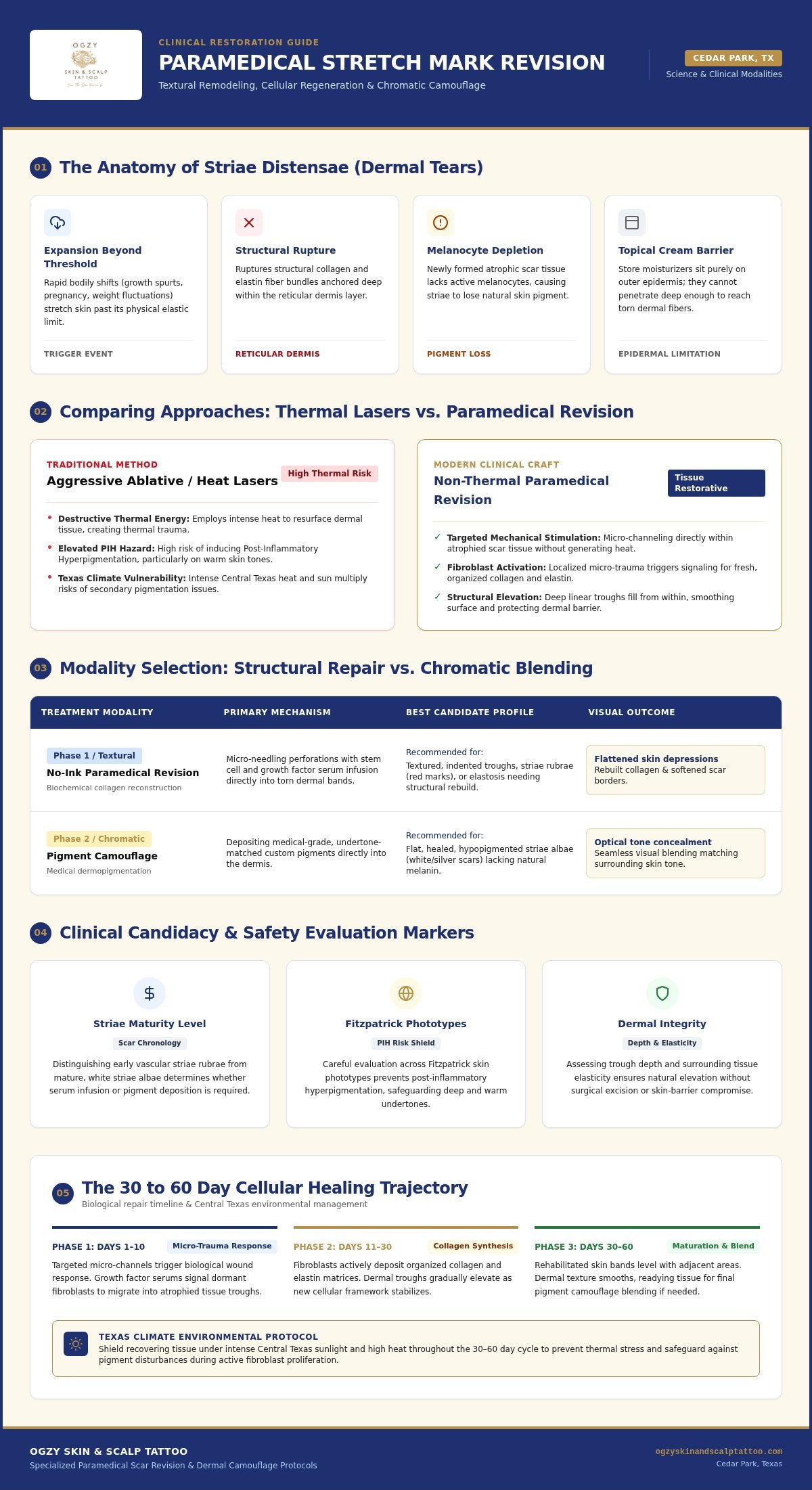
To understand why most store-bought treatments fail, you must first understand what stretch marks are at an anatomical level. Rapid bodily changes, whether from growth spurts, pregnancy, or weight fluctuations, stretch the skin beyond its elastic threshold. This rapid expansion ruptures the structural collagen and elastin fiber bundles anchored within the reticular dermis, leaving behind atrophic linear scars.
Because the damaged dermis thins out, these bands lose their underlying structural support. The newly formed scar tissue also lacks functional melanocytes, the cells responsible for producing natural pigment. Topical moisturizers and cosmetic oils sit solely on the protective outer epidermis, completely unable to penetrate deeply enough to mend ruptured dermal fibers.
Modern Paramedical Approaches: Moving Beyond Aggressive Ablative Lasers
In the past, medical providers routinely directed patients toward aggressive ablative or fractional heat lasers. While these devices can produce changes, their high thermal energy carries a significant risk of inducing post-inflammatory hyperpigmentation (PIH), especially on warm undertones exposed to Central Texas heat. Modern paramedical revision takes a more refined, non-thermal approach:
- Targeted Mechanical Stimulation: Specialized micro-needling devices gently create controlled micro-channels directly within the atrophied scar tissue without generating destructive heat.
- Fibroblast Activation: This localized micro-trauma triggers a cascade of natural healing responses, signaling fibroblasts to generate fresh, organized collagen and elastin.
- Structural Elevation: As healthy tissue develops, the deep linear troughs gradually fill from within, creating a smooth, touchable surface that integrates naturally with surrounding skin.
By focusing purely on restorative biomechanics, paramedical techniques gently rehabilitate compromised skin integrity while preserving your natural dermal barrier.
Ink vs. No-Ink Revision: Comparing Regenerative Serum Infusion and Pigment Camouflage
Achieving smooth, undetectable results requires understanding the difference between structural tissue repair and chromatic blending. In experienced clinical practice, no two cases of striae share the exact same depth, texture, or cellular age. That is why choosing the right approach to stretch mark revision Cedar Park TX comes down to evaluating whether your skin needs deep textural remodeling, optical concealment, or a sequenced combination of both.
| Treatment Modality | Primary Mechanism | Best Candidate Profile | Visual Outcome |
|---|---|---|---|
| No-Ink Paramedical Revision | Needling micro-perforations with stem cell and growth factor infusion | Textured, indented troughs, striae rubrae, or elastosis | Flattened skin depressions, rebuilt collagen, softened borders |
| Pigment Camouflage | Depositing medical-grade, undertone-matched pigments into dermis | Flat, healed, hypopigmented striae albae | Seamless visual blending matching surrounding skin tone |
No-Ink Paramedical Revision: Medical-Grade Stem Cells and Growth Factors
No-ink revision uses precise micro-channeling to deliver clinical-grade serums containing concentrated growth factors directly into torn dermal bands. This signaling triggers deep fibroblastic migration, stimulating the synthesis of fresh collagen and elastin fibers across thin scar tissue. By rebuilding compromised architecture from the base up, this process softens distinct borders and smooths tactile ridges. To learn more about how physical dermal remodeling revitalizes atrophic tissue, explore our microneedling for scars guide.
Custom Pigment Camouflage: Seamless Skin Tone Matching for Striae Alba
When striae are completely settled and pale, custom pigment camouflage steps in to resolve color loss. This paramedical tattooing technique deposits custom-formulated cosmetic pigments precisely into the hypopigmented void. Formulating these shades demands advanced color theory, balancing warm, cool, and neutral undertones so the correction looks natural in broad Texas daylight. High-grade paramedical pigments resist shifting toward unnatural blues or grays, maintaining their tone as skin turns over.
Hybrid Protocols: Combining Texture Smoothing with Visual Blending
Placing pigment into a deeply grooved stretch mark often leaves shadows that catch the light, drawing attention back to the indentation. Because of this, deep linear tears require structural leveling first. A phased hybrid protocol addresses dermal dips with no-ink cellular stimulation, waits six to eight weeks for complete tissue remodeling, and finishes with tailored pigment camouflage. If you’re wondering which protocol aligns with your goals, consider a personalized skin evaluation to map out a clear restorative plan.
Assessing Candidacy: Skin Tone Evaluation, Fitzpatrick Scales, and Striae Maturity
Determining whether someone is ready for paramedical treatment requires an objective, clinical assessment framework. Because skin is a living, reactive organ, a responsible specialist evaluates both cellular readiness and pigment biology before proceeding. When booking stretch mark revision Cedar Park TX, understanding where your skin falls on the maturity timeline ensures your procedure is completely safe, highly effective, and visually harmonious.
Evaluating Striae Rubra (Red/Purple) vs. Striae Alba (White/Silvery)
The color of your stretch marks indicates their biological stage. Early-stage marks, known as striae rubra, appear pink, red, or violaceous because active micro-vascularization and inflammation are still present under the skin. Introducing cosmetic tattooing pigments into vascularized tissue is counterproductive; the body’s ongoing immune response will degrade or distort the color.
Instead, striae rubra respond exceptionally well to no-ink regenerative treatments. Micro-channeling calms ongoing inflammation and prompts structural rebuilding. Mature striae alba, on the other hand, have lost their active vascular flow, leaving behind pale, settled bands that serve as ideal canvases for undertone-matched pigment camouflage.
Fitzpatrick Skin Typing and Melanin Safety Considerations
Skin phototypes on the Fitzpatrick scale (Types I through VI) react differently to mechanical trauma. Clients with deeper, melanin-rich complexions (Types IV through VI) have highly reactive melanocytes, creating a higher risk for post-inflammatory hyperpigmentation (PIH) if treated aggressively.
- Custom Needle Depth: Needling depth must be adjusted with micro-millimeter precision to stimulate fibroblasts without alarming epidermal melanocytes.
- Mandatory Patch Testing: Performing a discrete test session on a tiny, hidden segment allows the specialist to observe cellular healing and color retention over six to eight weeks.
- Culturally Competent Protocols: Safe clinical care respects unique undertones, ensuring deeper skin tones receive gentle, tailored pacing rather than a one-size-fits-all approach.
Key Pre-Treatment Qualifications: Tissue Health and Realistic Expectations
Before any procedure begins, the target area must be in baseline health. The skin should be entirely clear of active dermatitis, eczema flares, open blemishes, or sunburns. In addition, clients planning pigment camouflage must present their natural baseline skin tone. Recent sun tanning artificially shifts undertones, which ruins pigment formulations once the tan fades.
Finally, maintaining healthy expectations is vital. Paramedical revision creates substantial, transformative blending, but it does not surgically excise dermal tissue. The goal is seamless camouflage under natural daylight, giving you freedom from daily self-consciousness.
The Treatment Experience: Clinical Protocol, Healing Stages, and Texas Climate Aftercare
Stepping into a specialized studio should feel calm, transparent, and reassuring. Because paramedical procedures are non-surgical and minimally invasive, your appointment fits smoothly into normal life without requiring prolonged bed rest. Understanding the appointment workflow and aftercare guidelines for stretch mark revision Cedar Park TX ensures you navigate recovery with total peace of mind.
What to Expect During Your In-Clinic Revision Session
Every session prioritizes client comfort from start to finish. A medical-grade topical anesthetic is applied first, setting for roughly thirty to forty minutes so you feel minimal sensation during treatment. Every needle cartridge is single-use, gamma-sterilized, and opened directly in front of you under strict hospital-grade cleanliness protocols. Depending on the size of the target zone, appointments generally take between ninety minutes and three hours.
Healing Milestones: Managing Redness, Peeling, and Settling
Recovering from dermal revision follows an orderly biological progression across your skin’s natural renewal cycle:
- Days 1 to 4: Expect localized erythema (redness) and mild puffiness, resembling a moderate sunburn. Keep the area clean, dry, and protected.
- Days 5 to 14: The skin begins light cellular flaking as epidermal turnover kicks in. You must let this slough away naturally without picking or scratching.
- Weeks 4 to 8: Collagen remodeling continues deep below the surface while pigment or newly induced melanin fully settles into place.
If your personalized protocol calls for multiple sessions, appointments are scheduled six to eight weeks apart to give dermal tissues ample time to stabilize.
Sun Protection and Lifestyle Maintenance in Williamson County
Living under the intense Central Texas sun means aftercare requires extra diligence. Freshly revised dermal layers are highly vulnerable to ultraviolet radiation. Exposing healing tissue to direct UV light can trigger dark discoloration or cause pigments to fade prematurely. Coat treated areas in broad-spectrum mineral sunscreen containing zinc oxide whenever coverage by clothing isn’t possible.
During the initial two-to-three-week healing window, pause trips to local splash pads, hot tubs, chlorinated community pools, and open water at Lake Travis to safeguard against bacterial infection. If you’re exploring options across the wider metro area, review our comprehensive resource on Austin scar and stretch mark revision. When you’re ready to start your own restorative journey, schedule your Cedar Park consultation to receive a personalized recovery plan.
Restoring Skin Confidence in Cedar Park: Why Specialized Paramedical Expertise Matters
Revising compromised dermal tissue is both a delicate science and an exacting visual art. Unlike traditional day spas that treat only the surface, true paramedical restructuring requires an in-depth understanding of dermal pathology, precise needle depth control, and advanced pigment science. At Ogzy Skin & Scalp Tattoo, paramedical specialist Opal approaches every stretch mark revision Cedar Park TX procedure with meticulous technical precision and genuine clinical empathy.
Paramedical Mastery vs. General Esthetic Day Spas
Dermal revision goes far beyond generic spa treatments. While day spas focus on relaxation, paramedical practitioners work within living scar tissue that behaves unpredictably under trauma. Opal utilizes medical-grade needles, high-purity restorative serums, and custom-blended mineral pigments engineered specifically to remain color-stable in human tissue. This focused background prevents needle blowouts, excessive trauma, or color shifting, ensuring results look soft and natural under any lighting.
Serving Cedar Park, Leander, and Greater North Austin Communities
Ogzy Skin & Scalp Tattoo provides a discreet, serene studio setting designed to make clients feel instantly at ease. Situated conveniently near major routes like Highway 183 and Ronald Reagan Boulevard, the practice routinely welcomes clients from across Cedar Park, Leander, Round Rock, and North Austin. Every appointment takes place in a private, unhurried space where your personal goals and privacy remain top priorities:
- Convenient Regional Access: Easily accessible location for residents across Williamson and Travis counties.
- Private, Focused Environment: A dedicated clinical space free from the crowded noise of high-volume medical centers.
- Accommodating Scheduling: Flexible appointment options crafted around the schedules of busy professionals and active families.
Taking the Next Step: Your Personalized, Confidential Consultation
Beginning your transformation is simple and supportive. The journey starts with a confidential pre-consultation photo review, followed by an in-depth, in-person assessment of your skin’s elasticity, undertones, and striae maturity. Opal designs a tailored roadmap specifically suited to your body, whether you need regenerative serum microneedling, chromatic camouflage, or a progressive combination.
You don’t have to carry frustration or hide your skin beneath layers of clothing. By choosing dedicated paramedical stretch mark revision Cedar Park TX, you can step out under the Texas sun feeling balanced, restored, and completely confident in your own skin.
Reclaim Your Skin Confidence Under the Texas Sun
Living with stretch marks doesn’t have to dictate how you feel in your skin or what you choose to wear. By pairing targeted cellular remodeling with bespoke pigment camouflage, modern paramedical techniques achieve smooth, undetectable blending without invasive surgery or prolonged downtime. Real dermal renewal works in harmony with your body, patiently restoring texture and tone from the inside out.
At Ogzy Skin & Scalp Tattoo, paramedical specialist Opal integrates medical-grade stem cells, regenerative growth factors, and optical pigment artistry to rebuild tissue integrity. Centrally serving clients across Cedar Park, Leander, Round Rock, and the greater Austin metro, the studio provides a private, supportive setting focused entirely on your renewal. When you’re ready to experience advanced stretch mark revision Cedar Park TX, schedule your confidential skin restoration consultation and embrace your skin with complete, renewed self-assurance.
Frequently Asked Questions
How does paramedical stretch mark revision differ from laser resurfacing?
Paramedical revision utilizes precise mechanical micro-stimulation and pigment deposition without the thermal heat risks associated with ablative lasers. Lasers rely on intense heat that can trigger post-inflammatory hyperpigmentation on sun-exposed or melanin-rich skin. Paramedical revision rebuilds structural collagen through concentrated serums or custom pigments matched directly to your skin tone, offering a gentle alternative with minimal downtime and reduced complication risks.
Does paramedical stretch mark revision hurt during the procedure?
Discomfort is minimal thanks to a medical-grade topical anesthetic applied before your session begins. Most clients describe the sensation as a light vibration or gentle scratching across the treatment zone. Because the needles target localized dermal troughs rather than broad surrounding tissue, the process remains very manageable. Opal maintains a relaxed, unhurried pace to ensure you stay completely comfortable throughout your appointment.
Will stretch mark camouflage pigment turn unnatural colors when I tan?
Camouflage pigment will not change color over time, but it does not produce melanin when exposed to ultraviolet light. Because surrounding untreated skin darkens while pigment stays steady, significant tanning can make the camouflage visible. To protect your investment in professional stretch mark revision Cedar Park TX, you should apply broad-spectrum mineral sunscreen consistently to keep your natural tone balanced and even.
Can dark or deep skin tones safely undergo stretch mark revision in Cedar Park?
Yes, deeper Fitzpatrick types (IV through VI) can safely receive revision when treated by an experienced paramedical specialist. Opal utilizes conservative needle depths and tailored serum protocols specifically designed to avoid triggering hyperactive melanocytes. Discreet patch testing is performed on a hidden segment first, ensuring the skin demonstrates a calm, stable biological healing response before completing the entire treatment area.
How many stretch mark revision sessions are typically needed for optimal results?
Most clients achieve rewarding, noticeable improvement within one to three sessions per targeted area. The exact number depends on mark depth, tissue elasticity, and whether your protocol involves regenerative no-ink serums, pigment camouflage, or both. Sessions are spaced roughly six to eight weeks apart, giving the dermis adequate time to synthesize fresh collagen fibers and fully complete its natural turnover cycle.
What is the recovery downtime following a stretch mark revision session?
Paramedical revision requires virtually zero true downtime, allowing you to return to normal daily routines immediately. You can expect mild redness and light swelling resembling a modest sunburn for three to four days, followed by gentle cellular flaking. You simply need to pause strenuous workouts, avoid swimming in Lake Travis or community pools, and prevent direct sun exposure during the initial two-week window.
Can stretch mark revision fix older, white stretch marks from pregnancy or puberty?
Yes, older white or silvery stretch marks (striae alba) are actually prime candidates for restorative paramedical care. When seeking stretch mark revision Cedar Park TX for settled post-pregnancy or pubertal marks, custom pigment camouflage effectively fills hypopigmented channels with matching undertones. If deep textural troughs are present, no-ink needling can level the dermal architecture first before completing final color blending.

Article by
Opal Z
Opal is the owner and practitioner behind OGZY Skin & Scalp Tattoo in Austin, Texas. With more than three years in business and a longtime background in the aesthetics industry, she specializes in corrective and restorative treatments designed to address concerns that traditional aesthetics often overlook.
Her work focuses on scar and stretch mark revision, scar camouflage, scalp micropigmentation (SMP), hair regrowth treatments, and laser tattoo and permanent makeup removal. Opal works with a wide range of skin tones and takes an individualized approach to every client, considering skin color, texture, scar characteristics, treatment history, and realistic long-term outcomes.
Through OGZY Skin & Scalp Tattoo, her goal is to combine artistry, aesthetics, and technical treatment knowledge to help clients feel more comfortable and confident in their skin.
Love the skin you’re in.