
The right thicker fuller hair treatment depends on what is making your hair look less full. Breakage, reduced density, and hair that falls flat can call for different approaches, so it helps to look beyond product claims and first clarify what you want to change.
This guide compares cosmetic fullness, hair-focused treatments, and Scalp Micropigmentation (SMP). You’ll learn what each option is intended to do, how to set realistic expectations, and what details to bring to a treatment discussion.
At Ogzy Skin & Scalp Tattoo, options include regenerative hair treatments featuring medical-grade stem cells and growth factors, professional microneedling, and SMP. Regenerative treatments and microneedling support hair-regrowth goals, while SMP creates realistic follicle simulation for a fuller-looking appearance rather than regrowing hair. Your first step is to identify whether you’re seeking support for hair growth or a visual impression of greater density.
Key Takeaways
- Thinning, breakage, and reduced volume can look alike, but they may call for different approaches.
- A thicker fuller hair treatment may focus on cosmetic appearance, hair condition, or scalp-related goals. Learn how to tell these categories apart.
- Compare cosmetic products, professional hair treatments, and Scalp Micropigmentation by what each is intended to change.
- Use a simple framework to clarify your goals and prepare for a thoughtful treatment discussion without trying to diagnose the cause yourself.
- Explore how regenerative hair treatments and professional microneedling fit into personalized options in Austin and nearby communities.
What Does a Thicker Fuller Hair Treatment Aim to Change?
Hair that seems less full can raise a few different questions: Is it breaking before it grows longer, sitting flatter than usual, or changing in density? These concerns can look similar in the mirror but describe different things. A thicker fuller hair treatment is a broad term for an approach intended to change how hair looks or feels, support hair condition, or address scalp-focused goals. Start by identifying which change matters most to you.
That distinction helps set realistic expectations. Styling techniques and cosmetic products can lift roots or make strands feel more substantial without changing the number of follicles. Scalp-focused treatments have different aims, and suitability and potential outcomes depend on the individual and approach. A fuller-looking result doesn’t automatically mean new hair has grown or that follicles have been restored. For background on hair loss patterns and factors, see this overview of Hair loss.
A useful definition: Cosmetic fullness changes how hair looks or feels. A hair-regrowth treatment is intended to support hair-regrowth goals. Both may relate to wanting fuller hair, but they don’t describe the same result.
Is the concern breakage, flatness, or reduced density?
Breakage can leave shorter, fragile strands that make the overall shape look less full, even when the concern is mainly along the lengths. Fine-textured hair or a styling routine that doesn’t create lift can also look flat. Appearance alone doesn’t establish why. Reduced density describes a different concern involving how much hair appears across an area of the scalp. These clues can help you describe what you see, but they aren’t a diagnosis.
What does “fuller-looking hair” mean?
For one person, “fuller” means more root lift, a different strand feel, or a style that holds its shape. For another, the goal may involve the appearance of the scalp or support for hair-regrowth goals. Those aims call for different approaches and expectations. A cosmetic change doesn’t necessarily affect the scalp or growth pattern, and appearance alone can’t confirm hair loss or predict a treatment result.
Before comparing options, note what you’ve observed. A few simple details can make a treatment conversation more focused without asking you to identify the cause yourself. Consider recording:
- When you first noticed the change and whether it seems gradual or sudden.
- Where you see it most, such as the lengths, part, hairline, or overall shape.
- What you hope to change, from visible styling volume to a scalp-focused or hair-regrowth goal.
These observations give you a practical starting point. Compare approaches by what they’re designed to change, rather than relying on a product’s promise or the word “thicker” alone.
Why Hair Can Look Thinner, and What Treatment Can Address
A change in fullness can have more than one explanation, and different concerns call for different kinds of attention. Strands may break along their length, hair may sit flat or feel finer, or the scalp may appear more visible than before. These observations can help describe what you’re seeing, but they don’t identify the cause on their own.
The appearance of thin hair alone cannot establish its cause or ideal treatment. A thicker fuller hair treatment may focus on cosmetic appearance, hair condition, or scalp-related goals. These aims aren’t interchangeable. Styling products may alter how full hair looks, while professional treatments may be intended to support other goals. No single approach suits every concern.
How hair condition and scalp concerns differ
Fragile or broken strands can leave uneven lengths and reduce the impression of fullness, even if the scalp isn’t the focus. Strand-focused habits and products address how hair looks and feels. Professional scalp-focused approaches, by contrast, are considered in relation to scalp or hair-regrowth goals. A sudden, substantial, or otherwise concerning change deserves medical evaluation. Appearance alone can’t explain it.
Note what you’ve observed without trying to label it. For example, record whether you’re noticing short broken hairs, a change in how your style holds, or greater visibility of the scalp. Include when the change began and whether it seems to be continuing. Those details can make a conversation about next steps more focused.
What regenerative hair treatments are intended to support
Ogzy Skin & Scalp Tattoo offers regenerative hair treatments featuring medical-grade stem cells and growth factors to support hair-regrowth goals and encourage thicker, fuller-looking hair. Professional microneedling is also available to support skin rejuvenation and treatment efficacy. These services are not a promise of a particular outcome. A useful discussion considers the individual’s goals and sets realistic expectations.
Microneedling shouldn’t be treated as a universal answer to every reason hair may look thin. A considered plan starts by defining the goal and matching the discussion to an appropriate approach. For general information about how care options can differ, Mayo Clinic’s Hair loss treatments overview provides context on treatment categories. It doesn’t replace an individual assessment.
If you’re considering a scalp-focused option, a personalized discussion can help distinguish support for hair-regrowth goals from creating a fuller-looking appearance. Learn about personalized hair treatment options.
Hair Thickening Products vs. Scalp Treatments: What Is the Difference?
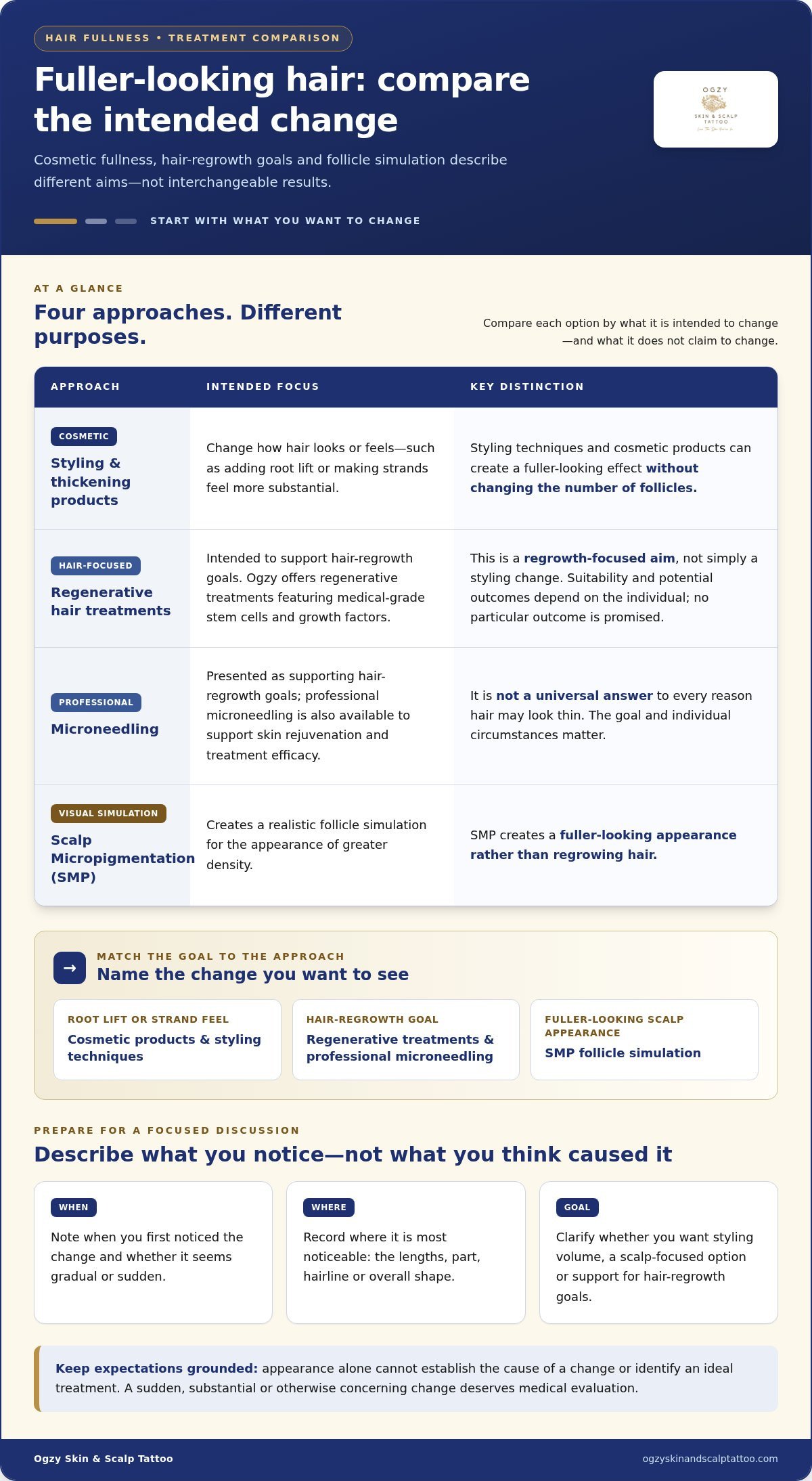
A thickening shampoo, a professional hair treatment, and Scalp Micropigmentation (SMP) aren’t interchangeable just because each may come up in a search for fuller hair. Compare them by what they’re intended to change, then consider whether that matches your goal. This makes it easier to assess claims without treating every option as a solution for the same concern.
| Option | Primary goal | What it changes | Expectation to hold |
|---|---|---|---|
| Cosmetic products | Support styling, hair feel, or visible volume | How strands look or feel, often as part of a styling routine | Appearance effects don’t necessarily change the scalp or hair-growth pattern. |
| Professional hair treatments | Address scalp-focused or hair-regrowth goals | The treatment approach is directed toward the individual’s stated goals | Suitability and results vary; no treatment should be viewed as a guaranteed outcome. |
| Scalp Micropigmentation (SMP) | Create the visual impression of fuller hair | Realistic follicle simulation on the scalp | SMP creates the appearance of follicles. It does not regrow hair or restore follicles. |
When cosmetic products may fit the goal
Products may suit you if you’re mainly looking for a different hair feel, a styling effect, or visible lift. For example, you may want roots to look less flat or your hairstyle to appear fuller for the day. These are cosmetic aims. A product’s effect shouldn’t be confused with a change in scalp condition or hair growth. Judge its claims against the specific result you want.
When professional scalp-focused options enter the discussion
If your goal is scalp-focused, a professional approach may be more relevant than a styling product. Ogzy Skin & Scalp Tattoo offers regenerative hair treatments featuring medical-grade stem cells and growth factors, as well as professional microneedling. These services can be discussed in relation to your goals, without assuming they’re right for every concern or promising a particular result. A guide to hair regrowth without surgery offers a broader overview of treatment approaches.
SMP is a separate option if you’re seeking visual density rather than hair regrowth. It uses follicle simulation to create a fuller-looking appearance, so the intended change is visual, not biological. Explore this Scalp Micropigmentation reference guide to learn more about that approach. The right thicker fuller hair treatment category depends on whether your priority is styling and feel, scalp-focused support, or the appearance of greater density. Match the goal to the approach before weighing claims.
How to Choose a Thicker Fuller Hair Treatment That Fits Your Goals
A thoughtful choice starts with your goal, not the most dramatic product claim. You don’t need to identify a cause or arrive with a treatment decision already made. Describe what you’ve noticed and what you hope will change. A useful framework is to describe the concern, clarify the goal, compare categories, discuss suitability, and set expectations.
Questions to clarify before considering treatment
Before a treatment conversation, jot down when you noticed a change, where it appears, and what you’ve already tried. Note whether your priority is styling volume, hair condition, scalp-focused support, or visual density. These observations keep the discussion grounded in your experience without turning self-observation into self-diagnosis. A specialist can then discuss options in relation to your goals and concerns.
- Describe the concern. Record visible changes in your hair or scalp, including when you first noticed them and whether they seem to be changing.
- Clarify the goal. Decide what matters most: a cosmetic styling effect, attention to hair condition, support for hair-regrowth goals, or the appearance of greater density.
- Compare categories. Consider whether cosmetic products, a professional hair treatment, or Scalp Micropigmentation better matches the kind of change you’re seeking.
- Discuss suitability. Share relevant concerns and previous approaches so the discussion can focus on your circumstances rather than broad promises.
- Set expectations. Agree on the intended outcome and how you’ll review whether the approach remains aligned with your goals.
Setting realistic expectations and tracking change
Before beginning an approach, make the desired change specific enough to review. Is your priority a visual change in density or support for a hair-regrowth goal? These are different outcomes. Avoid assuming a fixed timeline or degree of change; suitability and progress depend on the individual and the concern being addressed. A hair loss confidence solutions guide can also help you consider broader ways to approach the personal impact of hair concerns.
Keep a simple record of what you notice and revisit it at an agreed point in the process. Notes or photographs taken under similar conditions may help you compare appearance over time, though they can’t explain the cause or guarantee a result. The purpose is to support a clear, realistic conversation, not to judge yourself against someone else’s experience.
Before choosing an approach, clarify what you’ve noticed, what you want to change, which treatment category fits that goal, whether it suits your circumstances, and how you’ll review expectations. That checklist can make the next discussion more focused and less pressured. For a personalized conversation about hair treatment options, discuss your hair goals with Ogzy Skin & Scalp Tattoo.
Personalized Hair Treatment in Austin and Nearby Communities
Choosing an approach can feel more manageable once the goal is clear. Are you hoping to explore support for hair-regrowth goals, improve the appearance of density, or understand what a professional service involves? At Ogzy Skin & Scalp Tattoo, the discussion can begin with what you’ve noticed and what you hope to change, without assuming one thicker fuller hair treatment is right for everyone.
What a personalized treatment discussion can clarify
A focused conversation helps separate hair-focused treatment goals from visual simulation. Ogzy offers regenerative hair treatments featuring medical-grade stem cells and growth factors to support hair-regrowth goals and encourage thicker, fuller-looking hair. The discussion considers how this option relates to your goals and what expectations are appropriate, without promising a particular amount of growth or a specific timeline.
Ogzy also provides professional microneedling to support skin rejuvenation and treatment efficacy. Its role should be considered in the context of your goals, not treated as a guaranteed hair-growth solution. Scalp Micropigmentation (SMP) is different: it creates realistic follicle simulation for a fuller-looking appearance, but does not regrow hair. Knowing this distinction can help you decide whether your priority is a hair-focused treatment discussion or a visual change in how the scalp appears.
There isn’t one plan that fits every person. Your observations, desired outcome, and the concern you want to address all matter. A useful discussion keeps those details central and clarifies the intended result and realistic expectations, without unsupported promises about effects or safety.
Take a considered next step with Ogzy
You can begin by sharing what you’ve noticed, what you’ve tried, and what you’d like to be different. You don’t need to arrive with a diagnosis or choose a service in advance. Those details help shape an individualized conversation about whether regenerative hair treatment, professional microneedling, or SMP aligns with your goal.
For one person, the central question may be whether a hair-focused approach suits their aims. For another, the priority may be the appearance of fuller hair through follicle simulation. Keeping those goals distinct makes it easier to understand what each option is intended to address.
Ogzy Skin & Scalp Tattoo serves clients in Austin, Cedar Park, Leander, Round Rock, and Georgetown. If you’re in one of these communities, explore Ogzy Skin & Scalp Tattoo’s hair treatment options and consider which questions you’d like to bring to a personalized discussion.
Take the Next Step at Your Own Pace
You don’t have to make a decision today. A helpful next step is to write down what you’d like to feel or see change, along with any questions you want answered. That gives you a starting point for a conversation grounded in your priorities, not pressure or someone else’s experience.
Choosing a thicker fuller hair treatment is personal. Take time to weigh what matters, understand the intended goal, and decide whether an option feels right for you. A considered plan should leave you with clearer expectations and a sense of agency, even if you need time before moving forward.
If you’re ready to explore what may fit your goals, explore personalized hair treatment options with Ogzy. Start with your goals and move forward at a pace that feels comfortable.
Frequently Asked Questions
Can a thicker fuller hair treatment regrow hair?
Some treatments are intended to support hair-regrowth goals, but “thicker fuller hair treatment” can also refer to cosmetic options that change appearance only. No approach can promise regrowth, and the right direction depends on the concern. Clarify whether you want a visual change or support for hair growth, and discuss how that goal will be assessed before deciding.
Is Scalp Micropigmentation a hair regrowth treatment?
No. Scalp Micropigmentation (SMP) creates a visual effect through realistic follicle simulation; it doesn’t grow hair or restore follicles. It may suit someone whose priority is the appearance of density. Someone seeking support for hair-regrowth goals would be considering a different category of treatment. Keeping those aims separate helps you describe your desired result and avoid expecting a visual service to change hair growth.
Can microneedling make hair thicker?
Microneedling shouldn’t be viewed as a guaranteed way to make hair thicker. Ogzy offers professional microneedling to support skin rejuvenation and treatment efficacy. Whether it fits a hair-related goal depends on the individual approach and expectations. Before considering it, discuss the intended outcome and how it relates to your concern. A clear conversation can help explain the service’s role without overstating what it can do.
How do I know whether my hair is thinning or breaking?
You may notice clues, but appearance alone can’t confirm the cause. Breakage can leave shorter pieces and uneven lengths, while a changing part or increased scalp visibility may be a different observation. Both can occur together. Note where you see changes and compare photographs taken with similar lighting and styling. If a change is sudden, substantial, or worrying, seek medical evaluation rather than trying to diagnose it from these signs.
Are hair thickening products the same as hair regrowth treatments?
No. A styling product might make roots look lifted, help strands feel different, or create temporary visual volume. That doesn’t necessarily affect hair growth. A hair-regrowth treatment has a different intended goal and shouldn’t be judged by the same cosmetic effect. If a product makes your style look fuller for an evening, that alone doesn’t show a change in the scalp or growth pattern.
Can I combine Scalp Micropigmentation with a hair regrowth treatment?
These options address different goals, so they may be discussed as complementary parts of an individualized plan, but combining them isn’t automatically suitable for everyone. SMP creates a visual impression of follicles, while a regrowth treatment is intended to support hair-growth goals. Discuss your desired appearance, current concerns, and expectations before deciding on an approach. Ogzy serves clients in Austin, Cedar Park, Leander, Round Rock, and Georgetown.

Article by
Opal Z
Opal is the owner and practitioner behind OGZY Skin & Scalp Tattoo in Austin, Texas. With more than three years in business and a longtime background in the aesthetics industry, she specializes in corrective and restorative treatments designed to address concerns that traditional aesthetics often overlook.
Her work focuses on scar and stretch mark revision, scar camouflage, scalp micropigmentation (SMP), hair regrowth treatments, and laser tattoo and permanent makeup removal. Opal works with a wide range of skin tones and takes an individualized approach to every client, considering skin color, texture, scar characteristics, treatment history, and realistic long-term outcomes.
Through OGZY Skin & Scalp Tattoo, her goal is to combine artistry, aesthetics, and technical treatment knowledge to help clients feel more comfortable and confident in their skin.
Love the skin you’re in.