
If you’re tired of hiding your receding hairline, understanding what may be changing can help you weigh your options. Changes in appearance can raise questions, and those questions deserve clear, thoughtful answers.
Learn about common causes and signs to watch for, and how different approaches address different goals.
We’ll also explain what a professional consultation can clarify, so you can consider your next step with more confidence and less guesswork.
Key Takeaways
- Temple changes, an M-shaped outline, and thinning around the part can look different from person to person; noticing the pattern helps you describe what you’re seeing.
- Genetics and DHT are common factors in pattern hair loss, but a changing hairline doesn’t always have the same cause.
- Pay attention to whether the change is gradual or sudden, and whether thinning appears elsewhere on the scalp.
- Different options address different goals: scalp micropigmentation creates the look of greater density with pigment, rather than regrowing hair.
- A professional consultation can help clarify what may be contributing to the change and which approach aligns with your goals.
Why Do I Have a Receding Hairline?
A receding hairline can reflect inherited pattern hair loss, a naturally maturing hairline, or another change in how hair grows. In men, male-pattern baldness may begin in the 20s, while a hairline can start changing any time after puberty. Up to 50% of men experience a receding hairline by age 50, but that figure doesn’t tell you what’s causing an individual person’s hair loss.
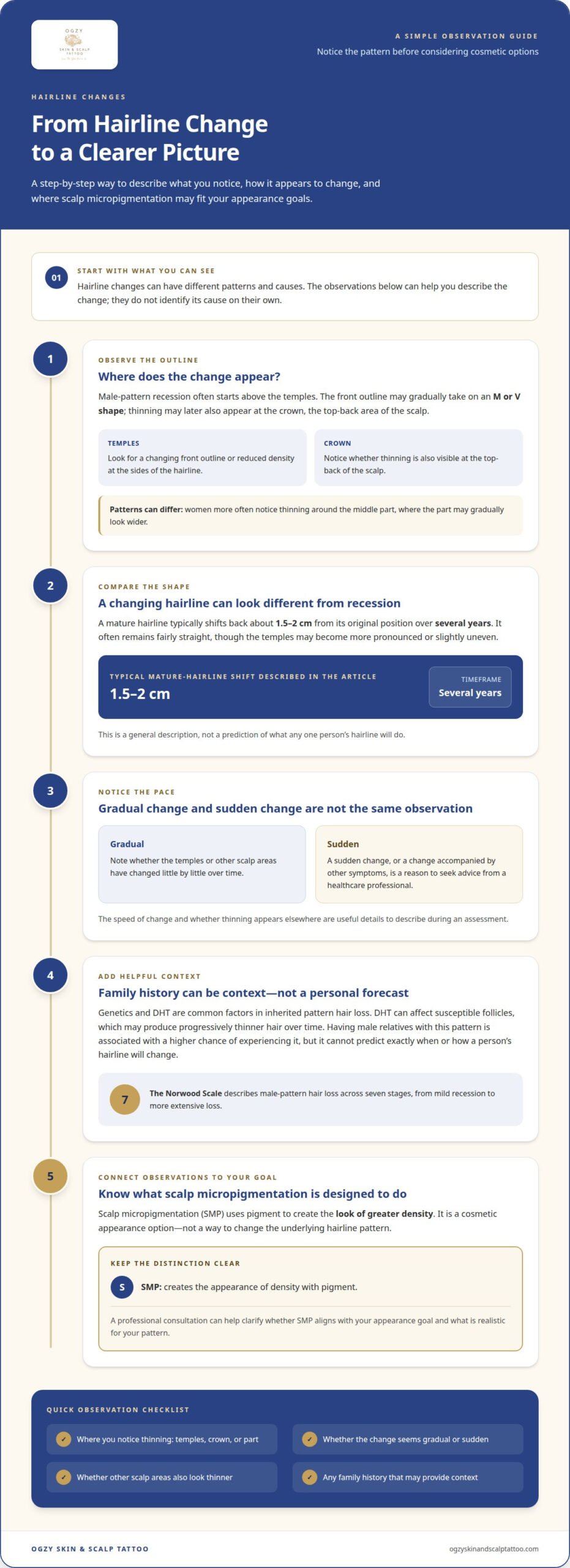
Look at the pattern, not just the hairline’s position. Male-pattern recession often starts above the temples, gradually forming an M or V shape. Thinning may later appear at the crown, the top-back area of the scalp. A mature hairline, by contrast, typically shifts back about 1.5 to 2 cm from its original position over several years. It often remains fairly straight, although the temples may become more pronounced or slightly uneven.
Genetics can influence male-pattern baldness. Having male relatives with androgenetic alopecia, a common inherited pattern of hair loss, is associated with a higher chance of experiencing it. Dihydrotestosterone, or DHT, can shrink susceptible hair follicles. Over time, those follicles may produce progressively thinner hair, making temple recession more visible even while other areas retain their previous density. The Norwood Scale describes male-pattern hair loss across seven stages, from mild recession to more extensive loss.
If you’re tired of hiding a receding hairline, styling can offer a temporary way to feel more comfortable. A shorter cut, side part, or textured style can soften the contrast at the temples. A hat or headband offers another option. Styling paste can shape existing hair, but it won’t change the underlying hairline pattern.
Hairline changes can affect confidence as well as appearance. Identify specific situations that feel difficult, such as photographs or bright overhead lighting, and choose one manageable coping step. Talking with someone you trust or a mental health professional can also help if anxiety or low self-esteem interferes with daily life.
Notice how the pattern changes over time. Gradual temple recession differs from sudden hair loss, and thinning across the scalp can look different from a changing front hairline. If recession is sudden or comes with other symptoms, seek advice from a healthcare professional. An assessment can help distinguish a common pattern from a change that needs a different kind of attention.
Male pattern baldness affects 85% of men; male receding hairlines usually begin above the temples. Men may first notice recession in their 20s, 30s, or 40s; most notice mature shifting at 17-29, and men’s hairlines commonly mature around 25-27.
Genetics, hormones, and DHT
Androgenetic alopecia is the medical term for inherited pattern hair loss. The American Academy of Dermatology identifies it as a primary factor in most receding hairlines in men. In this process, DHT affects susceptible hair follicles and can gradually shrink them. Smaller follicles produce finer strands, so the hairline may look less defined over time. Genetics help explain why relatives can share a pattern, while differences in timing and visible effects make each person’s experience distinct.
Genes influence susceptibility, not a single predictable hairline shape. One person might first notice changes at the temples, while another sees thinning elsewhere. Family history can offer useful context: male relatives with androgenetic alopecia are associated with a higher chance of experiencing it. But that association can’t show precisely when an individual’s hair loss will appear or how it will progress. An assessment can consider the visible distribution and history together, rather than treating family resemblance as a diagnosis.
Age and hormone activity also shape when changes become noticeable. Early-stage androgenetic alopecia affects about 25% of men by age 21, according to the research facts provided. That figure describes a group, not a prediction for every person. DHT’s effects depend on susceptible follicles, so two people of similar age can have different amounts of visible thinning. A gradual shift in the temples and a broader pattern across the scalp are different observations to describe during an evaluation.
Hormonal changes can also relate to hair thinning in women. Women in their 40s may experience hair loss as estrogen levels decline during menopause. This timing differs from male-pattern hair loss, and the visible pattern can differ too. Women more often notice thinning around the middle part, while some see subtle frontal changes. These examples show why “hormonal” does not name one universal cause: age, hormone changes, family history, and the location of thinning all contribute to the picture.
Genetic causes can’t be confirmed from a photograph or one relative’s experience. Compare the same areas over time: temples, frontal hairline, crown, and center part. Note whether the change is gradual, whether thinning appears in more than one area, and whether close relatives share a similar pattern. These details help distinguish a slowly changing outline from diffuse hair loss and give a healthcare professional clearer context than saying only, “My hair looks thinner.”
Treatment is a separate question from cause. Topical minoxidil is FDA-approved in the United States as a liquid and foam for hair loss, but that fact alone doesn’t explain an individual’s pattern. Family history and visible distribution help frame possible causes, while treatments address different goals. Understanding how DHT, genetics, and hormone changes relate to follicles gives you clearer language for describing what you notice.
Signs of a receding hairline
Changes often become clearer when you compare the same areas over time. A receding hairline may make the forehead look higher, reduce density at the temples, or appear different in older photographs. In men, temple thinning can form an M or V outline. These visual clues describe a pattern, but don’t identify its cause on their own.
For women, the pattern may look different. Hair loss often begins around the middle part, where the part may gradually appear wider. Some women also notice subtle frontal thinning in their late 20s to early 30s, or changes near the temples. Female hairline changes can be less sharply defined than male pattern baldness, so compare the part, front edge, and temple areas separately.
Notice whether the change is gradual or sudden, and whether it affects one area or several. Compare photographs taken in similar lighting, with your hair parted in the same place. Look for a widening center part, reduced density at the temples, or thinning at the crown. Alopecia means hair loss; the term alone doesn’t indicate whether the cause is inherited pattern hair loss or something else.
Normal shedding can make the scalp feel different, but a change in the hairline’s outline is a separate clue. Thinning across multiple areas may follow a different pattern from recession limited to the front. Nutrient deficiencies, including low levels of iron, zinc, protein, or some vitamins, are associated with excess shedding. A hairline photo can’t diagnose a vitamin concern, so note other changes to discuss during a consultation.
Some signs call for prompt professional attention. Sudden hairline recession or hair loss accompanied by other symptoms warrants a consultation with a healthcare professional. Patchy loss, irritation, or rapid change also deserves a closer look rather than an assumption of male-pattern baldness. A professional can review the timing, distribution, and relevant health history to understand what the visible signs may mean.
Finasteride, minoxidil, and hair transplants belong in discussions about treatment, not on a checklist of symptoms. Seeing one of these options mentioned doesn’t confirm the cause of hair loss or show which approach fits. A consultation can help clarify whether the visible pattern resembles androgenetic alopecia or whether another explanation needs consideration. Bringing consistent photographs and noting when changes began can make the conversation more specific.
Which treatments can slow or reverse a receding hairline?
Treatment goals differ: some approaches aim to slow further loss, while others address the appearance of areas already affected. In the United States, topical minoxidil is FDA-approved as a liquid and foam for hair loss. It may help slow hair loss at the hairline, and regular use is needed to maintain its effects. Stopping or inconsistent use can affect whether those effects continue.
Oral finasteride is FDA-approved in the United States to treat male-pattern hair loss. Used consistently and as directed, it can help slow recession and preserve existing hair, but it doesn’t restore hair already lost. Finasteride is a prescription medication, so discuss treatment decisions and possible effects with a healthcare professional. Preserving existing hair and rebuilding a receded outline are different goals.
Some prescribing options are off-label, meaning they’re used for a purpose outside their FDA-approved use. Oral minoxidil may be prescribed off-label for hair loss in the United States, as may topical finasteride. These options aren’t interchangeable with FDA-approved uses, and their suitability depends on medical considerations. A healthcare professional can explain how a medication’s form and intended use relate to your situation.
Medication studies sometimes examine combinations. One study reported improvements in hair loss for 94% of men using minoxidil with finasteride. That result describes the study participants, not a guaranteed outcome for every person. It also doesn’t mean that combining treatments is appropriate for everyone. A clinician can discuss the study finding alongside your health history, the pattern of loss, and the treatment’s possible effects.
Other approaches have different evidence and purposes. Platelet-rich plasma, or PRP, is still being studied for hair loss, and results for a receding hairline can be inconsistent and temporary. Low-level laser therapy is described as more effective at slowing hair loss than producing new growth. Ketoconazole shampoo alone isn’t recommended as a hair-loss treatment. These distinctions help separate options that may affect progression from products that aren’t standalone solutions.
Before choosing a treatment, clarify your goal: slowing further recession, preserving existing hair, or changing the visible outline. A professional discussion can consider where thinning occurs, how it has changed, and which treatment claims match that goal. Medication approaches require attention to their use and limits; cosmetic options work differently and don’t alter the underlying follicles. Understanding these differences helps you compare transplant surgery, scalp micropigmentation, and hair systems.
How do hair transplant surgery, scalp micropigmentation, and hair systems compare?
These options address a receding hairline in different ways. Hair transplant surgery moves follicles, scalp micropigmentation adds the appearance of density with pigment, and a hair system provides a non-surgical covering. Start by identifying your goal: changing where hair grows, creating a close-shaved look, or covering thinning with a hairpiece.
A hair transplant moves follicles from a healthier part of the scalp into areas with thinning or recession. Surgeons may use follicular unit extraction, or FUE, or follicular unit transplantation, or FUT. FUT removes a strip of tissue from the donor area, then separates it into follicular units under a microscope. The approach depends on the person’s hair loss and desired outcome. A transplant is a medical procedure, not a cosmetic pigment application.
Scalp micropigmentation, or SMP, uses carefully placed pigment to create the look of closely cropped follicles. It doesn’t move follicles or regrow hair. Instead, the visual effect can make thinning areas look more defined and complement a closely shaved style. The scalp design needs to suit your existing hairline, skin tone, and preferred look. SMP may suit you if your goal is visual density, not new hair growth.
A hair system is a hairpiece worn to cover thinning or bald areas. Unlike transplant surgery, it doesn’t move follicles. Unlike SMP, it uses hair rather than pigment to change visible coverage. Its appearance depends on how it’s selected and worn, and it requires ongoing personal upkeep. It can suit someone seeking coverage without a surgical procedure or scalp pigment, while still involving a wearable addition.
Think through the practical differences before choosing:
- Transplant surgery: moves follicles from one scalp area to another through a surgical procedure.
- SMP: places pigment to create the appearance of follicle density, without growing or relocating hair.
- Hair system: covers thinning with a wearable hairpiece rather than changing the scalp.
These options aren’t interchangeable. A transplant focuses on relocating follicles; SMP creates a visual effect; a hair system provides coverage with a hairpiece. Your hair-loss pattern, desired look, and comfort with each approach help define what fits. If you’re considering a close-cropped appearance, a scalp micropigmentation consultation can help clarify the design and realistic visual effect for your hairline.
The source area and intended destination are part of the transplant comparison. Hair transplants move hair from the back and sides of the scalp to the receded area. A hairline transplant moves healthy, DHT-resistant follicles from the back or sides of the head into receded areas. This changes follicle placement, unlike the visual effect of pigment or the coverage of a hair system.
Cost is another consideration when weighing a procedure against cosmetic coverage. That expense can be considered alongside the goal of relocating follicles, creating the appearance of density, or wearing a hairpiece. Comparing these aims with your preferred look and comfort with each approach can help narrow your options before deciding what to discuss in a consultation.
Ogzy Skin & Scalp Tattoo: Hair Regrowth Treatment
Ogzy Skin & Scalp Tattoo offers scalp micropigmentation (SMP) if you’re seeking a cosmetic approach to a receding hairline. SMP places pigment on the scalp to create the appearance of closely cropped follicles and greater visual density. It doesn’t stimulate hair growth or restore lost hair, so it serves a different goal from medical hair-loss treatment.
During a consultation, I can discuss your hairline, the look you want, and whether SMP suits your preferences. We’ll consider how the pigment design can work with your existing hair and the appearance you’re aiming for. A consultation is the best way to understand what may be realistic for your situation.
If you’d like to discuss SMP, contact Ogzy Skin & Scalp Tattoo to arrange a consultation.
Choose a next step that feels like you
A changing hairline can affect how you feel in photographs, at work, or in everyday conversations. You don’t have to decide on a cosmetic approach before understanding what it involves. If you’re tired of hiding your receding hairline, give yourself room to consider what could help you feel more at ease.
A consultation can help you explore whether a hairline design aligns with your preferences. Individual results vary with factors such as your skin and healing, so a personal conversation can clarify what may be realistic for you.
I welcome you to discuss your goals with Ogzy Skin & Scalp Tattoo at 13130 Pond Springs Rd #1105, Austin, TX 78729. Contact Ogzy Skin & Scalp Tattoo to arrange a consultation and consider your options with care.
Frequently Asked Questions
What is a mature hairline and what does it look like?
A mature hairline is a naturally changed adult hairline that often remains fairly even rather than continuing to recede. The temples may sit slightly farther back or look more pronounced, while the center front stays relatively straight. For example, a small shift at both temples without ongoing thinning elsewhere may fit this pattern. Hairline shape varies, so appearance alone can’t establish the cause.
Why does your hairline change?
Hairlines can change because of inherited pattern hair loss, age-related shifts, or other influences on shedding. In androgenetic alopecia, follicles sensitive to DHT can gradually produce finer strands. Stress can also trigger telogen effluvium, a period when more hairs enter the shedding phase. Hairstyles that repeatedly pull on the hair may contribute to traction alopecia. The distribution and pace of change help distinguish these patterns.
What causes a receding hairline in men and women?
In men, inherited androgenetic alopecia commonly affects the temples and may extend toward the crown. In women, hair loss more often appears as thinning around the center part, though the temples or frontal edge can also change. Hormonal shifts, including declining estrogen during menopause, may be associated with thinning in women. These patterns can overlap, so the visible location doesn’t prove a single cause.
How can I tell if my hairline is receding or naturally mature?
Compare clear photographs taken at different times, using similar lighting and hair styling. A mature hairline may show a relatively subtle shift that remains fairly stable; continuing temple recession or new thinning at the crown may suggest a changing pattern. For women, notice whether the center part is widening. If the change is sudden or comes with other symptoms, consult a healthcare professional.

Article by
Opal Z
Opal is the owner and practitioner behind OGZY Skin & Scalp Tattoo in Austin, Texas. With more than three years in business and a longtime background in the aesthetics industry, she specializes in corrective and restorative treatments designed to address concerns that traditional aesthetics often overlook.
Her work focuses on scar and stretch mark revision, scar camouflage, scalp micropigmentation (SMP), hair regrowth treatments, and laser tattoo and permanent makeup removal. Opal works with a wide range of skin tones and takes an individualized approach to every client, considering skin color, texture, scar characteristics, treatment history, and realistic long-term outcomes.
Through OGZY Skin & Scalp Tattoo, her goal is to combine artistry, aesthetics, and technical treatment knowledge to help clients feel more comfortable and confident in their skin.
Love the skin you’re in.