
The most successful scalp micropigmentation isn’t the one you notice; it’s the one that remains completely invisible to the naked eye. You’ve likely spent hours scrutinizing a scalp micropigmentation before and after gallery, feeling a delicate balance of hope and hesitation. It is completely normal to fear a “helmet look” or worry about pigments fading into unnatural hues. You deserve a solution that honors your unique features rather than masking them with a generic stencil.
We understand that reclaiming your confidence is about more than just adding pigment to skin; it’s about meticulous artistry and a deep commitment to realism. This guide will help you discover how sophisticated follicle simulation transforms hairlines through detailed case studies and healed results from 2026. We’ll walk you through the nuances of pigment behavior across various skin tones and explain the precise maintenance required to keep your results looking sharp. By the end, you’ll have a clear, expert perspective on how to achieve a restoration that feels as natural as it looks, giving you the certainty to step back into your social and professional life with renewed self-assurance.
Key Takeaways
- Learn why scalp micropigmentation is a restorative art form that shifts the focus from concealing hair loss to reclaiming a confident, natural image.
- Understand how follicle simulation is tailored to specific hair loss patterns, from the Norwood scale to the dense “buzz cut” look for total baldness.
- Discover how a scalp micropigmentation before and after result matures over one to three years and what factors ensure your pigment remains crisp rather than blurred.
- Gain a professional checklist for critically analyzing artist portfolios, emphasizing the importance of macro photography and precise follicle replication.
- Explore the personalized consultation process at Ogzy Skin & Scalp Tattoo, where custom pigment matching ensures a seamless, undetectable restoration.
Decoding the Scalp Micropigmentation Before and After Transformation
Living with a receding hairline or a thinning crown often feels like a constant exercise in concealment. You’ve likely spent years reaching for hats or carefully angling your head in mirrors to hide the patches where your hair has lost its density. This state of “hiding” creates a quiet but persistent anxiety that affects how you move through your daily life. Scalp micropigmentation (SMP) offers a path away from that frustration, serving as a restorative art form that bridges the gap between clinical precision and aesthetic craftsmanship.
Realistic follicle simulation is the precise replication of natural hair diameter and spacing to mirror the appearance of a healthy, shaven scalp. It’s a fundamental shift from merely covering a problem to actively reclaiming your image. When you study a scalp micropigmentation before and after gallery, you aren’t just looking at pigment on skin; you’re seeing the restoration of a frame for the face. This transition moves your internal narrative from one of loss to one of intentional style. Instead of worrying about harsh overhead lighting in a crowded room, you can finally focus on the conversation at hand.
Realistic Expectations for Hairline Restoration
Your face shape is the primary blueprint for a successful restoration. A skilled specialist doesn’t simply draw a line; they analyze your bone structure and the natural muscle movement of your forehead to determine the ideal placement. While some clients prefer a sharp, “defined” edge, most find that a “natural” or slightly receded hairline provides the most undetectable transition. We always suggest that “less is more” during the initial layout. It’s much easier to add density or lower a hairline in later sessions than it is to correct an overly aggressive design that doesn’t age well with your features. By starting conservatively, we ensure the results remain sophisticated and appropriate as you age.
The Immediate Post-Treatment Look vs. Healed Results
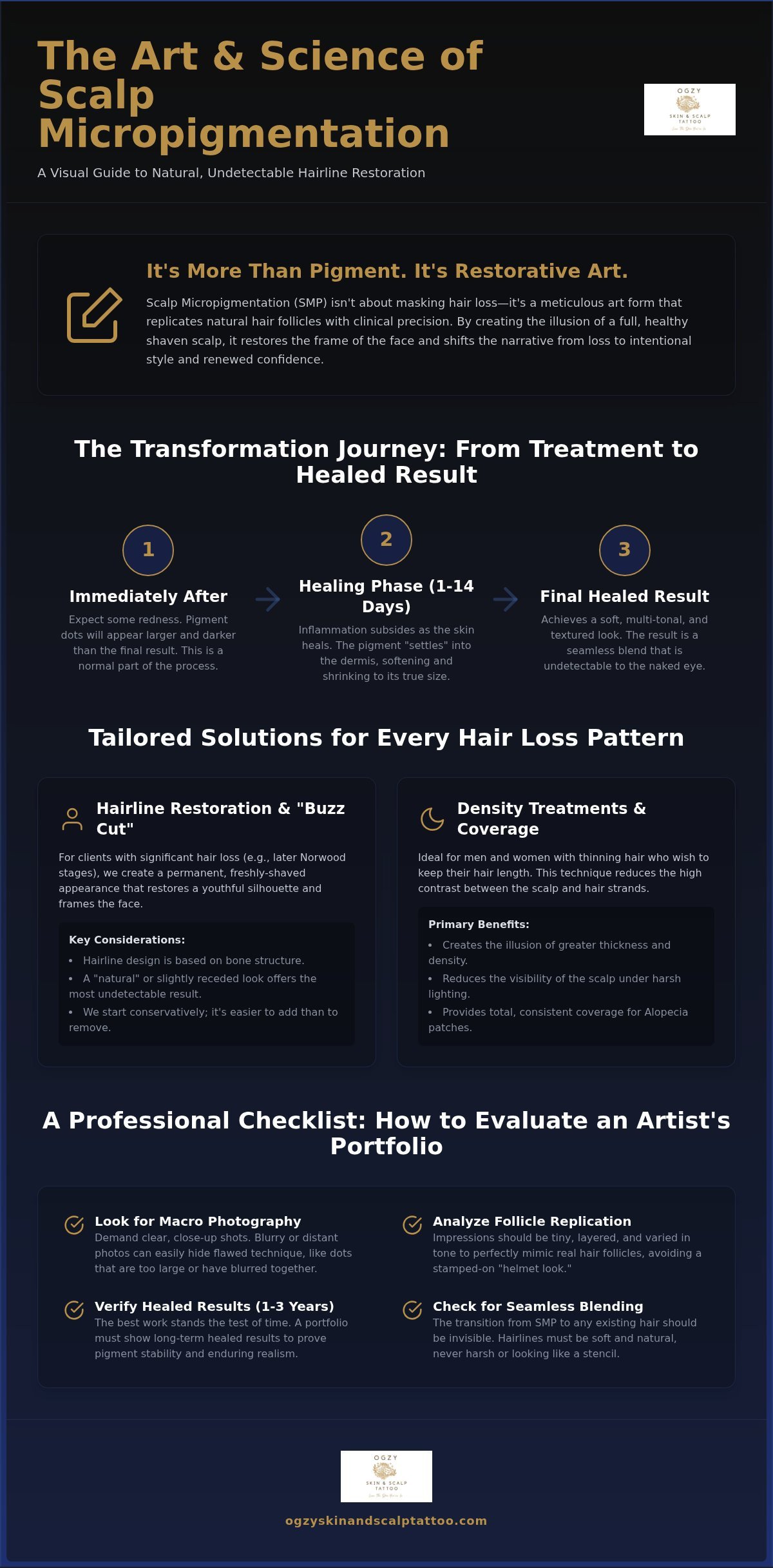
It’s common to feel a surge of concern when you see your reflection immediately after the first session. Your scalp will likely show some redness, and the pigment often appears significantly darker and larger than you expected. This is a normal part of the healing journey. Over the first 14 days, the skin undergoes a “settling” phase where the initial inflammation subsides and the pigment finds its permanent place in the dermis. This maturation is exactly why the second and third sessions are so vital. These follow-up appointments allow us to layer the simulation, adding the depth and subtle variation in tone that creates true realism in a scalp micropigmentation before and after transformation. The final, healed result is a soft, textured look that blends seamlessly with your existing hair.
Analyzing SMP Results Across Different Hair Loss Patterns
Hair loss doesn’t follow a single script. For some, it’s a slow retreat at the temples; for others, it’s a thinning that spreads across the entire crown. We categorize these patterns using the Norwood scale for men and the Ludwig scale for women. Each requires a tailored approach to ensure the simulation looks authentic from every angle. For clients who have reached the later stages of the Norwood scale, the transformation is profound. We design a 24/7 “freshly shaved” appearance that frames the face and restores a youthful silhouette. This is where you see the most dramatic scalp micropigmentation before and after results, as the visual shift from a bare scalp to a full, shaven hairline is immediate and life-changing.
Consider the journey of a client managing Alopecia. The patches are often erratic, making daily styling a source of intense stress. By integrating a scalp tattoo for hair loss, we can provide total coverage that mimics a consistent, healthy shave. This restoration allows the individual to stop managing their condition and start owning their aesthetic. It’s about moving from a place of vulnerability to one of quiet confidence.
Density Treatments for Thinning Hair in Men and Women
Not everyone is ready or willing to shave their head. Many clients seek density treatments to address thinning while maintaining their current hair length. This technique focuses on reducing the high contrast between the pale scalp and darker hair strands. A clinical study on SMP confirms that this method is highly effective for both men and women who want the appearance of a fuller head of hair. For women experiencing diffuse thinning, we create a shadow effect that makes the part line look significantly tighter and more voluminous. This requires a specialized “pointillism” approach that differs from the follicle replication used for shaved looks, as the goal is to create depth beneath existing strands.
Concealing FUE and FUT Hair Transplant Scars
Concealing scars from FUE or FUT transplants is a specialized niche within our craft. Scar tissue behaves differently than healthy skin; it can be tough and fibrous or thin and sensitive. We use custom pigment matching to camouflage linear FUT scars or the “moth-eaten” appearance sometimes left by FUE extractions. If you’re dealing with old, poorly executed work from another provider, we often suggest laser removal to clear the canvas before we begin a fresh, realistic restoration. This meticulous layering ensures that your scalp micropigmentation before and after experience results in a seamless blend that hides the evidence of previous surgeries. If you’re curious about how these techniques apply to your specific pattern, we’re here to help you explore a personalized restoration plan.
Beyond the Photo: How SMP Results Evolve Over Time
While the immediate scalp micropigmentation before and after reveal is undeniably powerful, the real magic happens in the months and years that follow. We view the initial treatment as the beginning of a long-term aesthetic partnership. Over the first one to three years, the pigment dots undergo a maturation phase where they lose their initial sharpness and begin to mimic the slightly softer look of a natural hair follicle. This evolution is intentional; it prevents the scalp from looking like a flat, painted surface and instead creates a multidimensional appearance that stands up to close inspection. Understanding this maturation helps you move past the “day one” look and appreciate the enduring quality of a professional restoration.
Many clients come to us with a singular worry: will the pigment turn blue? It’s a valid concern rooted in seeing poorly executed work from inexperienced providers. However, “blueing” is almost always a result of improper needle depth rather than the pigment itself. When an artist deposits pigment too deeply into the hypodermis, the light must travel through more layers of skin to reach it, which scatters the light and creates a bluish tint. By maintaining a precise, shallow depth in the upper dermis, we ensure the color remains a true, crisp charcoal or brown that matches your natural hair tone. This technical precision is essential for anyone seeking a permanent hair loss confidence solution.
The Impact of Pigment Selection and Needle Depth
The difference between a lasting restoration and a botched job often comes down to the specialized tools used. SMP pigments are formulated differently than traditional tattoo inks; they’re designed to be stable and resist the “bleeding” or migration that can occur with standard decorative inks. An NIH study on scalp micropigmentation highlights how the procedure’s success relies on this technical precision and the use of medical-grade equipment. We target the “sweet spot” in the dermis where the skin is stable enough to hold the pigment without allowing it to blur into neighboring dots. This meticulous approach ensures that each simulated follicle remains distinct and realistic as the years pass.
Managing Results in the Central Texas Climate
Living in the Austin and Cedar Park area means our skin faces unique environmental challenges. The intense Texas sun is the primary enemy of any pigment. UV exposure can break down the pigment particles over time, leading to premature fading if the scalp isn’t protected. We recommend a high-quality, non-greasy SPF 30 or 50 as a daily habit once you’ve fully healed. Additionally, the high heat and humidity in our region can increase oil and sweat production. While this doesn’t ruin a healed treatment, it’s important to manage during the initial 14-day healing phase to ensure the pigment “takes” evenly across the scalp. A little extra care in our climate goes a long way in preserving that sharp, day-one look for years to come.
How to Critically Evaluate an SMP Artist’s Portfolio
Choosing an artist for your restoration is a decision that carries significant emotional weight. While a vast gallery of images can feel reassuring, a true “refined restorer” provides more than just quantity; they offer transparency through detail. When you examine a scalp micropigmentation before and after gallery, your goal isn’t just to see if the person looks better. You are looking for the technical “tells” that separate a masterful simulation from a generic cosmetic tattoo. High-quality work should withstand the scrutiny of macro photography, showing individual, crisp deposits that mimic the organic variation of a natural scalp. Understanding what constitutes a realistic scalp tattoo and the markers of undetectable hair follicle simulation will help you ask the right questions and make a confident, informed choice.
One of the most important things to look for is consistency across different lighting conditions. Artistic ring lights can hide many flaws, such as pigment migration or improper blending. Request to see photos taken in natural daylight or under standard clinical lighting. This honesty in presentation ensures that your result will look just as convincing in a sunlit park in Cedar Park as it does in a dimly lit restaurant. If a portfolio only features heavily filtered or distant shots, it may be a sign that the artist is hesitant to show the fine details of their follicle replication.
Spotting Natural Follicle Replication vs. Stenciled Lines
Realism lives in the details of the hairline. A common warning sign of an inexperienced artist is the “stamped” or “helmet” look, characterized by a perfectly straight, solid line across the forehead. Natural hairlines are inherently irregular. Look for the “feathered” technique, where the artist places lighter, smaller, and more widely spaced dots at the very edge of the hairline. This creates a soft transition that mimics the way hair naturally thins toward the face. You should also see “depth layering,” where some dots appear slightly lighter or softer than others, providing the multidimensional texture that a real shaven head possesses.
Why Healed Photos Matter More Than Fresh Ones
Freshly completed work is always the most photogenic because the pigment is sitting on the surface of the skin and the “dots” are at their sharpest. However, the true test of an artist’s skill is how that work looks six months or a year later. Healed photos prove that the artist understands proper needle depth and pigment stability. You want to see that the follicles haven’t blurred together into a solid mass or shifted in color. When you review a scalp micropigmentation before and after, prioritize artists who can show long-term results on various skin tones. This level of proof demonstrates a commitment to your long-term confidence rather than just a quick “reveal” photo. If you are ready to see the difference that meticulous, artistic integrity makes, we invite you to view our portfolio of realistic restorations.
Starting Your Transformation with Ogzy Skin & Scalp Tattoo
Opal’s approach at Ogzy Skin & Scalp Tattoo isn’t just about applying pigment; it’s about a dedicated partnership in your restorative journey. Located in Cedar Park, we specialize in the meticulous simulation of follicles that blend seamlessly with your natural features. Every scalp micropigmentation before and after story we create begins with a deep understanding of the client’s emotional and aesthetic goals. We don’t believe in one-size-fits-all templates. Instead, we focus on the artistic integrity required to rebuild a hairline that looks as authentic in person as it does in a professional portfolio.
We recognize that hair loss is often just one part of a larger conversation about body confidence. For those looking for a comprehensive approach to skin revision and renewal, we also offer stretch mark camouflage. By addressing multiple concerns with the same level of clinical precision and aesthetic artistry, we help you build a total confidence plan that feels cohesive and deeply personal.
The Ogzy Consultation: Designing Your Custom Follicle Map
Your journey begins with a comprehensive consultation where we analyze your existing hair color and skin undertones. This detailed assessment ensures we select the perfect pigment match to prevent the unnatural color shifts often seen in lower-quality work. We map out a multi-session plan tailored to your specific hair loss pattern, whether you’re looking for density or a full shaven-head look. To get the most out of your first appointment, we suggest bringing photos of your hairline from several years ago. This helps us understand your natural growth patterns and bone structure, ensuring the final result feels like a true restoration of your original image.
Booking Your Session in Cedar Park and Beyond
Our studio is a premier destination for residents in Cedar Park, Austin, and Round Rock. We also frequently welcome clients from neighboring Leander and Georgetown who are looking for a specialist’s touch rather than a high-volume clinic experience. Preparing for your first session is simple but vital. We ask that you focus on scalp health by staying hydrated and moisturizing the area in the days leading up to your appointment. A healthy scalp provides the best canvas for the pigment, ensuring your scalp micropigmentation before and after results are crisp, vibrant, and long-lasting. Reclaiming your self-assurance is a profound transformation, and we’re here to ensure you feel supported and informed every step of the way.
Reclaiming Your Image with Confidence and Clarity
Choosing to address hair loss is a profound step toward personal renewal. We’ve explored how a successful transformation relies on more than just pigment; it requires a deep understanding of facial anatomy and the technical precision of follicle simulation. By prioritizing healed results and critically evaluating an artist’s portfolio, you ensure your journey results in a look that remains undetectable as the years pass. A professional scalp micropigmentation before and after gallery serves as a roadmap to what’s possible when clinical expertise meets artistic passion.
Ogzy Skin & Scalp Tattoo provides this level of sophisticated craftsmanship for clients across Cedar Park, Austin, and Round Rock. As specialists in paramedical tattooing, we focus on creating seamless, realistic outcomes that honor your unique features and skin tone. It’s time to move past the anxiety of thinning hair and embrace a future of quiet confidence. Book Your Private Consultation at Ogzy Skin & Scalp Tattoo Today to begin your own refined restoration. You don’t have to navigate this journey alone; we’re here to guide you toward a renewed sense of self.
Frequently Asked Questions
How long does scalp micropigmentation last before needing a touch-up?
Scalp micropigmentation typically remains vibrant for three to five years before a rejuvenation session is required. The longevity of your results depends largely on your lifestyle and skin type, particularly your level of daily sun exposure. We often see clients return for a subtle touch-up to restore the original crispness and depth of the follicle simulation as the pigment naturally matures within the dermis over several years.
Is scalp micropigmentation painful compared to a traditional tattoo?
Most individuals find this procedure significantly more comfortable than receiving a traditional decorative tattoo. We use specialized, smaller needles and work at a much shallower depth in the skin, which minimizes the impact on nerve endings. While some areas of the scalp are naturally more sensitive than others, the sensation is often described as a light, rhythmic pressure or a mild tingling rather than sharp pain.
Can SMP be used on long hair to hide thinning or only on shaved heads?
Scalp micropigmentation is an excellent solution for individuals with long hair who want to address diffuse thinning or a widening part line. This technique, known as a density treatment, reduces the high contrast between your pale scalp and your darker hair strands. By adding a subtle shadow beneath your existing hair, we create the visual illusion of a much fuller head of hair without requiring you to shave.
What happens to the SMP pigment if my natural hair turns grey?
Your results will continue to look natural even as your hair transitions to grey or white over time. Because we use specialized pigments designed to mimic the “salt and pepper” look of a shaven scalp, the simulation blends seamlessly with greying hair. If your hair turns completely white, we can adjust the pigment depth and tone during a future touch-up session to maintain a soft, realistic transition.
How much does scalp micropigmentation cost in the Austin area?
The investment for your restoration varies based on the extent of your hair loss and the complexity of the treatment plan. Factors such as the size of the area requiring coverage, the presence of scar tissue from previous surgeries, and the desired level of density all influence the final scope of work. We provide a detailed, personalized quote during your private consultation in our Cedar Park studio to ensure complete clarity.
Can I exercise or sweat immediately after my SMP session?
You should avoid heavy exercise or excessive sweating for at least four to five days following your session. Sweat contains salts and oils that can interfere with the pigment’s ability to settle properly in the upper dermis during the critical initial healing phase. Keeping the scalp clean and dry is essential for ensuring your scalp micropigmentation before and after results remain crisp, well-defined, and free from premature fading.
What is the difference between SMP and a hair transplant?
Scalp micropigmentation is a non-surgical, paramedical tattooing procedure that simulates the appearance of hair follicles, while a hair transplant is a surgical relocation of actual hair. Many clients choose follicle simulation because it offers immediate visual results without the downtime or potential scarring associated with surgery. In some cases, we use this technique to complement a transplant by adding density to areas where the donor hair was limited.
How do I choose the right hairline shape for my face?
We determine your ideal hairline shape by analyzing your unique bone structure, face shape, and natural muscle movement during a detailed consultation. We generally recommend a softer, slightly irregular hairline for the most realistic scalp micropigmentation before and after outcome. A perfectly straight line can often look artificial and “stenciled,” so we focus on creating a feathered edge that mimics the organic growth patterns of natural hair.