
What if the secret to a fuller, more resilient hairline isn’t found in a surgical suite, but within the biological signals your body already understands? It’s deeply unsettling to look in the mirror and see your scalp where there used to be thick, vibrant hair. You’ve likely felt the weight of that emotional distress, perhaps paired with a fear of invasive procedures or simple confusion over which regenerative claims are actually grounded in science.
We’re here to provide clarity and hope through a partnership with your body’s own healing potential. This guide reveals how growth factor therapy for hair loss uses medical-grade stem cells to wake up dormant follicles and restore your natural density without a single incision. You’ll learn exactly how these signaling proteins work to refine your hairline, why professional microneedling is the ideal delivery method, and what a non-surgical recovery process looks like. By the end, you’ll understand how this sophisticated craftsmanship can help you reclaim your confidence and achieve a seamless, natural look through the power of regenerative medicine.
Key Takeaways
- Understand how growth factor therapy for hair loss utilizes natural signaling proteins to revitalize dormant follicles and restore hair density from within.
- Learn why professional microneedling is the vital delivery vehicle for creating the precise micro-channels needed for medical-grade stem cells to reach their target.
- Identify the clinical signs of early-stage thinning that make you an ideal candidate for this sophisticated, non-surgical approach to restoration.
- Compare the recovery expectations and long-term scalp health benefits of regenerative treatments versus invasive surgical hair transplants.
- Discover what to expect during your initial consultation in Cedar Park and how a tailored plan can help you achieve a seamless, natural-looking hairline.
What is Growth Factor Therapy for Hair Loss?
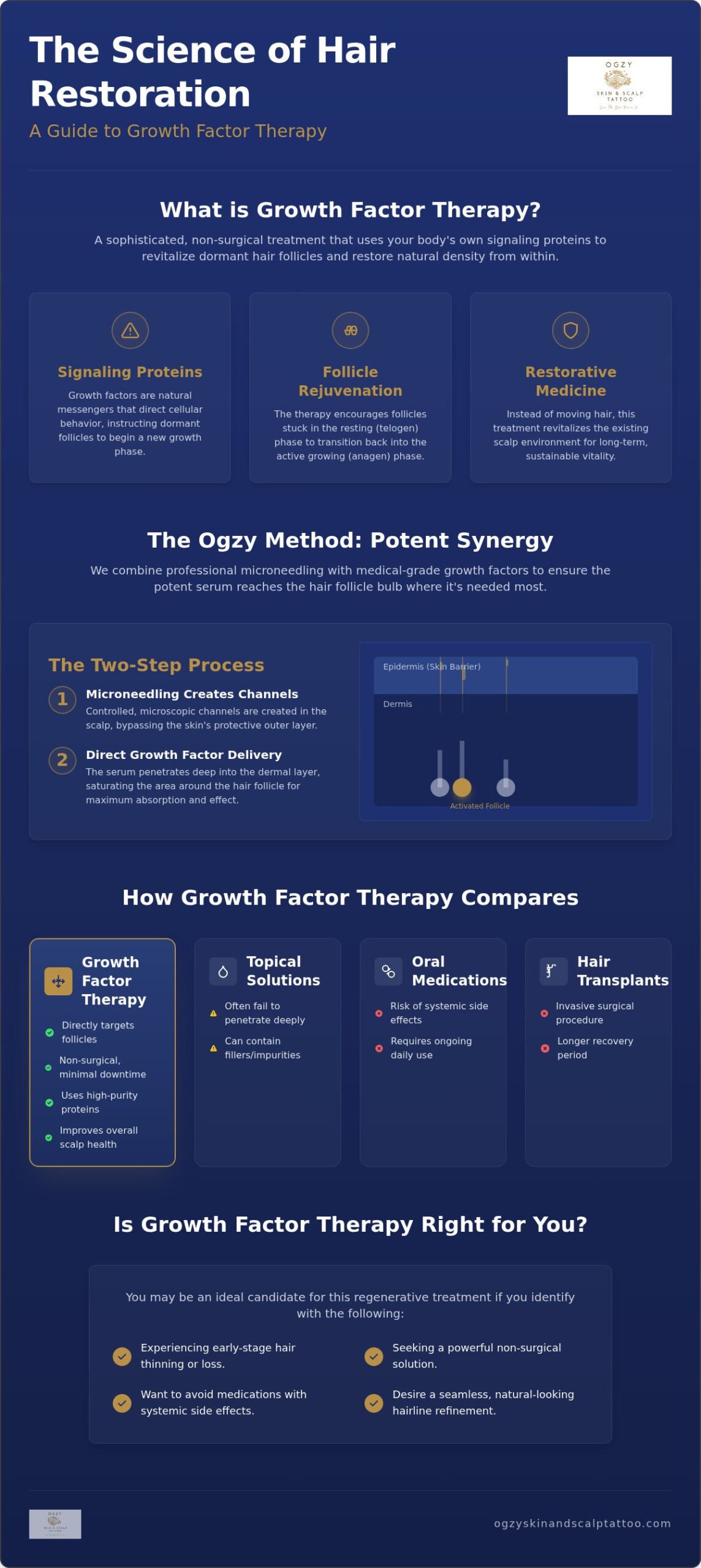
Growth factors are naturally occurring signaling proteins that act as the internal architects of your body’s healing processes. In the context of scalp health, these proteins serve as sophisticated messengers that direct cellular behavior, specifically targeting the hair follicle niche. Growth factor therapy for hair loss is a bio-communicative treatment for thinning hair that restores the dialogue between your scalp’s cells and dormant follicles. By introducing these concentrated proteins, we provide the precise biological instructions needed to encourage renewal and refinement in areas where density has begun to fade.
This approach represents a significant shift toward hair regrowth without surgery, moving away from invasive grafts and toward restorative medicine. Instead of simply moving hair from one place to another, we’re revitalizing the existing landscape of your scalp. It’s a partnership between advanced science and your body’s innate ability to heal, focusing on long-term vitality rather than a temporary fix.
The Biological Mechanism of Follicle Rejuvenation
To understand how this works, we have to look at the natural rhythm of your hair’s life cycle. Every follicle alternates between the anagen phase, where hair is actively growing, and the telogen phase, where the follicle rests and eventually sheds. When thinning occurs, many follicles become stuck in an extended resting state or produce increasingly miniaturized strands. Growth factor therapy for hair loss provides the necessary signals to trigger the transition from the telogen phase back into a robust anagen phase, effectively waking up follicles that have become quiet but are still viable.
Medical-Grade Stem Cells vs. Conventional Treatments
Many individuals seeking help have already experimented with various hair loss treatments, ranging from over-the-counter foams to daily pharmaceutical pills. While these options have their place, they often face significant hurdles. Topical solutions frequently fail to penetrate the skin barrier deeply enough to reach the follicle’s base, while oral medications can introduce systemic side effects that many prefer to avoid. Regenerative therapy using medical-grade stem cells offers a more targeted and high-purity alternative. For a deeper understanding of how concentrated proteins create a biological reset for your scalp, our comprehensive growth factor hair treatment guide explores the science behind these regenerative therapies in detail. We focus on these core advantages:
- Direct Delivery: We bypass the surface barrier to deliver proteins exactly where they’re needed.
- High Purity: We utilize medical-grade proteins that are free from the fillers often found in commercial products.
- Synergistic Health: Rather than just masking symptoms, we’re fostering a healthier scalp environment for sustainable results.
The Ogzy Method: Synergy of Microneedling and Growth Factors
Even the most potent medical-grade stem cells require a clear path to reach the hair follicle bulb. The skin is a protective barrier, designed to keep substances out. This is why we utilize professional microneedling as the essential delivery vehicle for growth factor therapy for hair loss. By creating thousands of microscopic, controlled channels in the scalp, we effectively bypass the surface layers. This allows the regenerative serums to saturate the deeper dermal layers where follicles reside. In the Austin area, we find that clients appreciate this blend of technical skill and aesthetic artistry.
Beyond delivery, this technique provides a secondary biological advantage. The process initiates a “wound healing response,” a natural reaction where the body rushes oxygenated blood and essential nutrients to the area. This localized surge in circulation revitalizes the scalp environment, providing a fertile foundation for the growth factors to perform their work. We meticulously adjust the treatment depth based on your specific anatomy. The skin thickness on the crown often differs significantly from the delicate tissue at the hairline, requiring a specialist’s eye for detail. This tailored approach ensures we reach the follicle without causing unnecessary stress to the surrounding tissue.
Professional Scalp Microneedling Standards
Achieving the results seen in our microneedling for hair regrowth before and after documentation requires extreme precision. In our Cedar Park clinic, we adhere to clinical-grade safety protocols using specialized equipment. We prioritize your comfort throughout the session, ensuring the experience is manageable and stress-free. Every pass is deliberate, aimed at fostering a sense of healing rather than trauma. Our goal is to make the process feel like a supportive step in your journey toward self-assurance.
Optimizing the Scalp Environment
Preparation is just as vital as the procedure itself. We begin by ensuring the scalp is perfectly primed for maximum absorption, removing any surface debris that might hinder the microscopic channels. After the session, we provide a detailed restorative plan to keep the growth factor therapy for hair loss active and protected while the micro-channels close. This comprehensive care ensures that the signaling proteins have the best possible chance to integrate and begin the renewal process. If you’re ready to see how this precision can work for you, scheduling a personal consultation is the first step toward reclaiming your density.
Anatomy of a Transformation: A Case Study in Hair Restoration
The journey toward a fuller hairline often begins with a quiet realization in the mirror. For most, a typical candidate for growth factor therapy for hair loss is someone experiencing the early stages of thinning or a subtle recession at the temples. These individuals aren’t looking for a radical, artificial change; they’re seeking to reclaim the density they once had. During your initial consultation in Austin, we focus on assessing follicle viability. We look for evidence of miniaturized hairs, which are the biological indicators that your follicles are dormant rather than gone. Identifying these “sleeping” follicles is the first step in determining how our regenerative approach can help you achieve a more refined and natural-looking result.
The psychological impact of this transformation is often as significant as the physical change itself. Thinning hair can create a persistent sense of vulnerability, leading many to avoid certain lighting or social situations. When we restore density, we’re doing more than just revitalizing the scalp; we’re helping you reclaim a sense of self-assurance. This process is a partnership between our technical expertise and your body’s own healing capacity. It’s a methodical path that moves from clinical assessment to visible, artistic refinement.
Phase 1: The Initial Restoration Sessions
The first 48 hours after your session are a time of subtle biological awakening. You might experience minor redness or a feeling of tightness, which indicates that the micro-channels are successfully initiating the scalp’s natural repair mechanisms. Consistency is vital during this early phase of growth factor therapy for hair loss. We focus on maintaining a steady stream of signaling proteins to keep the follicles engaged. It’s common to notice minor “shedding” or shifts in hair texture during the first few weeks, as the scalp begins to cycle out weaker strands to make room for more robust growth. We guide you through these changes with a reassuring bedside manner, ensuring you feel supported at every turn.
Phase 2: Long-Term Maintenance and Maturation
True maturation of the hair follicles takes time and patience. By the 3-month mark, many clients start to see a change in the overall quality and “grip” of their hair. As we reach the 6-month milestone, the new growth integrates seamlessly with your existing hair, creating a cohesive and undetectable transition. A full course of treatment typically results in a significant increase in visible hair density and a noticeably thicker, more resilient texture across the treated areas. This phase is about the sophisticated integration of new growth, ensuring that your results look as natural and effortless as possible.
Growth Factors vs. Hair Transplants: Which is Right for You?
Choosing between a surgical hair transplant and a non-invasive regenerative path is a deeply personal decision that balances your desired outcome with your lifestyle. Surgical procedures involve a significant investment of time, often requiring weeks for physical recovery and months for the transplanted grafts to establish themselves. In contrast, growth factor therapy for hair loss offers a seamless integration into your daily life. While surgery physically relocates follicles from a donor site, regenerative therapy focuses on revitalizing the follicles you already have, fostering a healthier scalp environment without the need for incisions or stitches.
One of the most concerning risks of surgical restoration is “shock loss,” a condition where the trauma of the procedure causes existing, non-transplanted hair to shed temporarily. Regenerative treatments avoid this trauma entirely. Instead of a sudden, invasive change, growth factors provide a gradual build of density that mimics the natural rhythm of hair growth. Approximately 62% of consumers now prefer non-invasive solutions for hair loss, reflecting a growing desire for treatments that respect the body’s biological integrity. Deciding between smp vs microneedling for hair loss depends on whether your priority is immediate visual simulation or long-term biological renewal.
When to Choose Non-Surgical Restoration
Growth factor therapy is particularly effective for individuals experiencing diffuse thinning, where hair density is decreasing across the scalp rather than in one isolated patch. It’s an ideal path for those who wish to avoid the potential for surgical scarring or the “doll-hair” look that can sometimes occur with traditional grafts. However, it’s important to recognize that regenerative therapy requires viable, though dormant, follicles to be successful. In cases of complete baldness where the follicle has been replaced by scar tissue, the signaling proteins may not have a target to communicate with. For those in the earlier stages of thinning, this non-surgical route provides a sophisticated way to preserve and refine your natural hairline. Men dealing with androgenetic alopecia in particular may benefit from exploring a dedicated growth factor hair treatment protocol designed to address the progressive nature of this condition before further follicle loss occurs.
Complementary Strategies for Hair Density
We often find that the most impactful results come from a multi-layered restoration strategy. The “Ogzy Approach” views hair restoration as a combination of biological health and aesthetic artistry. For instance, Scalp Micropigmentation (SMP) can be used to enhance the look of regenerative results by adding the appearance of shadow and depth beneath newly thickened strands. This creates a personalized plan that addresses both the biological volume and the visual color of the hair. By pairing these techniques, we can achieve a level of refinement that looks completely natural in any light. If you are ready to explore a tailored path to restoration, learning more about our integrated techniques can help you make an informed choice for your personal transformation.
Beginning Your Hair Restoration Journey in Cedar Park
Choosing a specialist for growth factor therapy for hair loss is about more than finding a technician; it’s about finding a dedicated guide who understands the profound personal impact of hair thinning. At Ogzy Skin & Scalp Tattoo, we approach every session with the eye of a paramedical aesthetician. We focus on the subtle details that make a hairline look natural and the biological signals that make that restoration possible. Our studio is a space of healing and precision, where your transformation is handled with the artistic integrity it deserves.
Preparing for your first visit is simple. We recommend bringing a list of any current hair care routines, supplements, or medications you’re using, as well as a clear idea of your primary goals. Whether you’re looking to fill in a receding temple or address diffuse thinning at the crown, having these details ready allows us to build a more accurate profile of your scalp health. We’re committed to a results-driven approach that positions us as your partner in reclaiming self-assurance.
The Ogzy Consultation Experience
Your journey begins with a comprehensive analysis of your scalp environment. We don’t believe in one-size-fits-all solutions; instead, we evaluate the specific stage of your hair loss and the viability of your remaining follicles. This transparency is the foundation of our practice. We’ll have an honest discussion about the time commitment required for growth factor therapy for hair loss and what you can realistically expect from your specific skin type. Our goal is to ensure you feel empowered and informed before we ever begin the first micro-channeling pass.
- Scalp Assessment: A close look at follicle density and skin health.
- Goal Setting: Defining the specific areas of refinement you want to prioritize.
- Investment Clarity: A clear breakdown of the session schedule and long-term plan.
Serving the Austin and Round Rock Communities
Located in Cedar Park, our studio provides convenient access for residents across the North Austin area, including those in Round Rock, Georgetown, and Leander. We understand that regenerative health is a process, not a single event. Being a local provider allows us to offer the personalized follow-up care that’s essential for tracking your progress and making subtle adjustments to your plan as your hair matures. We invite you to step into a space where clinical authority meets a warm, reassuring bedside manner. If you’re ready to start your restorative path, Book your stem cell hair regrowth consultation today and take the first step toward a denser, more confident future.
Reclaiming Your Confidence Through Regenerative Care
Restoring your hair density is a journey of both biological renewal and personal transformation. We’ve explored how growth factor therapy for hair loss acts as a vital signaling system, waking up dormant follicles and fostering a healthier scalp environment without the need for invasive surgery. By combining professional microneedling with high-purity, medical-grade regenerative serums, we provide your body with the precise tools it needs to refine your hairline and restore a seamless, natural look.
At Ogzy Skin & Scalp Tattoo, you’re more than just a client; you’re a partner in a mission-driven process of restoration. Opal’s specialized expertise in both Scalp Micropigmentation (SMP) and advanced microneedling ensures that every aspect of your density, from color to volume, is handled with meticulous craftsmanship. We’re dedicated to providing the empathetic, personalized care you need to feel understood and hopeful about your results. If you’re ready to move past the distress of thinning hair and embrace a sophisticated, non-surgical solution, we invite you to schedule your hair restoration consultation in Cedar Park today. Your path to a fuller, more resilient hairline begins with a single, supportive step toward renewal.
Frequently Asked Questions
Is growth factor therapy for hair loss permanent?
Results from growth factor therapy for hair loss are long-lasting, but they aren’t considered permanent because the biological process of thinning is often progressive. Think of it as a restorative partnership that requires occasional maintenance sessions to sustain your density. Most clients find that a touch-up every six to twelve months keeps their follicles active and their hairline looking refined and full.
How many sessions of stem cell hair regrowth treatment will I need?
Most individuals achieve their desired density through a series of three to six initial sessions. We space these appointments approximately four weeks apart to align with your hair’s natural growth cycle. This methodical approach allows the signaling proteins to build a cumulative effect, providing a steady foundation for follicle renewal. We’ll refine your specific schedule during your consultation based on your scalp’s unique needs.
Does growth factor therapy hurt more than standard microneedling?
This sensation is very similar to a standard microneedling session for the face, often described as a light, vibrating pressure. While the scalp can be sensitive in certain areas, we use precise techniques to ensure the experience remains comfortable throughout. Our focus is on a restorative, healing environment, and most clients find the process much more manageable than they initially anticipated before their first visit.
Can I use growth factor therapy if I have already had a hair transplant?
Yes, regenerative therapy is an excellent way to support the health of both transplanted grafts and your original hair. It helps to optimize the scalp environment, which can improve the overall success of the transplant and prevent further thinning in the surrounding areas. Many clients choose this integrated path to ensure their surgical results look as dense and natural as possible over time.
What is the difference between PRP and growth factor therapy?
A primary difference lies in the source and concentration of the signaling proteins. While Platelet-Rich Plasma (PRP) relies on proteins extracted from your own blood, growth factor therapy for hair loss utilizes medical-grade, high-purity proteins refined in a clinical setting. This ensures a consistent, concentrated dose of the specific messengers your follicles need, removing the biological variability often found in blood-derived treatments.
Are there any side effects to regenerative hair treatments?
Side effects are typically mild and limited to the immediate treatment area. You might notice some redness, minor swelling, or a feeling of scalp tightness that usually dissipates within 24 to 48 hours. Some clients also experience a temporary shift in hair texture as the scalp environment resets. Because we prioritize sterile, professional standards, these reactions are a normal part of the healing response.
How soon will I see new hair growth after the first session?
Visible results in density and thickness generally appear between three and six months after your first session. Hair restoration is a gradual process that follows your body’s natural biological clock rather than providing an overnight change. You’ll likely notice that your hair feels more resilient and has better ‘grip’ before you see significant changes in coverage. Patience is key to achieving a sophisticated and lasting transformation.
Is this treatment suitable for women with thinning hair?
Absolutely, this treatment is highly suitable and effective for women experiencing diffuse thinning or a widening part line. Female hair loss often responds exceptionally well to regenerative signals because it typically involves miniaturized follicles rather than complete baldness. It provides a non-surgical, subtle way to restore volume and confidence, allowing for a seamless integration with your natural hair style and daily routine.