What if the most effective way to erase the shadow of a scar isn’t by covering it up, but by inviting your skin to remember its original texture? It’s completely natural to feel a sense of hesitation when weighing the merits of ink vs no ink scar revision. You want to feel confident in your own skin again, yet the fear of a “fake” look or a pigment that shifts color over time often creates a barrier to seeking help. Many people find themselves trapped between the desire for change and the anxiety of making a permanent mistake.
This guide explores the technical and artistic nuances of these procedures to help you move past the confusion and find a path toward genuine, lasting transformation. You’ll discover how these specialized techniques differ in their approach to healing and aesthetics. We will break down how pigment camouflage provides immediate tonal harmony and how regenerative needling uses medical-grade growth factors to rebuild skin from within, ensuring you choose the method that honors your unique skin type and personal goals.
Key Takeaways
- Understand the core distinctions of ink vs no ink scar revision to determine whether your skin requires tonal concealment or cellular-level texture repair.
- Learn how regenerative needling utilizes medical-grade stem cells and growth factors to stimulate natural collagen production for a seamless, natural finish.
- Discover the artistic precision of custom pigment matching and why waiting for scar maturity is essential for achieving a permanent, undetectable blend.
- Identify which method best suits your specific needs, whether you’re addressing textured surgical scars or looking to restore the natural glow of stretch marks.
- Find out how a personalized consultation ensures a tailored treatment plan designed to restore both your skin and your self-assurance.
Ink vs. No-Ink Scar Revision: Understanding the Fundamental Difference
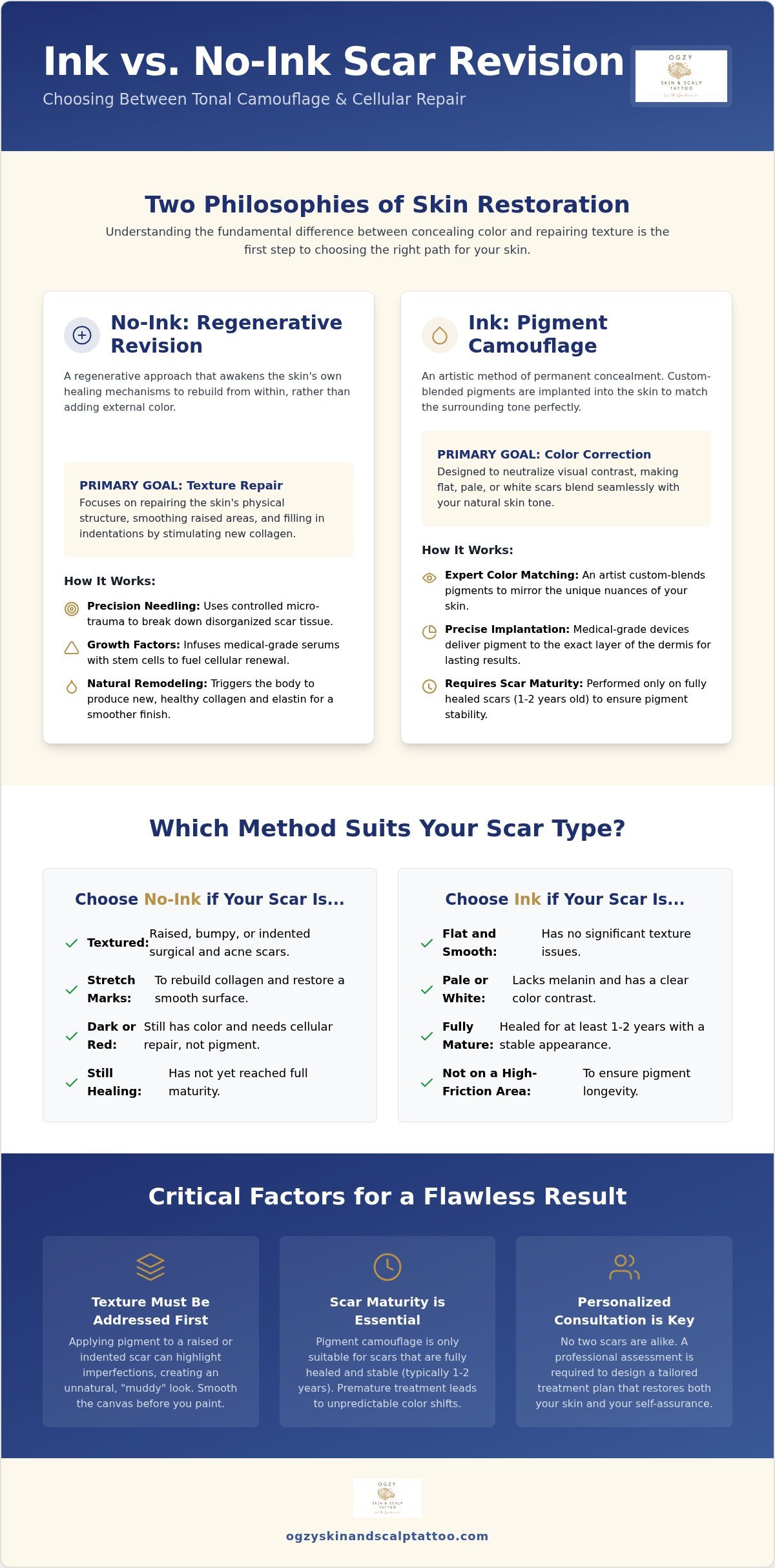
Deciding how to address a scar that affects your self-esteem is a deeply personal journey, and understanding the core technology behind your options is the first step toward reclaiming your confidence. The choice between ink and no-ink methods represents two distinct philosophies of skin restoration. Ink-based revision, commonly known as pigment camouflage, acts as a sophisticated, permanent form of tonal correction. By using custom-blended pigments that mirror the subtle nuances of your natural skin, this method neutralizes the visual contrast of pale or white scars, allowing them to blend seamlessly with the surrounding tissue.
In contrast, no-ink revision is a purely regenerative approach. Rather than introducing external color, this method uses specialized medical-grade needling and nutrient-dense serums to awaken the skin’s own healing mechanisms. The primary goal of each technique is what truly sets them apart. Ink is designed to hide color contrast, making it an excellent choice for flat, pale marks. No-ink revision focuses on repairing the skin’s physical texture and depth. Choosing the wrong method for your specific scar type can lead to unsatisfactory, “muddy” results. For example, applying pigment to a scar that is still raised or heavily textured can accidentally highlight the very ridges you wish to hide, creating an unnatural finish that lacks the refinement of healthy skin.
What is Paramedical Tattooing?
Paramedical tattooing is a specialized discipline that bridges the gap between clinical science and aesthetic artistry. Unlike traditional body art, which is designed for decorative expression, paramedical techniques prioritize restoration and the subtle integration of damaged tissue. This craft requires an expert understanding of needle depth and skin physiology. Practitioners use medical-grade devices to reach precise layers of the dermis, ensuring that pigments or serums are delivered exactly where they can be most effective. This level of precision is what allows for the sophisticated craftsmanship necessary to make a surgical or traumatic scar appear virtually invisible to the naked eye.
The Role of Melanin and Collagen in Healing
To appreciate how these treatments work, it is helpful to look at why scars look different from the rest of your skin. Healthy skin relies on a structured network of collagen for its smooth texture and melanin for its unique color. When a wound heals, the body often produces a disorganized form of collagen, leading to a texture that feels firm, raised, or indented. Furthermore, the skin often loses its ability to produce melanin in that area, resulting in a white or hypopigmented appearance.
No-ink methods frequently utilize collagen induction therapy to address these structural issues. By creating microscopic, controlled channels in the scar tissue, the treatment encourages the body to reorganize its fibers and produce new, healthy cells. This process can even help restore some of the skin’s natural pigment production over time. Controlled trauma through precise needling triggers the skin’s natural repair mode to fill in indented marks and smooth out the surface. Whether your scar is white and flat or dark and textured, understanding these biological foundations ensures you select the most restorative path for your skin.
The Power of No-Ink: Regenerative Scar Revision with Stem Cells
For many people, the goal isn’t just to hide a scar, but to actually improve the health and resilience of the skin itself. Regenerative scar revision, often called “inkless” tattooing, represents a shift away from concealment toward true cellular renewal. When weighing the benefits of ink vs no ink scar revision, it’s essential to understand that the no-ink approach works with your body’s natural chemistry rather than masking it with pigment. This method is a sophisticated choice for those who want to see their skin return to its original state through natural healing.
MCA Needling: Beyond Standard Microneedling
This technique, rooted in the legacy of “dry tattooing,” has evolved significantly. By using a single-needle tattoo machine instead of a multi-needle roller, a specialist can target individual scar fibers with unmatched precision. This precision is vital for smoothing out raised or bumpy scars that haven’t responded to traditional treatments. The process creates microscopic channels that allow for the deep infusion of restorative serums, which is why professionals prioritize obtaining a paramedical tattoo certification to master these intricate tools. Modern serums have revolutionized the results, turning a simple needling session into a powerful restorative event.
Infusing Medical-Grade Growth Factors
While some clinics use basic hyaluronic acid, the most effective results come from stem cell scar treatment. These medical-grade growth factors are superior to standard serums because they provide the specific biological signals needed to thicken thin, “parchment-like” scar tissue. This biostimulation effect does more than just smooth the surface; it can naturally encourage the return of melanin to white, hypopigmented scars. It’s a particularly safe profile for all skin types, including deeper complexions where the risk of pigment rejection or color shifting is a concern.
Ideal candidates for this method often have indented surgical marks, deep stretch marks, or scars that feel tethered to the underlying tissue. It’s also the perfect solution for anyone wary of permanent ink who prefers a result that looks and feels entirely natural. If you’re ready to see how your skin can heal itself, a personalized consultation for scar and stretch mark revision in Austin is a gentle way to begin your restorative journey.
The Art of Camouflage: Custom Pigment for Permanent Concealment
If regenerative needling is the foundation of skin repair, then custom pigment camouflage is the final, artistic layer that restores visual peace. This method is often considered the gold standard for flat, white scars that have lost all natural color. When you’re weighing the choice of ink vs no ink scar revision, it’s vital to recognize when your skin needs structural help versus when it simply needs its color restored. For scars that are smooth but starkly pale, introducing custom-blended pigments can create a seamless transition that makes the mark nearly indistinguishable from the surrounding area.
Patience is a prerequisite for success in this specialized field. Unlike some quick-fix solutions you might see on social media, professional camouflage requires the scar to be fully matured. You must wait at least 12 months for the tissue to stabilize before applying ink. Applying pigment too early to a “young” scar that is still pink or changing can lead to unpredictable color shifts as the body continues its natural healing process. Waiting for maturity ensures that the canvas is ready to hold the pigment precisely as intended, providing a reliable and beautiful result.
The Science of Color Theory in Skin
Achieving a natural look requires a deep understanding of human physiology and color theory. Your skin isn’t a single, flat shade; it’s a complex, translucent organ with various undertones. A skilled artist blends multiple tones to mimic this natural translucency, ensuring the pigment doesn’t look like a solid “patch.” Because these pigments sit within the dermis, they can react to UV exposure over time. This makes daily sun protection a non-negotiable part of your aftercare to maintain the integrity of the match. Relying on a single, pre-mixed shade often results in a flat, unnatural appearance that looks more like a mask than part of your living skin.
Stability and Longevity
A common concern for many is whether the camouflage will eventually turn an unnatural blue or green. High-quality medical pigments are specifically formulated to avoid the heavy metals found in some traditional tattoo inks, ensuring the color remains true as it ages. A Systematic Review of Medical Tattooing for Scars highlights the efficacy and safety of these professional techniques when performed by specialists. While the results of a stretch mark camouflage tattoo are incredibly durable, they aren’t entirely immune to the passage of time. You might find that a “refresh” session is needed every 3 to 5 years to keep the tones vibrant. If you’re dealing with poorly executed work from a previous provider, advanced laser technology can be used to clear the old pigment before starting a new, more refined journey toward restoration.
Making the Choice: Which Method Suits Your Scar Type?
Finding the right path requires more than just looking at a scar’s color; it involves assessing the physical story your skin is telling. The decision between ink vs no ink scar revision often comes down to whether your primary concern is the way the scar feels or the way it catches the light. For many, the most sophisticated results aren’t found in a single method, but in a strategic sequence that respects the skin’s natural healing timeline.
Surgical marks and C-section scar revision often require a focus on texture before color. These scars are frequently raised or indented, meaning that applying pigment alone won’t hide the shadow cast by the uneven surface. Stretch marks present a different choice. You might prefer the “glow” of a no-ink treatment, which restores the skin’s natural vitality and thickness, or you might choose the “coverage” of pigment camouflage to mask the stark white contrast against your natural skin tone.
We often recommend a hybrid approach to achieve the most seamless integration. By starting with a no-ink regenerative treatment, we can first improve the skin’s structural integrity and smooth out the texture. Once the surface is refined, we can then apply custom-blended ink for a final, perfect color match. This sequential method ensures that the pigment sits on a healthy, smooth canvas, preventing the “muddy” or artificial look that can occur when tattooing over poorly textured tissue.
Categorizing Your Scars
Understanding the physical characteristics of your scar is essential for choosing the correct needle technique. Hypertrophic scars are raised and firm, requiring precise needling to break down excess collagen, while atrophic scars are sunken and need biostimulation to regain volume. You should also identify if your mark is hypopigmented (lighter than your skin) or hyperpigmented (darker). A simple way to check your skin’s readiness is the “pinch test.” Gently pinch the skin around the scar; if it has enough elasticity to move freely, it is likely a good candidate for revision. If the skin feels tight or tethered, we’ll focus on regenerative methods to restore flexibility first.
Comparison Framework: Ink vs. No-Ink
The journey to restoration varies in both time and technique. No-ink treatments typically involve a more noticeable initial recovery, often characterized by redness and light swelling as the skin begins its repair process. However, this method carries less risk of color shift over time. When it comes to the number of sessions, no-ink usually requires 3 to 4 visits to build up skin density, while ink camouflage may only need 2 to 3 sessions to reach the desired opacity. For both methods, a “settling” period of 4 to 8 weeks between sessions is vital to allow the tissue to fully respond to the treatment. Skin type also plays a major role; those with deeper complexions (Fitzpatrick scales 4 to 6) often benefit more from regenerative no-ink methods, as these carry a lower risk of post-inflammatory hyperpigmentation. To understand the full science behind how growth factors and regenerative serums achieve these results, exploring the latest research on stem cell scar treatment and regenerative skin revision can provide valuable context for your decision.
If you’re ready to determine the most effective strategy for your skin, the experts at Ogzy Skin & Scalp Tattoo are here to guide you through a personalized consultation and a tailored revision plan.
Personalized Scar Revision in Austin: Your Journey to Restored Confidence
Choosing between ink vs no ink scar revision is a significant decision, and you don’t have to navigate it alone. At Ogzy Skin & Scalp Tattoo, we serve the vibrant Central Texas community, providing a sanctuary for those in Cedar Park, Austin, and Round Rock who are ready to let go of the physical reminders of past traumas. Our approach is defined by a unique blend of sophisticated craftsmanship and medical-grade science. By combining the artistic precision of paramedical tattooing with the restorative power of regenerative growth factors, we ensure your results look as natural as the skin you were born with.
The Consultation Process
Your transformation begins with a thorough physical assessment in our private Cedar Park studio. This initial meeting is essential for evaluating your scar’s maturity and overall skin health. We take the time to understand your history and your goals, ensuring that the treatment plan we create is as unique as your skin. During this session, we provide clear, honest guidance on what you can expect and the timeline required for optimal healing. This empathetic, one-on-one environment allows you to ask questions and feel completely supported as we chart your path toward renewal.
Preparing for your first session is a collaborative effort. we recommend staying well-hydrated and avoiding sun exposure on the treatment area for at least two weeks prior. After your procedure, you’ll enter a healing phase where the skin may appear slightly red or textured as it begins to rebuild itself. This is a normal part of the biostimulation process. We provide detailed aftercare instructions to ensure your skin remains protected and nourished, allowing the results of your ink vs no ink scar revision to settle beautifully into your natural complexion.
Next Steps for Your Transformation
Reclaiming your body confidence is closer than you think. We offer convenient options for booking your initial assessment, whether you prefer to visit us in Cedar Park or are looking for services near Austin and Georgetown. If you’re just starting your research, our virtual consultations provide a comfortable way to receive an initial scar assessment from the privacy of your home. This allows us to review your skin and discuss potential outcomes before you ever step foot in the studio.
Your scars tell a story, but they don’t have to define your future. Moving past the visibility of surgical marks or stretch marks is a profound act of self-care. We’re honored to be your partners in this journey, offering the expertise and compassion needed to help you feel whole again. It’s time to embrace a version of yourself that feels unburdened and truly restored.
Embrace the Next Chapter of Your Skin’s Story
The path to visible healing is rarely a straight line, but understanding the nuances of ink vs no ink scar revision empowers you to make a choice rooted in both science and self-care. Whether your journey requires the structural restoration of medical-grade stem cell scar treatment or the artistic harmony of custom pigment camouflage, the goal remains the same: skin that feels like home again. By prioritizing texture repair for surgical marks and tonal balance for matured scars, you can achieve a level of refinement that traditional methods often miss.
As a specialist in regenerative growth factor treatments, I’m dedicated to providing restorative results for C-section, injury, and surgical scars across Cedar Park, Austin, and Round Rock. You don’t have to carry the weight of visible scarring any longer. I invite you to Book Your Personalized Scar Revision Consultation in Austin to discover a tailored approach designed specifically for your unique skin type. Your transformation is a partnership, and I’m here to guide you toward the confidence you deserve.
Common Questions About Your Scar Revision Journey
Is inkless scar revision more effective than laser treatment?
Inkless revision is often superior for texture repair and restoring natural melanin in white scars compared to certain laser treatments. While lasers are excellent for resurfacing, regenerative needling with growth factors focuses on rebuilding the skin’s structural integrity from the inside out. This approach is generally gentler and carries a lower risk of post-inflammatory hyperpigmentation, making it a highly effective alternative for those seeking a more natural healing response.
Can I get a camouflage tattoo on a scar that is less than a year old?
No, you must wait at least 12 months before applying pigment to any scar. A scar that is less than a year old is still actively healing, and its color and texture will continue to shift as the tissue stabilizes. Applying ink too early can result in an unnatural, distorted match once the healing process is complete. Waiting for full scar maturity ensures the canvas is permanent and ready to hold the custom pigment exactly as intended.
Will the pigment used in scar camouflage change color over time?
High-quality medical pigments are specifically formulated to remain true to their original tone rather than shifting to blue or green like traditional tattoo inks. Over time, these pigments will naturally fade as your skin ages and undergoes UV exposure. Most clients find that a subtle refresh session every 3 to 5 years is sufficient to maintain the seamless blend and vibrant appearance of their camouflage work, keeping the results looking refined and natural.
Does inkless stretch mark revision actually remove the stretch marks?
Inkless revision doesn’t technically remove stretch marks, but it significantly reduces their visibility by improving texture and stimulating melanin. By infusing the skin with stem cells and growth factors, the procedure thickens the thin, translucent tissue within the stretch mark. This makes them feel smoother to the touch and helps them blend more naturally with the surrounding skin, often making them nearly invisible to the naked eye after a series of sessions.
How many sessions of no-ink scar revision are typically required for results?
Most clients require between 3 and 4 sessions of no-ink revision to achieve optimal structural improvement. Each session builds upon the last, gradually increasing skin density and smoothing out surface irregularities. We typically schedule these appointments 4 to 8 weeks apart to allow your body’s natural collagen production to fully respond to the treatment. This methodical approach ensures the most refined and long-lasting results for your unique skin type and scar characteristics.
Is the procedure painful, and is there any downtime involved?
Most clients describe the sensation as a light scratching, and we use high-quality topical numbing to ensure your comfort throughout the process. Downtime is remarkably minimal; you may experience some redness or light swelling for a few days, similar to a mild sunburn. You can typically return to your normal daily activities immediately, though we recommend avoiding intense exercise or direct sun exposure on the treated area for about a week to ensure proper healing.
Can dark skin tones safely receive ink vs no ink scar revision?
Darker skin tones can safely receive ink vs no ink scar revision, though no-ink regenerative methods are often preferred to minimize the risk of hyperpigmentation. Because regenerative needling works with your body’s natural healing mechanisms rather than introducing foreign pigments, it’s an exceptionally safe choice for Fitzpatrick scales 4 through 6. We always conduct a thorough assessment to ensure the chosen technique respects the specific needs and resilience of your unique and beautiful complexion.
What happens if I tan after getting a scar camouflage tattoo?
If you tan after receiving scar camouflage, the treated area will remain the same color while the surrounding skin darkens, potentially making the scar more noticeable. Custom pigment does not contain melanin, so it cannot change color in response to UV rays like your natural skin does. We strongly advise using high-SPF sunblock on the treated area to maintain the integrity of the match and protect the longevity of the artistic work.